











How to Develop Account-Based Marketing Strategies
To develop account-based marketing strategies, a company selects the accounts that matter most, aligns marketing and sales around them, and measures...
10 min read
10 min read
At ICX Consulting, where we design account-based and B2B sales strategies, we define an ABM strategy as the coordinated effort of marketing and sales to win a short list of high-value accounts with personalized campaigns. It is the gateway to closing B2B deals because it concentrates budget, content and seller time where revenue is most likely.
If 86% of marketers say their ABM strategies acquire more customers than traditional methods, improving customer lifetime value with reports of up to 76% higher ROI, and their sales and marketing teams work exceptionally well together, why haven't all companies implemented this methodology?
Despite positive statistics on the effectiveness of Account-Based Marketing (ABM), there are several reasons why not every company adopts this methodology. They face obstacles such as limited resources, complexity, lack of internal alignment and poor-quality data. A weak understanding of ABM and a poor fit with the business model also make companies hesitate.
Recent benchmarks support the case. The 2023 Momentum ITSMA study, based on 279 ABM leaders and practitioners, found that 84% of ABM programs reported pipeline growth, 72% said ABM outperforms other marketing on return and 66% said it significantly improves marketing and sales alignment. For a CEO or CCO, those three results translate into a fuller pipeline, a better return on marketing spend and less friction between the teams that generate revenue.
Although implementing Account-Based Marketing may seem challenging, its precise focus offers significant benefits. The strategy revolves around detailed personalization, enabling companies to target high-value accounts specifically. Imagine starting your strategy directly with accounts that match your Buyer Persona profile. The advantages are numerous, starting with not wasting valuable time on leads with a low probability of closing and moving quickly through the sales cycle with your target accounts.
Given the statistics associated with account-based marketing, it is not surprising that interest in this B2B strategy has steadily increased in recent years. The approach is highly beneficial for B2B strategies because it aligns sales and marketing teams around common goals, such as long-term business growth, customer satisfaction and revenue.
>> Account-Based Marketing: 8 Best Practices <<
Account-Based Marketing focuses on tailoring buying experiences to the needs of specific customers. The strategy stands out for personalizing service through campaigns and sales plans designed to target high-value accounts or clearly defined segments of a business audience.
Thanks to its results, ABM has become central to many companies' marketing strategies. Around 70% of B2B companies have allocated resources to Account-Based Marketing programs, which shows it goes well beyond a passing trend.
As mentioned earlier, the priority is identifying key accounts. The first step is to find the companies that fit the description of your Buyer Persona. Once you understand the characteristics that the prospective client must have, you generate lists and gather the most important information to contact them. You could have a list of 2 or 500 leads, but you must select those that are truly high-value.
With your account lists ready, you create strategies to attract them through personalized content, events of interest and other methods. What you ultimately seek are ways to interact with them.
Remember that Account-Based Marketing is not the same as Inbound Marketing. ABM focuses on attracting customers considered key accounts. It works because marketing and sales efforts are aligned and concentrated on a few targets rather than on mass attraction, and that dedicated attention creates a stronger customer experience.
| Dimension | Inbound marketing | Account-Based Marketing |
|---|---|---|
| Starting point | Attract many prospects with useful content | Select specific high-value accounts first |
| Funnel shape | Wide at the top, filtered by qualification | Narrow from the start, expanded within each account |
| Personalization | By persona or segment | By account and by buying role |
| Main metrics | Traffic, leads, conversion to opportunity | Account engagement, penetration, pipeline and revenue per account |
| Best fit | Broad markets, shorter cycles, lower ticket | Complex B2B sales, long cycles, high contract value |
In practice the two complement each other. Inbound content warms up the market and reveals which accounts are showing interest, and ABM concentrates resources on the accounts with the highest potential.
Account-Based Marketing does not have a single way of being carried out. It is often thought of as only customizing the customer experience, but there are three established ways to implement it.
Also called Strategic ABM, this requires the most resources because it assumes the service must be fully personalized for each target account. This does not mean creating completely customized content for each of your 20 target accounts, but rather for the companies at the top of your attention hierarchy.
If you want to pursue this type of ABM, you must understand the potential client thoroughly, evaluate their specific pains and pay close attention to the resources and solutions you can provide. It works best when a company targets a few organizations or accounts.
Also known as Sector or Segment ABM. It also focuses on personalization, but aims for a similar experience for groups of companies with similar pains or frustrations.
With this type of ABM you reach more companies with the same valuable content. You do not overextend marketing resources, because when you think about a particular sector or segment, the solution you offer will be the same or very similar.
Finally, there is Product or Solution ABM, used when targeting many profiles through various offers. It is used less often because it can end up looking like a traditional segmentation strategy. Today it is usually supported by technology that identifies accounts showing intent and personalizes advertising and web content at scale.
| Type | Number of accounts | Personalization | Resources needed |
|---|---|---|---|
| One-to-One (Strategic) | A few top accounts | Fully tailored to each account | High |
| One-to-Few (Segment) | Clusters of similar accounts | Tailored to the segment's shared pains | Medium |
| One-to-Many (Programmatic) | Hundreds of accounts | Light, often technology-driven | Lower per account |
Now that we have identified the three types, let us look at the steps to implement your Account-Based Marketing strategy.
>> Improve your profile and get better leads on LinkedIn <<
You need a team whose objective is to focus on key accounts. This team must have the capabilities to manage important accounts, make decisions and provide excellent service to contacts from those accounts. It must also be fully trained in ABM, able to implement it, track progress and measure results. Your entire team should be aligned with the strategy. That makes it much easier to create consistent experiences for the accounts and keep your plan efficient and straightforward.
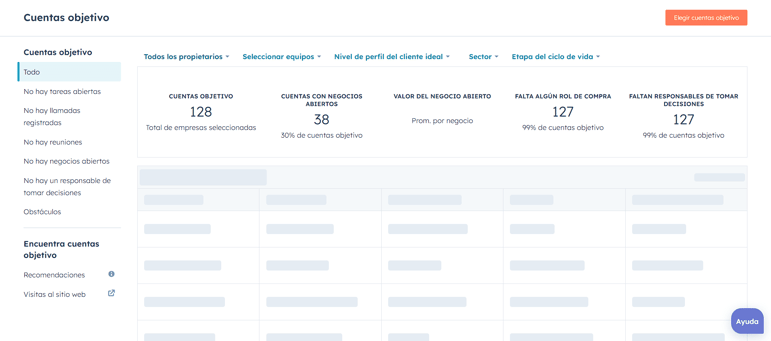
This team gathers and selects the accounts to work with through ABM. Prioritize the accounts so your experts can follow up on those at the top of the list. Not every account requires a high level of customization, so reserve ABM for those that can be most profitable.
>> ABM Scoring: Lead Scoring for Account-Based Marketing (ABM) <<
These recommendations help you identify and choose your ideal group of high-value target accounts.
Most CRMs now support this selection natively. In HubSpot, the ABM tools let you mark companies as target accounts, classify them in three ideal customer profile tiers and assign buying roles such as Decision Maker, Budget Holder and Blocker, available with Marketing Hub or Sales Hub Professional or Enterprise.
Target accounts are based on your Buyer Persona profiles, so you must continually review and improve them, considering aspects such as number of employees, industry, annual revenue and financial results. That way you know exactly what to offer, when to offer it and even the tone to use in negotiations.
Once you have the list of companies, your team must find the contacts you will address and understand their profiles. Although the strategy is designed for companies, the decision-makers are people, and you must know who they are. In an ABM strategy you can communicate with more than one person in the target account. You may have to pass through several filters, but ultimately you seek the decision-makers.
The first impression is very important, so prepare every point of contact and every detail, such as how you will introduce yourself, how you will speak to them, what you will show them and what you will offer. Once they grant you a meeting, look for the best way to keep the conversation moving, and make it clear from the first contact why your offer is the best answer to their needs.
Sometimes you can only obtain an email address. That is where personalized nurturing strategies built with the team come into play, with the goal of adding value for your prospect and securing that first meeting.
Being proactive with your contacts pays off in this strategy. These recommendations help you engage effectively.
In nurturing, personalized content makes sense, and this is where Account-Based Marketing borrows from Inbound Marketing. You generate personalized, exclusive content for key accounts to attract, educate and add value through what you publish. You can create a blog for this type of account or send materials directly to their emails. This makes them consider you above competitors and keeps you on their list of potential providers when they make a purchase decision.
As you have probably noticed, account-based marketing is a team effort. Make sure the marketing and sales members handling these accounts are involved in planning the content and deciding who it targets. Also make sure marketing and sales know the value proposition of your product or service perfectly, as well as the differentiator they should offer each account.
Any technology that strengthens your campaigns is valuable for implementing ABM. Rely on tools that automate processes, track prospects and support content creation from a single place. Think of comprehensive software such as an intelligent CRM, which provides what you need to manage accounts, generate personalized content and follow up effectively.
What is not analyzed is not improved, so monitor your success as you execute each of the steps above. Reviewing results helps you identify gaps or parts of the strategy that need to change to make it more effective for your business, your marketing and sales teams and your accounts, and of course for your customers.
These are some account-based KPIs that show how you are doing.
You are probably wondering whether your company can do ABM. The answer varies, and not every company should expect good results. Keep in mind that it is a strategy with high costs and a high level of personalization. If your product or service has a high price, ABM is well suited to achieving a positive return on investment. These questions help define whether ABM is the best option for your company.
If you answered yes to several or all of these questions, your company is prepared and has the potential to get the most from this strategy. ABM is not only an effective way to target specific customers and generate high-quality conversions. It also drives alignment between marketing and sales, resulting in greater efficiency and success in closing deals. By adopting this methodology, your company can adapt its approach to the needs and challenges of each potential customer, improving conversion rates and customer retention.
>> Account-Based Marketing on LinkedIn <<
At the end of the pilot, compare pipeline and win rates of the target accounts against similar accounts outside the program. That comparison gives leadership the evidence to scale, adjust or stop.
We understand that taking the first step toward ABM can feel overwhelming. ICX Consulting's advisory team supports you at every step of the process, from identifying key accounts to executing personalized campaigns and measuring return on investment. Our Account-Based Marketing and account-based sales services align both teams around the same accounts, and we implement the supporting tools on platforms such as HubSpot and Salesforce so your business goals become tangible results.
To map the people who decide in each target account, use our Persona Playbook toolkit and document the roles, pains and messages for every buying group.
Start with a list your team can genuinely serve. Many companies pilot with a few dozen accounts divided into tiers, giving the top tier one-to-one attention and the rest segment-level campaigns. The constraint is capacity, not ambition. If sellers cannot prepare a real account plan for every tier 1 account, the list is too long.
Engagement indicators such as meetings booked and new contacts per account usually move within the first quarter. Pipeline and revenue take longer because they follow the customer's buying cycle, which in complex B2B sales can last many months. Set leading and lagging indicators from the start so leadership can judge progress before deals close.
No. Inbound marketing builds awareness and shows which companies are researching your topics, which feeds account selection. ABM then concentrates resources on the accounts with the highest value. Most mature B2B organizations run both, with shared definitions of target accounts and qualified opportunities so the two programs reinforce each other.
It depends on the number of accounts and the level of personalization. One-to-one programs require dedicated time from senior sellers and marketers, tailored content and sometimes events. A practical approach is to estimate the margin of a typical won deal and set the program budget so that a small number of additional wins covers the investment.
If your best opportunities are concentrated in a few large accounts, a focused strategy will reach them faster than any mass campaign. Request a diagnostic with an ICX consultant and design an ABM program built around the accounts that matter most to your growth.

To develop account-based marketing strategies, a company selects the accounts that matter most, aligns marketing and sales around them, and measures...

 Meicel Valverde : May 29, 2025
ABM, or account-based marketing, boosts marketing and sales management by making both teams work from the same short list of high-value accounts....

 Victor Esquivel : May 29, 2025
The deadly sins of sales management are five structural habits that cap B2B revenue, namely outdated catalogs, general promotions, non-personalized...

