




Account-Based Marketing (ABM) to Align Marketing and Sales
ABM, or account-based marketing, boosts marketing and sales management by making both teams work from the same short list of high-value accounts....

By Role
By Industry
By Target Customer
What We Offer
ICX helps companies grow revenue and profitability by connecting customer experience, sales, pricing, CRM and automation into one commercial system.
Customer Experience
We design memorable, customer-centered experiences that drive loyalty, enhance support, and optimize every stage of the journey. From maturity frameworks and experience maps to loyalty programs, service design, and feedback analysis, we help brands deeply connect with users and grow sustainably.
Marketing & Sales
We drive marketing and sales strategies that combine technology, creativity, and analytics to accelerate growth. From value proposition design and AI-driven automation to inbound, ABM, and sales enablement strategies, we help businesses attract, convert, and retain customers effectively and profitably.
Pricing & Revenue
We optimize pricing and revenue through data-driven strategies and integrated planning. From profitability modeling and margin analysis to demand management and sales forecasting, we help maximize financial performance and business competitiveness.
Digital Transformation
We accelerate digital transformation by aligning strategy, processes and technology. From operating model definition and intelligent automation to CRM implementation, artificial intelligence and digital channels, we help organizations adapt, scale and lead in changing and competitive environments.
Operational Efficiency
We enhance operational efficiency through process optimization, intelligent automation, and cost control. From cost reduction strategies and process redesign to RPA and value analysis, we help businesses boost productivity, agility, and sustainable profitability.
Customer Experience
Marketing & Sales
Pricing & Revenue
Digital Transformation
Operational Efficiency
To develop account-based marketing strategies, a company selects the accounts that matter most, aligns marketing and sales around them, and measures progress account by account rather than lead by lead. Five metrics guide the work, namely coverage, awareness, engagement, program reach and program impact, and together they show whether ABM is moving key accounts toward revenue.
Many companies have heard of account-based marketing but have not defined a model for how their most valuable customers should experience the brand. The symptom is familiar. Marketing and sales disagree about which prospects deserve attention, how to communicate value and what return to expect, and the year ends with unfavorable results in the company reports. Have you seen that friction in your own planning meetings, with teams questioning pricing, trying to focus campaign ideas and debating ROI?
It usually happens for a simple reason. Neither team has focused its effort on creating personalized buying experiences for the customers that matter most. The sales team tries to sell the product or service, but the way it projects the company's value has not been tailored to the ideal customer. This is where Account-Based Marketing takes center stage. In this article you will learn what ABM is, how its metrics differ from traditional marketing, and how to develop account-based marketing strategies that improve account management. At ICX Consulting we see ABM as one of the most effective growth strategies for B2B companies, and this guide walks through it step by step.
Consider the quarterly pipeline meeting of a software or industrial equipment company. The marketing director reports that lead volume is up, and the sales director replies that none of the new leads resemble the companies that actually buy. Meanwhile, the three largest target accounts on the strategic list have not had a single coordinated contact in six months. The disagreement is real, but it is not about leads. It is about the absence of an agreed list of accounts that both teams are willing to be judged on.
B2B buying has become a group decision. Forrester's State of Business Buying 2024 found that a typical buying decision involves 13 people and that 89% of purchases involve two or more departments. A lead-by-lead approach that nurtures one contact at a time cannot reach a committee of that size. ABM addresses the whole account, which is why it matters to revenue leaders and not only to marketing.
For the CEO and CFO the attraction is focus. ABM concentrates budget and selling time on the accounts with the highest potential value, shortens the distance between marketing activity and pipeline, and gives leadership a clearer view of which investments actually move key accounts.
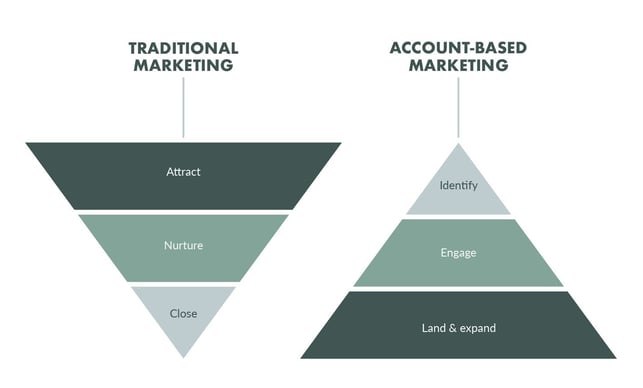
There are many definitions, but in essence Account-Based Marketing is a methodology for executing growth strategies that are specifically oriented and highly targeted toward individual buyers within a defined set of organizations, treating each organization as a market of one. Its best-known principles and metrics are these.
The first is accounts, not leads. Think of fishing. Traditional marketing uses campaigns like a net. You cast it, and what matters is the amount of fish, not the kind. With ABM you fish with a harpoon, and the company directs its attention to qualified accounts with the highest interest in buying from you. The second is quality rather than quantity. Following the fishing example, why chase poorly segmented campaigns that catch hundreds of sardines that may never be ideal clients, when you could look for the qualified accounts that represent a prize salmon for your business?
The third is months and years, not days and weeks. Traditional demand generation is measured in days and weeks. ABM is measured in months and years, because generating qualified marketing and sales opportunities in key accounts takes time. The company needs enough time to educate prospects and build the engagement and loyalty that turn them into customers and brand ambassadors. The fourth is an influence pipeline, not only a demand pipeline. Traditional marketing builds a funnel based on lead volume. ABM looks at an influence pipeline, analyzing the customer and buyer journey, the programs and channels key account contacts interacted with, and how enough engagement moves an account from marketing qualified account (MQA) to sales qualified account (SQA).
The fifth principle is inbound and outbound together. Beyond marketing practices with an inbound emphasis, ABM also designs outbound practices. That does not mean inbound marketing is ineffective. On the contrary, ABM was created to complement it.
%20(2).jpg?width=643&name=Dialpad-0507-2%20(1)%20(2).jpg)
>> Account-Based Marketing: 8 Best Practices <<
| Dimension | Traditional marketing | Account-based marketing |
|---|---|---|
| Unit of focus | Individual leads | Target accounts and their buying groups |
| Main goal | Volume of leads | Quality of engagement in the right accounts |
| Time horizon | Days and weeks | Months and years |
| Pipeline view | Demand pipeline from MQL to SQL | Influence pipeline from MQA to SQA |
| Ownership | Marketing generates, sales follows up | Marketing and sales plan and execute together |
To implement an ABM strategy, leaders should look at its metrics from a macro perspective, because they are the main differentiator and added value of ABM. With them, the company can shape strategies that fit its business model, its value proposition and the experience of our key customers efficiently. Before measuring, three foundations must be in place.
The first is to select and tier the target accounts. Marketing and sales must agree on the ideal customer profile and on a short list of accounts, grouped by priority, that deserve dedicated effort. The second is to map the buying group. For each account, identify the roles that influence the decision, such as economic buyer, technical evaluator, user and potential blocker. The third is to define the account plan, deciding which value message, content, channels and sales actions each tier will receive, and who owns each step.
Modern CRM platforms support this structure natively. HubSpot, for example, lets teams flag target accounts, assign ideal customer profile tiers and record buying roles such as decision maker, budget holder or blocker, with a shared target accounts view for sales and marketing. With these foundations in place, the five metrics below guide execution.
Many companies face an uncomfortable question. Do we have enough data, opted-in contacts and account plans for each target account? Coverage may be the simplest metric of all. It tells the company whether it has the right people in its database for each key account. You can define it simply through the information fields and roles of each prospect and customer, your buyer personas, their titles and roles, and all the information needed to win each opportunity.
If the company does not have that information, it is not yet doing account-based marketing, because without knowing who the contacts are it must first research them to understand what product or service they want to buy.
ABM has a highly successful practice known as the quick win, which ICX discusses in more detail in How and why you should leverage account-based marketing on LinkedIn. Imagine the sales team says it has 500 key accounts, but the database shows only 20 contacts related to them. If, six months later, the reports show complete account profiles for all those key accounts, that becomes the company's first ABM win. That is the moment organizations appreciate the value of coverage.
Awareness measures how many of the company's key or target accounts know about it. It can be established in many ways depending on the business rules the company chooses, such as time spent on the website, number of visits, pages viewed or events registered.
Engagement has been used so often in marketing that it seems omnipresent, but in ABM it is the soul of the method and the main metric of all. What companies need to answer is whether the right people from the right key accounts are spending time with the brand. The answer comes from analyzing each buyer persona and its interactions with the brand.
The next question follows naturally. Among the target accounts that matter, does the brand have engagement with the CEO, CSO, CTO, CMO or other key decision makers the company has identified? The company should define this over time, looking not only at the person but at the consistent trend of engagement and how it relates to each account. Marketing can show engagement metrics month by month, and when they rise, leaders can see whether the increase comes from the accounts that matter most. If it does, that is a strong sign.
Program reach is the alarm that shows whether marketing programs are working as a net, catching any lead whether or not it fits the buyer persona, or as a harpoon focused on ideal prospects. It tells the company whether its own marketing programs, or those run by a supplier, are reaching the people it cares about.
The method is to calculate, for each program, the percentage of successful interactions that come from the right people in the right accounts. Suppose 1,700 people registered for the biggest online event of the year and about 500 attended. What percentage of those 500 attendees belong to target accounts? That percentage of focus is a powerful way to rank programs and confirm the company is pursuing the right accounts.
Companies should size influence rather than only attribution, especially the correlation between ABM activities and sales outcomes. Are ABM efforts reflected in the results that matter? If the company runs a webinar for target accounts and the accounts that attended later show better win rates, the program has impact. This metric closes the ABM cycle, because the activities generated should ultimately improve sales results with key accounts.
An executive who wants to test ABM does not need new software or a large budget to begin. What is needed is a short list of accounts that the chief executive, the head of sales and the head of marketing all agree matter, and a quarter in which those accounts receive more coordinated attention than any others. The plan below is a sequence for that pilot, and it is deliberately modest so that the results can be read honestly at the end.
For specific tactics to accelerate each stage, see 7 tactics that will boost your account-based marketing process, and to prioritize accounts by fit and intent, read about lead scoring for account-based marketing.
For the executive team, ABM changes how effort is allocated along the commercial chain. To attract, marketing budget concentrates on accounts with the highest potential value instead of spreading across low-fit leads. To convert, engaging the full buying group reduces stalled deals and raises win rates in strategic accounts. The same account plans extend to existing customers, supporting renewals, expansion and advocacy, which is where retention and loyalty are built. On efficiency, marketing and sales stop duplicating effort, and leaders can see which programs truly influence revenue.
The decision that belongs to the executive team is the account list itself. When leadership owns the choice of target accounts, marketing and sales stop debating priorities and start executing together.
In industrial manufacturing and distribution, ABM tends to center on a few hundred accounts with long qualification cycles. Engineers, plant managers and procurement each evaluate the supplier differently, so an effective program supplies technical proof to the first, reliability data to the second and total-cost arguments to the third. In financial services and insurance, target accounts are often corporate clients or brokers, and the program relies heavily on relationship managers supported by content that demonstrates sector knowledge and regulatory fluency.
In technology and professional services, ABM frequently runs alongside a land-and-expand motion, where a first project in one business unit becomes the basis for a multi-year relationship across the account. In healthcare and life sciences, the buying group includes clinicians, administrators and compliance officers, and the program must respect strict rules about how and what can be communicated. The metrics are the same in every sector. The content, the channels and the roles in the buying group are not.
ABM fails less from poor tactics than from poor choices upstream. The most frequent failure is an account list assembled by marketing alone, which sales quietly ignores. A second is an overly long list that dilutes effort until the program resembles conventional demand generation with a new label. A third is impatience, since leaders accustomed to monthly lead reports may cancel a program before engagement in strategic accounts has had time to convert into pipeline.
There is also a measurement risk. Because ABM metrics focus on a small set of accounts, a single large win or loss can distort results for a quarter. Leaders should read the trends in coverage, engagement and reach alongside revenue, and compare pilot accounts with similar accounts outside the program, as the 90-day plan above suggests, before drawing firm conclusions about return.
ICX Consulting designs and runs ABM programs that connect marketing, sales and customer experience. Our account-based marketing practice defines the ideal customer profile, account tiers and engagement model, our account-based sales service equips sellers to work buying groups, and our buyer persona work makes every message relevant to each role, implemented on CRM platforms such as HubSpot or Salesforce. To define the personas inside your target accounts, use the free Persona Playbook toolkit from ICX.
It depends on deal size and team capacity. Companies often run three tiers, a handful of strategic accounts with fully personalized plans, a few dozen accounts handled in small clusters, and a larger group reached with lightly tailored programs. Starting with a focused pilot makes it easier to prove impact before scaling.
No. ABM fits any company whose revenue depends on a limited number of high-value customers, including mid-sized B2B firms. What matters is that deals involve several decision makers and that each account is valuable enough to justify tailored attention. Smaller companies often find ABM easier because marketing and sales already work closely.
Account-based marketing builds awareness and engagement across the target account through content, events and campaigns. Account-based selling is the sales team's work inside the same accounts, such as mapping stakeholders, running discovery and building mutual plans. The two work best as one coordinated program with shared targets.
Account-based marketing rewards companies that choose their customers deliberately and treat each one as a market worth winning. ICX can help you select the right accounts, align your teams and measure what truly moves them toward revenue. Want to know whether ABM is the right growth model for your business? Request an ABM diagnostic with an ICX consultant.
ABM, or account-based marketing, boosts marketing and sales management by making both teams work from the same short list of high-value accounts....
At ICX Consulting, where we design account-based and B2B sales strategies, we define an ABM strategy as the coordinated effort of marketing and sales...
Account-based marketing on LinkedIn means using LinkedIn's professional audience and advertising tools to reach a short, deliberately chosen list of...