











How to Develop Account-Based Marketing Strategies
To develop account-based marketing strategies, a company selects the accounts that matter most, aligns marketing and sales around them, and measures...
9 min read
9 min read
ABM, or account-based marketing, boosts marketing and sales management by making both teams work from the same short list of high-value accounts. Instead of chasing individual leads, they identify the companies that matter most, map the people who decide, personalize every interaction and measure success in pipeline and revenue per account rather than in lead volume.
ABM, or Account-Based Marketing, is a strategy that has been around for a long time but has recently gained much greater importance, and it works especially well for companies in B2B business. For a CEO or commercial director, the appeal is concrete. In complex B2B sales a small number of accounts usually generates a large share of revenue and margin, and every month those accounts spend undecided is a cost. ABM concentrates budget, talent and technology on those accounts and forces marketing and sales to manage a single pipeline. In the 2018 ABM Benchmark Study by ITSMA, Demandbase and the ABM Leadership Alliance, B2B marketers reported devoting 28% of their marketing budgets to ABM, and 45% of those with less than three years of experience said it delivered at least double the ROI of other marketing.
Consider the quarterly review of a company that sells industrial equipment and maintenance contracts. Marketing reports that campaigns generated three thousand leads, a record, and the sales director responds that none of the forty accounts that represent most of the company's margin has agreed to a new conversation. The CEO listens to both reports and recognizes the pattern. Each department is doing its job according to its own measure, yet the company is not winning the customers that would change its trajectory. The marketing budget is growing, the pipeline looks full and the forecast keeps slipping.
Account-based marketing begins with a different question. Instead of asking how many people marketing can attract, it asks which organizations the company most wants as customers and what it would take to be taken seriously by the people who decide inside them. That shift sounds simple, but it changes budgets, targets, meeting rhythms and the way success is reported. It is also a discipline that rewards leadership attention, since neither marketing nor sales can impose it alone.
ABM is a strategic approach to business marketing in which a company focuses its marketing efforts on specific account opportunities and on the individuals within each account who take part in the decision-making process.
Instead of spreading marketing, advertising and sales across a broad audience, an account-based marketing strategy focuses on a small group of prospects. Marketing efforts and assets are tailored to each individual's needs, to attract them and guide them toward a purchase. For a broader introduction, read What is Account-Based Marketing?
The difference from traditional demand generation is easiest to see side by side.
| Dimension | Traditional lead generation | Account-based marketing |
|---|---|---|
| Starting point | Generate as many leads as possible | Choose the accounts you most want to win |
| Unit of measure | Individual leads and MQLs | Accounts, buying groups and pipeline per account |
| Content | Broad, by persona or industry | Personalized by account and by role |
| Marketing and sales relationship | Sequential handoff | One team with shared targets |
| Success metric | Volume and cost per lead | Engagement, deal velocity, win rate and revenue per account |
If you choose this strategy, you probably want to do two things.
For example, if your company specializes in manufacturing medical supplies, you will probably want large, well-known hospitals in your region as clients. If you decide to expand your sales internationally, you should already know whom you want as customers in that country. There will also be another group, perhaps smaller, that could become customers, and the visibility of the large accounts will certainly help you attract that second segment.
From the moment you identify key accounts, all marketing and sales efforts should be directed at building an expert position with valuable content and the techniques and tools needed to reach those customers, and ABM is the best alternative for doing so.
>> ABM strategy, the gateway to closing B2B Deals <<
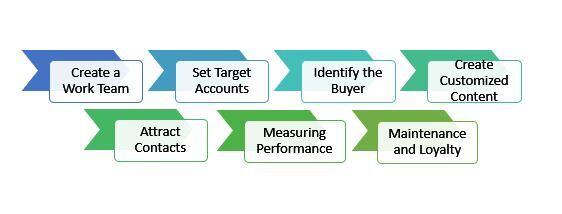
This team must be fully aligned with the company's objective and the tasks to be performed. In the initial stage, it can consist of one marketing person and one sales representative. What matters is that they share the same account list, targets and weekly review.
Use the ideal customer profile as the filter. The goal is to identify, in order of priority, which accounts are most suitable for the product or service and offer the greatest profitability. Many companies organize them in tiers, with a handful of strategic accounts receiving fully personalized programs and larger groups receiving lighter, segment-level personalization.
In each important account there are people with different roles and personalities. Each of these roles can be identified as one of the following.
The jobs-to-be-done (JTBD) approach is useful here. Each of these people has a different job to do, and the role of the sales rep is to think about how to help them do it better and to analyze which content will capture their attention, using personalized actions such as an assessment of their company, a personalized web page or personalized content, among others.
Attend conferences, find and contact people from each target account on social media, work with industry influencers or use sponsored ads aimed at those companies.
Measure every stage of the process, from initial engagement to conversion and closing. Some of the most important metrics to track are these.
Maintaining and building the loyalty of each important account is part of the core business. Keep quality controls and follow-up meetings in place, and prepare contract renewals as if they were a new sale, always showing interest in the account and how important the customer is to the company.
>> How to develop Account-Based Marketing strategies <<
ABM is often presented as a marketing tactic, but its biggest effect is on how sales is managed. Four changes stand out.
The same benchmark found that 66% of respondents said their ABM accounts were more likely to provide positive references and advocacy, which is exactly the type of asset that shortens future sales cycles.
The approach pays off where deals are large, buying groups are plural and relationships last. A manufacturer of medical equipment that sells to hospital networks must convince clinicians, procurement officers and administrators, and each of them evaluates the purchase differently. A corporate bank serving mid-sized companies competes for the relationship with the chief financial officer, and the value of a single client over many years justifies a personalized program. An IT services firm selling to retailers or insurers must demonstrate sector knowledge to several executives before a proposal is requested.
In each case the logic is the same. A small number of accounts represent a disproportionate share of potential revenue, the sale involves several roles, and generic communication fails to reach them. These are illustrative scenarios rather than sourced cases, yet they reflect how ABM is applied in practice. When deals are small and buyers decide alone, the economics change, and broader inbound marketing is usually more efficient.
The quality of the account list determines the quality of the program. A useful list starts with the ideal customer profile and combines three kinds of evidence. The first is fit, meaning the characteristics of the organization that make it a good customer, such as industry, size, complexity and need for the company's solution. The second is potential, which includes the value of the account over time and the possibility of expansion into other units or products. The third is timing, since an account that is changing leadership, entering a new market or renewing a contract is more receptive than one with no event on the horizon.
Leadership should be careful about two temptations. The first is to select accounts for prestige rather than for profitability, which leads to long, expensive efforts to win customers that will demand discounts and special terms. The second is to list too many accounts because the list feels safer. A program with fewer accounts and real personalization is almost always more productive than one that treats a hundred accounts with the same message. Revisiting the list every quarter, with sales and marketing together, keeps it honest and gives the executive team a clear view of where investment is going.
Read also: How to automate business processes with HubSpot Workflows and Sequence?
Managing contacts in the CRM lets you create custom properties, account labels and roles for each contact, so you can target efforts at the right buyer persona. A well-configured CRM supports ABM in several ways.
Platforms like HubSpot include these tools to help you implement different marketing strategies, with different license types depending on your needs. In HubSpot, the account-based marketing tools include a target account property, an ideal customer profile tier, buying roles such as decision maker, budget holder and blocker, a target accounts home and ABM reports, and they require a Marketing Hub or Sales Hub Professional or Enterprise subscription. Remember that it is important to have the right platforms to execute the strategies proposed to reach the organization's objectives, and that the account strategy has to be defined before the tool is configured.
For the executive team, ABM turns commercial strategy into a short list of decisions. To attract the right customers, approve a tiered account list based on profitability and not only size, and ask marketing to show engagement by account every month rather than lead totals. To convert them, require every strategic opportunity to have mapped buying roles and at least two active contacts before it moves to the proposal stage, since single-threaded deals are the ones that stall.
Retention and loyalty belong in the same conversation. Treat renewals of key accounts as new sales, with a plan, an owner and a date, and turn satisfied accounts into references and case studies that open doors in similar companies. Efficiency completes the picture. Reallocate budget from broad campaigns that do not reach target accounts to programs that do, and track acquisition cost per account so the board can see the return on the focus.
ICX Consulting designs account-based programs as part of a broader commercial strategy. Our account-based marketing and account-based sales services define the account list, buying roles and plays, while our marketing and sales strategy work aligns targets and governance between both teams. We then implement the model in the CRM, often on HubSpot, so every account is tracked from first touch to renewal.
To map the people who decide in each account, use the ICX Persona Playbook Toolkit with your sales and marketing team and build a profile for every buying role. For ready-to-use practices, see account-based marketing best practices.
No. Mid-sized companies often see results faster because their account lists are shorter and decisions move quickly. What matters is selling a high-value product or service to organizations where several people decide. If deal sizes are small and buyers decide alone, broad inbound marketing is usually more efficient.
Start with as many accounts as your team can genuinely personalize for. For a small team, that may mean a handful of strategic accounts plus a few dozen in a lighter tier. It is better to expand a program that works than to shrink one that spread too thin.
Engagement from target accounts usually appears within the first weeks, while pipeline and revenue follow the length of your normal sales cycle. If deals typically take six months to close, judge revenue impact over a comparable period and use engagement and meeting rates as early indicators.
The accounts that will define your next years of growth probably already have names. The question is whether marketing and sales are working on them together. If you want to build that focus with a clear plan and the right metrics, get expert advice from ICX and start with the accounts that matter most to your revenue.

To develop account-based marketing strategies, a company selects the accounts that matter most, aligns marketing and sales around them, and measures...

 Susana Matamoros : May 29, 2025
ABM scoring is the practice of ranking target accounts, and the people inside them, by how closely they match the ideal customer and how actively...

 Victor Esquivel : May 29, 2025
Account-based marketing on LinkedIn means using LinkedIn's professional audience and advertising tools to reach a short, deliberately chosen list of...

