











The 4 most common mistakes when creating your B2B buyer persona
ICX Consulting, a commercial strategy and customer experience consultancy, sees the 4 most common mistakes when creating your B2B buyer persona...
10 min read
10 min read
The key differences between a B2B buyer persona and a B2C buyer persona lie in who decides, why they buy and how they buy. A B2B persona represents a role inside a buying group that weighs risk, budget and return over a long cycle; a B2C persona represents an individual whose purchase is faster, more emotional and shaped by convenience.
It is the third week of the quarter, and the chief revenue officer of a regional distributor is explaining why a promising account has gone silent. The sales team had won over the operations manager, who loved the product. What nobody had mapped was the finance director, who worried about payment terms, or procurement, which needed three supplier references before it could sign. Meanwhile, down the hall, the e-commerce team celebrates a campaign that doubled consumer orders in a weekend, using the same playbook that stalled the enterprise deal. The company has one idea of "the customer," and two very different buyers are paying the price.
A Buyer Persona is a semi-fictional representation of an ideal customer used to understand customer needs, desires and behaviors. Used well, it helps improve products, services and processes, which makes it a strategic tool for decision-making rather than a marketing exercise. For an executive team the difference between the two types is not academic. It determines how the sales force is organized, which channels deserve investment, how prices and discounts are set, and how service is designed. Companies that copy B2C tactics into a B2B market, or treat consumers as if they were procurement committees, spend more to acquire customers and keep fewer of them.
The market is constantly changing, and the way commercial and operational activities are developed must adapt to stay competitive. A business-to-business (B2B) relationship differs from a business-to-consumer (B2C) relationship, so correctly identifying the Buyer Persona and understanding the critical differences guides how to improve each one's experience. This article lays out those differences, argues that the buying group is the single most underestimated one, and shows how to turn them into business rules.
Customers are the most valuable asset of a business. Thanks to them a company has cash flow and grows its value in the market. Investing enough resources to understand them is essential, because that understanding provides the information needed to improve as a company. A Buyer Persona gathers demographic, psychographic and attitudinal information about each type of customer, and thus determines the key factors that influence their purchasing decisions. For a practical starting point, see our guide to the 4 key factors in creating a successful Buyer Persona.
Companies must use everything they know to define the right strategies, give each person the desired experience and increase the probability of generating a prospect and a sale. Building a Buyer Persona summarizes and consolidates that knowledge for efficient understanding, communication, planning and decision-making.
The business case is strong. McKinsey's research on the value of getting personalization right found that about seven in ten consumers expect companies to deliver personalized interactions, roughly three-quarters get frustrated when that does not happen, and personalization most often drives a 10 to 15 percent revenue lift. Personalization at that level is impossible without a clear picture of who the customer is, and the persona is where that picture starts.
The purpose of having a tangible document on the profile of an ideal customer is to understand the surrounding context, so the company can customize business strategies, products, services and processes. However, there are differences between a B2B and a B2C profile that must be considered because of their impact on the design of the experience.
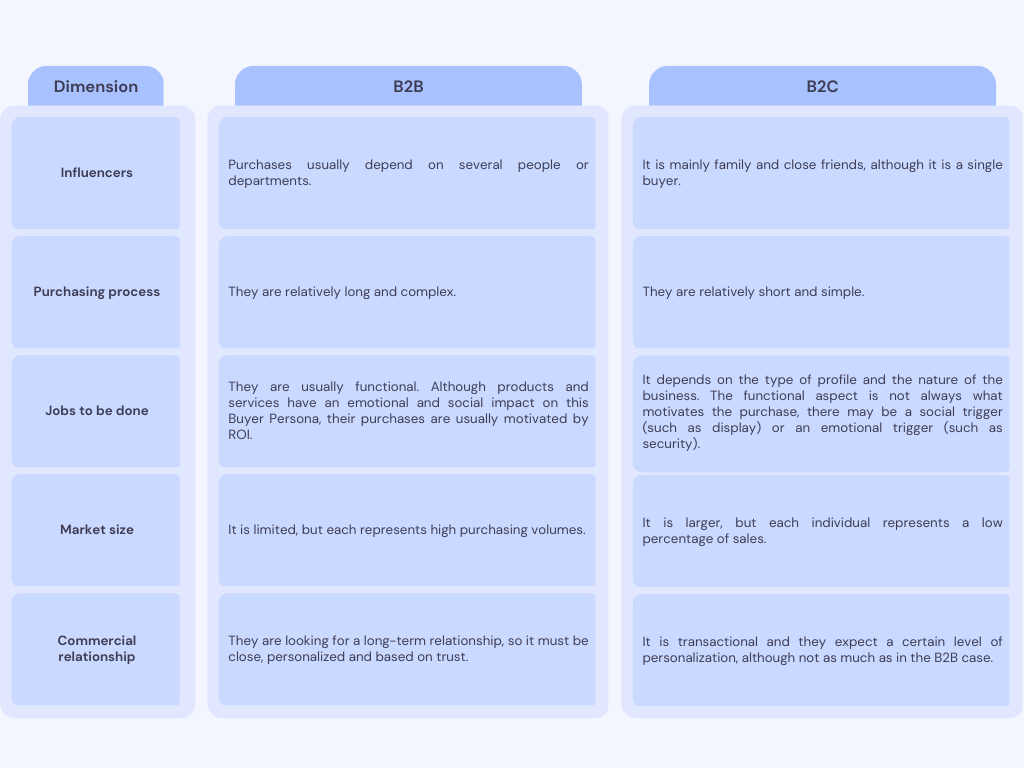
Start with who decides. In B2B, the decision belongs to a buying group of several roles, typically the user, a technical evaluator, finance, procurement and an executive sponsor. In B2C, it belongs to an individual or a household. That single fact changes motivation as well. The business buyer is judged on results, risk reduction, return on investment and even career reputation, since a bad supplier choice follows a manager for years. The consumer is moved by personal need, emotion, status, convenience and value for money.
The rhythm of the purchase differs accordingly. A B2B cycle runs from weeks to months, with formal stages and approvals, and a budget that is defined and approved in advance and tied to contracts and volumes. A B2C purchase can take minutes or days, is often impulsive or seasonal, and draws on a monthly household budget that is sensitive to credit and promotions. Information sources diverge in the same way. Business buyers lean on peer references, analysts, vendor content, commercial advisors and self-service digital research, while consumers rely on search, social media, reviews, influencers and store visits.
Finally, the relationship and the pricing logic are not the same. B2B relationships are long-term and contract-based, with account management and service levels, and prices are negotiated, with volume and term discounts and price lists by segment. B2C relationships are transactional or built on loyalty programs, with many customers per segment, and prices are published, supported by promotions, bundles and payment options. A leadership team designing its go-to-market has to keep these seven dimensions in view at once, because the weakest alignment is usually where revenue leaks.
Two of these differences deserve special attention. First, the B2B persona is never alone. Designing for one role, usually the end user, while ignoring finance or procurement is one of the most common reasons deals stall, exactly as in the distributor's lost account. The cost of getting this wrong is measurable. A Gartner survey of 632 B2B buyers published in May 2025 found that 74 percent of buyer teams showed unhealthy conflict during the decision process, and that buying groups that reached consensus were 2.5 times more likely to report a high-quality deal. A seller who understands each role in the group can help it reach that consensus; a seller who knows only the user cannot. A good practice is therefore to build a primary persona for each key role in the buying group and document how they influence one another. Our article on how to build your B2B buyer persona properly goes deeper into that exercise.
Second, B2B buyers increasingly behave like consumers in how they research. A Gartner survey of 646 B2B buyers published in March 2026 found that 67 percent prefer a rep-free experience, and 45 percent reported using AI during a recent purchase. The B2B persona must therefore describe digital behavior as carefully as a B2C persona does, while still mapping the human interactions that close complex deals. The trade-off for leaders is real. Investing heavily in self-service can shorten the research phase, but it also moves the moment of truth earlier, to a stage when no salesperson is present to correct a misunderstanding.
The Buyer Persona is a document that should be used constantly. Each business decides how robust or rudimentary this tool becomes. Knowing more about each persona's jobs to be done, expectations and pain points should point to the right value proposition for each profile. If the persona is not used this way, it will not generate any impact on the customer experience. To go further, read what the Buyer Persona is for, and how can I create one.
Each department should study its customers, listen to them and use their feedback to identify opportunities for improvement. Below are some ideas on how to use this document strategically. Still, the best way to learn is to carry out the exercise with a multidisciplinary team and then analyze the results to define action paths.
A strategic exercise from the customer's point of view is to understand the business model and determine whether the value proposition is economically viable, technically feasible and desirable to customers. Communication, sales, distribution and service channels should be defined according to each profile's expectations and pain points. A B2B Buyer Persona prefers to be informed through commercial advisors, may use business ecommerce to automate monthly purchases and delivery days according to a contract, and may be offered a personalized service channel to resolve issues. A B2C Buyer Persona requires informative and audiovisual content. In the author's experience, about 70 percent look for an advisor after searching online, and they want convenient payment options and delivery or pickup at points of sale.
A value curve analysis is another exercise that helps identify critical elements and supports decisions about the investments needed to match or surpass the competition strategically.

Marketing and sales cannot happen on a mass scale like in the 1960s. Personalization is one of the main ways to guarantee an extraordinary experience for customers. Monthly plans must consider customers' preferred channels, online habits and finances. A B2B Buyer Persona has a defined budget. Promotions and marketing should build relationships that generate trust, and prices and discounts should be set by purchase volume and contract term, varying by industry and company size. Communication must also generate traceable information through formal channels such as email or LinkedIn. Here omnichannel becomes important, even for channels such as WhatsApp.
A B2C Buyer Persona has monthly expenses that compete for the same wallet. Although credit is an option, these buyers seek to fulfill emotional and social jobs to be done. Promotion and marketing should focus on attraction and be aligned with influencers, budget and timing online, so ads reach the right channel, at the right time and the right person.
A Customer Journey or Service Blueprint complements Buyer Personas. These tools map the buying process for each type of customer and reveal the touchpoints, moments of truth and internal processes that need to be standardized to optimize service quality.
Process mapping creates a guide for carrying out tasks in sequence to meet the objectives of internal and external customers. Processes define who is responsible for each activity and the inputs, resources, outputs and systems needed to make the workflow as smooth as possible. They seek to reduce errors, bottlenecks and rework through standardization and automation.
A B2B Buyer Persona may require emergency supply, agile negotiation or immediate service. Defining business rules and automation so customers can self-manage their needs is a great help for requests outside office hours. This is only possible with a clear idea of the information required, the capacity in terms of resources and the availability of inventory. For a sector-specific illustration, see the Buyer Persona in the Retail Industry.
A B2C Buyer Persona can find alternative or substitute products with competitors. Automated follow-ups through preferred channels increase the probability of the sale. Automating promotions and discounts also frees consultants' time to focus on the relationship with customers and to make decisions based on pre-established criteria that make the journey faster. These strategies seek to incentivize sales efficiently.
Defining indicators is a way to assess the health and success of the business. With them, the company can measure the outcome of a new strategy and adjust its approach quickly as results move toward or away from the goal.

Many manufacturers, distributors, banks and telecom operators sell to businesses and consumers at the same time. They face a specific risk, which is running both segments with the same persona logic. The first and most frequent mistake is building one persona for "the customer." A single profile averages out two very different decision processes and ends up describing nobody. The second is using the same channel mix for both, so that business customers are pushed to a consumer call center, or consumers are asked to fill out a corporate credit form, and both abandon the process.
The third is applying the same pricing rules. Volume discounts designed for B2B leak into retail promotions, or consumer promotions undercut negotiated business prices and create channel conflict. Picture a telecom operator whose small-business plan is cheaper than its premium consumer plan, so that freelancers migrate and the margin on both erodes. The fourth is measuring both with the same metrics. Conversion rate and basket size work for B2C, while B2B needs pipeline velocity, win rate by buying group coverage and account retention. The fix is to define personas per segment and then decide deliberately where processes, systems and teams should be shared and where they must be separate.
Return to the distributor's quarterly review. The question for the executive team is not which persona is more important but whether each has been given its own commercial logic. On the side of attraction, marketing budget should be allocated by persona. B2B personas respond to expert content, references and account-based programs, while B2C personas respond to reach, creative and timing. On conversion, the sales model must be designed around the buying group in B2B, and around friction-free digital checkout and assisted sales in B2C.
Retention and loyalty follow the same split. In B2B, retention depends on account management and service levels by contract; in B2C, on loyalty programs and relevant, personalized follow-up. Service channels and response times should be set by persona so the highest-value customers get the right attention, and business rules and self-service should be used wherever personas allow it, so advisors spend their time on complex, high-value interactions. Efficiency, in this sense, is not cutting service but directing expensive human attention to where it changes outcomes.
An experienced consultant would begin with an inventory. List your customer segments and mark each one as B2B, B2C or mixed. For each B2B segment, identify every role in the buying group and confirm that each has a persona or at least a documented profile. Then, for each persona, write the top three jobs to be done, pains and expected gains, drawing on real interviews and CRM data rather than assumptions.
Next, check whether channels, pricing rules and service levels differ by persona. If they are identical, ask whether that is a deliberate choice or an accident of history. Map one priority journey per persona and mark the moments of truth, and finally assign an owner to keep personas updated at least once a year, or whenever the market shifts. In summary, B2B and B2C Buyer Personas differ in their objectives, decision-making processes, motivations and purchasing channels. A clear understanding of these differences allows a company to create its strategy, innovate in services and products for positive experiences and optimize its metrics. Increasing retention and sales while reducing costs depends on how capable the business is of making agile decisions focused on the expectations of its Buyer Personas.
ICX Consulting builds personas that leadership teams actually use to make decisions. Our buyer persona development service combines customer interviews and CRM data to profile each role and segment, and our market segmentation and positioning work turns those insights into a clear go-to-market. We then connect personas to the value proposition, pricing rules and sales process, so the differences between B2B and B2C customers show up in how the company sells and serves.
To put this into practice, download the ICX Persona Playbook toolkit and use it with your team to document each B2B role and B2C profile in a consistent format. For a complementary view, read One Buyer Persona to rule them all.
Bring this topic to your company
An ICX Consulting advisor will assess where your organization stands today and which decisions can move your commercial and customer experience results.
Usually one primary persona per key role in the buying group for each main segment, which often means only a handful. Too many become hard for teams to remember and use. Start with the roles that most often block or approve deals, such as finance and the executive sponsor, and add others only when they change decisions.
Yes, and companies that sell to both segments should. The key is to keep the personas separate and decide explicitly where they share processes, systems or teams. A distributor, for example, may share inventory and logistics across segments while running different pricing, channels and service levels for business accounts and consumers.
Persona definitions should be documented in a shared playbook, but the operational data belongs in the CRM. Tagging contacts and accounts with their persona lets marketing personalize campaigns, sales tailor conversations and service prioritize requests, and it lets leadership measure revenue and retention by persona over time.
Knowing whether you sell to a buying committee or to a consumer changes everything from the first ad to the last service call. If your personas look the same across segments, or no one in the company uses them, get expert advice from ICX and turn them into a working guide for how your teams attract, sell and serve.

ICX Consulting, a commercial strategy and customer experience consultancy, sees the 4 most common mistakes when creating your B2B buyer persona...

A B2C buyer persona is a semi-fictional representation of the consumer a company wants to serve, built from interviews and data on real customers,...

Understanding your buyer persona means knowing three profiles, not one. The good is the ideal customer you can help and serve profitably. The bad is...

