











Designing with empathy (Design Thinking)
 Aileen Pierce : Jun 05, 2025
Designing with empathy means starting every product, service or experience from a deep understanding of the people it is for: their needs, desires,...
9 min read
9 min read
Design thinking tools are the practical techniques a team uses at each stage of the design thinking process, from empathizing with users to prototyping and testing a solution. Used well, they help an organization replace opinion with evidence, reduce the risk of launching what customers do not want, and reach a viable innovation faster and at lower cost.
For an executive, the tools matter less than the discipline behind them. A team that holds a brainstorming session without having listened to a single customer produces confident ideas about the wrong problem. This article describes the mindset that makes the tools work, the three tests an innovation must pass, and the instruments that fit each of the five stages.
The product committee of a financial services company meets on a Thursday to approve a new mobile feature. Months of engineering effort are behind it, the demo is polished and the executive sponsor is enthusiastic. Then the head of customer service asks a question that no one has prepared for: which customers asked for this, and what were they trying to do when they did? There is a pause. The feature was designed from the inside, based on what the team believed customers wanted, and the answer is a guess.
The cost of that guess will not appear on the day of the launch. It will appear in low adoption, in support calls that explain what the feature does, in a marketing budget spent to compensate for a weak proposition. Design thinking exists to move that conversation to the beginning of the project, when changing direction costs a conversation instead of a development cycle. Its tools are how the conversation becomes systematic.
Design thinking is a methodology, a way of thinking and processing ideas to arrive at an innovative solution. Tim Brown, the longtime head of the global design firm IDEO, defines it in a Harvard Business Review article as a method of meeting people's needs and desires in a technologically feasible and strategically viable way. IDEO's own description is that Design Thinking is a human-centered approach to solving complex problems, and that it is a flexible, iterative process on which teams learn by making and testing.
Two ideas in that description deserve attention: collaboration and a human focus. The approach is designed to work with a multidisciplinary team, because different disciplines contribute different ideas and paradigms. And the focus on the human being is literal, since in the design thinking process the user is at the center of every decision. Both ideas shape how the tools should be used, and both are worth remembering when the methodology is put into practice. For a more structured view of method, see the ICX methodology approach to improvement, which complements design work with measurement.
Before choosing a tool, the team needs the right attitude. Five habits matter most.
The first is a commitment to empathy. The first stage of the process is empathy precisely because of the focus on the human being, and a team must care about the user so much that every idea is aimed at solving the user's problem or need. The second is co-creation. Collaboration is essential, which is why the multidisciplinary team matters, and participants need a teamwork mentality in which they contribute to others' ideas as others contribute to theirs. The third is to demonstrate ideas. An idea alone is not the optimal solution, and conceptual thinking must eventually become something tangible that others can react to. The fourth is to integrate feedback, listening to comments and opinions that guide improvement. The fifth is positivism, which means trusting the process and staying constructive when early results are imperfect.
These habits sound simple. They are in fact the hardest part of the practice in organizations organized by function and accustomed to defending positions. A leadership team that models them, for instance by asking customers before approving a budget, makes it far easier for every tool that follows to produce honest results.
A useful idea must pass three tests at the same time, and the tools of design thinking can be organized around them. The model of the three circles of innovation, closely related to the lenses that IDEO describes as desirability, viability and feasibility, shows where a good idea lives.
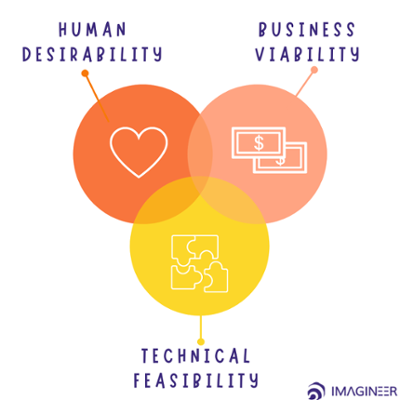
Human desirability asks whether the product or service is something people want and need. Business viability asks whether the market is willing to pay for it and whether there is a sustainable business model to support the idea. A good idea that people like but cannot be financed is a hobby, and the article on what a business model is and why it matters explains how to evaluate that support. Technical feasibility asks whether the solution can actually be built, because if technical reasons make it impossible, it is not worth pursuing. The key to a successful innovative idea lies in the center, where the three circles intersect.
Each circle has an owner inside the company, and that is why the model is useful as a governance device. Marketing and customer service usually speak for desirability, finance for viability and technology for feasibility. When an initiative is defended by only one of these voices, it tends to fail in one of the other two dimensions. A bank can design an attractive savings product that finance cannot price profitably. A manufacturer can specify a feature that customers praise and engineering cannot deliver at scale. Bringing the three voices into the same room from the beginning, with evidence from users in front of them, turns what is often a late argument into an early design decision.

The methodology follows an iterative and non-linear process made up of five stages: empathy, definition, ideation, prototyping and testing. It is designed so that the team first understands for whom it is creating value, whom it is designing a solution for and whom it puts at the center of the design. Understanding the user comes first because it is what allows the team to conceive solutions that address real needs.
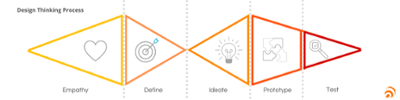
The first two stages, empathy and definition, form the problem space. The other three, ideation, prototyping and testing, form the solution space. The process is iterative and non-linear, which means that the team can use the result of one stage to evaluate and improve an earlier one. Testing might show that the problem was wrongly defined, and the team returns to the definition stage with better information. That flexibility lets the team redefine a problem when necessary and uncover insights and alternative solutions that had not been considered.
What, then, should a team do at each stage, and with which instruments? The following sections answer that question.
The best way to understand people's needs is to use all five senses: talk, listen, observe and enter their world. The questions guiding this stage are what users feel, what they think, what pains and challenges they face and what they like. Several instruments help. Interviews and surveys capture what people say. A stakeholder map visualizes the actors involved in a process, which is especially useful in business-to-business settings where the buyer, the user and the approver are different people. Cognitive immersion places the team in a specific situation to experience it as the user does, and covert observation allows the team to watch a group of people without their awareness in order to analyze their behavior.
Imagine a hospital group that wants to improve the experience of outpatient clinics. The leadership team could commission a satisfaction survey, but a more revealing approach is to spend a morning following a patient from the parking lot to the consultation room. The staff would discover that the long wait is not the main frustration, but that nobody explains how long it will be. That insight changes the design brief entirely, and it was found with observation, not with a questionnaire.

Having understood and gathered the information, the team defines the problem to be solved by analyzing customers' pains and frustrations. The buyer persona is a natural first step: after the interviews of the empathy stage, the team can analyze similarities among individuals and group them into segments. With buyer personas defined, an empathy map, available as an ICX empathy map template, helps analyze their feelings, perceptions and pains in depth. The customer journey map then reveals the customer's process and the most important moments of interaction, which is where pain points tend to concentrate.
Three further instruments sharpen the definition. The technique called inside and outside uses two separate spaces, virtual or physical, to move ideas around and decide which user needs the project will consider and which it will not. In a virtual meeting a collaborative board such as MURAL or Miro serves well, and in a face-to-face session sticky notes work equally. The cause and effect diagram, also known as the Ishikawa diagram, helps find root causes by analyzing different variables. Finally, a moodboard, a board or panel of images that explains an idea or concept, makes an abstract problem visible, and tools like Canva allow the creation of these inspiration walls.

From this point the team enters the solution space and uses creativity in sessions focused on solving the problem previously defined. Brainstorming is the best-known instrument, and its usefulness depends on the quality of the question it addresses. SCAMPER structures the generation of ideas by asking the team to substitute, combine, adapt, modify, repurpose, eliminate and rearrange elements of an existing product or service. The six thinking hats technique discusses an idea from different points of view, and ICX has a dedicated article on six thinking hats. A storyboard, like a comic book, captures a user experience visually and tends to generate more ideas for a solution.
An insurer might apply SCAMPER to its claims experience: what could be eliminated from the process, what could be combined with the repair network, what could be substituted by a photo sent from the customer's phone? Each prompt turns a vague ambition to improve service into a specific candidate for testing.
From the ideas generated, the team selects those with the greatest potential. A prototype is then built to test with potential users and guide the team toward the best final solution. It is important to understand that the prototype is not created to sell. Its purpose is to receive feedback and to learn which features of the proposed solution solve the user's needs and wants, and which do not.
To prototype, the team can use the Value Proposition Canvas, which analyzes the characteristics of the product or service together with the needs and desires of customers in the search for a clear value proposition. A virtual or physical mock-up makes the concept tangible, videos communicate how the experience would work, and user-driven prototyping, in which potential users take part in co-creation workshops, brings customers into the design itself.
To test, the team can use surveys, qualitative interviews in which individual users share their impressions and feelings about the prototype, focus groups in which several potential users discuss the prototype together, and user testing in which people use the prototype while the team notes successes and difficulties. Once testing is complete, the team draws conclusions and improves the prototype with the feedback received.
For the chief executive, design thinking is a risk management practice for growth. It does not guarantee success, but it moves the cost of learning forward, to a point where mistakes are cheap. A requirement that every major investment case includes evidence from direct contact with users is a simple way to institutionalize it.
For the chief customer, commercial and marketing officers, the tools of the empathy and definition stages provide the evidence needed to attract and retain customers: a sharper view of segments, journeys and pain points that feeds acquisition, service design and loyalty programs. For the chief financial officer, the prototyping and testing stages create decision gates, so that capital is released progressively as evidence accumulates and not all at once on the strength of a presentation. For operations and technology leaders, the discipline avoids building features and processes that the organization must later maintain without ever generating value, which is a direct contribution to efficiency.
A seasoned consultant would suggest a small start. Choose one real problem, such as a stage of the customer journey that produces repeated complaints or abandonment, and assemble a small team that includes someone from sales, someone from service and someone from technology. Give the team a week to talk to five customers and watch two of them in their own environment, using nothing more elaborate than a notebook and an interview guide.
At the end of the week, ask the team to present the problem in the customer's own words, with a journey map and the two or three pains that matter most. Only then allow ideation. Select one idea, build the simplest possible prototype, and test it with the same customers within another week. If the result is encouraging, scale the effort. If not, the company will have spent two weeks and avoided a development cycle. ICX provides a digital prototyping toolkit to support the prototype stage.
One caution belongs here. Tools can create a false sense of progress, since a wall of sticky notes looks like work. The measure of a good session is the decision it enables: which problem will be solved, for whom, and what will be tested next. Leaders who ask for that decision at the end of every stage keep the practice honest and keep the team focused on outcomes that matter to customers and to the business.
ICX Consulting is a Commercial Strategy and Customer Experience firm headquartered in Miami. Our design thinking practice brings leadership teams through the full cycle, from structured research with customers to prototypes that are tested before capital is committed. We connect it with customer journey maps and with the ICX Compass methodology, so that what the team learns turns into commercial and operational decisions. Related reading includes our article on designing with empathy and our overview of what design thinking is used for and its stages.
Explore the Persona Playbook and the Jobs to Be Done template from the ICX toolkit to start the empathy and definition stages with a ready framework.
Fewer than most teams expect. One or two instruments per stage, chosen for the question being asked, are enough. The value comes from the quality of contact with users and from the discipline of moving between stages, not from the number of techniques applied.
Yes. In business-to-business settings the stakeholder map and the customer journey map become especially important because several people with different goals take part in a purchase. The empathy stage simply needs to include the buyer, the user and the person who approves.
Largely. Interviews, journey mapping, inside and outside exercises, brainstorming and even user testing can be run on collaborative boards and video calls. Immersion and observation are richer in person, so combine both when the problem depends on physical context.
When the problem is already well defined and the solution is known, a more direct improvement method may be faster. It is most valuable when the problem is ambiguous, when customers' needs are unclear, or when earlier attempts have produced solutions that nobody adopts.

Tools only matter when they bring a team closer to the people it serves. If you would like to apply this process to a real challenge in your business, request a diagnostic with an ICX consultant and start with the customers who know the problem best.

Aileen Pierce : Jun 05, 2025
Designing with empathy means starting every product, service or experience from a deep understanding of the people it is for: their needs, desires,...

Design thinking is used to solve complex problems, innovate in products, services and processes, and design customer experiences by starting from the...

Aileen Pierce : Jun 05, 2025
Thinking outside the box means questioning the assumptions that quietly frame a problem before choosing a solution. Design Thinking makes that...

