











Design Thinking Tools
 Aileen Pierce : Jun 05, 2025
Design thinking tools are the practical techniques a team uses at each stage of the design thinking process, from empathizing with users to...
7 min read
7 min read
The Six Thinking Hats is a structured thinking method created by Edward de Bono in which a group looks at a problem from one perspective at a time, represented by six colored hats: facts (white), feelings (red), risks (black), benefits (yellow), creativity (green) and process control (blue). In Design Thinking it brings focus and discipline to ideation.
According to Edward de Bono, confusion is the main difficulty in thinking, and it happens because we try to do too much at once. De Bono also argued that thinking is the ultimate human resource. The problem is that we rarely know how to focus it. The six thinking hats emerged from that idea, so that each person does one kind of thinking at a time. For a leadership team, this is more than a workshop technique. Meetings where every executive argues facts, fears and opportunities simultaneously are slow, political and costly. A shared method to separate those modes shortens decisions, surfaces risk earlier and protects the creative ideas that drive growth. This article explains the six hats, including yellow hat thinking and its counterpart the black hat, and shows how to apply them in Design Thinking and in executive decisions.
Edward de Bono, the Maltese physician and thinker who coined the term lateral thinking and studied psychology at Oxford, created the six hats technique as a way to boost innovative thinking and make analysis and problem-solving easier. The University of Malta's tribute to Edward de Bono describes the method as parallel thinking, an alternative to argument in which everyone looks in the same direction at the same time.
The idea is to play a defined role, analyzing a situation from one specific perspective instead of thinking about many things at once. A group is brought together and six hats of different colors are used, as follows.

Yellow hat thinking is the deliberate search for value, benefits and feasibility in an idea. It is optimism with reasons. The person wearing the yellow hat does not simply say an idea is good, but explains why it could work, for whom, and under what conditions.
In business, yellow hat thinking is often the hardest to sustain. Experienced managers are trained to spot problems, so the black hat dominates most meetings and promising ideas are discarded before anyone articulates their upside. Asking a team to wear the yellow hat for ten minutes forces a balanced view and frequently reveals the reason an idea deserves a prototype.
Useful yellow hat questions include the following.
Yellow and black hats work as a pair. The yellow hat builds the case for an idea and the black hat stress-tests it. When both are applied explicitly and in sequence, executives get a clearer picture of upside and risk than when the two collide in a single debate.

Most executive meetings are adversarial by default. One leader defends a proposal, another attacks it, and the outcome depends on rank and rhetoric more than on the quality of the thinking. Parallel thinking changes the rule. At any moment, everyone wears the same hat, so the group collects all the facts, then all the risks, then all the benefits, and only then decides.
The publisher of de Bono's book, Penguin, presents the method as a way to run better meetings and make faster decisions, claiming it can reduce meetings to a quarter of their previous length and noting its use by organizations such as IBM, Siemens and NASA. Those are the publisher's claims, but the logic behind them is easy to recognize. Separating modes of thinking removes repetition, reduces defensive behavior and makes disagreement productive.
For commercial leaders, the benefits are concrete.
Design Thinking is an innovation methodology to solve complex problems creatively. The multidisciplinary team in charge follows an iterative and non-linear process, which means it can move forward or backward at any point as new doubts or findings arise. Even so, there is a step-by-step methodology consisting of five stages, consistent with the model taught in Stanford's design thinking process.
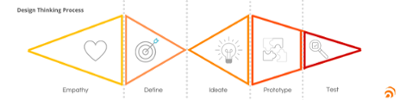
All stages matter and each has its reason for being. The hats can support every one of them, as the table shows, but their greatest value appears in ideation.
| Design Thinking stage | Most useful hats | What they contribute |
|---|---|---|
| Empathy | White, red | What we know about the customer and how they feel |
| Definition | White, blue | A precise problem statement based on evidence |
| Ideation | Green, yellow | Many options and the value behind each one |
| Prototyping | Yellow, black | Which ideas deserve a prototype and what to test first |
| Testing | White, black, red | Results, failure points and customer reactions |
Ideation requires divergent thinking because it is time to put on the creative hat and produce as many ideas as possible. That task can become overwhelming, so the six hats are a practical way to simplify the exercise. The author recommends this sequence.
Whatever the assignment, the dynamic consists of expressing opinions and ideas according to the hat. That allows the facilitator to say "take off the black hat and put on the yellow one" to someone who is being very negative, or "let's all put on the white hat" to think in a neutral and objective way.
With the six thinking hats, people can focus on one point of view to solve the problem rather than trying to be emotional, logical, positive, pessimistic and creative all at once.
For a leadership team exploring, for example, how to reduce customer churn, a simple agenda could look like this.
If you want more techniques for this stage, our guide to Design Thinking tools covers complementary methods.
The six thinking hats are a low-cost discipline that improves the quality and speed of commercial decisions. Applied to the ICX value chain, they help in several ways.
ICX Consulting facilitates innovation and decision workshops for leadership and commercial teams. Our Design Thinking consulting combines customer research, structured ideation techniques such as the six thinking hats, and rapid prototyping to turn ideas into tested solutions for sales, service and customer experience. We play the role of the blue hat, keeping the process focused on business outcomes. If your team is new to the method, start with our introduction to Design Thinking.
Good ideation starts with a real understanding of the customer. Use our Empathy Map Toolkit to give your white and red hats the customer insight they need before the session.
Yes. An individual can work through the hats in sequence when preparing a proposal or reviewing a decision. Writing a short list under each color exposes blind spots, especially missing facts and unexamined benefits, and makes the reasoning easier to present to a committee.
Brainstorming focuses only on generating ideas. The hats cover the whole thinking cycle, including information, emotions, risk, value and process control. In practice, a brainstorm is close to a green hat session, while the full method also evaluates and selects ideas.
It works well, often better than open discussion. The facilitator can announce each hat, use a shared board with a column per color and time-box contributions. Because everyone thinks in the same direction, remote participants interrupt less and quieter voices contribute more.
Most teams understand the rules in one session. Making it a habit takes a few weeks of consistent use, usually led by a facilitator who names the hats explicitly until the language becomes part of how the team runs meetings.
Better ideas rarely come from louder meetings. They come from teams that know how to look at a problem one angle at a time and then decide with confidence. If you want your leadership team to turn a complex customer or commercial challenge into tested solutions, request a diagnostic with an ICX consultant and we will guide the session with our blue hat on.


Aileen Pierce : Jun 05, 2025
Design thinking tools are the practical techniques a team uses at each stage of the design thinking process, from empathizing with users to...

 Sergio Gutierrez : Jun 05, 2025
Generating successful solutions with Design Thinking depends on balancing three tests at once, namely whether people want the solution, whether the...

Aileen Pierce : Jun 05, 2025
Designing with empathy means starting every product, service or experience from a deep understanding of the people it is for: their needs, desires,...

