




Generating Successful Solutions with Design Thinking
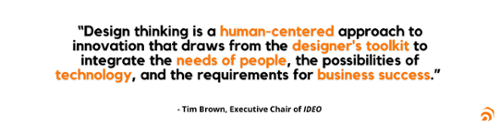
Generating successful solutions with Design Thinking depends on balancing three tests at once, namely whether people want the solution, whether the...

By Role
By Industry
By Target Customer
What We Offer
ICX helps companies grow revenue and profitability by connecting customer experience, sales, pricing, CRM and automation into one commercial system.
Customer Experience
We design memorable, customer-centered experiences that drive loyalty, enhance support, and optimize every stage of the journey. From maturity frameworks and experience maps to loyalty programs, service design, and feedback analysis, we help brands deeply connect with users and grow sustainably.
Marketing & Sales
We drive marketing and sales strategies that combine technology, creativity, and analytics to accelerate growth. From value proposition design and AI-driven automation to inbound, ABM, and sales enablement strategies, we help businesses attract, convert, and retain customers effectively and profitably.
Pricing & Revenue
We optimize pricing and revenue through data-driven strategies and integrated planning. From profitability modeling and margin analysis to demand management and sales forecasting, we help maximize financial performance and business competitiveness.
Digital Transformation
We accelerate digital transformation by aligning strategy, processes and technology. From operating model definition and intelligent automation to CRM implementation, artificial intelligence and digital channels, we help organizations adapt, scale and lead in changing and competitive environments.
Operational Efficiency
We enhance operational efficiency through process optimization, intelligent automation, and cost control. From cost reduction strategies and process redesign to RPA and value analysis, we help businesses boost productivity, agility, and sustainable profitability.
Customer Experience
Marketing & Sales
Pricing & Revenue
Digital Transformation
Operational Efficiency
9 min read
Aileen Pierce | Jun 05, 2025
9 min read
Aileen Pierce | Jun 05, 2025
Design Thinking is a human-centered methodology for solving complex problems that uses creativity and design tools as drivers of innovation. It moves through five stages, empathy, definition, ideation, prototyping and testing, so that a company understands the people it serves before it commits money to a solution.
Do you know what the world's largest media and entertainment conglomerate, Disney, the digital accommodation platform Airbnb, the enterprise software giant SAP and Apple have in common? All of them are widely cited as organizations that use Design Thinking. The claim is easy to repeat and harder to examine. What does it actually change inside a company, and why would a chief executive care?
Consider the scene that repeats itself in many boardrooms. Management has funded an innovation program for three years. The pipeline is full of projects, the workshops were lively, and yet the revenue from new offers is a rounding error. When the board asks why, the answers are about execution, timing and budget. Rarely does anyone question whether the projects began from a real customer problem. Design Thinking is, at its core, a discipline for starting there. Forrester's Total Economic Impact study of IBM's Enterprise Design Thinking practice, commissioned by IBM, modeled a return of about 301 percent over three years for a composite organization. The study is vendor-commissioned and should be read as an indication of scale, but it shows why a method that begins with understanding people can pay for itself (Forrester Total Economic Impact of IBM's Design Thinking).
Design Thinking is a methodology that facilitates the solution of complex problems, using creativity and design tools as drivers of innovation. In recent years it has become a trend on the internet, yet its origins are older than most people assume.
A very important figure is John Arnold, a psychologist and mechanical engineer who held summer creativity seminars at MIT in the 1950s. According to the account of Saavedra (2021), those programs brought together Buckminster Fuller and his concept of scientific design, the brainstorming technique of Alex Osborn, and W. J. Gordon with the methodology called Operational Creativity, where he spoke of his theory of synectics and what we know today as insights. Through this program Arnold understood the need to strengthen technical capabilities in aspects such as creativity and engineering. From there the design process began to evolve into a holistic methodology that considered both creativity and analysis, and it was no longer only about creating products and began to attract the attention of strategists.
Arnold later arrived at Stanford University, where he founded the Design Division of the Department of Mechanical Engineering. He was supported by Robert McKim, an early member of Stanford's product design program who developed the "visual thinking" approach based on sketching and rapid prototyping, and whose students include David Kelley, co-founder of IDEO and of Stanford's d.school (Stanford Engineering, on Robert McKim). At Stanford the methodology was developed theoretically, but the impulse to practice and dissemination was given by the IDEO team.
Read more: Design Thinking Tools
Design Thinking seeks to solve complex problems through innovation, which makes its applicability wide and, one could almost say, unlimited. Its process helps apply human-centered techniques, so it can be used to resolve design, business and strategy problems, and even everyday ones. At the business level, it supports the creative and innovative solution of problems, the design and development of products or services, the creation of companies, the definition of business models and the redesign and improvement of processes.
The industries that benefit most are those in which the customer's experience is the product, or in which the cost of a wrong guess is high. Imagine a regional insurer that wants to simplify how a policyholder reports a claim. The traditional route is to redesign the form. A design-led team sits with policyholders on the worst day of their year, learns that what they fear is not the paperwork but the silence after submitting it, and ends up designing proactive status updates that cost little and change satisfaction more than any redesigned form could. A manufacturer, a bank, a hospital or a developer of residential towers can find equivalent insights, each in its own context.
A second illustration comes from a regional supermarket chain whose online orders arrive with frequent substitutions. The operations team reads it as a picking problem and invests in better scanners. A design-led team shadows shoppers and discovers that the real frustration is not that a product was replaced, but that nobody asked before replacing it. The fix is a simple preference setting at checkout and a message to the customer before the substitution happens. It costs a fraction of the new equipment and addresses the complaint customers actually voice. The point is not that technology is wrong, but that understanding the person first tells the company which technology is worth buying.
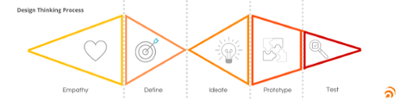
Being a methodology, Design Thinking follows a series of steps. There are five stages, namely empathy, definition, ideation, prototyping and testing. The process is iterative and non-linear, which means the team can use the result of one stage to evaluate and improve a previous one. This allows the team to understand the problem and redefine it when necessary, and to create new insights or alternative solutions that had not been thought of before.
The process divides into two parts, the problem space and the solution space. The first two stages, empathy and definition, make up the problem, and the next three, ideation, prototyping and testing, form the solution. Within each part the thinking alternates between divergence, in which the team opens up options, and convergence, in which it narrows them down. In the diagram, each triangle that opens signals divergent thinking and each triangle that closes signals the moment to decide.
Empathy comes first because an important pillar of the approach is that it is human-centered. The idea is to put the user at the center of everything. In this stage the team thinks divergently and uses different techniques to find the user's frustrations and pains, to understand what the person needs in order to succeed and how the experience could improve. In definition, all the information collected is taken and converged to a specific point: the characteristics of the user and the problem worth solving. A good definition is the most valuable output of the entire process, because it prevents the company from solving the wrong problem well.
From there the team enters the solution space. Ideation uses creativity in a brainstorming process focused on the defined problem, and once again the thinking diverges in order to create options. In prototyping the team selects the option it considers best and brings it to life, and the thinking converges because decisions are being made and not options created. Testing exposes the prototype to potential users. This stage is crucial because the feedback reveals opportunities to improve the solution, and it is an iteration phase in which improvements are considered, the prototype is adapted and retested until the optimal solution is designed.
Why is Design Thinking becoming more and more fashionable? Because, its practitioners argue, it delivers results. SAP, Disney, Airbnb, IBM, Apple and Zara are often named as well-known examples of companies that have understood its impact. One case with unusually well documented details is that of Bank of America.
The bank wanted more people to open accounts, specifically women, and it engaged IDEO as the driving force behind the methodology. The team traveled to observe customers in several US cities, interviewing many women. Among the people they met, they found a group that needed to keep close watch on its accounts, single mothers. One case stood out, a mother who rounded up every payment. If she bought groceries for $10.50, she wrote down $11, and at the end of the month she had a few extra dollars. IDEO's account also notes that many people rounded transactions up for speed and convenience, and that many mothers found it hard to save.
That observation became "Keep the Change", an idea whereby users save day by day almost without noticing. Each purchase made with a Bank of America debit card was rounded up to the next dollar and the difference deposited automatically into a savings account. A prototype video was created to test whether people were interested, the responses were positive, and the product was launched. Press reports on the program cite about 2.5 million customers, more than 700,000 new checking accounts and one million new savings accounts (Core77 on IDEO and Bank of America). You can watch the campaign in the video Bank of America: Keep the change.
The lesson for an executive is the sequence. The bank did not begin with a product. It began with a behavior it noticed in people's lives, built the cheapest possible test of whether the behavior could become a service, and expanded only once the response was clear. Each step reduced the risk of the next one.
It is worth being candid about the limits of the success stories. Cases such as Bank of America are selected precisely because they worked, and the public record rarely includes the prototypes that were abandoned along the way. The method does not guarantee a hit. What it offers is a way to fail cheaply and early, so that the ideas that reach the market have already survived contact with real people. An executive who expects every sprint to produce a blockbuster will be disappointed, while one who expects every sprint to produce a clearer decision will not.
For the chief executive, the method is a way to make innovation accountable. Instead of funding ideas on the strength of a presentation, the company funds learning in small increments, and each increment is judged by what customers did, not by what they were expected to do. This changes the conversation with the board, because progress can be described in evidence gained rather than activity completed.
For the commercial and customer experience leaders, it is a route to attract and retain customers by solving problems they feel but rarely articulate. The Bank of America story is a growth story and a loyalty story at once, since a savings feature keeps a customer connected to the institution. For the chief financial officer, the stage structure provides natural gates at which capital can be released or withheld, and early prototypes are an inexpensive way to test the revenue assumptions behind a business case. For operations, the method surfaces the unglamorous points at which processes fail the customer, which is where the cost to serve usually hides.
There is also a decision that belongs to the executive committee alone, which is who owns the findings. If the insights from customer research stay inside the innovation team, they become a report that nobody reads. If a commercial director, a finance leader and an operations manager each take responsibility for acting on a part of what was learned, the research changes budgets and processes. Naming those owners before the fieldwork begins is one of the simplest ways to make sure the method has consequences.
The caution is that Design Thinking is not a substitute for strategy. A company still has to decide which customers and problems deserve its attention, and a beautifully tested solution to an unimportant problem is still a poor investment. The method serves a strategy. It does not replace one.
Select a customer problem that matters financially, for example a segment with high churn or a journey with high abandonment, and commit a small team to spend two weeks on it. In the first week, the team should talk to or observe at least a handful of the people affected, preferably in their own environment, and record behaviors and workarounds as carefully as complaints. Workarounds are the most useful clue, because they reveal what customers are doing to compensate for something the company has not provided.
At the end of the first week, ask the team to produce a one-sentence definition of the problem and to reject any definition that sounds like a solution. In the second week, generate a broad range of ideas, select two or three, and prototype them with whatever is fastest, whether a mock-up, a role-play of the service or a short video like the one used by the bank. Show the prototypes to users, record what they say, and bring the results to the executive committee along with a recommendation on whether to continue, change direction or stop. A company that does this once will usually do it again, because the speed and clarity of the learning are persuasive.
Agree beforehand on what would count as a good outcome of the two weeks. It might be a validated definition of the problem, a prototype that at least a few users prefer to the current experience, or a list of assumptions the team can now discard. Without that agreement, the executive review tends to judge the work by how polished the prototype looks instead of by what the company learned, and teams quickly learn to polish rather than to test.
Return, finally, to the boardroom with the full innovation pipeline and the disappointing revenue. A year after adopting the practice, the board still asks why new offers are slow to contribute, but the answers are different. The committee can point to three problems that were chosen because they mattered financially, to the behaviors the team observed in customers' own environments, and to the prototypes that were stopped before they consumed a budget. One concept is moving to launch with evidence behind it, and two were retired with a clear explanation of what was learned. Nobody calls it a revolution. The company has simply started its innovation where its customers actually live.
ICX Consulting, headquartered in Miami, works with executive teams to apply Design Thinking to customer experience and commercial strategy, and to translate what is learned into redesigned journeys, services and sales processes. We combine it with customer journey maps and service design to make sure insight reaches daily operations. Teams that want to try the first stages themselves can start with our empathy map toolkit and our digital prototyping toolkit.
No single person did. Its roots lie in creativity and engineering design work from the 1950s, notably by John Arnold, and it was developed at Stanford by Arnold and Robert McKim. IDEO and the Stanford d.school later brought it into business practice and education.
The most widely taught model has five, empathy, definition, ideation, prototyping and testing. Other frameworks use more or fewer stages, but they all preserve the sequence of understanding people, defining the problem, generating options and testing them.
No. Smaller organizations often benefit more because they have fewer layers between the customer and the decision maker. The scale of the prototype and the team can be adjusted to the size of the problem, so a mid-market firm can run a useful cycle in two weeks.
The problem space covers empathy and definition and is about deciding what is worth solving. The solution space covers ideation, prototyping and testing and is about finding and validating how to solve it. Skipping the first space is the most common cause of failed projects.
Innovation that begins with a real customer behavior is far more likely to survive the budget review. If you would like to find the next "Keep the Change" hiding in your own customer base, talk to an ICX consultant about a first design sprint.
Generating successful solutions with Design Thinking depends on balancing three tests at once, namely whether people want the solution, whether the...

Art and science in Design Thinking meet when a company pairs the evidence-seeking habits of analysts with the prototyping instincts of designers, so...
The Six Thinking Hats is a structured thinking method created by Edward de Bono in which a group looks at a problem from one perspective at a time,...