











Design Thinking & Customer Experience Design
 Sergio Gutierrez : Jun 05, 2025
Design thinking applied to customer experience design is a five-stage method (empathize, define, ideate, prototype and test) for redesigning...
9 min read
9 min read
Designing with empathy means starting every product, service or experience from a deep understanding of the people it is for: their needs, desires, goals and emotions. In Design Thinking, empathy is the first stage of the process, and it is the foundation that keeps the later stages from producing attractive solutions to problems that customers do not have.
For executives, empathy is not a soft skill. It is a method for reducing commercial risk. Companies that skip it tend to discover their mistakes after launch, when they are expensive to correct. Companies that practice it find the real problem early, design what customers will value and spend less to do so. This article explains what empathy means in the Design Thinking process, why it matters for the customer experience and which techniques turn it into evidence.
A retail bank has just completed the redesign of its mobile app. The project was on time and under budget, and the usability tests recorded no serious problems. Six weeks after launch, the executive committee reads the dashboard: downloads are healthy, but the share of customers who complete a loan application inside the app is a fraction of the plan, and branch traffic has risen. The head of retail banking asks the project team what customers are saying. The answer comes in the form of a spreadsheet of tickets, categorized by type of error.
What the spreadsheet does not show is a customer in her kitchen on a Sunday night, trying to apply for a loan to repair her roof while her partner asks what documents the bank wants, and discovering that the app cannot save progress. She does not file a ticket. She stops, and on Monday she goes to a branch or to a competitor. The bank collected data about the app. It never saw the person.
That distance between what the organization measures and what the customer lives is exactly what the empathy stage of Design Thinking is designed to close.
Design Thinking is a methodology that facilitates problem solving, using creativity and design tools as drivers of innovation. Tim Brown, who led the global design firm IDEO for years, described it in the Harvard Business Review as a method of meeting people's needs and desires in a technologically feasible and strategically viable way. IDEO's own description is that it is a collaborative, human-centered approach that uses a design mindset to solve complex problems.
The application of Design Thinking is organized as a series of stages, although the process is iterative and non-linear: the team executing it can use the result of one stage to evaluate and improve a previous one. The stages are empathy, definition, ideation, prototype and test. All of them are essential. This article concentrates on the first because it determines the quality of everything that follows.

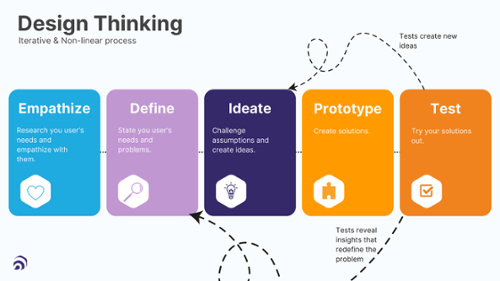
Empathy is a capacity that human beings develop to see the world through the eyes of other people. It means understanding their feelings and experiencing things as they do, which requires setting aside paradigms and preconceived ideas. In Design Thinking the concept is applied deliberately. IDEO's human-centered design toolkit, as quoted in a capacity strengthening tool on starting with empathy, defines it as a deep understanding of the problems and realities of the people you are designing for. The same source contrasts empathic research with traditional market research: it concentrates on motivations and thinking more than on measurable facts, and it requires interpreting what people mean and not only what they say.
In practice this means immersing oneself in the daily lives of the users for whom a solution is being designed, to understand their environment, their functions and their interactions. The Stanford d.school's well-known Bootcamp Bootleg frames the same idea in three activities, which it calls observe, engage and immerse: watch users in the context of their lives, interview them, and experience first-hand what they experience. It adds a point every executive should keep in mind, that what people say they do may differ from what they actually do, and both are valuable clues.
When an organization empathizes with people, it can analyze negative experiences and transform them into pleasant ones, which directly improves the customer experience (CX). Empathy is therefore the mechanism by which a company's intentions about the experience are compared with what customers actually go through.
Design Thinking is a human-centered methodology, which is the main reason why empathy is the first stage. But empathy also performs four functions that go beyond principle.
It lets the team understand people's paradigms: how they see the world, interpret circumstances and interact in the situations they live. It makes the team aware of the needs of users, both physical and emotional, and prevents designs that satisfy the first and ignore the second. It reveals the effect of people and their perceptions on the context being investigated, which is often where hidden variables appear. And it sometimes offers a perspective different from the one the team expected, because immersion in the actual environment of the user challenges assumptions that were comfortable.
Consider a hospital group that wants to shorten waiting times in the emergency room. Management data indicates that the average wait is within target. A team that spends a night in the waiting area sees something the data cannot: relatives are afraid, nobody tells them what is happening, and the perceived wait is far longer than the measured one. The solution that follows is not faster triage. It is information, delivered at the right moment, to the right person. The target of the project has moved from a number to an experience, and it only moved because someone looked.

The empathy stage is the right moment to gather information and observations and to understand the experiences and perceptions of users, so as to build a solid foundation for the rest of the process: define, ideate, prototype and test. Several methods can be used, and the best choice depends on the problem.
Observation based on photographs or video makes it possible to discover users' needs in relation to the problem to be solved and the emotions they experience. These observations should be made in a natural environment, or in scheduled sessions with the team. A manufacturer that wants to improve the maintenance experience of its equipment, for example, learns more from a recording of a technician working under pressure in a plant than from any satisfaction survey.
Depending on the problem, it may make sense to hand the camera to the users, with instructions to photograph and film their activities during a set period. The difference from the previous method is that the equipment does not intervene until it is time to collect the observations, which reduces the effect of being watched. A telecom operator exploring how families use connectivity at home could ask a few households to document where and when the network frustrates them.

Interviews are a way of getting to know users and of obtaining an empathic view of their needs, desires and goals. Their quality depends on how they are conducted. The d.school guidance recommends asking why even when you think you know the answer, asking about a specific instance instead of generalities, encouraging stories, using neutral rather than leading questions and avoiding yes or no questions. An insurer interviewing policyholders about their last claim would ask them to walk through what happened on that day, not whether they were satisfied.
Bodystorming is a technique in which the team physically experiences a situation to immerse itself completely in the environment of the users. By placing the team in the users' shoes, it increases the empathy felt for the target group. A retailer might ask its executives to complete a return using only a mobile phone, standing in line at a store during a busy weekend. The discomfort is useful information.

Empathy by itself does not create value. Its purpose is to establish the basis for a solution that meets the three circles of innovation: desirability, feasibility and viability. What the team learns in this stage should be consolidated in tools such as the empathy map and the customer journey map, so that the findings can be shared across functions and tested against data in the definition stage. Leaders should expect the team to return from the field with stories, not only statistics, because stories are what allow a multidisciplinary group to feel the same problem.
The cost of skipping empathy is rarely visible in the project plan, because the project plan assumes that the problem has already been understood. It shows up later, in products that need constant explanation, in service processes that customers bypass by calling the call center, in campaigns that must work harder to sell an offer that does not quite fit. A manufacturer that launches a digital ordering portal without observing how its distributors actually place orders may find that they continue to use the telephone, now with the added irritation of a system they were forced to learn. The investment was real and the return depends on a change in behavior that nobody studied.
A subtler cost is internal. When teams design from assumptions, disagreements are resolved by hierarchy or by the loudest opinion in the room. When teams design from observed evidence, disagreements are resolved by returning to what customers did and said. The second pattern is less personal, faster and far more likely to produce decisions that survive contact with the market. That is one reason empathy is also a management practice, because it changes how a company argues with itself.
Empathy research is subjective by nature, since it requires interpreting what people mean and not only recording what they say. That is its strength and its risk. A small number of conversations cannot represent an entire market, and a charismatic participant can distort the team's view. Good practice is to treat the findings as hypotheses, to look for patterns across several users and contexts, to include extreme users whose behavior illuminates the average, and to test conclusions later with larger samples and with prototypes.
There is also a risk of empathizing only with the customers who are easy to reach. Companies tend to talk to loyal accounts and to those who respond to surveys, which leaves out the customers who left without complaining and the prospects who never bought. Designing the sample with the same care as the questions, and deliberately including people who stopped using the product, makes the empathy stage far more honest.
For the chief executive, empathy is a discipline of seeing the company as customers see it. It is worth the time of the top team to spend a few hours a quarter in direct contact with customers, not to approve decisions but to listen. The practice resets the conversation in the boardroom, where information tends to arrive filtered by averages.
For the chief customer, commercial and marketing officers, the empathy stage supplies the insight to attract the right customers, convert them with a proposition that fits and retain them with an experience that deserves loyalty. For the chief financial officer, it is a way to reduce the cost of failed launches, because misunderstandings that would otherwise cost a development cycle are found in a week of fieldwork. For operations and technology leaders, listening to the people who use their systems and processes exposes friction and waste that never appear in process diagrams, and removing that friction contributes directly to efficiency and to a better cost to serve.
Select one moment of your customer journey that the data shows as problematic, such as a stage where applications are abandoned or where complaints cluster. Ask a small team to spend one week on it. On the first day, they prepare an interview guide with open questions, such as asking customers to describe the last time they went through the process. Over the next three days, they conduct five or six interviews and observe at least two customers in their real context. On the last day, they bring back what they saw and heard, in the customers' own words, and describe the emotions behind the behavior.
Resist the temptation to jump immediately to solutions. A first week devoted only to understanding frequently changes the problem statement itself, and that change is the most valuable result. When the team presents it, leaders should ask what surprised the team, because surprise is the sign that empathy produced learning and not confirmation.
One final observation concerns pace. Executives often worry that the empathy stage will slow a project that is already under pressure. In practice the opposite tends to happen. A week of structured fieldwork is short compared with the months spent building the wrong thing, and the findings give the team a common language that speeds up every later decision. The stage also produces material that is useful beyond the project itself: verbatim quotes for marketing, examples for training service teams, and a shared picture of the customer that can be reused in the next initiative. Treated as an asset, empathy compounds.
ICX Consulting is a Commercial Strategy and Customer Experience firm headquartered in Miami. Our design thinking consulting helps leadership teams run the empathy stage with rigor, from preparing the research to turning findings into personas, empathy maps and journeys, which we connect to the ICX Compass methodology and to customer journey maps. You can start with our empathy map template, and continue with the companion articles on design thinking tools and on what design thinking is used for and its stages.
No. Sympathy is feeling concern for someone, while empathy in design means understanding how a person experiences a situation well enough to design for it. It is a professional skill that is developed through observation, listening and immersion, not through good intentions alone.
There is no fixed number, because the goal is understanding and not statistical proof. Teams often begin to see patterns after a handful of interviews per segment. Add conversations until new interviews stop changing the picture, then validate the findings with quantitative data.
It complements them. Surveys measure how widespread a behavior or opinion is, and empathy research explains why it exists. Used together, qualitative findings can shape better survey questions, and survey results can show where to look more deeply.
Prepare neutral questions, avoid suggesting answers, observe real behavior as well as stated opinion, and bring more than one person to interviews so that interpretations can be compared. Be especially careful with customers you already know, whose answers may reflect the relationship with the company.

The companies that understand their customers best are usually those that spend time among them. If you would like to bring that practice into your own business, request a diagnostic with an ICX consultant and start designing from the customer's point of view.
Sergio Gutierrez : Jun 05, 2025
Design thinking applied to customer experience design is a five-stage method (empathize, define, ideate, prototype and test) for redesigning...

Design thinking is used to solve complex problems, innovate in products, services and processes, and design customer experiences by starting from the...

 Aileen Pierce : Jun 05, 2025
Design thinking tools are the practical techniques a team uses at each stage of the design thinking process, from empathizing with users to...

