




Design Thinking: What is its importance in the customer experience?
Design thinking matters in customer experience because it makes companies solve the right problem before investing in a solution. By starting from...
By Role
By Industry
By Target Customer
What We Offer
ICX helps companies grow revenue and profitability by connecting customer experience, sales, pricing, CRM and automation into one commercial system.
Customer Experience
We design memorable, customer-centered experiences that drive loyalty, enhance support, and optimize every stage of the journey. From maturity frameworks and experience maps to loyalty programs, service design, and feedback analysis, we help brands deeply connect with users and grow sustainably.
Marketing & Sales
We drive marketing and sales strategies that combine technology, creativity, and analytics to accelerate growth. From value proposition design and AI-driven automation to inbound, ABM, and sales enablement strategies, we help businesses attract, convert, and retain customers effectively and profitably.
Pricing & Revenue
We optimize pricing and revenue through data-driven strategies and integrated planning. From profitability modeling and margin analysis to demand management and sales forecasting, we help maximize financial performance and business competitiveness.
Digital Transformation
We accelerate digital transformation by aligning strategy, processes and technology. From operating model definition and intelligent automation to CRM implementation, artificial intelligence and digital channels, we help organizations adapt, scale and lead in changing and competitive environments.
Operational Efficiency
We enhance operational efficiency through process optimization, intelligent automation, and cost control. From cost reduction strategies and process redesign to RPA and value analysis, we help businesses boost productivity, agility, and sustainable profitability.
Customer Experience
Marketing & Sales
Pricing & Revenue
Digital Transformation
Operational Efficiency
9 min read
Sofía Lizano | Jun 02, 2025
9 min read
Sofía Lizano | Jun 02, 2025
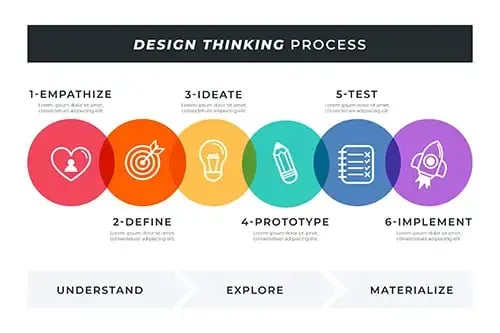
Design thinking is used to solve complex problems, innovate in products, services and processes, and design customer experiences by starting from the real needs of the people affected. It follows five stages, empathy, definition, ideation, prototyping and testing, which reduce the risk of building something nobody wants and bring teams from different disciplines to a shared solution.
The stakes are commercial. A frequently cited statistic holds that 84% of design projects fail because of a lack of understanding of users' real needs, and Design Thinking is the methodology that seeks to change that statistic by focusing on the human being. Whatever the exact figure in a given company, executives recognize the pattern: investments that looked sound in the boardroom and found little demand in the market.
In this article: What is Design Thinking? | Process and stages | What is it used for? | When can it be used? | How to use it for CX?
A chief customer officer at a regional telecom operator reviews the renewal numbers for a premium support plan that the company launched eighteen months earlier. The plan was the result of careful work: a benchmark of competitors, a financial model and a well-designed brochure. Yet renewals are far below the forecast, and the account managers report that customers describe the plan as something they pay for and do not use.
Nothing in the project was careless. What was missing was a conversation, early on, with the people who would have to pay for the plan. Had someone watched a small-business owner trying to resolve an outage on a Saturday morning, the team would have learned that customers did not want faster tickets. They wanted to know, within minutes, whether the outage was theirs or the operator's. A different service would have emerged, and probably a better business case. This is the problem that design thinking was created to solve, and the reason it deserves a place in the executive agenda.
Design Thinking is a methodology based on finding effective and innovative solutions to complex problems. It centers on the human being, with their needs, backgrounds and desires. The tool allows a team to understand those affected, starting from empathy and the creation of ideas that help design and implement a solution focused on the real problem, benefiting both the company and its customers. The approach also promotes experimentation and research for solving challenges and creating prototypes, always keeping the users at the center.
The definition used by IDEO, the design firm most associated with the method, is a human-centered approach to solving complex problems that combines what is desirable for people, what is viable for organizations and what is feasible with technology. Tim Brown, who led IDEO for years, gave a similar definition in the Harvard Business Review: a method of meeting people's needs and desires in a technologically feasible and strategically viable way. The convergence of those three lenses is what distinguishes design thinking from simple creativity. An idea must be wanted, financially sustainable and buildable at the same time.
It is also a multidisciplinary approach. A single department rarely holds all the perspectives needed to understand a complex problem, so the assistance of different teams and disciplines is part of the method, not a courtesy. Sales knows what customers ask for, service knows what they complain about, operations knows what is possible and finance knows what is sustainable.
To arrive at a correct solution, the process passes through several stages, each with its own techniques and tools. It is divided into two spaces. The problem space is where the right question is formulated, through the stages of empathy and definition. The solution space contains three stages: ideation, prototyping and testing. For a detailed review of tools for each one, the ICX article on design thinking tools is a natural companion.
<< Six Thinking Hats [Design Thinking] >>
In this initial stage the foundation of the design is formed. The team identifies the user, along with their needs and problems, or pain points, through a process of understanding, observing and listening to experiences and challenges. Several techniques help collect the information, including interviews, the five Ws questions, exploring the experience and observing interactions. A bank that wants to redesign its small-business onboarding would not begin in a workshop room. It would begin by sitting with a shop owner during the first week of opening an account.
<< Designing with empathy (Design Thinking) >>
In this phase the problem starts to make sense. The team analyzes, synthesizes and organizes the information gathered earlier, and clarifies what needs to be done, what the user really requires and which pain points matter most. In other words, it identifies the root cause of the problem. A technique that supports the stage is the creation of a buyer persona: with what the team has heard and observed, it builds a profile of customers, with their concerns and desires, among other aspects.
The third stage is the most creative of the process. The team focuses on generating ideas with potential solutions to the problem, aiming for as many as possible and then categorizing them by type. Brainstorming, mind maps and the grouping of ideas by content are common tools. After this the team can incorporate changes or additional ideas from colleagues. The discipline here is to postpone judgment. A manufacturer exploring after-sales service might generate forty ideas in an hour, and only later discover that the three most promising share a single theme.
Based on the ideas generated, the team selects improvements and builds low-fidelity prototypes. Features are added gradually to these prototypes so that they can be presented to the customer and the team can assess whether it is approaching a solution to the initial problem. Techniques include storytelling, storyboards, and physical and digital models.
In the last stage the prototype is delivered to the customer for feedback. With that information the team makes the necessary improvements, and the process is repeated as many times as needed until a solution to the initial problem is achieved. Testing is not an inspection at the end. It is the moment when the organization learns, cheaply, which of its assumptions were wrong.

Design thinking serves four purposes that executives should distinguish. It brings innovation and creativity to the design of ideas for a product, service or process. It makes multidisciplinary teamwork a working method instead of a slogan. It provides a path to effective problem solving, particularly when the problem is ambiguous. And it puts the customer at the center of decisions that organizations otherwise make by habit.
The business argument for these purposes has been tested in at least one large study. A Forrester Total Economic Impact study commissioned by IBM in 2018, based on interviews with four IBM clients and a survey of 60 respondents, modeled a composite global enterprise and reported a 301% return on investment from IBM's design thinking practice, with design time cut by 75% and projects reaching the market twice as fast. Readers should note the context, since IBM commissioned the study and the figures refer to a modeled organization, but the direction of the finding is consistent with what many practitioners see: money is saved when problems are understood before solutions are built.
The method fits situations in which the company needs to innovate, improve processes, solve a problem for a customer or within the company, develop new products and services, or design a customer experience. These categories overlap, and that is why the approach travels so well across functions.
An insurer that wants to simplify the process of reporting a claim is improving a process and designing an experience at the same time. A hospital that wants to reduce no-shows in outpatient clinics is solving a problem inside the organization that is also a problem for patients. A manufacturer of industrial equipment that wants to move toward service contracts is developing a new offer that depends on understanding the daily reality of maintenance teams. In each case the question is the same: whose problem are we solving, and how do we know?

Because the methodology focuses on the customer, it gives a company a systematic way to see what customers actually go through. The customer's experience is their perception of the company or brand, and the use of this method helps leaders understand the needs of users well enough to create a better buyer persona and a better customer journey. On one side, it reveals the concerns and desires of customers. On the other, it allows the team to define the problem from what was discovered in the empathy process, from which innovative and creative ideas for various solutions can then emerge.
Consider a retailer whose online store has a satisfactory conversion rate but a high rate of returns. Analytics shows what happens and not why. Observing customers unboxing products and interviewing a few who returned items might reveal that size guidance on the product page is the cause, and a modest redesign would save more margin than a new campaign could earn. This is the kind of insight that links customer experience with efficiency, and it is where design thinking proves its value outside of innovation labs.
A method that promises better decisions has to be judged by decisions. The first signal is behavioral: leaders begin to ask who the customer is and what evidence supports a proposal before they ask about the budget. The second is economic, visible in the share of launches that reach their adoption targets, in the number of ideas stopped cheaply after testing and in the reduction of rework after release. The third is relational, because customers who are consulted and then see their feedback reflected in a product or service tend to become more loyal and more willing to refer others.
These signals are easier to capture when the team defines them at the start of the project. A retailer might agree that the redesign of its returns process will be judged by the return rate, the cost to serve per return and the satisfaction of customers who go through it. A bank might judge a new onboarding journey by the time to first transaction and the percentage of applicants who finish. Setting these measures before the first interview prevents the common temptation to declare success on the basis of enthusiasm in the workshop.
The method is not a guarantee, and executives should understand where it can disappoint. It can be superficial when teams adopt the vocabulary and the sticky notes but skip the contact with customers. It can be slow when applied to problems that are already well understood, and it can produce attractive prototypes that the organization lacks the capability to build. The remedy is leadership that asks for evidence from users at each stage, defines decision criteria in advance and connects the output to the commercial plan and to the operating model that must carry it.
There is also a question of fit with culture. Organizations that reward certainty and punish visible mistakes struggle with a method that depends on early, inexpensive failure. In those companies, the most useful step may be for the executive team to share its own uncertainties openly, show that a prototype that fails in a week is a success of the process, and give teams explicit permission to change course. Without that signal from the top, even a well-run design thinking project tends to be reduced to a presentation of conclusions that were already decided, and the opportunity to learn from customers is lost.
For the chief executive, design thinking is a way to reduce the uncertainty of growth bets. It does not replace strategy, but it provides the evidence that makes strategy credible. Ask for the voice of the customer in every major investment proposal, and treat the absence of it as a gap in the business case.
For the chief customer, marketing and commercial officers, the method sharpens attraction and retention. Segments are defined from observed behavior, journeys are redesigned around moments that matter, and proposals are tested before campaigns are funded. For the chief financial officer, prototyping and testing allow capital to be released in steps tied to evidence. For operations leaders, involving the people who deliver the service in the design avoids redesigns that look good on paper and collapse in the field. All of these contribute to the efficiency of the organization, because the cheapest correction is the one made before launch.
Choose one concrete experience in your company that generates complaints, abandonment or rework, and give a small multidisciplinary team three weeks. In the first, they talk to and observe real customers. In the second, they define the problem in the customers' own words and generate ideas. In the third, they build a simple prototype and test it with the same people. Ask for a short presentation at the end, centered not on the solution but on what the team learned about the customer that it did not know before.
That presentation is often the most valuable output. It shows leadership how far internal assumptions are from customer reality, and it builds the appetite for a more systematic practice. If the exercise is repeated twice a year on different topics, the organization gradually develops a habit of testing ideas before funding them.
ICX Consulting is a Commercial Strategy and Customer Experience firm headquartered in Miami. Our design thinking work guides leadership teams through the five stages, from research with customers to prototypes tested before investment, and links the results to customer journey maps and to the ICX Compass methodology, so that insight turns into commercial and operational decisions. To start working with templates, explore the Persona Playbook and the empathy map template from the ICX toolkit.
Bring this topic to your company
An ICX Consulting advisor will assess where your organization stands today and which decisions can move your commercial and customer experience results.
No. It borrows the mindset of designers but is used by commercial, operations, finance and service teams. IDEO itself notes that the goal is to work more creatively and collaboratively, not to turn everyone into a designer.
It depends on the problem, but a first cycle on a focused topic can be done in a few weeks, and the process is intended to be repeated. Because it is iterative, results from testing may send the team back to an earlier stage.
The problem space, made of empathy and definition, is where the team makes sure it is asking the right question. The solution space, made of ideation, prototyping and testing, is where it explores and validates answers. Many failed initiatives enter the second space without having completed the first.
Yes. It combines well with customer journey mapping, the value proposition canvas, lean and agile delivery, and continuous improvement methods. In ICX engagements it is often the starting point that defines the problem before other methods are used to measure and scale the solution.
Companies rarely fail for lack of ideas. They fail because they invest in ideas before understanding the people those ideas are for. If you would like to bring that discipline to a real decision in your business, request a diagnostic with an ICX consultant and begin with the customer's point of view.
Design thinking matters in customer experience because it makes companies solve the right problem before investing in a solution. By starting from...
Design Thinking is a human-centered methodology for solving complex problems that uses creativity and design tools as drivers of innovation. It moves...
Design thinking tools are the practical techniques a team uses at each stage of the design thinking process, from empathizing with users to...