





Value Proposition Canvas to Design Better Products
The Value Proposition Canvas is a tool for designing products and services around what customers actually need. It places a customer profile of jobs,...

By Role
By Industry
By Target Customer
What We Offer
ICX helps companies grow revenue and profitability by connecting customer experience, sales, pricing, CRM and automation into one commercial system.
Customer Experience
We design memorable, customer-centered experiences that drive loyalty, enhance support, and optimize every stage of the journey. From maturity frameworks and experience maps to loyalty programs, service design, and feedback analysis, we help brands deeply connect with users and grow sustainably.
Marketing & Sales
We drive marketing and sales strategies that combine technology, creativity, and analytics to accelerate growth. From value proposition design and AI-driven automation to inbound, ABM, and sales enablement strategies, we help businesses attract, convert, and retain customers effectively and profitably.
Pricing & Revenue
We optimize pricing and revenue through data-driven strategies and integrated planning. From profitability modeling and margin analysis to demand management and sales forecasting, we help maximize financial performance and business competitiveness.
Digital Transformation
We accelerate digital transformation by aligning strategy, processes and technology. From operating model definition and intelligent automation to CRM implementation, artificial intelligence and digital channels, we help organizations adapt, scale and lead in changing and competitive environments.
Operational Efficiency
We enhance operational efficiency through process optimization, intelligent automation, and cost control. From cost reduction strategies and process redesign to RPA and value analysis, we help businesses boost productivity, agility, and sustainable profitability.
Customer Experience
Marketing & Sales
Pricing & Revenue
Digital Transformation
Operational Efficiency
8 min read
Aileen Pierce | May 29, 2025
8 min read
Aileen Pierce | May 29, 2025
Use the Value Proposition Canvas when a decision depends on understanding one customer segment in depth, such as launching a product, entering a new segment, repositioning an offer, redesigning pricing or reacting to falling conversion and retention. It maps what customers are trying to get done, what gets in their way and what they want, against what your offer delivers.
For a leadership team, the question is less "what is the canvas" and more "when is it worth the effort." Used at the right moment, it prevents expensive launches built on assumptions, sharpens the message that sales and marketing take to market and gives the company a shared definition of value proposition that finance, product and commercial teams can all work from. Used at the wrong moment, it becomes a workshop poster that nobody revisits. The difference shows up in revenue, margin and the cost of acquiring and keeping customers.
If you have ever searched for "business model," "value proposition" or similar terms, you will have come across Strategyzer. Strategyzer builds practical strategy tools and makes them available to business strategy professionals, and on its website it describes its purpose this way, "We love to build products and create experiences that benefit people, organizations and society." Its co-founder is Alexander Osterwalder, known for creating tools used worldwide, such as the Business Model Canvas, the Value Proposition Canvas and the Business Portfolio Map. The canvas is explained in depth in the book Value Proposition Design, which Osterwalder wrote with Yves Pigneur, Greg Bernarda and Alan Smith.
Strategyzer presents the canvas as the official tool to map what customers are trying to get done, what gets in their way and what they want to achieve, working in conjunction with the Business Model Canvas. That pairing is the key to knowing when to use it.
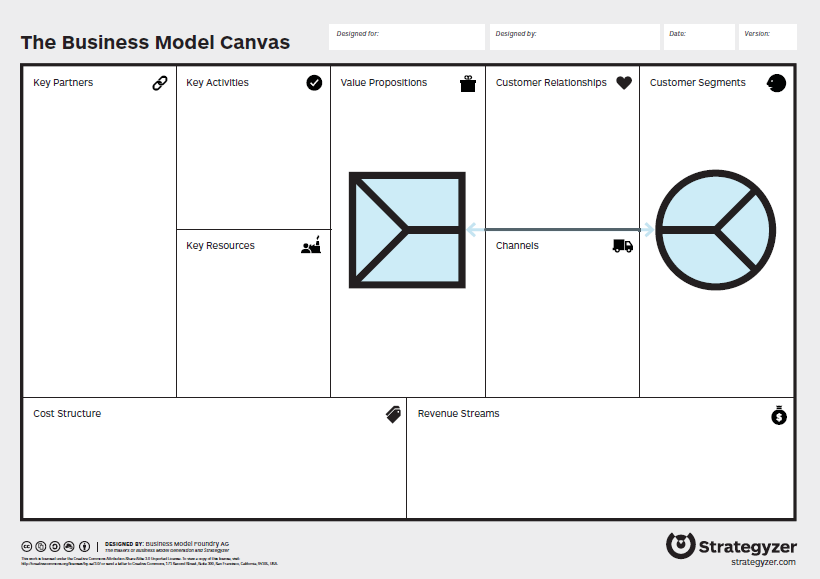
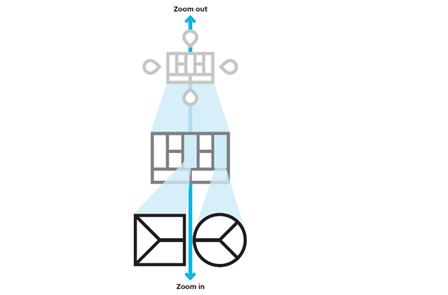
The Value Proposition Canvas is a tool that facilitates the in-depth analysis of two of the blocks of the Business Model Canvas, customer segments and value proposition. It makes the value proposition visible and tangible, and therefore easier to create and manage, and it checks that proposition against the needs of the market you want to serve.
Before going further, it helps to recall what those two Business Model Canvas blocks consist of.
While the Business Model Canvas helps you design how your business creates, delivers and captures value, the Value Proposition Canvas zooms in on how you create value specifically for your customers. To learn more about the business model, read Business Model: what is it and why is it important?

>> Value Proposition Canvas in less than 800 characters <<
If you have a business idea in mind and you are planning to launch it, you need a guide that captures the elements required for it to work. Otherwise, it would be like starting to build a house without the plans. By placing your idea under the microscope of the Value Proposition Canvas, you can see more clearly who your customers are, what their habits are and which of their problems your business can solve. The tool is not only useful for ideas in progress. It applies just as well to established organizations.
If you are starting from scratch, you will first design your business model, which is easier with the Business Model Canvas, as it defines the 9 building blocks that make a business work. Then you zoom into that model and define more specifically the value you will bring to customers. If your company is already up and running but has no explicit business model, you can apply exactly the same sequence.
In practice, consulting work shows six moments when the canvas earns its place on the leadership agenda.
| Business moment | The question the canvas answers | What leadership gets |
|---|---|---|
| New product or service launch | Which job, pain or gain does this offer address better than the alternatives? | A go or no-go based on customer evidence, not internal enthusiasm |
| Entry into a new segment or country | Do these customers have the same jobs and pains as our current ones? | A decision on whether to adapt the offer, the message or both |
| Repositioning or rebranding | What do customers actually value about us today? | A message anchored in real gains instead of internal vocabulary |
| Pricing or packaging review | Which gains are customers willing to pay more for, and which are table stakes? | Packages and price levels tied to perceived value |
| Falling conversion or rising churn | Which pain did we stop relieving, or which competitor relieves it better? | A focused fix instead of a broad discount |
| Digital channel or experience redesign | Which jobs do customers now want to complete on their own? | Priorities for self-service, content and automation |
Designing the canvas is the first step. Then you need to validate what you put on paper with your customers, test the value proposition and analyze the market response. That test helps you fine-tune the proposition and keep improving it.
If you want to learn more about business model patterns, read 14 successful business model patterns.

Knowing when to use the Value Proposition Canvas also means knowing when it will not help. Three situations call for a different tool first.

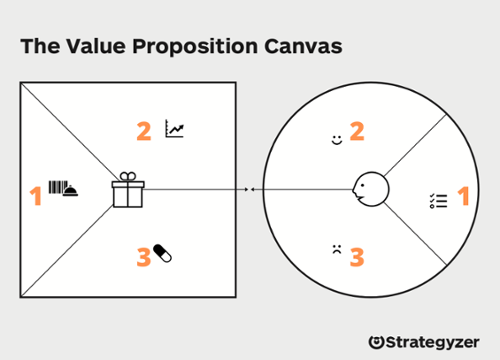
The Value Proposition Canvas consists of two parts, the value map on the left and the customer profile on the right.
It describes the characteristics of your value proposition in detail, specifying the products and services offered, how you relieve pains or frustrations and how you create benefits for the customer.
It describes a market segment in a specific and structured way, detailing the customer's work, frustrations and joys.
The objective is for the customer profile and the value map to fit and work in harmony. That fit is achieved when the products and services in the value proposition respond to the frustrations customers feel and the outcomes they expect. The analysis must be developed for each market segment, because each one has different pains and motivations. As Strategyzer puts it, fit is a claim until customers confirm it.
The Value Proposition Canvas is used to do three things.
The advantages of using the canvas are clear for any management team.
For a visual and dynamic explanation, you can watch the video published by Strategyzer, Value Proposition Canvas Explained.
Applied consistently, the canvas stops being a one-time exercise and becomes a continuous learning loop. You design, test, measure and refine value propositions based on real feedback and market behavior. That discipline reduces the risk of failed launches and shortens the time to market for solutions that matter. Over time, it also strengthens the company's ability to spot emerging pains and opportunities before competitors do.
A practical rhythm works well for most companies.
For executives under pressure to deliver growth, the Value Proposition Canvas offers a concrete way to connect strategy with execution. It links high-level ambitions such as revenue growth, digital transformation and customer centricity to specific customer jobs, pains and gains. That connection lets you prioritize initiatives, allocate resources and make sure every new product, service or feature is anchored in proven customer value.
ICX Consulting helps leadership teams turn customer understanding into decisions on offer, price and go-to-market. Our value proposition consulting combines customer research with the business model work that surrounds it, and the ICX Compass methodology connects those findings to the customer experience the company must deliver. When the canvas reveals a gap in how value is priced or sold, our go-to-market strategy team takes it to execution.
To run your first session with a ready structure, download the ICX Value Proposition Toolkit and use it with your team on the segment that matters most this quarter. For a step-by-step method, see the definitive guide to filling in the Value Proposition Canvas, and for its link to service quality, how the Value Proposition Canvas impacts the customer experience.
Large companies often benefit more, because they serve many segments with offers designed years ago. The canvas helps them check whether legacy products still relieve current pains, and it gives business units a common format to compare segments. The key is to run it per segment and per decision, not once for the whole company.
A first draft for one segment usually fits in a half-day working session with people who talk to customers every week. Validation takes longer, typically a few weeks of interviews or tests. Budget most of the effort for validation, since that is where the canvas turns from opinion into evidence.
Include someone from sales, customer service and product or operations, plus a leader who owns the decision. Frontline people bring the customer's language and real objections. Without the decision owner, the session tends to produce insights that never reach the budget or the roadmap.
A buyer persona describes who the customer is, including role, motivations and behavior. The canvas describes what that customer is trying to accomplish and how well your offer helps. They work best together, with the persona defining the segment and the canvas testing the fit of the offer for that segment.
Organizations that embed the Value Proposition Canvas into planning and innovation build an advantage that lasts. They create experiences that resonate, products customers are willing to pay for and relationships that grow over time. If you are about to launch, reposition or reprice an offer and want customer evidence behind the decision, request a diagnostic with an ICX consultant and test your value proposition before the market does it for you.
The Value Proposition Canvas is a tool for designing products and services around what customers actually need. It places a customer profile of jobs,...
The Value Proposition Canvas is a visual tool, created by Alexander Osterwalder, that describes one customer segment's jobs, pains and gains and...
A value proposition is the promise a company makes to a specific customer segment about the value it will deliver, and the reason that segment should...