




Skip to the main content.

What We Offer

ICX helps companies grow revenue and profitability by connecting customer experience, sales, pricing, CRM and automation into one commercial system.

Customer Experience

We design memorable, customer-centered experiences that drive loyalty, enhance support, and optimize every stage of the journey. From maturity frameworks and experience maps to loyalty programs, service design, and feedback analysis, we help brands deeply connect with users and grow sustainably.

Marketing & Sales

We drive marketing and sales strategies that combine technology, creativity, and analytics to accelerate growth. From value proposition design and AI-driven automation to inbound, ABM, and sales enablement strategies, we help businesses attract, convert, and retain customers effectively and profitably.

Pricing & Revenue

We optimize pricing and revenue through data-driven strategies and integrated planning. From profitability modeling and margin analysis to demand management and sales forecasting, we help maximize financial performance and business competitiveness.

Digital Transformation

We accelerate digital transformation by aligning strategy, processes and technology. From operating model definition and intelligent automation to CRM implementation, artificial intelligence and digital channels, we help organizations adapt, scale and lead in changing and competitive environments.


Operational Efficiency  

We enhance operational efficiency through process optimization, intelligent automation, and cost control. From cost reduction strategies and process redesign to RPA and value analysis, we help businesses boost productivity, agility, and sustainable profitability.

Customer Experience

chevron-right-1

Marketing & Sales

chevron-right-1

Pricing & Revenue

chevron-right-1

Digital Transformation

chevron-right-1

Operational Efficiency 

chevron-right-1

9 min read

What is a Buyer Persona?

9 min read

What is a Buyer Persona?

A buyer persona is a fictional but research-based archetype of a company's target audience. It describes in detail who the buyer is, what they do, what they need, what worries them and how they decide, so that sales, marketing and service can design more targeted strategies. It turns the abstract question of who the customer is into a concrete character that every team can recognize.

Imagine the quarterly board meeting of a growing distribution company. The chairman asks a simple question. Who exactly is our customer? The commercial director answers that it is the mid-sized retailer in the capital city. The marketing manager says that it is the owner who is under forty and buys online. The head of customer service says that the customers who call most often are older store managers who value a personal relationship. All three are describing real people, and all three are partly right. But each team has been designing campaigns, pricing conversations and service scripts for a different customer, and nobody noticed because nobody had written the customer down.

When we search for strategies and tools for sales and marketing we have many options, and it is hard to know which one deserves effort and resources. We also live in accelerated times, in which the aim is to go to the point and be efficient in providing a product or service. That is why buyer personas matter. They are one of the few tools that improve decisions in several departments at once, and they cost far less than the campaigns and projects they help avoid or correct.

What is a buyer persona?

A buyer persona is a fictional character, an archetype, of the audience a company wants to serve. It reflects that audience in enough detail that the company can generate sales and marketing strategies aimed directly at it. To build one, a company needs statistical information, analysis, observation and study of the audience. The Nielsen Norman Group, a leading authority on user research, describes a persona as a fictional yet realistic description of a typical or target user, which synthesizes research into a single memorable profile and warns that personas without a research basis, or cluttered with details that do not affect any decision, lose their usefulness.

A helpful way to think about it is that the persona is a story the company writes about its customer, one that captures the attention of the customer because it begins with what they care about. To write that story well, it is essential to know the details of motivation and pain, so that the company can position its product or service in a way that is interesting and attractive to the reader and, in the end, leads them to acquire it. Among the details worth knowing are what the person does, where they live, their socioeconomic status, their hobbies, the social networks they use, their shopping habits and trends, and their challenges.

The most useful personas are not collections of demographics. They answer practical questions. What triggers the search for a solution? What information does the person look for, and where? Who else must agree before a purchase happens? What would make them walk away? When those answers are written down, the persona stops being an exercise for the marketing department and becomes a shared reference. For a vivid illustration of the idea in practice, read our article One Buyer Persona to rule them all.

What are the benefits of having buyer personas?

A buyer persona lets the business know what it has to do to attract and retain potential customers, and as a result it clarifies four things. It tells the company which material it should create, which material it should share, where it should concentrate its efforts and where it should improve to be at the forefront. All of this comes from studying the behaviors, trends and patterns of the audience, and not from assumptions that executives happen to share.

The financial logic is straightforward. Effort that is aimed at the wrong audience is wasted effort, and most commercial teams waste a good deal of it without noticing. A marketing team that writes for a buyer who does not exist produces content that attracts the wrong visitors. A sales team that pitches the wrong benefits loses deals it could have won. A service team that does not understand what the customer values answers well and still disappoints. By focusing everyone on the same description, a persona reduces the cost of misalignment, which is one of the least visible but most persistent costs in a commercial organization.

Consider a regional bank that launches a savings product. Its first persona, a salaried employee who values security and wants simple tools, responds to branch presence and clear messages about guarantees. Its second, a young freelancer with irregular income, responds to flexible deposits and a mobile application. A single campaign addressed to the average of the two would persuade neither. Two campaigns, each built around a persona, can use different channels, different language and different offers from the same product. That is the practical meaning of focusing on the needs and desires of specific groups.

What types of buyer persona exist?

There are two basic classifications of buyer persona. The first is B2B, business to business, which focuses on companies and on the people inside them who need to solve the needs and problems of the organization. The second is B2C, business to consumer, which focuses on the final consumer who buys for a specific purpose and thereby solves a problem or a need of their own. The difference is more than a matter of terminology. In B2B, a purchase usually involves several people with different interests, while in B2C the person who decides and the person who uses are often the same, though family purchases may include other influences.

Inside each classification, personas can be described by the role they play in the purchase. The decision maker decides whether to buy or not. The prescriber recommends a product or service. The influencer, through their opinion, persuades positively or negatively on the purchase. And there is a type that many companies overlook, the negative persona, which is not a customer, but which the company must know so as not to take that direction. A negative persona is the profile of the person who consumes resources without generating value, such as the contact who requests information repeatedly with no intention to buy, or the customer whose needs the company cannot serve profitably.

Understanding these roles changes how a team works a sale. Picture a manufacturer of medical equipment selling to a hospital. The clinician who will use the device is a prescriber, the procurement manager who negotiates is an influencer on price and conditions, and the administrative director who signs the contract is the decision maker. A seller who speaks only to the clinician may win enthusiasm and lose the contract. A seller who understands all three can prepare a different argument for each and anticipate the objection that might stall the deal. The persona, in this case, is not one character but a small cast.

How is a buyer persona different from a target market?

It is important not to confuse the buyer persona with the target market. The target market is broader and is usually delimited by age, place of residence and social class. The persona is much more specific. It goes beyond who the buyers are statistically and describes how they think, what they are trying to achieve and what influences them. Several personas can exist within the same target market, each with different motivations, and a company that treats the whole market as one customer will always feel that its message is slightly off.

This distinction also shows the limits of the tool. A persona is a model, and models simplify. A company should therefore avoid treating the persona as a stereotype and should test it against real behavior. The CRM is the best place to do so. HubSpot, for example, offers a Persona property for contacts that lets teams categorize contacts by persona and then filter by it in segments, saved views, forms and reports. When the persona is stored in the system, leaders can see whether the groups they imagined behave differently in conversion, deal size and retention. If they do not, the model needs revision. Our article on buyer personas as the key to a customer-centric CRM explains that integration in more depth.

Why must a buyer persona be a dynamic process?

The construction of buyer personas must be dynamic and must adapt as the business evolves and grows. It is not static. It should be included in a schedule of periodic reviews and used as an effective tool to guide the company toward its objectives. Markets change, products change and customers change, and a persona written three years ago may describe a buyer who no longer exists. The most common sign is a growing gap between what sellers say customers care about and what the persona document says.

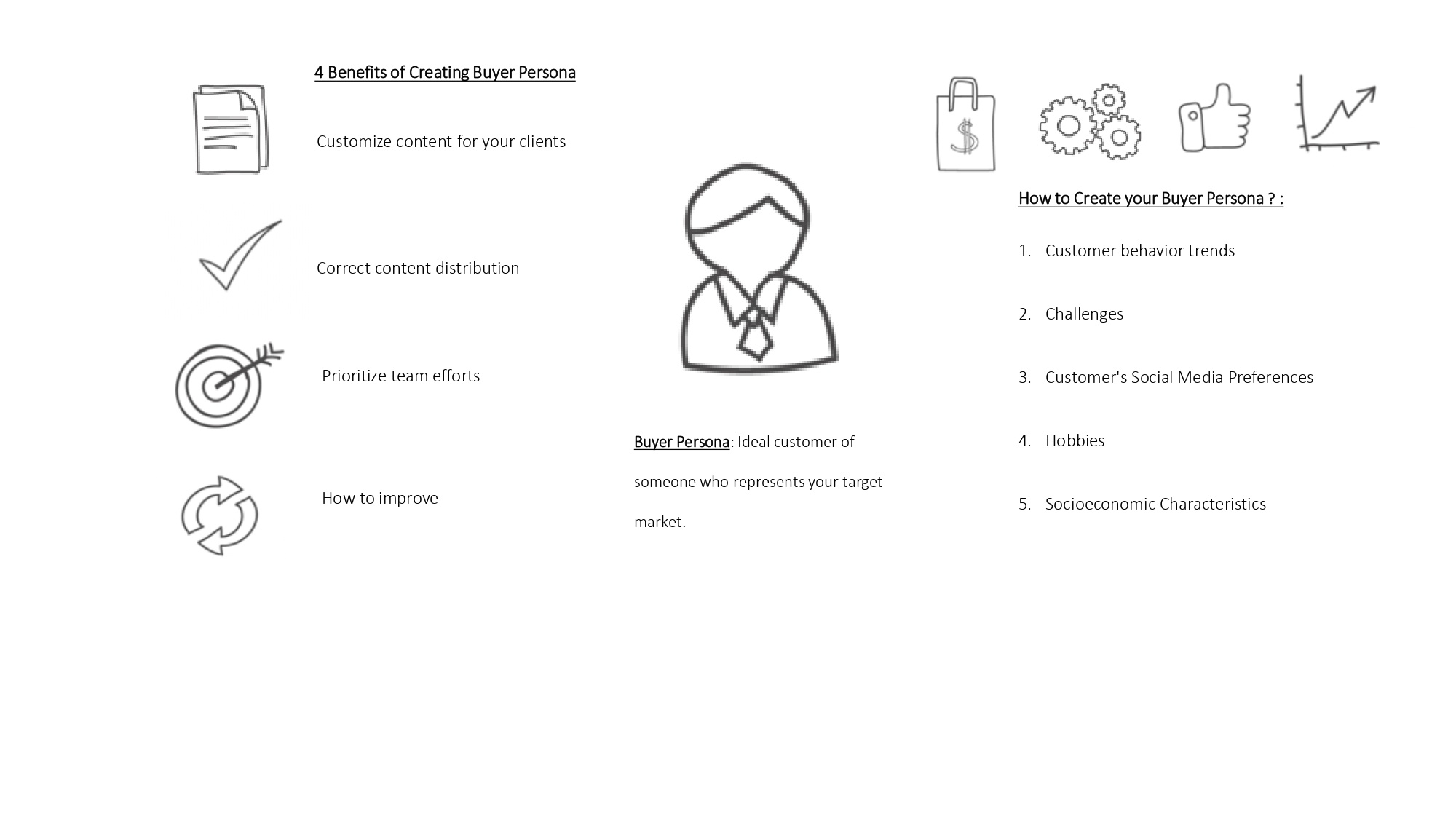
A practical rhythm is to review personas once a year and whenever something significant happens, such as the launch of a new product, entry into a new segment or a sharp change in results. The review should draw on fresh evidence, including interviews with recent customers and with recent losses, an analysis of the questions that sellers hear, and data from the CRM. The infographic below summarizes the details and advantages of the buyer persona for easy review.

Infographic summarizing what a buyer persona is, its classifications, benefits and review cycle

How does a buyer persona improve the sales process?

The persona matters most at the points where a sale could be lost. In prospecting, it tells sellers whom to look for and what problem to mention first. In discovery, it supplies the questions that reveal whether the prospect fits the profile. In the proposal, it indicates which benefits deserve prominence and which objections should be answered before they are raised. After the sale, it guides onboarding and renewal conversations. Our article on how a buyer persona improves the sales process develops this sequence in detail.

A sales leader can see the effect in a few weeks. Calls become shorter and more focused because sellers know what matters to the person on the other end. Proposals stop being generic documents with the customer's name inserted. Forecasts become easier to defend because the team can describe which kind of buyer is in each opportunity and what has to happen for the purchase to proceed. None of this requires new technology. It requires a shared, written description of the buyer and the discipline to use it, and that is precisely what a persona provides.

It also helps with a subtler problem, the loss of knowledge when people leave. When a seasoned seller departs, her understanding of how clients decide leaves with her. A persona that captures the patterns she recognized allows a new colleague to start from experience instead of from zero, which shortens the learning curve and protects the accounts in her portfolio.

What does a buyer persona mean for the C-level?

For executives who want to attract and convert customers, the persona is a way to decide where not to spend. Every channel, campaign and sales program can be tested against the question of whether it serves a defined persona, and those that do not can be questioned or stopped. For those responsible for retention and loyalty, understanding what each persona values allows the company to design service and renewal conversations that reflect real priorities instead of a standard script. And for those who care about efficiency, a persona that is shared across departments reduces the rework that appears when marketing, sales and service each work from their own idea of the customer.

The chief executive has a particular role. Personas become part of how a company operates only if leadership asks for them in strategy discussions, product decisions and budget reviews. A simple test is to ask in a committee meeting which persona a given proposal is intended for. If nobody can answer, the proposal is not ready.

How can a director get started?

An experienced consultant would suggest beginning modestly. Gather the commercial, marketing and service leaders for a working session and ask each to describe the customer in their own words, as in the board scene above. The differences will be revealing. Then talk to ten real customers and a few lost prospects, asking how they discovered the need, how they evaluated the options and who else was involved in the decision. Combine what you find into two or three draft personas, including one negative persona if the evidence supports it, and check them against what the CRM shows about your best customers. Write each persona on a single page, give it a name and share it with every team that touches the customer.

To structure the work, use the ICX Persona Playbook toolkit, a practical template for defining personas, their goals, their obstacles and the content and conversations that suit each one.

How ICX helps

ICX Consulting helps companies define, validate and put buyer personas to work, from the research that supports them to their use in marketing, sales and service. Our buyer persona service is connected with our market segmentation and positioning and customer journey work, so that personas lead to decisions and not only to documents. If you want to know whether your teams are describing the same customer, request a diagnostic with an ICX consultant. You may also be interested in our article on the most common mistakes when creating your B2B buyer persona.

Bring this topic to your company

An ICX Consulting advisor will assess where your organization stands today and which decisions can move your commercial and customer experience results.

Request a diagnostic with an ICX consultant

Frequently asked questions

How many interviews are enough to build a persona?

There is no universal number, but a first version can be built with around ten well-chosen conversations, mixing recent customers, long-standing customers and lost prospects. Stop when new interviews no longer reveal new motivations or objections. What matters is the variety of the sample, not its size.

Should a persona have a name and a photo?

A name helps teams refer to the persona in conversation, which is why many companies use one. A photo is optional. Include only details that influence a decision, because decoration makes the persona memorable for the wrong reasons and can disguise a lack of research.

Can a small company use buyer personas?

Yes, and the benefit is often greater, because small teams cannot afford to waste effort. One or two well-researched personas, based on conversations with the founder's best customers, are enough to improve messaging, prioritize channels and guide the first sales scripts.

Is a buyer persona the same as a customer segment?

No. A segment is a group of customers defined by shared characteristics such as industry, size or purchase history, and it can be extracted from data. A persona is a narrative model of the typical person inside a segment, built from research into motivations and context. Segments tell you how many there are, personas tell you how to speak to them.

What is the biggest mistake companies make with personas?

Creating them and never using them. A persona that does not change a campaign, a sales conversation or a service rule is a document, not a tool. Link each persona to concrete decisions and to fields in the CRM so that results can be measured.

Companies that agree on who their customer is make faster and better decisions about everything that follows. If you want your sales, marketing and service teams to work from the same understanding of the buyer, talk with ICX about building personas that guide real decisions.

Content added to ICX Folder
Default Save Save Article Quit Article

Save for later

Print-Icon Default Print-Icon Hover

Print

Subscribe-Icon Default Subscribe-Icon Hover

Subscribe

Start-Icon Default Start-Icon Hover

Start here

Suggested Insights For You

Key differences between a B2B Buyer Persona and B2C Buyer Persona

Key differences between a B2B Buyer Persona and B2C Buyer Persona

The key differences between a B2B buyer persona and a B2C buyer persona lie in who decides, why they buy and how they buy. A B2B persona represents a...

What Is the Buyer Persona For, and How Can You Create One?

What Is the Buyer Persona For, and How Can You Create One?

A buyer persona is for aligning marketing, sales and service around one evidence-based picture of the customer you most want to win, so that every...

One Buyer Persona to Rule Them All: Designing Customer Experience (CX)

One Buyer Persona to Rule Them All: Designing Customer Experience (CX)

One buyer persona to rule them all means using a single, well-researched profile of your ideal customer as the common reference for marketing, sales,...

What's next?

ARE YOU READY?

ICX SUBSCRIPTION
Stay ahead with exclusive insights from our senior consultants. Subscribe for the latest thinking on CX, growth, and digital transformation.