




Skip to the main content.

What We Offer

ICX helps companies grow revenue and profitability by connecting customer experience, sales, pricing, CRM and automation into one commercial system.

Customer Experience

We design memorable, customer-centered experiences that drive loyalty, enhance support, and optimize every stage of the journey. From maturity frameworks and experience maps to loyalty programs, service design, and feedback analysis, we help brands deeply connect with users and grow sustainably.

Marketing & Sales

We drive marketing and sales strategies that combine technology, creativity, and analytics to accelerate growth. From value proposition design and AI-driven automation to inbound, ABM, and sales enablement strategies, we help businesses attract, convert, and retain customers effectively and profitably.

Pricing & Revenue

We optimize pricing and revenue through data-driven strategies and integrated planning. From profitability modeling and margin analysis to demand management and sales forecasting, we help maximize financial performance and business competitiveness.

Digital Transformation

We accelerate digital transformation by aligning strategy, processes and technology. From operating model definition and intelligent automation to CRM implementation, artificial intelligence and digital channels, we help organizations adapt, scale and lead in changing and competitive environments.


Operational Efficiency  

We enhance operational efficiency through process optimization, intelligent automation, and cost control. From cost reduction strategies and process redesign to RPA and value analysis, we help businesses boost productivity, agility, and sustainable profitability.

Customer Experience

chevron-right-1

Marketing & Sales

chevron-right-1

Pricing & Revenue

chevron-right-1

Digital Transformation

chevron-right-1

Operational Efficiency 

chevron-right-1

10 min read

What Is the Value Proposition and How to Create One for Your Business

10 min read

What Is the Value Proposition and How to Create One for Your Business

A value proposition is a clear, concise statement of the unique benefits a company, product or service offers its customers and why they should choose it over the competition. To create one for your business, define a target segment, understand its jobs, pains and desired gains, map how your offer responds, and turn the result into a specific, provable promise.

A solid value proposition is the cornerstone for standing out and capturing customers' attention. More than a statement, it reflects the essence of the business, what makes it unique, relevant and desirable to its target audience. It is the bridge between customer needs and the solutions the company offers, and it creates both an emotional and a practical connection that can make the difference against the competition.

Without a clear value proposition, marketing and sales lose direction and effectiveness. Faced with countless options, customers look for a concrete answer to one essential question. Why should I choose this company over another? A well-defined value proposition helps attract new customers, retain existing ones and build long-term trust. For an executive team, it is also a financial instrument, because it determines how much of the value you create you can charge for, how efficiently you acquire customers and how long they stay.

This article explains what a value proposition is, why it matters for companies and, above all, how to create one that highlights your strengths and meets your customers' needs.

The symptoms of a weak value proposition are familiar to any commercial director. The sales team negotiates almost every deal on price, because the only difference it can explain to a buyer is a lower number. Marketing produces content on many topics without a thread that links them. New hires take months to explain what the company does in a way that customers repeat. At the end of the quarter, the chief executive reviews the discounts granted and realizes that the company has been paying, in margin, for a promise it never made clear.

Index

Business team working together to create a value proposition

What is the meaning of the value proposition?

The value proposition is a clear and concise statement that describes the unique benefits a company, product or service offers its customers and highlights what sets it apart from the competition. Essentially, it is the main reason customers should choose a particular offer over the others available in the market.

It focuses on how the product or service addresses a specific need or solves an important problem for the customer. It emphasizes the unique benefit that makes it stand out, whether through price, quality, convenience, innovation or another relevant attribute. And it highlights the tangible results or positive impact the customer will experience.

For example, a company that sells project management software might state its value proposition as "We make team collaboration easier with an intuitive platform that saves time, improves organization and helps teams reach their goals faster." The example shows both the benefits, saving time and improving organization, and the differentiating factor, an intuitive platform.

Ultimately, the value proposition guides how a company positions itself in the market, helps attract ideal customers and ensures that marketing and sales efforts focus on what truly matters to the audience. For a deeper look at its building blocks, see our article on the elements of a value proposition, with examples.

>> When to use Value Proposition Canvas <<

What makes a value proposition strong?

A value proposition is a clear, direct, concise and objective statement of the benefits the business provides. A strong one has three characteristics:

  • It is specific. It focuses on the benefits target customers will receive.
  • It addresses pain points. Potential customers understand that the product or service will solve their problems, relieve their pains and improve their daily lives.
  • It is exclusive. It is aimed at a defined segment and stands out because it is different.

Once established, it becomes a vital instrument for developing marketing strategies. It introduces the business and defines its scope, so the public knows what to expect from its products or services, how they work and what the company's purpose is in the market.

The value proposition can be built on a canvas and then integrated into the nine building blocks of the business model. You may be interested in this article:

>> Business model, a new way to understand your customers <<

This visual representation helps teams capture ideas, look inward at the business, analyze and study their customers, and establish a value proposition aligned with the direction the company needs to take.

Why is the value proposition important for companies?

The value proposition plays a crucial role in business success. It is the central axis that connects an organization with its customers, the promise of unique benefits that differentiates the company from its competitors. A well-defined value proposition communicates not only what a company does but also why it does it better or differently, which is key to attracting and retaining customers.

In a competitive market, it helps businesses position themselves strategically. By identifying and clearly communicating what makes them unique, organizations capture the attention of their target audience in an environment saturated with options. This increases the chances of conversion and builds strong relationships based on trust and customer satisfaction.

The value proposition also brings clarity and direction inside the company. It works as a strategic guide that aligns marketing, sales and product development so that all areas pursue a common purpose. A well-structured proposition makes decisions easier and keeps the business focused on what truly matters, creating real value for customers and building a sustainable competitive advantage.

Research supports the idea that value is multidimensional. Bain & Company's work published in Harvard Business Review identified 30 elements of value, grouped into functional, emotional, life-changing and social impact needs, and found that combining the right elements leads to stronger customer loyalty, greater willingness to try a brand and sustained revenue growth. A value proposition that speaks only to price or features leaves most of those levers unused.

Some of the reasons to establish a value proposition and dedicate time to this exercise are:

  1. Guide the path to success and prepare for crises. Be clear about what you offer, position the brand in the market and build credibility.
  2. Frame the value differentiator. Know what distinguishes the business, what makes it unique and why it prevails over the competition.
  3. Understand and listen to customers. Keep customers' pains at the forefront and give them a clear, straightforward message about how you solve their problems.
  4. Show qualities and virtues to prospects. Make a strong first impression and increase the likelihood that they acquire your products or services.

These reasons are the starting point for gathering the team and building the value proposition on a canvas. If your company already has one, review it and confirm that it still fits today's needs.

How do value propositions differ across industries?

The same exercise leads to very different statements depending on the business. A regional bank serving small companies cannot win by promising lower rates, since larger institutions can always offer them. Its credible promise is closeness and speed, such as a decision on working capital in days from a manager who knows the client's business. A manufacturer of packaged foods that sells through retailers must speak to two audiences at once, offering the shopper a clear reason to choose the product and the retailer a reliable supply and margin. A professional services firm sells expertise that the buyer cannot easily evaluate in advance, so its proposition must include proof such as results in comparable companies and a transparent method.

These are illustrative scenarios, but they show a principle that executives often miss. The proposition is not a slogan applied on top of the business. It is a decision about which customers to serve, which problems to solve for them and which trade-offs the company is willing to accept. A bank that promises speed must accept the operational discipline that comes with it, and a manufacturer that promises supply reliability must invest in inventory and logistics.

How does the value proposition affect price and margin?

Price is where the strength of a proposition becomes measurable. When customers understand and believe the value they receive, the conversation moves from cost to results, and the company can defend its price with arguments instead of discounts. When the proposition is vague, the buyer compares offers on the only dimension that is easy to compare, which is the number at the bottom of the quote. This is why finance and commercial leaders should look at the value proposition as part of the pricing architecture and not only as a marketing text.

A practical way to test it is to review the last ten deals lost and the last ten won. If the reasons customers give for choosing the company match the proposition, it is working. If they mention price, relationships or convenience that the company never designed, the proposition on paper and the proposition in the market have diverged, and the gap is costing margin every month.

Step by step on how to create your value proposition

Building a value proposition works best in sessions with a multidisciplinary team. Sheets of paper, sticky notes, whiteboards and any material that helps bring out the team's creativity are welcome for writing down and analyzing ideas.

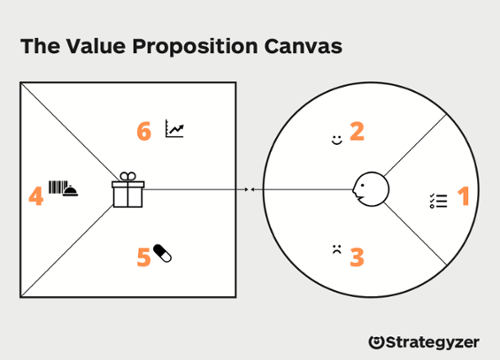
The method below is based on the Value Proposition Canvas conceived by Alexander Osterwalder, which helps examine the critical aspects of a business model in a clearer and deeper way. Each element is a prompt to discuss, analyze and study over several sessions, and together they help ensure a balance between product and market. Strategyzer, the company behind the canvas, describes it as a way to clarify what customers want to get done, what gets in their way and what they hope to gain. The image below shows what the canvas looks like.

Value Proposition Canvas with customer profile and value map

The team develops each numbered element, starting on the right with the circle, the customer profile, and then moving to the left with the square, the value map.

Step 1. Choose the customer segment

Before filling in anything, agree on which segment you are designing for. A proposition for "everyone" ends up persuading no one. Start with the segment that represents the most revenue at stake or the greatest growth opportunity, and build a separate canvas for each additional segment.

Step 2. Build the customer profile

  1. Jobs to be done. The activities the customer needs to carry out to solve their needs. Identify whether these jobs are functional, social or emotional.
  2. Expectations or desires. The benefits and moments of satisfaction the customer wants.
  3. Needs or frustrations. The situations the customer wants to avoid at all costs.

Use evidence wherever possible. Customer interviews, won and lost deals recorded in the CRM, service tickets and online reviews are far more reliable than internal opinions.

Step 3. Build the value map

  1. Products and services. The list of products and services that meet the customer's needs.
  2. Satisfaction generators. The benefits and expectations the products and services create.
  3. Relief generators. How the product or service relieves the customer's difficulties.

Once the team is clear about the activities the customer performs, it can determine which products or services are useful to them. And when it knows the desires and frustrations customers expect, it can innovate and design solutions that provide more significant relief. The tool is clear, accessible and visual, which helps teams from different areas of the company understand and capture ideas together. Our definitive guide to filling in the Value Proposition Canvas explains each block in detail.

Step 4. Write the value proposition statement

Translate the canvas into one or two sentences. A simple structure helps the first draft.

ComponentQuestion it answersExample for a project management platform
Target customerWho is it for?Distributed project teams
Job or painWhat do they need or struggle with?Losing time coordinating tasks across tools
Main benefitWhat result do they get?Save time and reach goals faster
DifferentiatorWhy us and not others?An intuitive platform that needs no training
ProofWhy should they believe it?Customer results, data or recognized references

Step 5. Test it with customers and frontline teams

Share the draft with a handful of customers and with salespeople and service agents. Ask whether it describes a problem they recognize, whether the benefit is credible and whether they could repeat it. Adjust until both groups can explain it naturally. Then test it in the market through a landing page, a campaign variation or a sales pitch, and measure the response.

Step 6. Activate it across the organization

A value proposition that lives only in a presentation creates no value. Translate it into website messaging, sales playbooks, pricing arguments, onboarding scripts and service standards, so every touchpoint delivers the same promise.

>> Why generate a digital value proposition? <<

Common mistakes when creating a value proposition

  • Describing the product instead of the result. Customers buy outcomes, not features.
  • Trying to please every segment. Generic promises are easy to copy and hard to believe.
  • Promising what operations cannot deliver. A broken promise costs more trust than a modest one kept.
  • Never revisiting it. Markets, competitors and customer expectations change. The proposition must change with them.

What this means for the C-level

For the executive team, the value proposition is a commitment that has consequences across the company. On the commercial side, build campaigns from the jobs and pains of each priority segment so that marketing reaches buyers who value what you offer, and give sales a value proposition per persona with proof points, which shortens discovery and protects price.

Keeping customers depends on operations, not on messaging. Make sure service and delivery honor the promise every day, since retention depends on keeping it and not on stating it. Finally, communicate the proposition consistently at every touchpoint so that customers can recommend you in the same words, which is the most efficient form of loyalty a company can build.

How ICX helps

ICX Consulting helps companies create and activate value propositions that sell. Our value proposition consulting combines customer research, jobs-to-be-done analysis and facilitated canvas sessions, and our value proposition development service turns the result into messaging, offers and pricing arguments. We connect it with market segmentation and positioning and with sales and CRM processes so the promise reaches every customer interaction.

To get started, download our free value proposition toolkit and use it in your first working session with your team.

Frequently asked questions

Who should take part in creating the value proposition?

Involve a cross-functional team with marketing, sales, product, service and finance, plus a senior sponsor who can make decisions. Frontline people bring customer evidence that executives often lack, and finance checks that the promised benefits can be delivered profitably. Including a few trusted customers in validation sessions improves the result considerably.

How long does it take to create a value proposition?

A first draft for one segment can come out of two or three working sessions. Testing and refining it with customers usually takes several weeks. Companies with multiple segments or business units should plan a phased process, starting with the segment that matters most to revenue.

What is the difference between a value proposition and a unique selling proposition?

A unique selling proposition highlights a single feature that distinguishes a product, often for advertising. A value proposition is broader. It explains the full set of benefits for a specific segment, the problems it solves and why the company is the best choice. The selling proposition is usually one expression of the value proposition.

How do I know my value proposition is working?

Look at commercial indicators such as win rate, sales cycle length, average discount, customer acquisition cost and retention. If customers repeat your promise when explaining why they chose you, and salespeople rely less on discounts to close, the proposition is doing its job.

Creating an effective value proposition requires introspection, strategy and a deep understanding of customers. It is more than an attractive phrase. It reflects what the company stands for and how it improves the lives of those who choose its products or services, and once defined it becomes the central guide for commercial and marketing efforts. By investing time and resources in an authentic, persuasive proposition, you invest in the future of the business, differentiate it in a saturated market and strengthen customer loyalty. Communicated clearly and consistently across every touchpoint, it can turn customers into ambassadors for your brand.

The value proposition is the soul of the business, the promise you make and keep with customers every day. If it is time to define yours or review the one you have, talk to an ICX consultant and build it with ICX Consulting's Strategy team, who will listen to your challenges and help you turn them into a promise customers choose.

DOWNLOAD GUIDE VALUE PROPOSITON CANVAS

Content added to ICX Folder
Default Save Save Article Quit Article

Save for later

Print-Icon Default Print-Icon Hover

Print

Subscribe-Icon Default Subscribe-Icon Hover

Subscribe

Start-Icon Default Start-Icon Hover

Start here

Suggested Insights For You

How does the Value Proposition Canvas impact the customer experience?

How does the Value Proposition Canvas impact the customer experience?

The Value Proposition Canvas impacts the customer experience by forcing a company to design its offer around what customers are actually trying to...

Value Proposition Canvas: Key Questions Explained

Value Proposition Canvas: Key Questions Explained

The Value Proposition Canvas in less than 800 characters is a one-page tool that matches a customer segment's jobs, pains and gains with the...

Value Proposition Canvas to Design Better Products

Value Proposition Canvas to Design Better Products

The Value Proposition Canvas is a tool for designing products and services around what customers actually need. It places a customer profile of jobs,...

What's next?

ARE YOU READY?

ICX SUBSCRIPTION
Stay ahead with exclusive insights from our senior consultants. Subscribe for the latest thinking on CX, growth, and digital transformation.