











What is a Buyer Persona?
 Sofía Oviedo : May 29, 2025
A buyer persona is a fictional but research-based archetype of a company's target audience. It describes in detail who the buyer is, what they do,...
10 min read
10 min read
A buyer persona is for aligning marketing, sales and service around one evidence-based picture of the customer you most want to win, so that every campaign, offer and conversation addresses real needs and pains. You create one by researching current customers, finding repeatable patterns and documenting them in a profile your teams actually use.
Most leadership teams get consumed by the operational and set aside what is essential for what is urgent. We try to serve as many clients as possible and let no opportunity pass. Yet the companies that grow with discipline pause to build the strategies that pay off over time, and the buyer persona is one of them. It decides who you spend acquisition budget on, what your sellers say in the first meeting and which customers your service model is designed to keep. Get it wrong and you pay for it in wasted media, longer sales cycles and churn.
Consider the quarterly sales review of a software company that sells to mid-sized manufacturers. The marketing director reports a healthy flow of leads from a new webinar series. The head of sales replies that most of them are students and consultants who will never buy. The customer success lead adds that the clients who do buy tend to cancel when the finance director, who was never part of the conversation, discovers the cost. Three leaders describe three different customers, and each is correct about the one they know. The company is spending money to attract the first, training sellers to talk to the second and failing to keep the third. A shared, evidence-based persona is how it stops paying for that misalignment.
The buyer persona is the semi-fictitious illustration of the ideal customer in an organization, which allows us to capture our customers' real needs and pains. It is semi-fictitious because it has a name, a face and a story, but every attribute comes from research on real buyers rather than from a brainstorm in a meeting room. HubSpot's knowledge base describes personas as fictional, generalized characters that encompass the needs, goals and behavior patterns of your customers. To explore the concept with a guided template, you can review HubSpot's Buyer Persona tool.
Three distinctions keep the concept useful for executives:
What is the purpose of creating a buyer persona, and is it crucial for my organization? These questions come up in almost every leadership team, and the answer is that the work helps us realize objectives and focus in the following way:
In this way, the teams in our organizations have greater clarity on who that potential customer is. There is greater maturity in positioning and selling our products and services, since we present ourselves with more empathy and credibility when we aim to close a deal.
For a deeper look at business buyers, read Build your B2B buyer persona properly.
The purpose becomes clearer when you look at how buyers actually purchase. Gartner describes the B2B purchase as a set of six buying jobs, from problem identification and solution exploration to requirements building, supplier selection, validation and consensus creation, and reports that most B2B buyers revisit nearly every buying job at least once before they buy. A persona tells you which job each stakeholder is doing, what information they need to move forward and where your team can help.
Taking the time to create buyer personas is rewarded, whether the organization is small, medium or large. These are ten reasons the effort matters:
Read as a leadership agenda, these advantages fall into three economic outcomes. The first is lower acquisition cost, because media and content stop reaching people who will never buy. The second is higher conversion, because sellers open conversations with the problem the buyer already recognizes. The third is better retention, because onboarding and service are designed for the customer you intended to win rather than for an average that does not exist.
These benefits are a good reason to invest time and resources in building personas. The work is less about creativity than about disciplined research. A practical sequence looks like this:
The following critical questions can be taken as a reference when you get down to work:
Below is a graphic example of what a buyer persona looks like.
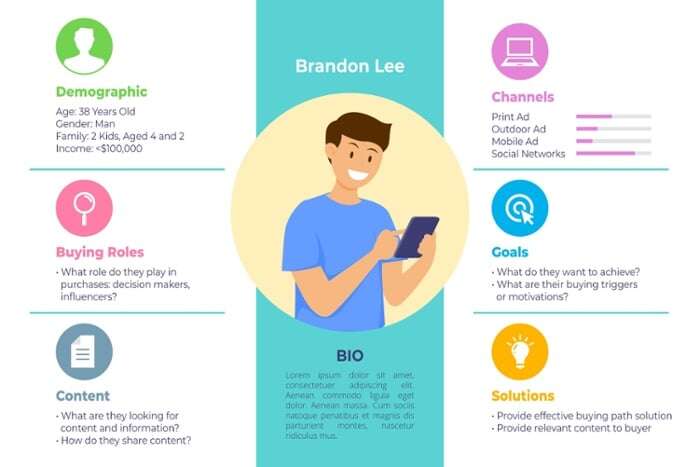
The questions can be adapted to the buyer persona according to the industry each organization belongs to. In B2B, add the persona's role in the buying group, the metrics they are measured on, who they report to and the objections they typically raise. In consumer markets, purchase occasions, price sensitivity and preferred channels usually carry more weight. You can learn more about how ICX builds personas, and about the downloadable that helps you create one, on the Buyer Persona page.
If your team still works from generic profiles, read 10 reasons why you need a Buyer Persona and not an Archetype.
The same method yields very different profiles depending on the sector. In banking, a persona for small business owners looks nothing like one for salaried professionals. The first values speed of credit decisions and a relationship manager who understands cash flow, while the second values transparency of fees and a clean digital experience. Treating both as simply bank customers hides the reason one segment grows and the other leaves.
In industrial distribution, the relevant persona is often a buying group rather than an individual. The maintenance manager cares about uptime, the purchasing lead about total cost and supplier reliability, and the plant director about safety and compliance. Each needs its own evidence from the supplier, and a seller who speaks only to the person who answers the phone will meet a veto later in the process.
In healthcare services or private education, the person who decides is frequently not the person who benefits. A parent chooses a school for a child, and an adult child selects a clinic for an older parent. The persona has to capture both the decision maker's worries and the end user's needs, since the experience must satisfy each of them. In every one of these cases, the persona earns its place by explaining a decision pattern that numbers alone cannot reveal.
Most organizations already have something they call a persona. The question for leadership is whether it is driving decisions. This simple maturity scale helps you locate your company:
| Level | What it looks like | Business consequence |
|---|---|---|
| 1. Assumed | Profiles written from opinion in a workshop, never validated | Campaigns reach broad audiences; sellers ignore the profiles |
| 2. Documented | Research-based profiles stored in a presentation | Better messaging, but little change in daily sales or service work |
| 3. Operational | Persona assigned to contacts in the CRM and used in segments, forms and reports | Marketing, sales and service act on the same definition of the customer |
| 4. Managed | Persona performance tracked by conversion, deal size, retention and cost to serve, and reviewed regularly | Investment shifts toward the personas that generate profitable growth |
Moving from level two to level three is usually the turning point. In HubSpot, for example, the Persona property is available on every plan and can be used to filter segments, as a form field and in reports, which means the persona stops being a document and becomes data the business can measure.
For a closer look at B2B pitfalls, see the most common mistakes when creating your B2B buyer persona, and for differences by business model, the guide to B2B and B2C buyer personas.
A buyer persona is a management tool, not a marketing deliverable. Mapped to the value chain ICX uses with leadership teams, it supports four decisions:
These applications point to a broader executive responsibility, which is to decide which customers the company is built to serve. A CEO who sponsors personas is effectively choosing where the organization will concentrate its effort, and that choice should be revisited as markets change. A CFO can strengthen the exercise by attaching profitability to each persona, because a profile that generates volume but little margin deserves a different service model from one that does the opposite. A chief revenue officer will see the practical effect in shorter sales cycles, since sellers who recognize the buyer's situation spend less time educating and more time advancing the decision. There is a trade-off, however. Prioritizing a few personas means saying no to some attractive but misfitting opportunities, and leaders need to accept that discipline as the price of focus.
To speed up the work, use the Persona Playbook toolkit, which guides your team through research, profile and activation, and pair it with the Empathy Map template to capture what your customer thinks, feels and needs.
A sensible way to begin is modest. Choose the single persona that matters most to next year's plan, and in the coming month hold five conversations with customers who fit it, two who left and three who stayed. Write down the exact words they use to describe their problem and the moment they decided to act. Share those notes with sales and service before anything is designed, and ask them what is missing. The profile that emerges is rarely elegant, but it carries the kind of detail that makes a persona useful, and it builds the habit of listening that keeps the profile alive long after the first version is published.
ICX Consulting builds buyer personas from customer research and connects them to the decisions that drive revenue. Our buyer persona development work feeds market segmentation and positioning, customer journey mapping and the sales architecture your team executes every day. Through ICX Compass, we turn those profiles into journeys, processes and CRM rules so the persona lives in daily operations, not in a slide.
Do you suspect your teams are selling to different customers? Request a diagnostic with an ICX consultant.
Bring this topic to your company
An ICX Consulting advisor will assess where your organization stands today and which decisions can move your commercial and customer experience results.
Start with as few as your revenue allows, usually the two or three profiles that explain most of your sales and margin. You can add more once the first ones are used in the CRM and in sales conversations. Each new persona should justify itself with a distinct buying behavior, not just a different job title or age range.
Review personas at least once a year and whenever something material changes, such as a new product line, a new market, a pricing change or a shift in who signs the contract. A quick review with front-line sellers and service agents is often enough to detect when a profile no longer matches the customers they meet.
Marketing usually leads the research, but ownership should be shared with sales and customer service, ideally sponsored by a commercial or customer experience director. Shared ownership is what keeps the persona in use, because each area contributes evidence and each area is accountable for applying it in its own process.
You can draft a hypothesis from CRM data, analytics and seller input, but treat it as provisional. Interviews reveal the motivations, triggers and objections that numbers rarely show. Even a handful of conversations, including customers you lost, usually changes the profile in ways that improve messaging and qualification.
You can start building the buyer persona your organization needs with these tips and tools. The more precisely you understand this ideal customer, the more the persona will help your teams attract, convert and keep the right clients. If you want an outside view of who your most profitable customers really are, talk to an ICX consultant and let us help you turn that knowledge into growth.

Sofía Oviedo : May 29, 2025
A buyer persona is a fictional but research-based archetype of a company's target audience. It describes in detail who the buyer is, what they do,...

Refreshing a buyer persona means reviewing, with recent data, whether the profile on which campaigns are based still describes real buyers and the...

 Sergio Gutierrez : Jun 05, 2025
One buyer persona to rule them all means using a single, well-researched profile of your ideal customer as the common reference for marketing, sales,...

