




Skip to the main content.

What We Offer

ICX helps companies grow revenue and profitability by connecting customer experience, sales, pricing, CRM and automation into one commercial system.

Customer Experience

We design memorable, customer-centered experiences that drive loyalty, enhance support, and optimize every stage of the journey. From maturity frameworks and experience maps to loyalty programs, service design, and feedback analysis, we help brands deeply connect with users and grow sustainably.

Marketing & Sales

We drive marketing and sales strategies that combine technology, creativity, and analytics to accelerate growth. From value proposition design and AI-driven automation to inbound, ABM, and sales enablement strategies, we help businesses attract, convert, and retain customers effectively and profitably.

Pricing & Revenue

We optimize pricing and revenue through data-driven strategies and integrated planning. From profitability modeling and margin analysis to demand management and sales forecasting, we help maximize financial performance and business competitiveness.

Digital Transformation

We accelerate digital transformation by aligning strategy, processes and technology. From operating model definition and intelligent automation to CRM implementation, artificial intelligence and digital channels, we help organizations adapt, scale and lead in changing and competitive environments.


Operational Efficiency  

We enhance operational efficiency through process optimization, intelligent automation, and cost control. From cost reduction strategies and process redesign to RPA and value analysis, we help businesses boost productivity, agility, and sustainable profitability.

Customer Experience

chevron-right-1

Marketing & Sales

chevron-right-1

Pricing & Revenue

chevron-right-1

Digital Transformation

chevron-right-1

Operational Efficiency 

chevron-right-1

9 min read

What is Service Blueprint and why use it to improve CX?

9 min read

What is Service Blueprint and why use it to improve CX?

A service blueprint is a visual tool that maps a customer's experience with a service, showing the steps and touchpoints the customer goes through and, underneath them, the people, systems and processes the company needs to deliver each one. It is used to find the gap between what customers expect and what the business actually delivers, and to design or improve a service before that gap turns into churn.

Imagine a regional insurer that has just launched a mobile app for reporting car accidents. The customer experience director presents a satisfying result in the pilot, with the app working as designed. Three weeks later the claims director reports that average resolution time has not improved and that call volume has increased. The reason is not in the app. A photo uploaded by the customer sits in a queue until an adjuster opens it manually, a second system must be updated before the workshop can be authorized, and nobody on the phone can see either step. The customer saw a modern front end, and then waited as before.

That kind of disappointment is common, and it is the situation the service blueprint was created for. Do you want to generate an extraordinary customer experience? Do you want to design a service that truly satisfies customers? If you need help figuring out where to start, this article explains how a service blueprint works, what it contains, what it is for and how executives can use it to turn a good intention into a service that performs, always with an eye on the gap between the user's expectations and the reality your business offers.

What is a service blueprint?

A service blueprint is a visual tool that maps the customer's experience with a service. It describes the steps and touchpoints the customer goes through when interacting with the business, and the processes and resources needed to deliver that service. Nielsen Norman Group defines it as a diagram that visualizes the relationships between different service components, meaning people, props and processes, that are tied to touchpoints in a customer journey, and notes that blueprints work like treasure maps that help businesses discover weaknesses and bridge cross-department efforts, as described in its article on service blueprints.

The tool, created by Lynn Shostack, takes the customer journey as a reference and broadens its scope. It uses the step-by-step process of the customer, but it also analyzes the actions the business performs with the customer and those that occur internally, concentrating on the variables, employees, systems and processes, that support the main points of contact. A journey map tells you how the customer feels. A blueprint tells you why, and what would have to change inside the company to change it.

What does a service blueprint include?

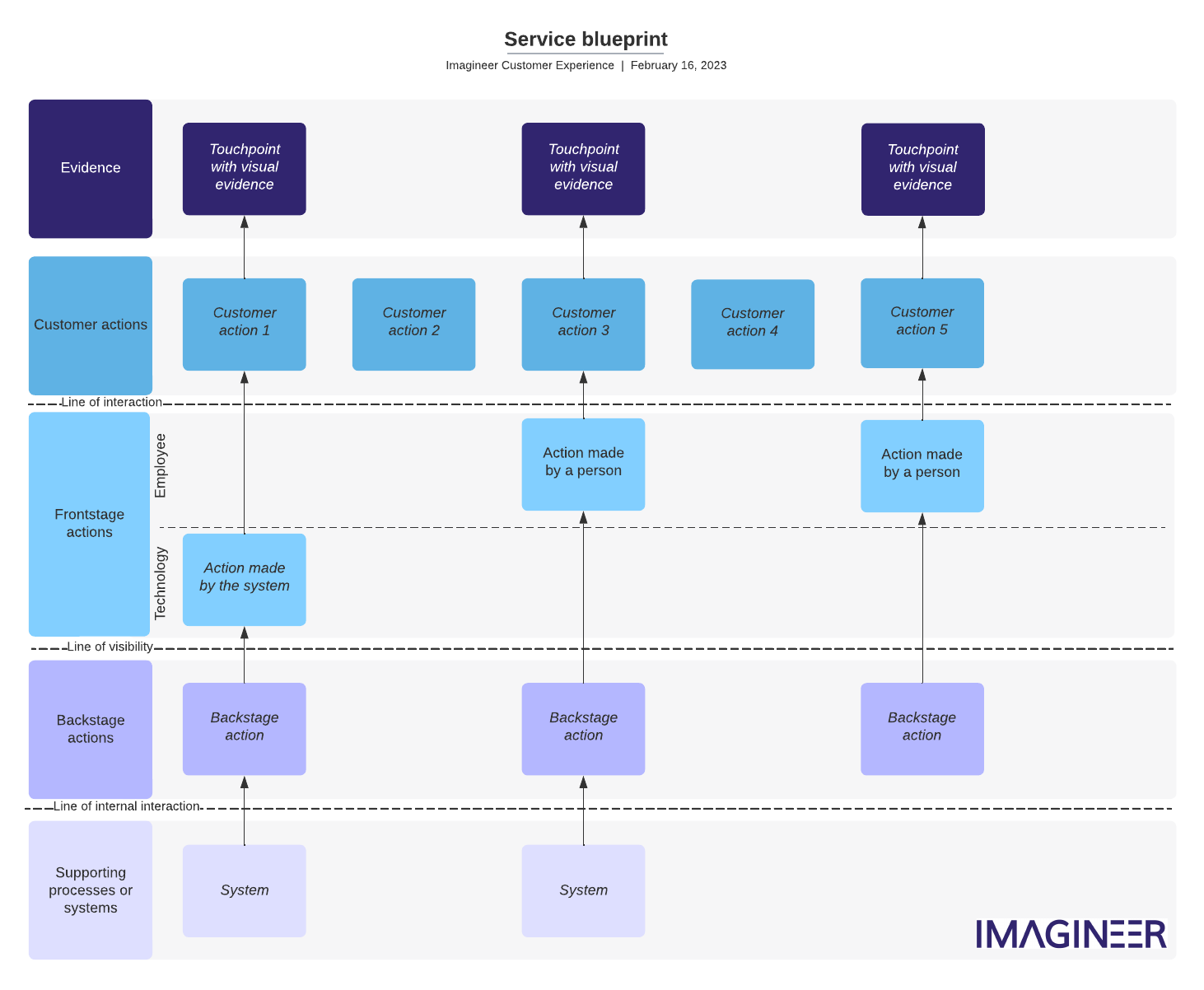
A blueprint typically consists of a series of horizontal rows that represent the participants in the delivery of the service, such as the customer, front-line employees, second-level employees and the supporting systems or technology. Each row is divided into vertical columns that represent the different stages of the customer journey, so that anyone reading it can follow a single moment in time from the customer's action down to the system that supports it.

Five components give the blueprint its structure. The first is the steps of the customer journey, which are the customer's actions before, during and after the purchase of a product or service. The second is the front-end actions, the visible actions that occur in the interaction between business and customer, such as exchanging information by phone or email, sending documents or paying at a physical branch. The third is the back-end actions, which the business performs internally without the customer seeing them, such as picking in the warehouse or the accounting procedure when an order is processed.

The fourth component is the support systems, the technology that helps those responsible for the process, for example a CRM or an ERP. The fifth is the pair of interaction and visibility lines, the dividers that show where the interaction begins and which actions the customer can or cannot see. The visibility line deserves particular attention from executives, since everything below it is where service quality is decided and where customers cannot see the effort, or the failure, until it reaches them. For readers who want the broader frame, the article on the customer journey explains how the starting map is built.

Example of a service blueprint with customer actions, front-end and back-end actions and support systems

What is a service blueprint for?

A service blueprint is used to identify opportunities to improve the customer experience and to optimize service delivery processes. It also facilitates collaboration and communication among the various parties involved in the service. The practical benefits fall into four areas.

It helps the company anticipate customer needs at every stage of the process, so that expectations are addressed proactively and the service becomes more personalized. It helps streamline the process by revealing inefficiencies and bottlenecks, which lets the company reduce wait times and raise satisfaction. It facilitates communication among the parties involved, because the blueprint is a shared picture that gives marketing, operations, technology and service the same reference, and the customer receives a more consistent experience as a result. And it improves service quality, since a clear and detailed map of the process shows the places where quality is likely to be poor and invites the team to address them. Taken together, applying a service blueprint makes the customer journey easier to understand and leads to a more positive and satisfying experience.

Why should executives care about what happens behind the visibility line?

Because that is where the money and the risk sit. McKinsey found that in a new-customer onboarding example every touchpoint had at least a 90 percent chance of going well, yet average satisfaction fell almost 40 percent across the full journey, and that at a European energy retailer redesigning one journey cut customer-service cost by 15 percent, according to its article on seeing the world as customers do. The lesson for leaders is that excellence at individual touchpoints does not add up to a good experience if the back-end connections between them are weak. The blueprint is the instrument that makes those connections visible.

Consider how this plays out across industries. In banking, a blueprint of account opening may show that a customer who completes the digital form in six minutes then waits four days because compliance review is performed in a separate system. In hospitality, mapping a corporate booking can reveal that the sales team confirms a rate that the revenue management system has not yet loaded, which produces errors at check-in. In telecommunications, a blueprint of a service installation can expose a handoff between the commercial team and the field technicians that explains most repeat visits. In each case the visible interface was acceptable, and the problem lived behind the line.

How is a service blueprint built?

The work starts with a defined scope. Choose a specific service and a specific customer type, because a blueprint that tries to cover everything ends up describing nothing. Draw the customer's journey first, using research with real customers instead of assumptions, and then add the front-end actions, the back-end actions and the support systems beneath each step. Involve the people who perform the work at every layer, since they know the workarounds that official procedures omit.

The next stage is analysis. Look for failure points, which are the moments where a delay, a repeated request or a handoff between departments can disappoint the customer. Look also for the points where employees depend on systems that do not share information, and for the steps that exist only because of an old policy. Then prioritize, because a blueprint always reveals more problems than a company can solve at once. Choose the ones that affect the most valuable customers or the highest volume of contacts, set owners and indicators for each, and review the blueprint regularly, since services change continually. When the visible service and the internal reality are aligned in a single document, the company can design changes with their consequences in view.

How does a service blueprint relate to other process tools?

A blueprint is one of several maps a company can draw, and the choice depends on the question being asked. A customer journey map is the right starting point when leaders want to understand what customers do and feel. A value stream map, which we describe in our article on the value stream map and customer experience, is better when the main concern is time, waiting and waste along an end-to-end flow. The service blueprint sits between them. It keeps the customer's perspective of the journey and adds the organizational layers that explain why the experience is what it is.

In practice, mature companies use the three together. The journey map identifies the moments that matter, the blueprint reveals the internal causes of those moments, and the value stream map quantifies the delays and rework in the internal flow. Starting with the blueprint is often the most efficient route for services with many handoffs, such as claims, onboarding, installation or after-sales support, because it exposes the cross-functional problems that single-department process maps tend to miss.

What mistakes should you avoid when using a service blueprint?

The first mistake is drawing the blueprint of the service as designed instead of the service as delivered. Procedures describe the ideal case, while employees handle exceptions every day with workarounds the documentation never mentions. A blueprint built without the people who do the work will look tidy and be wrong. The second is treating it as a one-time deliverable. Services change with every new product, policy and system, and a blueprint that is not updated quickly becomes a decorative poster.

The third mistake is scope. Trying to blueprint the entire company in one exercise produces a diagram nobody can use, and the fourth is skipping the decisions. A blueprint is valuable only if it ends with named owners, indicators and dates for the changes it suggests. Leaders who ask at the end of each session what will be different next month, and who is responsible, turn the tool from an illustration into a management instrument.

What this means for the C-level

For the CEO, a service blueprint is a tool to hold the whole organization accountable for an experience that no single department owns. It turns statements such as improving customer experience into specific decisions about processes, systems and responsibilities, and it makes visible who must change what. For the COO and the technology leader, it shows where investments in systems will have the greatest effect on the customer, and where a new application would simply digitize a broken handoff.

The CFO should see it as a lens on cost to serve. Duplicate steps, manual re-entry and avoidable contacts are expenses that grow with volume, and a blueprint shows where they are generated. The customer experience and service leaders gain the evidence they need to retain customers and build loyalty, because they can trace each complaint to its operational cause. And the commercial director learns which promises sales can safely make, which is a protection for both revenue and reputation.

How to start on Monday morning

Choose one service where customers complain or where cost to serve is rising, and gather a small group that represents each layer of the delivery, from a front-line employee to someone from technology. Spend a morning drawing one real customer's journey step by step, on a wall if possible, and then ask at each step what the employee does that the customer cannot see and which system they use to do it. The disagreements among participants about how things actually work are the most valuable finding of the session.

Mark the three places where the customer waits longest, repeats information or receives conflicting answers, and trace each of them to its cause below the visibility line. Pick one to fix within a month and define how you will know it worked, for example a shorter resolution time or fewer repeat contacts. This is also the right moment to consider the broader view of the organization, which our article on the six dimensions to understand customer experience develops, because a blueprint tends to reveal gaps in strategy, people, process, data, digital capabilities and operations all at once.

Do not wait for a perfect diagram. A first version drawn in an afternoon, with sticky notes and honest disagreements, is worth more than a polished one produced months later. Share it with the executive committee in its rough form, ask each leader which line on it they own, and you will learn quickly where accountability is clear and where it has been left to chance. That conversation, more than the artifact itself, is what begins to change the service.

How ICX Consulting helps

ICX Consulting facilitates the design of service blueprints with the teams that deliver each service, connects them to customer research and to the service design work that follows, and turns the findings into a prioritized roadmap. Where technology is part of the answer, we help implement the changes in the CRM and the digital channels your teams use, always after the process has been defined. If you require support in designing a service process and improving the customer experience, ICX Consulting can help.

Bring this topic to your company

An ICX Consulting advisor will assess where your organization stands today and which decisions can move your commercial and customer experience results.

Request a diagnostic with an ICX consultant

Frequently asked questions

What is the difference between a service blueprint and a customer journey map?

A customer journey map shows the steps, emotions and touchpoints of the customer. A service blueprint includes the journey but adds the visible and invisible actions of the company, the supporting systems and the lines that separate them. The journey map describes the experience, and the blueprint explains how the organization produces it.

Who should participate in building a service blueprint?

People from every function involved in delivering the service, including front-line employees, back-office staff, technology and the manager who owns the outcome. Customers contribute through research or interviews. A blueprint drawn by one department tends to describe the procedure as it is written, not as it is performed.

How detailed should a service blueprint be?

Detailed enough to show where handoffs, waits and systems affect the customer, and no more. Start with a high-level version of one service and add detail only where the analysis points to a problem. A blueprint that nobody can read in a meeting is not useful.

When is the right time to create a service blueprint?

Before launching or redesigning a service, when customer complaints or costs are rising without an obvious cause, and when a new technology is about to be introduced. Doing it before the investment helps avoid automating a process that customers already find frustrating.

Do you need special software to create a service blueprint?

No. A whiteboard, sticky notes or a shared slide are enough for the first version, and many teams keep using them. Specialized diagramming tools help when the blueprint must be shared across locations or maintained over time, but the quality of the conversation matters far more than the quality of the drawing.

If your customers experience a service that looks polished on the surface and slow underneath, a service blueprint will show you where the difference comes from. Request a diagnostic with an ICX consultant and we will help you map the service that matters most, find the failure points behind the visibility line and design the changes that customers will notice.

Content added to ICX Folder
Default Save Save Article Quit Article

Save for later

Print-Icon Default Print-Icon Hover

Print

Subscribe-Icon Default Subscribe-Icon Hover

Subscribe

Start-Icon Default Start-Icon Hover

Start here

Suggested Insights For You

Value stream map: transforming the customer experience

Value stream map: transforming the customer experience

A value stream map is a visual representation of every step a company performs to deliver a product or service, from the moment the customer places...

Customer Journey Map: What it is and how to create one?

Customer Journey Map: What it is and how to create one?

ICX Consulting, a customer experience and commercial strategy firm, builds customer journey maps to show leaders where revenue leaks. A customer...

Why define the processes that affect the customer experience?

Why define the processes that affect the customer experience?

Companies should define the processes that affect the customer experience because a good experience that depends on who happens to serve the customer...

What's next?

ARE YOU READY?

ICX SUBSCRIPTION
Stay ahead with exclusive insights from our senior consultants. Subscribe for the latest thinking on CX, growth, and digital transformation.