





Skip to the main content.

What We Offer

ICX helps companies grow revenue and profitability by connecting customer experience, sales, pricing, CRM and automation into one commercial system.

Customer Experience

We design memorable, customer-centered experiences that drive loyalty, enhance support, and optimize every stage of the journey. From maturity frameworks and experience maps to loyalty programs, service design, and feedback analysis, we help brands deeply connect with users and grow sustainably.

Marketing & Sales

We drive marketing and sales strategies that combine technology, creativity, and analytics to accelerate growth. From value proposition design and AI-driven automation to inbound, ABM, and sales enablement strategies, we help businesses attract, convert, and retain customers effectively and profitably.

Pricing & Revenue

We optimize pricing and revenue through data-driven strategies and integrated planning. From profitability modeling and margin analysis to demand management and sales forecasting, we help maximize financial performance and business competitiveness.

Digital Transformation

We accelerate digital transformation by aligning strategy, processes and technology. From operating model definition and intelligent automation to CRM implementation, artificial intelligence and digital channels, we help organizations adapt, scale and lead in changing and competitive environments.


Operational Efficiency  

We enhance operational efficiency through process optimization, intelligent automation, and cost control. From cost reduction strategies and process redesign to RPA and value analysis, we help businesses boost productivity, agility, and sustainable profitability.

Customer Experience

chevron-right-1

Marketing & Sales

chevron-right-1

Pricing & Revenue

chevron-right-1

Digital Transformation

chevron-right-1

Operational Efficiency 

chevron-right-1

10 min read

Definitive Guide: How to Fill in the Value Proposition Canvas

10 min read

Definitive Guide: How to Fill in the Value Proposition Canvas

Definitive Guide: How to Fill in the Value Proposition Canvas
8:24

To fill in the Value Proposition Canvas, start on the right with one customer segment and rank its jobs to be done, pains and gains. Then complete the value map on the left with your products and services, pain relievers and gain creators. Fit exists only when each reliever and creator answers a high-priority pain or gain.

The quarterly sales review has just ended, and the chief commercial officer is looking at a familiar chart. Pipeline is healthy, yet win rates are slipping and the team is conceding discounts it did not need to give two years ago. The head of marketing says that the message is clear. The head of sales says that customers keep asking what makes the offer different. The head of product says that the roadmap reflects exactly what customers requested. Everyone is right about their own part, and no one can say what the customer is actually trying to get done. That silence is the real cost of a value proposition built from inside the company.

What is a business without customers? A failed project. A competitive advantage gives companies a unique value that lets them stand out in a saturated market, especially those that understand their business model must be customer driven. The question is whether you truly understand your customers. Do you know what they are looking for, what they need, what frustrates them and what makes them happy? For an executive team this is not an academic exercise. A value proposition that misses what customers care about shows up as low conversion rates, heavy discounting, long sales cycles and churn. A sharp one does the opposite. It lets marketing attract the right buyers, lets sales defend price and tells product teams what to build next. The Value Proposition Canvas is one of the simplest tools for getting there, and this guide explains how to fill it in step by step and how to use it in a leadership workshop.

What is the Value Proposition Canvas?

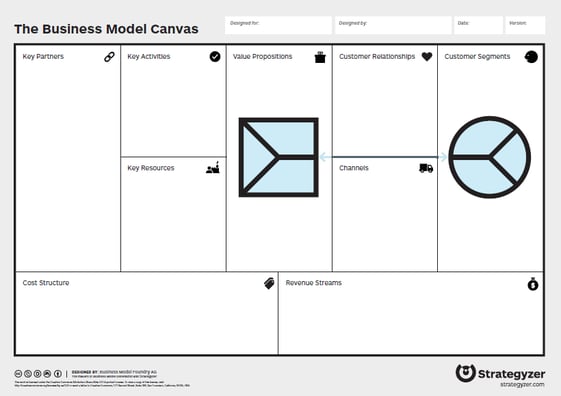
The Value Proposition Canvas (VPC) is a graphical tool created by the Strategyzer team that makes the value proposition of your business visible and tangible, and therefore easier to create and manage. It was designed to complement the Business Model Canvas (BMC), created by the same team. The BMC helps you design a sustainable and scalable business model. Once that part is ready, you need to analyze in more detail what your customers need, and the VPC does this by zooming into two blocks of the BMC, customer segments and value proposition.

Customer segments are the people or organizations that are potential customers, and the value proposition is the set of products or services you offer them. The objective is for the value proposition to solve the problems your potential customers experience. Strategyzer's own description of the canvas frames it as a way to clarify what customers want to get done, what gets in their way and what they hope to gain, and it stresses that fit is a claim until customers confirm it. That last point is the one executives most often overlook, because a canvas completed in a conference room feels like knowledge when it is still a hypothesis.

How the Business Model Canvas and the Value Proposition Canvas connect

If you want to understand more about what a business model is, the nine blocks of the tool, what the BMC is for and how to fill it in, read Build a Business Model Canvas step by step. For a shorter introduction to the canvas itself, see what the Value Proposition Canvas is and what it is for.

Do you identify with these situations?

In the book Value Proposition Design (2014), Alexander Osterwalder, Yves Pigneur, Greg Bernarda and Alan Smith state that if you have faced any of a series of situations when trying to create a value proposition, you will appreciate what the Value Proposition Canvas offers. The task of creating value seems overwhelming, or you feel you might be pursuing the wrong tasks. It is difficult to learn what consumers really want. You get frustrated with unproductive meetings and poorly aligned teams, and the team does not work with defined processes and tools. Perhaps you have been involved in bold projects that did not work and ended up wasting money, or the failure of a good idea has let you down.

If this sounds familiar, the canvas can help you avoid going through these situations again. In larger organizations the symptoms show up in management language, such as a product launch that missed its targets, a sales team that cannot explain why customers should pay more, or a marketing message that changes every quarter. A regional bank that launches a premium account and discovers that its target segment never wanted a premium account, but wanted faster approval of credit lines, is a typical example. The product was good. The proposition was addressed to a job the customer was not trying to do.

How will the Value Proposition Canvas help you?

Leaving failed projects and frustration behind, the canvas helps you deliver value to the customer in three ways. The first is clarity. It arranges information in a simple, clear way, which makes patterns visible, and that is how you build business models and value propositions that truly solve customer problems. The second is alignment. With well-defined processes and tools, the organization speaks the same language and meetings become more productive, since marketing, sales, product and service work from one picture of the customer. The third is lower risk. You avoid wasting time on ideas that will not work, because you test hypotheses gradually and refine the proposal.

The canvas also changes the conversation in the boardroom. Instead of debating opinions about what customers want, the team debates evidence about specific jobs, pains and gains. Anyone who has sat through a pricing or portfolio discussion knows how much that shift is worth. For more on timing, read >> When to use Value Proposition Canvas <<

How to fill in the Value Proposition Canvas step by step

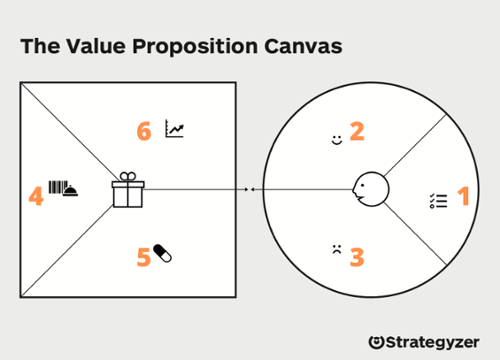
Value Proposition Canvas with customer profile and value map

Start on the right side of the canvas, the customer profile. Revisit what you wrote under customer segments in your Business Model Canvas, because you will now explore the desires and frustrations of your potential customers in depth. Consumers are people, some impulsive and others cautious, of different ages, genders and lifestyles, so you need to be very clear about who your buyer personas are. Design a separate Value Proposition Canvas for each segment.

The customer profile

The first element is the jobs to be done, which are the customer's tasks or goals, at work or in daily life. They include tasks the customer is trying to complete, problems to solve or needs to satisfy, and they can be functional, social or emotional. Functional jobs are specific, such as decorating a room, mowing the lawn or hanging a portrait. Social jobs relate to how others perceive us, for example carrying a trendy handbag to be seen as fashionable. Emotional jobs involve feeling a specific emotion, such as security, peace or happiness.

This idea echoes Clayton Christensen's research. In Harvard Business Review's article on customers' jobs to be done, Christensen and his co-authors argue that customers hire products to get a job done, that jobs are never purely functional, and that the circumstances of the job matter more than demographic traits. For a commercial leader, the implication is uncomfortable and useful. Segmenting customers by age or industry alone may hide the fact that two very different customers are trying to do the same job, or that two similar customers are not.

The second element is gains, which in short is what makes the customer happy. Gains describe what the customer wants to achieve and expects to receive, and they come in four degrees. Required gains are mandatory, since without them the solution does not work. If you buy colored pencils, you assume you will be able to color your drawings. Expected gains are basic benefits the customer anticipates, although the solution could still work without them, such as the design of a product. Desired gains go beyond what the customer expects and are not basic to the proposition, but the customer would love to have them. Unexpected gains go beyond both, because they are features the customer had not thought of and that take them by surprise.

The third element is pains, the frustrations customers experience while trying to complete their tasks and the obstacles that make their jobs harder. Pains include the consequences of doing the job badly or not completing it at all, and they follow the same logic as jobs. They can be functional, social or emotional, as in "the supposed solution doesn't work", "I look bad doing this" or "I feel bad doing this". Once you have listed the customer's jobs, gains and pains, rank each by importance. Jobs range from important to insignificant, gains from essential to a simple nice to have, and pains from extreme to moderate. The ranking is what turns a description into a decision tool.

The value map

Now move to the left side of the canvas, the value map. Revisit what you wrote under value proposition in your Business Model Canvas, because you will analyze what your product or service offers to the customer profile you just described. The first block lists the products and services you offer as a value proposition. They should help the customer complete functional, social or emotional jobs, and they may be tangible, such as a mobile phone, a table or a lamp, intangible, such as advisory services or customer service, digital, such as online products or services, or financial, such as investment funds, insurance or financing.

The second block holds the pain relievers, which describe how your value proposition alleviates customers' pains, frustrations or obstacles. The third holds the gain creators, which describe how your proposition generates benefits by delivering required, expected or desired gains. You should not respond to every customer desire. Concentrate on the most relevant ones, because a proposition that tries to answer everything ends up convincing no one. Once you have analyzed your products and services, pain relievers and gain creators, rank each by importance, from essential to nice to have. A concise approach to the whole exercise is explained in >> Value Proposition Canvas in less than 800 characters <<

How do you know you have achieved fit?

The goal is for the value proposition to solve the problems your potential customers experience. You achieve it when the two parts of the Value Proposition Canvas, the customer profile and the value map, are in harmony. Customers are excited by your value proposition because it answers their need, makes their tasks easier, relieves their pain and creates meaningful benefits. Once the canvas is complete, review each pain reliever and gain creator and make sure it responds to a pain or gain the customer actually cares about. If any are left unmatched, they probably do not add value.

A rigorous review tests four kinds of fit. Problem fit asks whether the top three jobs, pains and gains really matter to this segment, and the evidence that counts is customer interviews, support tickets and lost-deal reasons. Solution fit asks whether each reliever and creator maps to a top-ranked pain or gain, which prototype tests, pilot results and usage data can confirm. Market fit asks whether customers will pay for the solution at a price that works for the company, and pre-orders, win rates and realized price against list price answer it. Message fit asks whether sales and marketing can explain the proposition in one sentence the customer repeats, which campaign conversion and sales call feedback will reveal. A proposition that passes the first test and fails the third, a frequent pattern in subscription businesses, is a pricing problem disguised as a product problem.

Consider an industrial equipment manufacturer that sells to plant managers. Its canvas lists durability and technical specifications as the main gains, and its sales team leads every meeting with them. Interviews with customers who chose a competitor tell a different story. The plant manager's most important job was keeping the line running, and the most extreme pain was waiting days for a spare part. Durability was a required gain that every serious supplier already met. The proposition that won was not a better machine but a guaranteed parts and service response, priced as a contract. The product team had been right about the machine and wrong about the job, and only the canvas, filled in from the customer side first, made that visible.

How to run a Value Proposition Canvas workshop with your leadership team

A workshop works best when it is small and evidence-driven. Choose one segment, the one with the highest revenue at stake or the weakest conversion, and commit to one canvas per segment, never a blended average customer. Bring evidence into the room in the form of interview notes, CRM data on won and lost deals, service tickets and survey comments, and ask frontline sales and service staff to attend, because they carry the customer's words that executives rarely hear first hand.

Fill in the customer profile first and spend at least half the session on jobs, pains and gains before anyone mentions your product. Then map your offer honestly. List what you deliver today and not what is on the roadmap, and mark the relievers and creators that have no matching pain or gain. Close by agreeing on three hypotheses to test, for example a pain you believe is critical, a gain you believe customers will pay for and a message you believe will convert. Run small experiments, such as a landing page, a sales pitch variation or a pilot, and update the canvas with what you learn. Treat the workshop as the start of a learning loop and not as a deliverable.

What are the common mistakes when filling in the canvas?

The most frequent mistake is starting with the product. Teams that begin on the left side usually describe features and then invent pains to justify them. The second is mixing segments, since a canvas for "all customers" hides the differences that drive pricing and messaging decisions. The third is listing everything. Twenty pains with equal weight give no direction, and ranking is what turns the canvas into a decision tool. The fourth is never testing, because a canvas filled in from internal opinions is a hypothesis and not a strategy. To see how these choices change what customers experience, read how the Value Proposition Canvas impacts the customer experience.

What this means for the C-level

Return to the sales review. A leadership team that wants to attract better buyers should build marketing messages from the top-ranked pains and gains of each segment instead of from product features, because buyers respond to descriptions of their own problems. To convert, give sales a canvas per persona so they lead conversations with the customer's jobs and can defend price with relevant gains. A seller who can name the customer's most expensive pain rarely needs to lead with a discount.

For retention, use the pains reported by existing customers to prioritize service and product fixes before they turn into churn. On efficiency, the canvas gives an executive the permission to stop. Features and services that do not map to any important pain or gain consume engineering, support and marketing resources that could be redirected, and a ranked canvas makes that case far more persuasive than a budget argument alone.

How ICX helps

ICX Consulting facilitates value proposition work with executive teams and turns it into commercial decisions. Our value proposition development service combines customer research, canvas workshops and testing, and our business model consulting connects the result with revenue streams, channels and costs. When the proposition is clear, we help translate it into pricing, sales playbooks and CRM processes so the whole organization delivers it consistently.

Use the ICX value proposition toolkit to prepare your first canvas session, the persona playbook toolkit to define the segment each canvas will describe, and the jobs to be done toolkit to go deeper into the customer profile.

Frequently asked questions

How long does it take to fill in a Value Proposition Canvas?

A first version for one segment can be drafted in a two to three hour workshop if the team brings customer evidence. Validating it takes longer, typically several weeks of interviews and small experiments. Treat the first draft as a set of hypotheses and schedule a review once you have real customer feedback.

Can the Value Proposition Canvas be used in B2B?

Yes, but B2B purchases involve several people. Build a profile for each key role in the buying group, such as the user, the economic buyer and the technical evaluator, because their jobs, pains and gains differ. The value map then shows which parts of your offer matter to each role.

Should the canvas be filled in by marketing alone?

No. The most useful canvases come from cross-functional teams that include sales, service, product and finance. Frontline staff bring direct customer evidence, and finance helps judge whether the gains you create can be priced profitably. Marketing usually owns the final document and the messaging that comes from it.

How often should the canvas be updated?

Revisit it whenever you enter a new segment, launch a major product, see a drop in win rates or notice competitors changing the conversation. Many companies review their main canvases once a year as part of strategic planning, so the canvas stays tied to current customer evidence.

A value proposition only creates value when customers recognize themselves in it. If you want your team to build one that sells and holds its price, request a diagnostic with an ICX consultant and plan a facilitated canvas session for your priority segment.

GET CONSULTING

Content added to ICX Folder
Default Save Save Article Quit Article

Save for later

Print-Icon Default Print-Icon Hover

Print

Subscribe-Icon Default Subscribe-Icon Hover

Subscribe

Start-Icon Default Start-Icon Hover

Start here

Suggested Insights For You

What is the Value Proposition Canvas and what is it for?

What is the Value Proposition Canvas and what is it for?

The Value Proposition Canvas is a visual tool, created by Alexander Osterwalder, that describes one customer segment's jobs, pains and gains and...

What Is a Value Proposition? Elements and Examples

What Is a Value Proposition? Elements and Examples

A value proposition is the promise a company makes to a specific customer segment about the value it will deliver, and the reason that segment should...

When to Use the Value Proposition Canvas: A Decision Guide for Leaders

When to Use the Value Proposition Canvas: A Decision Guide for Leaders

Use the Value Proposition Canvas when a decision depends on understanding one customer segment in depth, such as launching a product, entering a new...

What's next?

ARE YOU READY?

ICX SUBSCRIPTION
Stay ahead with exclusive insights from our senior consultants. Subscribe for the latest thinking on CX, growth, and digital transformation.