





Skip to the main content.

What We Offer

ICX helps companies grow revenue and profitability by connecting customer experience, sales, pricing, CRM and automation into one commercial system.

Customer Experience

We design memorable, customer-centered experiences that drive loyalty, enhance support, and optimize every stage of the journey. From maturity frameworks and experience maps to loyalty programs, service design, and feedback analysis, we help brands deeply connect with users and grow sustainably.

Marketing & Sales

We drive marketing and sales strategies that combine technology, creativity, and analytics to accelerate growth. From value proposition design and AI-driven automation to inbound, ABM, and sales enablement strategies, we help businesses attract, convert, and retain customers effectively and profitably.

Pricing & Revenue

We optimize pricing and revenue through data-driven strategies and integrated planning. From profitability modeling and margin analysis to demand management and sales forecasting, we help maximize financial performance and business competitiveness.

Digital Transformation

We accelerate digital transformation by aligning strategy, processes and technology. From operating model definition and intelligent automation to CRM implementation, artificial intelligence and digital channels, we help organizations adapt, scale and lead in changing and competitive environments.


Operational Efficiency  

We enhance operational efficiency through process optimization, intelligent automation, and cost control. From cost reduction strategies and process redesign to RPA and value analysis, we help businesses boost productivity, agility, and sustainable profitability.

Customer Experience

chevron-right-1

Marketing & Sales

chevron-right-1

Pricing & Revenue

chevron-right-1

Digital Transformation

chevron-right-1

Operational Efficiency 

chevron-right-1

10 min read

What is the Value Proposition Canvas and what is it for?

10 min read

What is the Value Proposition Canvas and what is it for?

What is the Value Proposition Canvas and what is it for?
8:42

The Value Proposition Canvas is a visual tool, created by Alexander Osterwalder, that describes one customer segment's jobs, pains and gains and matches them with the products, pain relievers and gain creators a company offers. It is for designing, testing and improving offers that fit real customer needs, before significant money is spent building or selling them.

Alexander Osterwalder, creator of the business models Canvas, developed this tool to make it easier to design a value proposition focused on customers, their needs and their requirements. The Value Proposition Canvas promotes teamwork and helps everyone understand what added value means in the eyes of the client. For leadership, that matters because most failed launches, stalled sales and price wars share a root cause. The company built or promoted something customers did not value enough to pay for. The canvas is a disciplined, inexpensive way to find that out early.

Consider a product committee at a regional insurer that has just approved a digital health plan after nine months of work. Six weeks after launch, sales are a fraction of the forecast, the sales team says the price is too high, marketing says the message is unclear and the product team says the coverage is the best in the market. Each side may be right about its own piece. The deeper issue is that nobody wrote down, before building, which job the customer wanted done, which fear stood in the way and which result would be worth paying for. A single working session with the canvas would have exposed that gap for the cost of a few sticky notes.

What is the Value Proposition Canvas?

The Value Proposition Canvas helps organizations and teams systematically create solutions that fit the real needs of their customers. It is used before and during the development of deep customer knowledge, because it lets teams collect, structure and make tangible the customer's information, including needs, requirements, joys and frustrations.

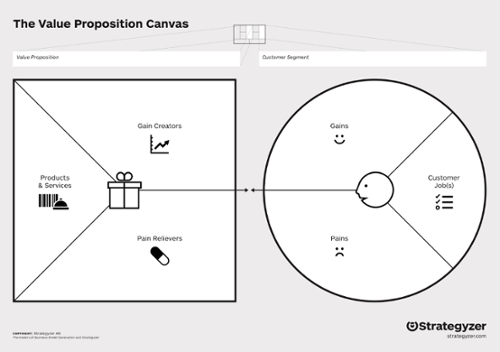
Strategyzer, the company Osterwalder co-founded, describes it as a tool to map what customers are trying to get done, what gets in their way and what they want to achieve, and it works in conjunction with the Business Model Canvas. The canvas has two halves. The customer profile captures the jobs customers are trying to do, the pains they experience and the gains they hope for. The value map describes your products and services, the pain relievers that address those pains and the gain creators that produce those gains.

>> What is the Value Proposition Canvas and what is it for? <<

Value Proposition Canvas template with the value map and the customer profile

What is the Value Proposition Canvas for?

Before developing your value proposition, which is your solution, highlight what you need to learn from customers. Once you collect that information, analyze and evaluate how well your solution fits customer needs. This saves time, because you have the input to develop the products and services customers actually want.

In business terms, the canvas serves five purposes.

PurposeWhat it preventsBusiness result
Understand a segment in depthDesigning for an "average customer" who does not existOffers and messages that convert better in each segment
Prioritize what to build or improveSpreading budget across features nobody valuesLower development and marketing waste
Align teams on customer valueSales, marketing and product each describing value differentlyA consistent promise across channels
Test before scalingLaunching on assumptionsLower risk and faster learning
Defend priceCompeting on discounts by defaultPricing anchored in the gains customers value

Generating added value

The Value Proposition Canvas is developed as a complement to the Business Model Canvas, and it helps teams pay special attention to the main purpose of every business model, which is customers. Anyone can generate creative ideas, yet those ideas might not satisfy customers' wants and needs. With the Value Proposition Canvas, organizations identify customer needs in a visual, structured way, because it reveals in a simple manner the customer's requirements, their sources of pain or frustration and their sources of joy.

Joys and sorrows, what the canvas helps you identify

The Value Proposition Canvas helps us identify two things. The first is what customers want and what problems they have. The second is how we can solve those problems, focusing on relieving pain or frustration and generating joy or memorable experiences.

Once these points are identified and visualized in a structured way, you can see how to build a strong value proposition for the product. Use the following questions as a guide for your team.

What are the jobs your customers are trying to do?

Jobs represent the tasks customers are trying to perform, and they are the reason customers "hire" solutions, meaning products and services. The idea draws on the jobs-to-be-done theory developed by Clayton Christensen and colleagues, who explain that when we buy a product we essentially hire it to help us do a job, and that jobs always have functional, social and emotional dimensions. Organizations should make sure their products and services are aligned with those needs and requirements. To carry out the analysis properly, the team needs a clear understanding of the three types of jobs, functional, social and emotional. Here are some basic questions to keep in mind.

What tasks do your customers perform in their personal and professional lives, and what functional problems are they trying to solve? What problems do you think your customers have but ignore? What emotional needs are they trying to satisfy, and which jobs, if completed, would make them feel fulfilled? How do your customers want to be perceived by other people, and what do they do to be perceived that way? How do they want to feel, and what do they do to feel this way?

>> What is the value proposition and how to create one for your business? <<

What is the origin of your customer's sorrow?

We understand pain as anything that frustrates your customers before, during and after trying to do a job, or that prevents them from doing the job for which they hire a solution. Pain describes the unpleasant effects of completing the work, including costs, risk, falling sales and competition, among others. Not all pains carry the same weight, so they should be ranked. These questions help your team investigate customer pains.

How do your customers decide that something is too expensive, takes too long or requires too much effort? What makes them feel bad, and what are their frustrations or headaches? How do they rate existing value propositions, which features are missing, are there performance issues, and what do they say works badly? What social consequences do they fear, such as losing status, power or trust? What common mistakes do they make, and are they using a solution incorrectly?

What are your customers' sources of happiness?

By happiness or gain we mean the results and benefits your customers want. Some gains are required, expected or desired, and some will surprise your customers. Gains include functionality, status, positive emotions and cost savings. These questions help your team explore customer gains.

What savings in time, money and effort would make your customers happy? What level of quality do they expect? What are they looking for most, whether design, warranty or a specific feature? What do they dream of, what do they aspire to achieve, or what would be a great relief for them? What would increase the likelihood of adopting a value proposition, whether lower costs, smaller investment, less risk or better quality?

How to obtain information from customers

To obtain customer information, ICX recommends an ethnographic study, which consists of talking to and observing customers. As you gather information, take notes and group them into categories. You will gradually see a complete picture of how to serve your customers in the best possible way, which is what we call fit with the market. Remember that, as providers, it is important to solve the biggest pain customers have. When we are clear about what customers want, we know how to offer a value proposition with the elements that matter most to them.

Ethnography works best when it is combined with data the company already has. Observation and interviews reveal jobs and emotions customers rarely put in a survey. CRM and sales notes show the objections and reasons for lost deals, while service records show recurring pains after the purchase. Digital behavior adds a further layer, because it shows which questions customers try to answer on their own.

Solution and market fit

There must be a fit between the value proposition and the market. It is achieved with solutions that relieve pain and generate gains for customers. The Value Proposition Canvas reduces the chances of failure because it puts us in a position of advantage to develop a service that helps our customer segment. Remember that fit is initially assessed by us as a business, but the customer has the last word, or, as Strategyzer puts it, fit is a claim until customers confirm it.

How to test your value proposition

Once you have created a value proposition that looks promising, test it early so you can make adjustments in time. Customer requirements about jobs, gains and pains may have been misunderstood, and the assumptions made in the process may be wrong. The value proposition must therefore be put into practice. With a Value Proposition Canvas, always test the proposition together with the customer to establish whether it adds value. The customer is guided step by step to assess whether the assumptions and interpretations are correct. After all, it is the customer who decides whether the value proposition will deliver results for them.

Practical tests range from low to high commitment. Start with interviews and prototypes, move to landing pages or pilot offers and only then commit to full development or a commercial launch. Each step should have a pass or fail criterion agreed in advance.

Characteristics of a strong value proposition

Remember at all times that the value proposition is a crucial part of the business model. Focus on the gain creators and pain relievers that are most meaningful to your customers, and align the success criteria of the value proposition with the customer's success criteria. Differentiate it from the competition in a meaningful way, and address functional, social and emotional jobs.

A strong proposition beats the competition substantially in at least one dimension, focuses on unsatisfied jobs, pains or joys, and is difficult to copy. That last quality is the one executives tend to underestimate, since an advantage that a competitor can reproduce in a quarter is a promotion, not a position.

Recommendations for better results with the Value Proposition Canvas

Preparation matters more than it seems. Print the tool in B1 format (707 mm x 1000 mm), buy markers and medium-size sticky notes in different colors, and create a color code for the notes. Write one idea per sticky note and mix ideas with drawings, and include in the team people who have frequent contact with customers.

Keep your product or service simple, and avoid trying to relieve every pain or create every possible joy. Do not mix present and future ideas, and if you need to, use the color code. Do not mix value propositions either, and use one canvas for each.

Remote teams can apply the same rules on a digital whiteboard, keeping one board per segment and the same color code.

Team workshop recommendations for completing the Value Proposition Canvas

How does the canvas apply in different industries?

The canvas is neutral, but the jobs and pains it reveals depend on the sector. In consumer goods, the job may be as simple as feeding a family on a tight budget without sacrificing taste, and the pain a shelf where the product is hard to find. In banking, a small business owner hires a lender to keep cash flowing, and the pain is not the interest rate alone but the weeks of paperwork before a decision. In industrial B2B, the buyer hires a supplier to avoid a line stoppage, so reliability and technical response weigh more than a small price difference.

Imagine a software provider for logistics companies that assumes its value is route optimization. In interviews, dispatchers describe a different job, which is to explain delays to customers without calling every driver. The gain they want is a clear status for each delivery, and that discovery changes the product roadmap, the sales pitch and the pricing logic at once. This is the kind of finding that justifies the hour spent with customers.

What are the limits of the canvas?

The canvas is a thinking tool, not a research method by itself. A team that fills it in a conference room from memory will produce a tidy picture of its own assumptions, and the neat layout can make guesses look like facts. It also describes one segment at a time, so companies with several segments need several canvases and a way to decide which one deserves investment first. A third limit is that it does not size the market or price the offer. It tells you what customers value, and other tools must tell you how many will pay and how much.

The discipline that makes the canvas valuable is evidence. Every pain and gain on the board should be tagged with where it came from, whether an interview, a sales note or a service record, and unsupported items should be treated as hypotheses to test. That small habit separates a workshop from a decision.

What this means for the C-level

Return to the product committee. To attract, ask marketing to build campaigns on the top-ranked gains of each segment instead of generic brand claims. To convert, make the canvas part of sales enablement so reps open conversations with the customer's job and biggest pain, not with a feature list. The insurer in the scene would have discovered which of those two the market was missing.

To retain, use service data to update the pains column every quarter, since new pains after purchase are early signals of churn. For efficiency, require that new products and features show which pain or gain they address before they receive budget. A leadership team that applies this single rule will see fewer launches and better ones.

How to run your first canvas

Choose one segment and one offer, and gather the evidence that already exists in the CRM, sales notes and service records. Interview or observe a small group of customers in that segment, then complete the customer profile before the value map, so the solution does not contaminate the diagnosis. Rank pains and gains, and mark the matches and gaps.

Close by defining one test with a pass or fail criterion and a date. On Monday morning, the useful first move is simply to pick the segment where sales are weakest relative to effort and book three customer conversations for that week.

How ICX helps

ICX Consulting helps companies understand customers in depth and translate that understanding into offers they can sell profitably. Our value proposition consulting uses customer research and the canvas to define what each segment values, while our user and customer research teams run the interviews and observation behind it. The ICX Compass methodology then connects those findings with the experience the company delivers.

Download the ICX Value Proposition Toolkit to run your first session, and pair it with the Jobs to Be Done Toolkit to sharpen the customer profile. If you need to decide when the canvas is worth running, read when to use the Value Proposition Canvas, and for a condensed version, the Value Proposition Canvas in less than 800 characters.

Frequently asked questions

Is the Value Proposition Canvas the same as the Business Model Canvas?

No. The Business Model Canvas describes the whole business, from partners and costs to channels and revenue. The Value Proposition Canvas zooms into two of its blocks, the customer segment and the value proposition, and analyzes them in much more detail. Most teams use the business model first and the value proposition canvas to deepen it.

Does the canvas work for B2B companies?

Yes, with one adjustment. In B2B, several people take part in the purchase, and each has different jobs, pains and gains. A procurement manager cares about risk and cost, while the end user cares about ease of use. Build a profile for each key role and check that the offer answers all of them.

How many customers should we talk to?

There is no fixed number. Keep interviewing until new conversations stop revealing new pains or gains for that segment. In practice, teams often see patterns repeat after a modest number of well-chosen interviews, provided they include recent buyers, lost prospects and long-standing customers.

Customers rarely tell you directly what they value. They show it in what they struggle with, what they pay for and what they leave. If you want to turn that evidence into an offer your market recognizes, request a diagnostic with an ICX consultant and start with the segment that matters most to your growth.

GET CONSULTING

Content added to ICX Folder
Default Save Save Article Quit Article

Save for later

Print-Icon Default Print-Icon Hover

Print

Subscribe-Icon Default Subscribe-Icon Hover

Subscribe

Start-Icon Default Start-Icon Hover

Start here

Suggested Insights For You

When to Use the Value Proposition Canvas: A Decision Guide for Leaders

When to Use the Value Proposition Canvas: A Decision Guide for Leaders

Use the Value Proposition Canvas when a decision depends on understanding one customer segment in depth, such as launching a product, entering a new...

Value Proposition Canvas to Design Better Products

Value Proposition Canvas to Design Better Products

The Value Proposition Canvas is a tool for designing products and services around what customers actually need. It places a customer profile of jobs,...

How does the Value Proposition Canvas impact the customer experience?

How does the Value Proposition Canvas impact the customer experience?

The Value Proposition Canvas impacts the customer experience by forcing a company to design its offer around what customers are actually trying to...

What's next?

ARE YOU READY?

ICX SUBSCRIPTION
Stay ahead with exclusive insights from our senior consultants. Subscribe for the latest thinking on CX, growth, and digital transformation.