






Skip to the main content.

What We Offer

ICX helps companies grow revenue and profitability by connecting customer experience, sales, pricing, CRM and automation into one commercial system.

Customer Experience

We design memorable, customer-centered experiences that drive loyalty, enhance support, and optimize every stage of the journey. From maturity frameworks and experience maps to loyalty programs, service design, and feedback analysis, we help brands deeply connect with users and grow sustainably.

Marketing & Sales

We drive marketing and sales strategies that combine technology, creativity, and analytics to accelerate growth. From value proposition design and AI-driven automation to inbound, ABM, and sales enablement strategies, we help businesses attract, convert, and retain customers effectively and profitably.

Pricing & Revenue

We optimize pricing and revenue through data-driven strategies and integrated planning. From profitability modeling and margin analysis to demand management and sales forecasting, we help maximize financial performance and business competitiveness.

Digital Transformation

We accelerate digital transformation by aligning strategy, processes and technology. From operating model definition and intelligent automation to CRM implementation, artificial intelligence and digital channels, we help organizations adapt, scale and lead in changing and competitive environments.


Operational Efficiency  

We enhance operational efficiency through process optimization, intelligent automation, and cost control. From cost reduction strategies and process redesign to RPA and value analysis, we help businesses boost productivity, agility, and sustainable profitability.

Customer Experience

chevron-right-1

Marketing & Sales

chevron-right-1

Pricing & Revenue

chevron-right-1

Digital Transformation

chevron-right-1

Operational Efficiency 

chevron-right-1

9 min read

How does the Value Proposition Canvas impact the customer experience?

9 min read

How does the Value Proposition Canvas impact the customer experience?

How does the Value Proposition Canvas impact the customer experience?
5:06

The Value Proposition Canvas impacts the customer experience by forcing a company to design its offer around what customers are actually trying to do, what frustrates them and what they hope to gain. When that fit is carried into each moment of the customer journey, the experience stops being generic and starts delivering the promise customers chose the brand for.

Let's first talk about the value proposition. Simply put, the value proposition of a business is that "something" for which a potential customer would buy from you and not from your competition. It is the differentiator, the core of your competitive advantage. The value proposition goes beyond a simple description of a product or service. It is a promise, a solution, a way of meeting customer needs that sets the company apart, and ultimately a whole experience. For executives, the link matters because the experience is where the promise is either confirmed or broken, and that is what drives retention, referrals and the ability to sustain price.

The gap between promise and experience is a familiar scene in executive meetings. A commercial director of a private bank presents a value proposition built around personal attention for high-net-worth clients, while the head of service reports that those same clients wait on hold for the general line and are asked to re-verify their identity on every call. Neither executive is wrong about their own function. The proposition was designed in one room and the experience in another, and the client lives the contradiction. The Value Proposition Canvas is useful precisely because it forces the two conversations into the same document.

How do you define your value proposition and make sure the experience delivers it? There is a tool that helps create and manage it.

>> Value Proposition Canvas in less than 800 characters <<

What is the Value Proposition Canvas?

The Value Proposition Canvas is a visual tool that helps a company understand who its customers are, their habits and activities, and what they are looking to satisfy that the company can solve. Derived from the Business Model Canvas, the Value Proposition Canvas defines in greater detail two blocks of the BMC, customer segments and the value proposition. Strategyzer, which publishes the tool, describes it as a simple way to clarify customers' jobs to be done, pains and gains.

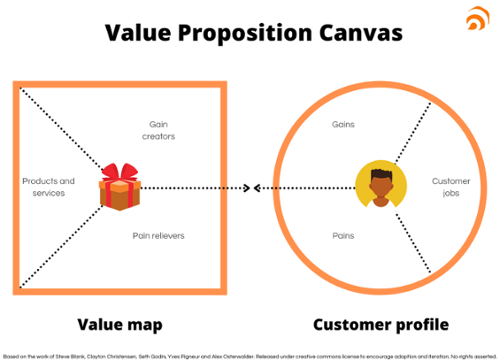
Value Proposition Canvas showing the customer profile and the value map

>> Why generate a digital value proposition? <<

On the right, the canvas profiles the customer. It identifies the jobs or tasks they want to complete, which can be functional (painting the house), social (pleasing a group of friends) or emotional (feeling secure or happy). It also identifies the pains and problems customers experience while trying to complete those tasks and, finally, the gains they hope for, including their wishes, ideal solutions and expected benefits.

On the left, the value map defines the products and services the business offers, how they create gains and how they relieve customers' pains and frustrations.

The objective is to design the customer profile and the value map so that they fit. The value proposition must respond to the customer's needs and provide benefits that place the company above the competition, so that its products and services match the solutions customers expect and relieve the pains they experience.

The Value Proposition Canvas should be designed for each market segment, that is, one canvas for each buyer persona, since each profile has different characteristics, desires and needs.

Read: Value Proposition Canvas: A gift for success

What is customer experience?

Customer experience can be defined as the set of moments a customer lives with a brand throughout the relationship. Those moments can be positive or negative, and the overall experience depends on them. The better the customer experience, the better the relationship and the greater the likelihood of retention. Every interaction either adds to or subtracts from the trust the customer places in the brand, which is why consistency across moments matters as much as any single highlight.

The experience does not start when the customer walks into the store. It starts the moment they discover the brand, browse the website and realize it offers a solution to their problem. Understanding the customer journey is vital to identify the touchpoints and which interactions are "moments of truth" for the customer.

To read more about the customer journey, see Customer journey: build the best customer experience and Introduction to the Customer Journey.

To give a good experience, a company needs to understand the customer, know what they are looking for and how they expect to receive it. By understanding needs, desires and pains, it can offer a value proposition that makes it special in the eyes of its customers and supports a quality experience.

The journey matters more than any single interaction. McKinsey's CEO guide to customer experience reports that customer journeys are significantly more strongly correlated with business outcomes than individual touchpoints, and that CX leaders using advanced analytics can achieve revenue gains of 5 to 10 percent and cost reductions of 15 to 25 percent within two or three years.

Satisfied customer as the result of a value proposition delivered across the journey

Impact of the Value Proposition Canvas on customer experience

The Value Proposition Canvas is a customer-centric tool. Its purpose is to generate value for potential customers by matching the value proposition with the needs of the market.

By developing the exercise, a company identifies the customer profile. Who buys from it, what habits they have, what tasks they need to complete, what frustrates them or causes pain, what obstacles they face and what would bring them satisfaction or help them succeed. By understanding the customer, it can match products and services to market needs, relieve frustrations and create benefits.

This generation of benefits and solutions, combined with an understanding of the Customer Journey and its important moments, allows the company to define a strategy for each touchpoint and give customers a rewarding experience.

A company may understand the customer journey and still not offer anything interesting. With a well-managed value proposition, it can analyze the moments of truth and put its proposition into play at each of them, retaining more customers.

How do you connect the canvas to the customer journey?

The canvas describes what customers value. The journey describes where they experience it. Connecting the two is what turns a strategic exercise into a better experience. The table shows how each element of the canvas translates into experience decisions.

Canvas elementQuestion for the journeyExperience decision
Customer jobsAt which stage is the customer trying to get each job done?Design the touchpoints that help complete the job fastest
PainsWhere in the journey do those pains appear today?Prioritize fixes at the moments of greatest frustration
GainsWhich moments could create the benefits customers hope for?Invest in those moments to exceed expectations
Pain relieversIs the relief visible when the pain occurs?Make the solution evident at that exact touchpoint
Gain creatorsDoes the customer notice the benefit when it is delivered?Communicate and measure the gain, not only the feature

This mapping reveals a common gap. Many companies design pain relievers that exist in the product but are invisible in the journey, for example a flexible return policy that customers only discover after a frustrating call. Moving the relief to the moment of the pain is often a low-cost, high-impact improvement.

What changes in the experience when the canvas is done well?

The first visible change is clearer messages. Marketing speaks to real jobs and pains, so prospects recognize themselves and convert faster. Prioritization improves as well, because product, service and digital teams invest in the pains customers rank highest, not the ones that are easiest to fix. Promises are broken less often, since sales and service know exactly what the company promises and can deliver it consistently.

Experiences also become segment-specific. Because each persona has its own canvas, the experience can differ where it should and stay consistent where it must. Finally, the fit becomes measurable. Strategyzer stresses that fit is a claim until customers confirm it, which pushes teams to test the proposition with evidence rather than opinion.

What does this look like in a real business?

Consider an illustrative case. An industrial supplier sells spare parts to maintenance managers at manufacturing plants. Building the canvas for this persona, the team finds that the main job is not "buying parts" but "keeping the line running." The biggest pain is uncertainty about delivery when a machine is down, and the most valued gain is confidence that the right part will arrive on time.

Overlaying the journey shows that this pain peaks at two moments, when the customer requests an urgent quote and when they wait for the shipment. The company already has a pain reliever, an emergency stock program, but customers rarely know it exists. The experience redesign is therefore simple and targeted. Make urgent availability visible in the quote, give proactive shipment updates and assign a named contact for critical orders.

Nothing about the product changed. The value proposition was always there. What changed is that the experience now delivers it at the moments that matter to the customer, which is precisely the impact the canvas is meant to have.

Which mistakes limit the impact of the canvas on CX?

The most frequent mistake is filling it in from the office. A canvas built on internal assumptions describes the company's view of the customer, not the customer. A related error is to use one canvas for everyone, because averaging segments hides the pains that matter most to each one. Teams also tend to list features as gain creators, although a feature is not a gain until the customer experiences the benefit.

The costliest mistake is stopping at the workshop. If the canvas never reaches the journey, the service blueprint or the metrics, the experience does not change, and the exercise becomes one more poster on a meeting-room wall.

What this means for the C-level

On conversion, a value proposition grounded in real jobs and pains shortens decisions, so the executive question is whether the sales narrative and the website reflect the canvas. On retention, which depends on keeping the promise after the sale, the task is to review the moments of truth where the value proposition is most at risk. Loyalty follows from gains that customers notice and remember, which means the experience must surface them and not only the product.

Efficiency is the quieter benefit. Focusing on the pains that matter most prevents investment in features and touchpoints customers do not value, and in a budget cycle that discipline is worth as much as any new initiative.

How does the canvas apply in different industries?

In retail banking, the jobs customers hire a bank to do are often emotional, such as feeling secure about money, and the pains cluster around paperwork and waiting. A canvas that reveals this shifts investment from product features toward onboarding and service recovery. In consumer goods, where the brand does not control the shelf, the canvas helps decide which gains are delivered by packaging, availability or communication, and which depend on retail partners.

In healthcare services, the main job is often reassurance, so the gain creators are clarity and responsiveness more than clinical sophistication. In B2B software and professional services, the job is usually to reduce risk in front of a boss or a board, and the canvas helps teams understand that the buyer is buying confidence as much as capability. In each case the same exercise produces different experience priorities, which is the proof that the canvas is a thinking tool and not a template to be completed.

Where does the canvas fall short?

The canvas is a hypothesis generator, not a research method. It organizes what a team believes or has learned about a segment, and its quality is only as good as the evidence behind it. A canvas completed from interviews with six enthusiastic customers may flatter the company, and one completed from survey averages may miss the specific pains that drive switching. Teams should treat every version as a claim to be tested, as the previous sections note, and should record which entries are validated and which remain assumptions.

It also says little about economics. A proposition can fit a segment perfectly and still be unprofitable to deliver, which is why pricing, cost to serve and channel economics must be examined alongside the canvas. Leaders who use it to decide where to invest in experience should therefore pair it with a view of segment profitability, so that the pains they choose to relieve are the ones customers will pay for.

A five-step plan to apply the canvas to your customer experience

A director who wants to test the idea does not need a company-wide program. The most persuasive demonstration is a single segment, a single journey and a single quarter, with the commercial, service and operations leaders sitting together for the first working session. The five steps below are written for that setting, and they deliberately end with measurement, because the credibility of the canvas inside the company depends on showing that the experience, and not only the poster, has changed.

  1. Pick one priority segment and build its canvas with real customer interviews and data.
  2. Rank jobs, pains and gains by importance to the customer.
  3. Overlay the journey and mark where each top pain and gain occurs.
  4. Redesign two moments of truth where the promise is weakest.
  5. Measure and repeat with satisfaction, effort and retention indicators for that segment.

Our Value Proposition Toolkit and Customer Journey Toolkit are designed to be used together for exactly this exercise.

How ICX helps

ICX Consulting connects strategy and experience. Our value proposition development work builds and validates the canvas with real customers, our customer journey consulting turns it into moment-by-moment design, and the ICX Compass methodology keeps both aligned with business goals. For a step-by-step method, see our definitive guide to filling in the Value Proposition Canvas.

Frequently asked questions

Is the Value Proposition Canvas only for new products?

No. It is widely used to design new offers, but it is just as useful for established products whose experience has drifted from what customers value. Revisiting the canvas for an existing offer often reveals pains the company stopped noticing and gains that competitors now deliver better.

How is the canvas different from a customer journey map?

The canvas captures what a customer segment values, the jobs, pains and gains, and how the offer responds. A journey map shows the sequence of steps and touchpoints the customer goes through. The canvas tells you what matters, and the journey map tells you where and when it matters.

How often should the canvas be updated?

Review it at least once a year, and sooner when there are signals of change, such as new competitors, falling satisfaction in a segment or shifts in buying behavior. Treat each version as a hypothesis to be validated with fresh customer evidence.

Who should take part in building the canvas?

Include people who know the customer first-hand, such as sales, service and field teams, together with marketing, product and someone with authority to change processes. Customers themselves should validate the result. A diverse group surfaces pains that a single department would miss and makes the experience changes easier to approve.

GET CONSULTING

A value proposition only becomes real when customers feel it at the moments that matter to them. If you want to see where your experience is breaking the promise you make, talk to an ICX consultant and connect your canvas to the journey your customers actually live.

Content added to ICX Folder
Default Save Save Article Quit Article

Save for later

Print-Icon Default Print-Icon Hover

Print

Subscribe-Icon Default Subscribe-Icon Hover

Subscribe

Start-Icon Default Start-Icon Hover

Start here

Suggested Insights For You

Value Proposition Canvas to Design Better Products

Value Proposition Canvas to Design Better Products

The Value Proposition Canvas is a tool for designing products and services around what customers actually need. It places a customer profile of jobs,...

What is the Value Proposition Canvas and what is it for?

What is the Value Proposition Canvas and what is it for?

The Value Proposition Canvas is a visual tool, created by Alexander Osterwalder, that describes one customer segment's jobs, pains and gains and...

Definitive Guide: How to Fill in the Value Proposition Canvas

Definitive Guide: How to Fill in the Value Proposition Canvas

To fill in the Value Proposition Canvas, start on the right with one customer segment and rank its jobs to be done, pains and gains. Then complete...

What's next?

ARE YOU READY?

ICX SUBSCRIPTION
Stay ahead with exclusive insights from our senior consultants. Subscribe for the latest thinking on CX, growth, and digital transformation.