











What is Lead Scoring and how can you set it up within HubSpot?
Lead scoring is a marketing and sales automation technique that assigns points to every prospect according to who they are and how they behave, so...
9 min read
9 min read
HubSpot is a customer platform that combines a free CRM with marketing, sales, service, content, data and commerce tools on one database. It is the best CRM for many growing companies because teams adopt it quickly, it adapts to different business models and it connects every customer interaction, from first visit to renewal, in one place.
Setting up a business has never been simpler, but growing one is the real challenge. Short-sighted strategies that once worked are now irrelevant for attracting customers. Persisting with mass mailings and advertising that do not distinguish your customers from everyone else, forcing every deal without a methodology behind it, and believing that growth at the expense of customers will continue to work is no longer a viable scenario. It fails in a market where customers know they have plenty of options. For a leadership team, the choice of CRM is therefore a choice about how the company will attract, convert and keep customers for the next decade.
Picture the monthly commercial committee of a mid-sized education or services company. The marketing lead reports leads generated, the sales director reports deals lost, and the head of service reports a rise in cancellations. Three honest presentations, three different systems, and no way to connect a campaign to a signed contract or to the renewal that did not happen. The chief executive leaves with a familiar sense that the company is working hard and learning little. A CRM is the instrument that closes that gap, and the question this article takes up is why HubSpot has become the instrument of choice for so many companies in that position, and when it is not.
These problems are common, which is why improving customer relationship management should be a priority, with a CRM as the ideal platform for customer management.
It becomes truly relevant when you realize how much word of mouth weighs in customers' decisions. When customers are happy and refer your company, everything looks like paradise. When they are not, you lose them, and they tell everyone about it. At that point it is clear that the business cannot keep using short-term tactics and must invest in the customer experience. In this article we take a closer look at HubSpot as a case study of how a CRM supports that shift.
If process automation is your main concern, read how to automate business processes with HubSpot workflows and sequences.

Investing in customer experience is clearly important, but where should a company start? That is where a CRM (customer relationship management) comes in. HubSpot is a CRM platform that drives business growth by helping companies attract, convert, close and delight customers through the inbound marketing methodology, and it is one of the leading CRMs on the market.
HubSpot is built around a free cloud CRM, today called Smart CRM, surrounded by specialized products for marketing, sales and customer service, as well as content, data and commerce. Through its tools, properties and integrations, it gives companies the resources to implement their methodologies and business strategies, boost their potential and grow more efficiently, supported by an omnichannel experience.
From the start, HubSpot was software for inbound marketing and sales. If the concept is new to you, read what inbound marketing is and how to apply it successfully. HubSpot was designed to help companies attract visitors, convert leads and close opportunities, and to guide the implementation of inbound strategies within monthly and yearly planning. That gives salespeople more time to meet with qualified leads and grow the business with more sales.
HubSpot has more capabilities and integrations than a single article can cover, so it helps to start with the purposes of its CRM. The platform serves four strategic purposes that should guide any implementation, which the author calls "The Four Aces of Success of HubSpot CRM".
The first is to adapt to your business model. Throughout its history HubSpot has adapted to a wide range of methodologies and business models, such as inbound marketing, design thinking, agile, lean startup and customer experience design, among others. The second is to consistently increase the productivity of your teams. As we explain in our article on CRM as the ideal platform for customer management, a robust CRM like HubSpot allows a company to automate its processes, which helps any organization enormously.
The third is to expand customer segmentation and loyalty. HubSpot can segment contacts in large databases, for small or large businesses, whether customers are B2C, B2B or both, and combined with methodologies focused on inbound marketing and customer experience it offers extensive resources to manage customer relationships and loyalty. The fourth is to achieve the long-awaited omnichannel. HubSpot lets the company manage its commercial activity in one place. In the CRM you manage customer contacts and run prospecting with automation tools such as email marketing, calling and sequences, workflows and lead management, which simplify tasks, increase the chances of selling and provide statistics on the performance of every business activity.
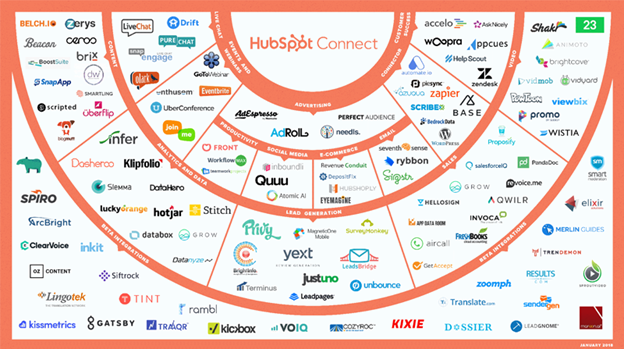
Integrations matter because no CRM works alone. HubSpot's ecosystem has grown substantially. The HubSpot Marketplace now lists more than 2,500 apps, agents and workflow templates, and many of the most used integrations, such as Gmail and Slack, are built and maintained by HubSpot itself, which makes them simple to connect in any account. HubSpot's ecosystem has three main parts. The App Marketplace holds applications that integrate HubSpot with the rest of the company's environment, from email and calendars to ERP, telephony, payments and AI agents. The template marketplace offers free and paid themes, templates and modules for blogs, email, websites and landing pages, and according to the author's review of the marketplace it offers more than 3,000 assets for businesses with Professional licenses. The solutions directory, finally, is where companies that already use HubSpot can find certified Solutions Partners to implement and optimize the platform.
The executive question is not how many integrations exist, but which ones the business really needs and who will govern them. Each integration is a data flow, and each data flow needs an owner.
Governance begins by naming a source of truth for each object. Decide whether customers, products, prices and orders are mastered in HubSpot, the ERP or another system, and configure the sync direction accordingly. Start with the integrations that touch revenue, since email, calendar, telephony, ERP and payments usually come first because they affect how fast the team sells and invoices. Then review installed apps every quarter, removing those nobody uses, checking permissions and confirming that data is still flowing as designed.
A practical illustration is a distributor whose quotes are created in the ERP and whose opportunities live in HubSpot. If nobody has decided which system owns the price, sales will quote one figure, finance will invoice another, and the first customer dispute will be settled by whoever shouts loudest. Governance of this kind is unglamorous, but it is what separates a connected platform from an expensive collection of connectors.
HubSpot can be adapted to almost any industry and company size, and it is particularly strong in a handful of areas. The first is customization, with a wide range of custom properties for contacts, tickets, deals, companies and products, so the CRM reflects how your business actually works. The second is the design of buyer personas and the customer journey, where HubSpot offers resources to design your buyer personas and map the customer journey of each one through the inbound methodology.
The third is support for account-based strategies. HubSpot supports account-based marketing (ABM), a strategic approach that focuses on high-value accounts, in which marketing and sales jointly identify target accounts and coordinate highly personalized customer experience and management strategies for them. Lead scoring is related, since lead qualification models score each prospect and buyer persona so the team focuses its follow-up on the best-qualified leads and customers, and you can learn more in what lead scoring is and how to set it up within HubSpot.
The ecosystem around the product matters as well. HubSpot Academy offers free online courses and certifications that companies can use to train their users on the platform and on high-demand skills, and an active user community lets companies exchange practices and solve problems together. The most recent differentiator is AI built into the CRM. HubSpot's Breeze AI assistant and agents work on the same customer data as the rest of the platform, which means data enrichment, summaries and recommendations improve as the CRM is used. The value of that AI depends on the quality of the data and rules the company puts in place, so it rewards disciplined implementations.
HubSpot is the best CRM for many companies, but not for all. The right answer depends on the business model, the complexity of the operation and the capabilities of the team. This table summarizes the signals ICX uses when advising leadership teams.
| Signal | HubSpot is usually a strong fit | Evaluate alternatives carefully |
|---|---|---|
| Growth model | Growth depends on marketing, inbound demand and a defined sales process | Revenue comes from a few large contracts managed mostly offline |
| Team and adoption | Fast adoption by sales, marketing and service is a top priority | A large in-house IT team prefers to build heavily customized processes |
| Integration needs | Standard integrations cover ERP, email, telephony and payments | Complex, real-time integration with legacy systems is the main requirement |
| Scale and complexity | Mid-market and growing enterprises with several teams or countries | Highly regulated, very complex configurations across many business units |
| Total cost | Leadership values predictable licensing and lower implementation effort | The organization already owns another suite deeply embedded in operations |
For a side-by-side comparison, see CRM showdown, HubSpot, Salesforce and Oracle compared, and for the specific capabilities that drive growth, read top HubSpot CRM features for business growth.
For the executive team, the platform choice touches each stage of the commercial chain. To attract customers, choose a CRM that connects marketing to revenue, so investment decisions are based on which campaigns create customers and not only leads. To convert them, insist on one pipeline definition across the company. HubSpot makes this easy to configure, but leadership must agree on it first.
To retain customers and build loyalty, bring service and customer success into the same platform so retention risks and expansion opportunities are visible to everyone. And for efficiency, prioritize adoption over features. A simpler CRM that every team uses beats a powerful one that only administrators understand.
The platform behaves differently depending on the sector it serves. A software or professional services firm usually uses HubSpot as its entire commercial backbone, from the first website visit through proposal, onboarding and renewal, because its revenue model is recurring and its sales cycle is driven by content and referrals. A real estate developer or a school uses it to manage high volumes of inquiries, scheduled visits and follow-up sequences, where the speed of the first response often decides the sale.
A manufacturer or distributor tends to adopt it in stages. It begins with the sales pipeline and quoting, adds service tickets for post-sale issues and later connects the ERP so that order status is visible to the account team. A retailer or consumer goods company with direct customers will lean on segmentation and automated communications. In each case, the lesson is that the platform's strength lies in joining the front office, and the executive should judge it by how much of the customer journey it can make visible, not by the size of its feature list.
An honest assessment also names the trade-offs. HubSpot's ease of use can lead companies to configure quickly and govern slowly, which produces duplicated properties, inconsistent lifecycle stages and dashboards that nobody trusts. Pricing scales with contacts, seats and editions, so a company that grows its database without cleaning it can see costs rise faster than value. And organizations with deeply specific processes, such as complex configure-price-quote scenarios or heavy regulatory workflows, may find that part of the requirement is better served by a specialized system connected to HubSpot than by the CRM alone.
None of these risks is a reason to avoid the platform. They are reasons to define ownership, data rules and scope before the first configuration, which is precisely the work that distinguishes a successful implementation from a disappointing one.
To structure that last decision, use our free implementer partner selection toolkit, which helps leadership compare implementation partners against clear criteria.
ICX Consulting is a Commercial Strategy and Customer Experience firm and a long-standing HubSpot Solutions Partner. We start with the commercial model, through our CRM consulting services and methodologies such as ICX Compass and the ICX Transformation Framework, and then configure the platform through our HubSpot implementation practice so that adoption, data and results follow.
Are you deciding whether HubSpot is the right CRM for your next stage of growth? Talk to an ICX consultant.
No. HubSpot started as inbound marketing software, but today its CRM supports sales, customer service, content, data management and commerce on the same database. Many companies first adopt it for sales pipeline management and add marketing or service later, which is possible because all products share the same customer records.
Yes. In B2B it manages companies, multiple contacts per deal, account-based strategies and long sales cycles. In B2C it handles large contact databases, segmentation, automated communications and service at scale. Companies that sell to both can run separate pipelines and segments while keeping one view of each customer.
Costs combine licenses, which depend on products, editions and seats, with implementation, data migration, integrations and training. For many mid-market companies, the first-year services investment is comparable to or larger than the licenses. Defining scope by business outcome, rather than by feature list, is the best way to control it.
A focused first phase, for example sales pipeline, email integration and core dashboards for one team, often goes live in a matter of weeks. Multi-team rollouts with marketing automation, service, ERP integration and data migration are usually delivered in waves over several months. The timeline depends more on how quickly leadership defines processes and data ownership than on the software.
The best CRM is the one that turns your growth strategy into daily habits for every team that touches the customer. If you want to know whether HubSpot can be that platform for your company, an ICX consultant can help you decide with clarity and confidence.


Lead scoring is a marketing and sales automation technique that assigns points to every prospect according to who they are and how they behave, so...

A HubSpot Sequence is a sales automation tool that sends a planned series of personalized emails and follow-up tasks to a prospect from a...

 Rebeca Delgado : May 29, 2025
The strategic use of the buyer persona within HubSpot CRM means turning each persona into a property that every contact carries, then using it to...

