





Skip to the main content.

What We Offer

ICX helps companies grow revenue and profitability by connecting customer experience, sales, pricing, CRM and automation into one commercial system.

Customer Experience

We design memorable, customer-centered experiences that drive loyalty, enhance support, and optimize every stage of the journey. From maturity frameworks and experience maps to loyalty programs, service design, and feedback analysis, we help brands deeply connect with users and grow sustainably.

Marketing & Sales

We drive marketing and sales strategies that combine technology, creativity, and analytics to accelerate growth. From value proposition design and AI-driven automation to inbound, ABM, and sales enablement strategies, we help businesses attract, convert, and retain customers effectively and profitably.

Pricing & Revenue

We optimize pricing and revenue through data-driven strategies and integrated planning. From profitability modeling and margin analysis to demand management and sales forecasting, we help maximize financial performance and business competitiveness.

Digital Transformation

We accelerate digital transformation by aligning strategy, processes and technology. From operating model definition and intelligent automation to CRM implementation, artificial intelligence and digital channels, we help organizations adapt, scale and lead in changing and competitive environments.


Operational Efficiency  

We enhance operational efficiency through process optimization, intelligent automation, and cost control. From cost reduction strategies and process redesign to RPA and value analysis, we help businesses boost productivity, agility, and sustainable profitability.

Customer Experience

chevron-right-1

Marketing & Sales

chevron-right-1

Pricing & Revenue

chevron-right-1

Digital Transformation

chevron-right-1

Operational Efficiency 

chevron-right-1

9 min read

Introduction to Value Proposition Canvas

9 min read

Introduction to Value Proposition Canvas

Introduction to Value Proposition Canvas
6:56

The Value Proposition Canvas (VPC) is a strategic tool, created by Alexander Osterwalder and the Strategyzer team, that maps a customer segment's jobs, pains and gains against the products, pain relievers and gain creators a company offers. Its purpose is to achieve fit, so that what the business sells matches what customers genuinely need.

For leadership teams the canvas is more than a workshop template. Most growth problems, whether low conversion, discount dependence or churn, trace back to an offer that does not match what a specific customer segment values. The VPC makes that match visible and testable before money is spent on campaigns, technology or new products, which is why it belongs in strategy and portfolio decisions, not only in innovation labs. This introduction explains what the canvas is, how its parts work, when to use it and what advantages it brings.

Imagine the strategy offsite of an industrial distributor that has just lost two large accounts to a competitor with a higher price. The commercial director insists that the company's service is better. The CFO notes that the accounts never mentioned service in their exit conversations and spoke only about delivery windows and inventory visibility. Both executives are describing the same customer in different words, and neither has evidence for the claim. The company has a value proposition on its website and in its sales deck, yet nobody can say which job it helps the customer do, which pain it removes or which gain it creates. That is the situation in which a canvas stops being a workshop exercise and becomes a leadership tool.

What is the Value Proposition Canvas?

To explain what the Value Proposition Canvas is, it helps to first explain the Business Model Canvas (BMC). Both tools were created by Alexander Osterwalder and his team at Strategyzer, a company he co-founded, with the purpose of creating value for businesses and customers.

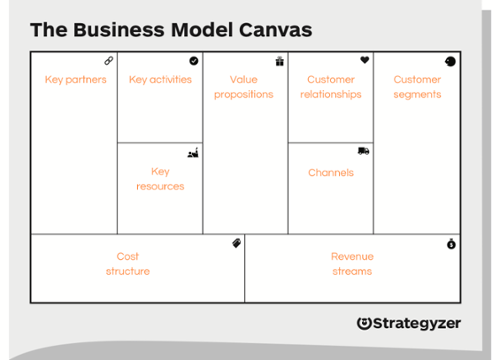
In 2010, Osterwalder and Yves Pigneur published the book "Business Model Generation" (Wiley) as a practical guide to designing a business model, which can be defined as the way a company creates, delivers and captures value. To do this, it is necessary to identify the factors that make it possible to generate profits. According to Strategyzer's account of the canvas, Osterwalder and Pigneur searched for the most important elements any organization must decide on and arrived at nine interrelated building blocks.

Customer segments are the groups of people or organizations the company serves, and value propositions are the bundle of products and services that creates value for each segment. Channels describe how the company reaches and delivers value to its customers, customer relationships the type of relationship established with each segment, and revenue streams how the company earns money from each of them.

The remaining blocks describe what it takes to operate the model. Key resources are the assets required to make it work, key activities the most important things the company must do, and key partnerships the network of suppliers and partners that make the model possible. Cost structure gathers the main costs incurred to operate it.

>> How to create a value proposition <<

Business Model Canvas with its nine building blocks

>> Value Proposition Canvas in less than 800 characters <<

To understand more about business models and the canvas used to design them, read these articles.

Business model: What is it and why is it important? introduces the concept, Business Model Canvas: Osterwalder-Pigneur and alternatives compares it with other frameworks, and Build a Business Model Canvas Step by Step walks through the construction.

How does the Value Proposition Canvas relate to the Business Model Canvas?

The Value Proposition Canvas was created as a complement to the BMC. While the Business Model Canvas helps a company create value for the business, the Value Proposition Canvas helps it visualize, design and test how it will create value for customers. It is a complement because the VPC takes two blocks of the Business Model Canvas, customer segments and the value proposition, and analyzes them in depth.

Why these two blocks? The aim of the VPC is to ensure that the product or service the company offers matches the needs of the market as closely as possible. That harmony can be hard to achieve, especially when the company is not clear about the problems its customers face and how it can solve them. The Value Proposition Canvas ensures that the value proposition responds to and satisfies customer needs, with a message that is concrete, clear and aligned with how the customer thinks.

AspectBusiness Model CanvasValue Proposition Canvas
Main questionHow does the company create, deliver and capture value?How does the offer create value for a specific customer segment?
ScopeThe whole business model, nine blocksTwo blocks in depth, customer segment and value proposition
Typical usersLeadership, strategy, financeLeadership, marketing, product, sales, customer experience
Main outputA coherent, viable business modelEvidence of fit between offer and customer needs

>> What is the Value Proposition Canvas and what is it for? <<

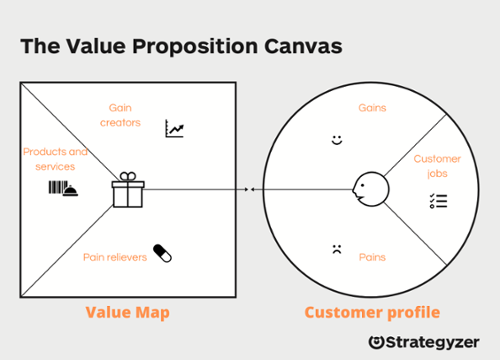
Value Proposition Canvas with the value map and the customer profile

What are the parts of the Value Proposition Canvas?

As the image shows, the Value Proposition Canvas has two parts, the customer profile and the value map. Strategyzer describes the tool as a simple way to clarify customers' jobs to be done, pains and gains and to link them to what the company offers.

Customer profile

The customer profile begins with customer jobs, a description of the jobs and tasks customers are trying to complete, which may be functional (getting from point A to B), social (impressing friends) or emotional (feeling happy). Pains capture the frustrations customers experience while trying to complete their work, including obstacles and the negative consequences they want to avoid. Gains describe the benefits customers are looking for and how they will measure success in completing a job, including the positive outcomes they expect.

Read: What is the Value Proposition Canvas and what is it for?

Value map

The value map starts with products and services, a description of what the company offers and on which the value proposition is based. Pain relievers explain how these products and services reduce or eliminate customers' pains and frustrations, making their lives easier, and gain creators show how the value proposition maximizes the benefits customers expect or desire.

Fit is achieved when the pain relievers address the pains that matter most and the gain creators produce the gains customers value most. Strategyzer insists that fit is a claim until customers confirm it, which is why the canvas is a starting point for testing, not a final answer.

When should you use the Value Proposition Canvas?

Since the tool helps synchronize a company's customer segments with the products and services it offers, it is easier to see when to use it. Some tools are designed specifically for start-ups, ideas and new businesses, while others suit mature products or established companies, so a tool may not fit a business that lacks the characteristics it was designed for.

The Value Proposition Canvas does not have that limitation. It suits any type of business at any stage. Whether you are a start-up or an established company, the canvas helps you understand how to solve customers' problems with your product or service.

The VPC is often described as a tool for creating new products and fitting them to the market from the start, and that is true, but existing, mature products should not be left behind. Continuous improvement matters, and companies should always look for opportunities to evolve. If that means assembling a team to design the value proposition canvas again, so be it. Typical moments to use it include these.

Typical moments include launching a new product, service or business line and entering a new market or customer segment. The canvas is also useful when the company must respond to falling conversion, rising churn or growing price pressure, when it redesigns a digital channel, ecommerce store or customer portal, or when it needs to align marketing, sales and service around a single promise.

For a broader view of when the whole model needs attention, read 10 signs that it's time to update your business model.

What are the advantages of the Value Proposition Canvas?

The first advantage is that it reveals real customer needs. The VPC helps the company understand what potential customers truly need and the value its products and services bring to the market, synchronizing the offer with the customer profile. It also sharpens the ideal customer profile, because identifying the jobs to be done of each market segment, along with their pains and gains, lets the company define its ideal customer correctly.

It focuses effort. Once the components are defined, ranking them by importance lets the company concentrate on the problems that matter most to the customer and on the parts of the value proposition that contribute the most. It reduces the risk of new ideas, since the tool helps shape an idea more clearly and encourages testing once the canvas exists, which minimizes the risk of failure and refines the value proposition.

It improves existing offers, because for products or services already in development or on the market it supports the improvement and management of the value proposition and strengthens competitive advantage. And it is visual and practical. Its format makes it easy to organize information about customer characteristics, desires and pains, together with the elements of the value proposition, so patterns become visible.

How does the canvas relate to Jobs to Be Done?

The customer jobs block of the canvas draws on the same idea as the Jobs to Be Done approach. Customers do not buy products for their own sake. They "hire" them to make progress on something in their lives or work. Jobs to Be Done goes deeper into that single question, exploring the circumstances, motivations and alternatives behind each job, while the Value Proposition Canvas places the job next to pains, gains and the company's offer to test fit.

Used together, they are powerful. Jobs to Be Done research uncovers what customers are really trying to achieve, and the canvas turns those insights into design decisions. Our Jobs to Be Done toolkit is a useful companion when the customer jobs block feels vague or generic.

How do you run a first Value Proposition Canvas session?

Choose one segment first, and never mix segments on the same canvas. Start with the one that matters most to revenue or growth, and bring evidence to the session, such as interview notes, sales feedback, complaints and usage data. Fill the customer profile before anything else, describing jobs, pains and gains without thinking about the product.

Then build the value map by listing products, pain relievers and gain creators and connecting each to a specific pain or gain. Rank the top pains and gains and check whether the offer addresses them, and finish by defining tests that turn the main assumptions into experiments with customers, with clear success criteria.

Our Value Proposition Toolkit includes the templates needed for this session, and the Business Model Canvas toolkit helps check that the new value proposition fits the wider model.

How the canvas plays out in different industries

The structure is constant, but the content of each block depends on the sector. A retail bank that applies the canvas to young professionals may discover that the dominant job is not saving money but feeling in control of it, which shifts the proposition from rates and products toward visibility and simple tools. A manufacturer of packaging may learn that the buyer's pain is not price per unit but the cost of a stopped production line when an order arrives late, and that reliability is a gain it can price. A hospital group serving corporate clients may find that the human resources director, the finance director and the employee have three different canvases for the same service. And a software or services firm may realize that its strongest gain creator is a feature the sales team never mentions because it seems obvious.

Limits of the canvas, and how to avoid common mistakes

The canvas is a thinking tool, not a research method. A team that fills it in from internal opinion will produce an elegant document of assumptions, which can be worse than a blank page because it looks like knowledge. The remedy is the one Strategyzer itself stresses, which is to treat each entry as a hypothesis and to test it in conversations and experiments with the people it describes. Another frequent error is to describe a segment so broadly that its jobs, pains and gains contradict one another. If a canvas has conflicting statements, it probably contains two segments.

A third limitation is that the canvas says little about economics. A proposition may fit the customer perfectly and still be unprofitable to deliver, which is why the Business Model Canvas remains the necessary companion and why pricing and cost analysis should follow, not precede, the discovery of fit. Return to the distributor's offsite. A month later the team has interviewed ten former and current customers, and the canvas shows that inventory visibility and delivery reliability, not service in general, are the jobs the competitor does better. The discussion moves from defending the company's self-image to deciding which gain creator to build first.

What this means for the C-level

On attraction, messages built from real jobs and pains resonate faster with the right buyers and reduce wasted media spend. On conversion, a clear fit between offer and need shortens sales cycles and reduces reliance on discounts. On retention, revisiting the canvas for existing products reveals the pains that drive churn before they show up in the numbers, and on efficiency, ranking pains and gains prevents investment in features and services customers do not value.

How ICX helps

ICX Consulting uses the Value Proposition Canvas as part of a broader commercial strategy. Our value proposition development work validates the canvas with real customers, our business model consulting makes sure the proposition fits a viable model, and our buyer persona research grounds every canvas in evidence rather than assumptions.

Frequently asked questions

Who created the Value Proposition Canvas?

Alexander Osterwalder developed it with the Strategyzer team as a companion to the Business Model Canvas he created with Yves Pigneur. It was designed to zoom in on the relationship between a customer segment and the value proposition, the two blocks where many business models succeed or fail.

How long does it take to complete a canvas?

A first draft can be produced in a focused half-day session if the team brings customer evidence. Validating it takes longer, typically several weeks of interviews and experiments. The draft is quick, but the value comes from testing it with real customers and refining it.

Can the canvas be used in B2B companies?

Yes. In B2B, the customer profile usually has to reflect several roles in the buying group, such as the user, the economic buyer and the technical evaluator, each with different jobs, pains and gains. Building a profile for each role often reveals why deals stall.

GET CONSULTING

Remember that the value proposition can always fail if the business model is not well established, which is why the VPC and the BMC complement each other. The value map must fit the customer profile and the business model at the same time. If you want to test whether your offer truly fits what your customers need, talk to an ICX consultant and turn your canvas into evidence your leadership team can act on.

Content added to ICX Folder
Default Save Save Article Quit Article

Save for later

Print-Icon Default Print-Icon Hover

Print

Subscribe-Icon Default Subscribe-Icon Hover

Subscribe

Start-Icon Default Start-Icon Hover

Start here

Suggested Insights For You

When to Use the Value Proposition Canvas: A Decision Guide for Leaders

When to Use the Value Proposition Canvas: A Decision Guide for Leaders

Use the Value Proposition Canvas when a decision depends on understanding one customer segment in depth, such as launching a product, entering a new...


What Is the Business Model Canvas? How to Use It and Alternatives

What Is the Business Model Canvas? How to Use It and Alternatives

The Business Model Canvas is a one-page tool, created by Alexander Osterwalder and Yves Pigneur, that describes how a company creates, delivers and...

We Love the Business Model Canvas (and so should you!)

We Love the Business Model Canvas (and so should you!)

The Business Model Canvas is a one-page map of how a company creates, delivers and captures value. Its nine blocks, from customer segments and value...

What's next?

ARE YOU READY?

ICX SUBSCRIPTION
Stay ahead with exclusive insights from our senior consultants. Subscribe for the latest thinking on CX, growth, and digital transformation.