





Lean Six Sigma: The Tool for a Better Customer Journey Map
Lean Six Sigma improves a customer journey map by turning it from a picture of the experience into a working improvement plan. Lean removes the...

By Role
By Industry
By Target Customer
What We Offer
ICX helps companies grow revenue and profitability by connecting customer experience, sales, pricing, CRM and automation into one commercial system.
Customer Experience
We design memorable, customer-centered experiences that drive loyalty, enhance support, and optimize every stage of the journey. From maturity frameworks and experience maps to loyalty programs, service design, and feedback analysis, we help brands deeply connect with users and grow sustainably.
Marketing & Sales
We drive marketing and sales strategies that combine technology, creativity, and analytics to accelerate growth. From value proposition design and AI-driven automation to inbound, ABM, and sales enablement strategies, we help businesses attract, convert, and retain customers effectively and profitably.
Pricing & Revenue
We optimize pricing and revenue through data-driven strategies and integrated planning. From profitability modeling and margin analysis to demand management and sales forecasting, we help maximize financial performance and business competitiveness.
Digital Transformation
We accelerate digital transformation by aligning strategy, processes and technology. From operating model definition and intelligent automation to CRM implementation, artificial intelligence and digital channels, we help organizations adapt, scale and lead in changing and competitive environments.
Operational Efficiency
We enhance operational efficiency through process optimization, intelligent automation, and cost control. From cost reduction strategies and process redesign to RPA and value analysis, we help businesses boost productivity, agility, and sustainable profitability.
Customer Experience
Marketing & Sales
Pricing & Revenue
Digital Transformation
Operational Efficiency
9 min read
Aileen Pierce | Jun 05, 2025
9 min read
Aileen Pierce | Jun 05, 2025
DMAIC is a five-phase method for improving an existing process, and it belongs to the Six Sigma family of tools. Its phases are Define, Measure, Analyze, Improve and Control. Combined with Lean principles and support tools such as flow diagrams, SIPOC, the Ishikawa diagram and the PDCA cycle, it helps a company standardize operations, reduce variation and improve the customer experience.
Consider a bakery that a family opens in part of their garage. They have a display case, good ovens, a pleasant sign and every intention of growing. A neighbor buys a loaf one afternoon and finds it excellent, with a good texture, a soft crumb and just enough salt. The following week the same loaf is saltier. The week after, the texture changes, and on another day the baking time is longer than it should be. Nothing is broken, and no one is careless. What fails is the absence of a standardized process, which turns a good product into an unpredictable one. The customer who liked the first loaf cannot know which version will arrive next, and unpredictability is a quiet reason for customers to leave.
The same story plays out in boardrooms every week. A bank approves a loan in two days for one customer and in nine for another with the same profile. An insurer settles one claim in a week and an equivalent one in a month. A manufacturer delivers one order complete and the next one short. The cost shows up as rework, complaints, expedited shipping and customers who stop calling. The old industrial maxim that what you cannot measure, you cannot control, applies as much to service processes as to ovens. This article explains the work philosophy that seeks standardization and the reduction of variation, the improvement method that organizes the effort and the tools that make it practical, with attention to the choices executives must make to turn them into results.
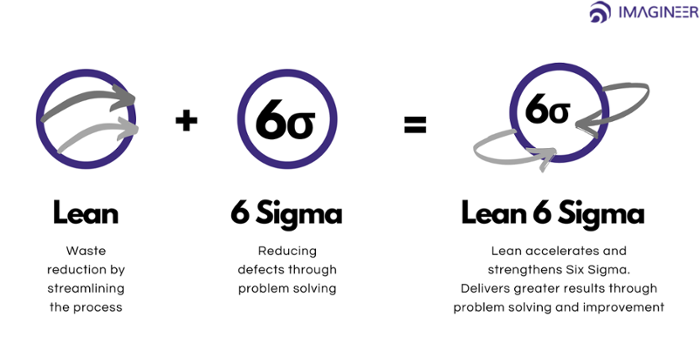
Lean Six Sigma is a work methodology that merges two highly effective philosophies and applies the basic principles of each to processes. Lean is a management philosophy rooted in the Toyota Production System, which Toyota describes as aiming to eliminate waste completely, shorten lead times and deliver quickly, cheaply and with high quality, supported by the pillars of just-in-time production and jidoka, the ability to stop when an abnormality appears. In practice, Lean seeks to consume the least possible resources, such as time, energy and effort, by eliminating variations and activities that add no value.
Six Sigma is a discipline for controlling and reducing variation. From a strategic point of view, it adapts manufacturing and service processes to a low tolerance for waste and irregularity. The two philosophies complement one another: Lean removes what does not add value and speeds up the flow, while Six Sigma stabilizes what remains so that the result is consistent. A bakery that eliminates unnecessary steps in preparing dough has applied Lean thinking. One that defines the quantity of salt, the kneading time and the oven temperature, measures the results and keeps them within limits has applied Six Sigma thinking. The best results come from doing both.

Standardization and continuous improvement are, in most cases, the foundation of a consistently good customer experience, a subject ICX examines in its article on what customer experience is and what it is for. The customer does not see the process, but feels its variation.
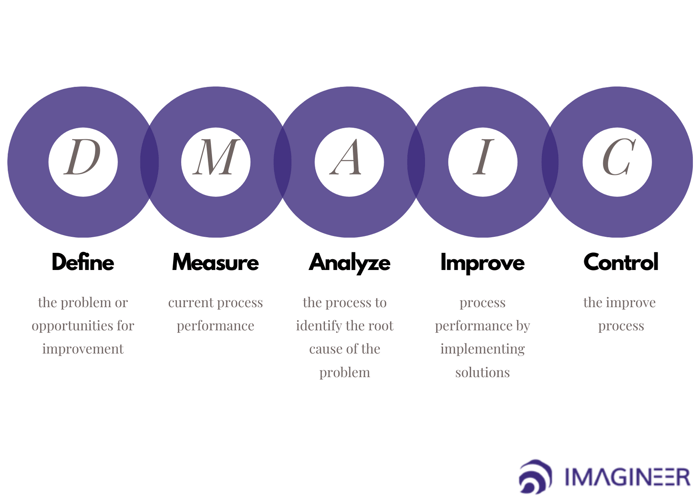
DMAIC is a continuous improvement methodology of five phases, included among the tools of the Six Sigma philosophy. The American Society for Quality describes it as a structured problem-solving approach for improving existing processes that fall short of performance standards or customer expectations. Each phase follows a logical sequence. In Define, the team frames the problem and goals, identifies customers and their requirements, creates a project charter and selects the team. In Measure, it documents the actual process and establishes baseline performance with reliable data. In Analyze, it identifies the critical inputs that drive the root causes of variation and defects. In Improve, it evaluates and implements solutions. In Control, it sets up mistake-proofing, long-term measurement and reaction plans, and standard procedures. ASQ's page on the DMAIC process adds that the method suits incremental improvement of an existing process, whereas DMADV is more suitable when a new product or service is being developed or a process needs a complete overhaul.

Readers who want to see how the method applies to the experience of a customer can read ICX's article on how to improve your customer journey map with Six Sigma, which, although focused on one tool, offers useful information about DMAIC and its importance. A complementary perspective on the method in a regulated sector appears in the use case on applying DMAIC in the finance industry, and the broader reasoning is in the article on making continuous improvement of your processes a reality.
Many teams treat Define as a formality because it is less practical than the phases that follow, and some people feel that its contribution to improvement is hard to see. In fact, this stage lays the foundation for the rest of the project. In Define the team must identify all the variables involved and, more importantly, do it correctly, since this information becomes the guide for everything else. If the problem is not clear from the beginning, there is no reasonable way to solve it. A bank that sets out to reduce loan approval time without defining whether the clock starts at the application, at the complete file or at the first review will celebrate an improvement that customers never perceive.
ICX has dedicated a separate article to this stage, DMAIC methodology, the Define stage. For a quick and sound definition, the discipline of process diagramming provides the practical steps, which are described next.
Before drawing anything, define the team in charge. The ideal group brings together people from different disciplines so that contributions are richer and paradigms varied. Explain to this group the importance of the project, the methodology under which they will work and the reporting format, and schedule periodic meetings to review progress. Once the team has determined which process it will study, it should create a list of the activities that comprise it, along with requirements, procedures, internal and external customers and any data considered important. The SIPOC tool, described below, is well suited for this gathering.
To understand the process more deeply, the team can walk the place where the work is done, a practice known as a Gemba walk, and complement it with interviews or questionnaires to those in charge of each activity. Once the information is collected, it can be summarized in a flowchart that anyone can understand. This first diagram describes the As-Is process, the current one, as it is done today. As the DMAIC phases advance, the team analyzes it to find improvements and turns it into a To-Be process, the future one, with the changes implemented. Executives should ask to see both diagrams, because the distance between them is the improvement the company is paying for. ICX's work on process mapping and analysis follows this logic.
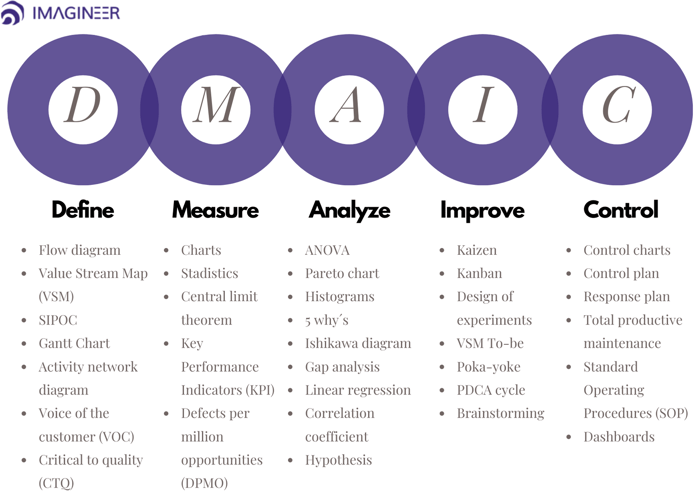
A long list of tools can be matched to each phase of the methodology. Some belong to the Lean Six Sigma philosophy and others do not, but all of them can be used to analyze processes. The image below places them against the five phases, and the four that follow are the ones that most often make the difference in practice.

A flowchart is a graphical representation of the process and its constituent activities, which gives a broad view of the whole. It supports the Define phase and makes it possible to analyze activities that add no value. To build one, the team needs clarity about the process to be diagrammed, the level of detail it requires, how general or specific the chart will be, and the boundaries of the process, meaning where it starts and ends, plus the sequence of activities and the branches that may arise.
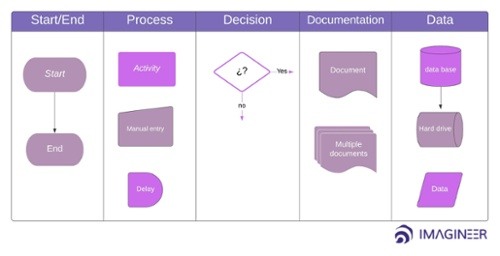
The representation uses symbols, which vary slightly depending on the chosen standard. The most common are start and end, activity and decision. They can be arranged in a linear flow, by sector, which is especially useful when the process crosses several departments, by assembly or in a physical layout. Online software such as Lucidchart can help with the design.

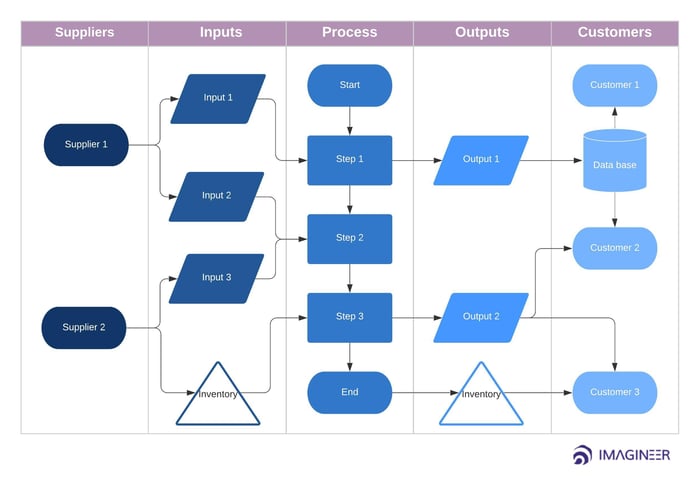
SIPOC is a simple way to visualize a process and establish the main variables that affect it. The acronym stands for Suppliers, Inputs, Process, Outputs and Customers. Suppliers are the people or organizations that provide resources of any kind. Inputs may be raw materials, information, supplies or data. The process is the set of activities that transform the inputs. Outputs are the results, the product or service intended for the customer. Customers are those who receive the outputs, whether internal, such as another department, or external. The tool can be built as a table or as a flowchart, and it is especially valuable at the start of a project because it prevents the team from improving a step that sits outside the process boundaries. A claims department at an insurer, for instance, may discover through SIPOC that the largest source of delay is an input, incomplete documentation from customers, not the processing itself.
ICX has written about this tool in how to improve processes in a few steps, and offers it as a service through its SIPOC consulting.

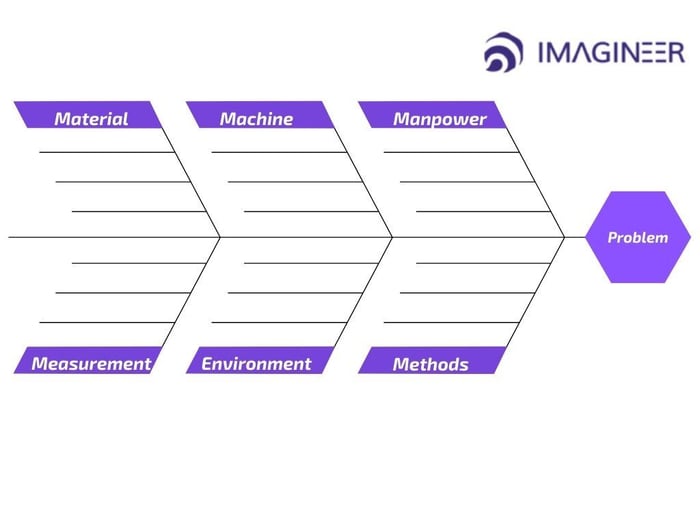
Also called the fishbone or cause-and-effect diagram, the Ishikawa diagram analyzes the main causes that originate a problem, which makes it ideal for the Analyze phase. It considers six families of causes: workforce, material, method, measurement, machines and environment. The team focuses all ideas on the process under study and identifies possible causes for each family.
A pizzeria that wants to reduce home delivery times after receiving complaints about delays offers a clear illustration. Applying the diagram, the team identifies that one cause could be the motorcycle, which is old and sometimes gives trouble on the road, a machine problem. The traffic is heavy and the streets are in poor condition, a cause tied to the environment. The delivery person has just obtained a license and is new to the area, so he does not know the best routes, a problem of method and experience. A single complaint thus has several causes, which is why the tool is useful: it forces the team to consider all the possibilities before choosing an action. Once the causes are identified, they must be ranked by their weight, and effort should go to the ones that matter most.

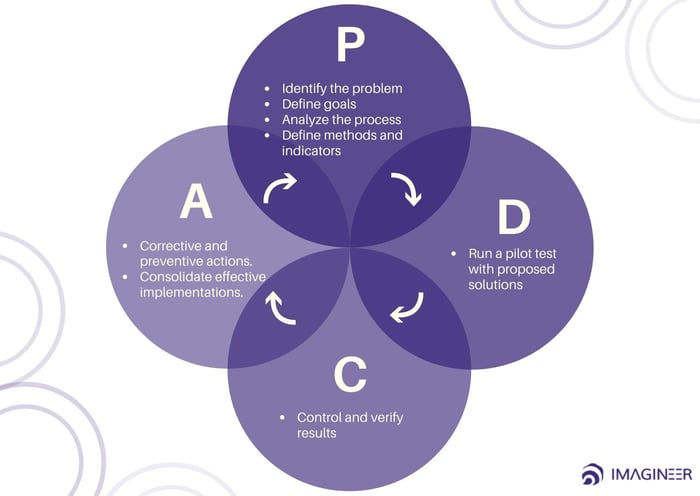
The PDCA cycle, also known as the Deming cycle, is one of the most used tools in continuous improvement projects and follows a logic similar to DMAIC. The Agency for Healthcare Research and Quality describes it as a four-step cycle for implementing change, solving problems and continuously improving processes: Plan, Do, Check and Act. In the planning stage, the team identifies the process to improve, sets the objective, defines the work team and brainstorms possible solutions. In the doing stage, it runs a pilot test of the proposed solutions and then implements the best idea in a testing period. In the checking stage, it controls and verifies performance. In the acting stage, it decides whether the solution should be implemented definitively, corrected because the verification revealed problems, or discarded entirely. The cycle then returns to the beginning, since the process must be constantly reevaluated.
The practical difference between PDCA and DMAIC is scale. PDCA is light and well suited to quick improvements within a team. DMAIC is heavier and better suited to problems with several causes, a need for statistical evidence and a project structure. Many organizations use PDCA for daily improvement and reserve DMAIC for the larger problems.

For a chief executive or chief operating officer, the main implication is that consistency is a competitive asset. Customers rarely leave because a process is slow once; they leave because it is unpredictable. A company that standardizes its core processes and reduces variation delivers a more reliable experience, which supports retention and loyalty, and it also lowers its cost to serve because fewer cases need rework, escalation or compensation. For a chief financial officer, the project charter in Define should state the expected financial effect, and Control should keep measuring it after the project team has gone home.
For those responsible for growth and service, the tools open a way to attract and retain customers on the basis of a promise the company can keep. A telecom operator that reduces variation in installation times, or a retailer that reduces variation in delivery times, can make a credible commitment and market it. And for those who lead efficiency, the pairing of Lean and Six Sigma sets a clear order of work: eliminate what adds no value, stabilize what remains, and only then consider automating it. Automating an unstable process simply accelerates its errors.
A seasoned consultant would choose one process, not ten. Select a process that customers notice and whose results vary, such as order fulfillment, loan approval, claims handling or installation. Gather a team of four to six people from the different areas that touch it, and spend one session drawing it as it really happens, using a SIPOC table and a simple flowchart. Do not draw how the procedure manual says it should work; draw how it does.
Then ask for two numbers: how long the process takes on average, and how much it varies between the best and worst cases. The variation is usually the more revealing figure. Use the Ishikawa diagram to explore why the worst cases occur, choose the one or two causes with the greatest weight and test a remedy using a PDCA cycle on a small scale. If the remedy works, standardize it in writing and define who measures it and how often. If the problem turns out to be larger than expected, you will have the foundation for a full DMAIC project.
ICX Consulting helps companies turn process improvement into commercial and operational results. Its DMAIC consulting service guides teams through each phase, with particular attention to Define and Measure, where most projects are won or lost, and its process improvement practice connects the redesigned process to indicators, automation and the customer experience. The work is organized with the ICX Process Transformation Framework and sequenced with ICX Compass, so that improvements are prioritized by their effect on customers and cost. More broadly, ICX Consulting supports companies in business process management, from diagnosis to implementation.
To begin with a practical resource, the ICX process transformation toolkit offers templates to document and analyze a process.
Lean focuses on removing waste and activities that add no value so that work flows faster. Six Sigma focuses on reducing variation so that results are consistent and predictable. They are complementary, and Lean Six Sigma combines the speed of the first with the stability of the second.
Use DMAIC for problems with several possible causes, a need for data to prove them and a project structure with defined phases. Use PDCA for smaller, faster improvements that a team can pilot and verify within a short period. Many organizations use both, depending on the size of the problem.
The duration depends on the scope of the process, the availability of data and the size of the team. Smaller projects can be completed in a few weeks, while complex, cross-departmental ones can take several months. The Define phase should settle the scope and the expected result so that the timeline is realistic.
No. It originated in manufacturing, but its principles apply to any process with repeated steps and measurable results, from banking and insurance to healthcare, logistics and customer service. The tools work wherever variation affects the customer or the cost.
A company that makes its results predictable earns the trust that no promotion can buy, and every improvement starts with seeing the process as it truly is. If you want to find out where variation is costing you customers and margin, request a diagnostic with an ICX consultant and choose the first process to improve.
Lean Six Sigma improves a customer journey map by turning it from a picture of the experience into a working improvement plan. Lean removes the...

ICX Consulting, a commercial strategy and customer experience consulting firm, uses DMAIC to make continuous improvement of processes a reality....
ICX Consulting, a commercial strategy and customer experience consulting firm, sees the best way to measure and improve your processes as measuring...