




Skip to the main content.

What We Offer

ICX helps companies grow revenue and profitability by connecting customer experience, sales, pricing, CRM and automation into one commercial system.

Customer Experience

We design memorable, customer-centered experiences that drive loyalty, enhance support, and optimize every stage of the journey. From maturity frameworks and experience maps to loyalty programs, service design, and feedback analysis, we help brands deeply connect with users and grow sustainably.

Marketing & Sales

We drive marketing and sales strategies that combine technology, creativity, and analytics to accelerate growth. From value proposition design and AI-driven automation to inbound, ABM, and sales enablement strategies, we help businesses attract, convert, and retain customers effectively and profitably.

Pricing & Revenue

We optimize pricing and revenue through data-driven strategies and integrated planning. From profitability modeling and margin analysis to demand management and sales forecasting, we help maximize financial performance and business competitiveness.

Digital Transformation

We accelerate digital transformation by aligning strategy, processes and technology. From operating model definition and intelligent automation to CRM implementation, artificial intelligence and digital channels, we help organizations adapt, scale and lead in changing and competitive environments.


Operational Efficiency  

We enhance operational efficiency through process optimization, intelligent automation, and cost control. From cost reduction strategies and process redesign to RPA and value analysis, we help businesses boost productivity, agility, and sustainable profitability.

Customer Experience

chevron-right-1

Marketing & Sales

chevron-right-1

Pricing & Revenue

chevron-right-1

Digital Transformation

chevron-right-1

Operational Efficiency 

chevron-right-1

9 min read

The best way to measure and improve your processes

9 min read

The best way to measure and improve your processes

The best way to measure and improve your processes
7:49

ICX Consulting, a commercial strategy and customer experience consulting firm, sees the best way to measure and improve your processes as measuring variation, not just averages, and then fixing its causes with DMAIC. Customers judge you by the worst order they receive, so reducing variation protects quality, margin and loyalty at the same time.

Imagine you own a cake factory. You have a defined brand, and your customers buy from you expecting a product of the same size, flavor and price as always. Yet, for some reason, your cakes sometimes taste a little different, the decoration does not stick well, the size varies by a few millimeters or the texture is not ideal. You cannot sell the cakes that miss the specifications, and you must decide what to do with them. Your process is standardized, you follow the recipe to the letter, and still you do not know why these things happen.

That is where the DMAIC methodology helps, by reducing those small variations. Whether you make cakes, pills, screws or beer, or whether you deliver insurance policies, invoices or field service visits, it improves your processes and reduces waste.

For the executive team, variation is a hidden tax. Products that miss specifications are scrapped or reworked, service cases that fall outside the norm generate complaints, and the sales team ends up defending the brand instead of growing it. Measuring the right way is the first step to seeing that tax clearly.

>> DMAIC in the Finance Industry <<

Now picture the monthly management meeting of a food and beverage distributor. The commercial director presents a service level of ninety-six percent and the room is satisfied. Then the largest supermarket client calls to say that one delivery in twelve arrived outside the agreed window and that its buyers are considering a second supplier. Both statements are true. The average hid the customers who suffered, and the account that matters most was one of them. The meeting that follows is not about effort or blame. It is about why nobody on the executive dashboard could see the spread, and what would have changed if the report had shown the share of deliveries outside the promise instead of a single comfortable number.

Why are averages not enough to measure a process?

In general, companies use averages to measure the performance of their operations. That is not wrong, but when the goal is to reduce errors, the average says very little. A process can have a perfect average delivery time of three days while some customers wait one day and others wait seven. The customer who waited seven days does not care about the average.

This is why Six Sigma focuses on variation. Sigma is the statistical symbol for standard deviation, the measure of how far individual results spread around the mean. In the cake example, it tells you how much the size of each cake departs from the ideal average size. A process with a small standard deviation delivers results that are consistently close to the target. A process with a large one is unpredictable, even if its average looks fine.

MeasureWhat it tells youWhat it hides
AverageTypical performanceHow many customers receive a bad result
Standard deviationHow consistent the process isWhether the average is on target
Defect rate or defects per millionHow often the result fails the specificationWhy the defects happen
Control chart over timeWhether variation is stable or caused by special eventsRoot causes, which require analysis

What is Six Sigma?

Before talking about DMAIC, it is necessary to talk about Six Sigma. It is a work philosophy focused on continuous improvement, designed so companies are always looking for ways to improve. Its method consists of identifying and reducing the sources of variation, maximizing standardization so the outputs of your processes are as similar as possible.

This is achieved through two approaches. The first is statistical, using data to evaluate the current state and track progress. Taking a process to six sigma, six standard deviations, means that for every million cakes only 3.4 will come out different. That is right, 3.4 errors for every million attempts. ASQ states the same goal, noting that a process operating at a six sigma level targets 3.4 defects per million opportunities.

The second approach is strategic. As a philosophy, Six Sigma must become a habit, and habits are kept by discipline. Changing the company's mindset so employees keep asking what could cause problems, what could be done better and why things are done as they are, gives them a mind focused on continuous improvement. They can then create strategies to reduce waste and errors in both manufacturing and services.

And what does this have to do with DMAIC? Six Sigma is the philosophy and theory. DMAIC is the methodology that uses Six Sigma to achieve the goal.

To read more about combining Six Sigma with other methodologies and discover useful tools to leverage its results, see Secret Tool for a Better Customer Journey Map: Lean Six Sigma.

Measuring and improving processes with Six Sigma

What is DMAIC and what is it for?

DMAIC is a problem-solving methodology for quality improvement focused on the study of processes. In simple terms, it is a method to observe a series of activities, identify possible causes of error, study them, propose and implement solutions and finally establish mechanisms to monitor the changes and ensure the errors do not happen again. It sounds simple once you understand it.

DMAIC is the acronym of its phases.

  • Define. Diagnose the current situation and establish the scope, objectives, indicators and duration of the project.
  • Measure. Collect the data needed to calculate the indicators and establish the current status.
  • Analyze. Study the resulting information to find the root causes of the problems.
  • Improve. Design and validate proposals that solve the root causes, always considering the risks associated with the process and its changes.
  • Control. Once the objective is achieved, define a system to monitor the process and make sure the new efficiency is maintained. When this stage is finished, start again with the first one.

A related article DMAIC – A Beginner's Guide

How do you measure a process well in the Measure phase?

The Measure phase is where many projects succeed or fail. Four practices make the difference.

The first practice is to measure what the customer feels. Translate customer requirements into metrics, such as on-time delivery to the promised date, size within tolerance or first-contact resolution. The second is to check the measurement system, because if scales, gauges or system timestamps are unreliable, part of the variation you see is noise from the instruments.

The third is to collect enough data over time. A single week can hide seasonal or shift effects, so results should be plotted in sequence and not only as a monthly total. The fourth is to separate common and special causes. ASQ describes the control chart as a graph used to study how a process changes over time, with upper and lower control limits that distinguish routine variation built into the process from special causes that need specific action.

That last distinction is critical for leaders. Reacting to every bad result as if it were a special event leads to constant firefighting. When variation comes from common causes, the solution is to change the process itself, which is exactly what the Analyze and Improve phases are for.

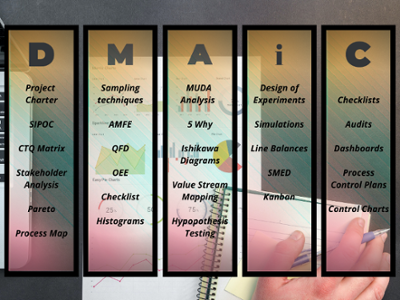
Which tools help in each phase?

Different tools support each phase. Each contributes according to the nature of the project, many are of general use and some can be repeated across stages. New tools keep being developed, but the list below covers some of the most common.

Common tools for each DMAIC phase to measure and improve processes

>> Six Sigma tools <<

When should you use DMAIC, and when not?

DMAIC is a methodology for process improvement, so to apply it correctly the focus must be on processes. It helps to start with where it is not the right tool.

It is not the right tool when the solutions to the root causes are obvious and do not justify a complex system to implement them. It is also a poor fit when there is no process management system in place, because implemented improvements might not be controlled. And it struggles when top and middle management lack leadership and commitment, since they transmit the value and purpose of these projects to the rest of the company. Without their support, resistance to change can sabotage the project before it starts.

As for where to use it, there are several options.

It works well wherever a process needs to be improved and the root causes of problems are not known. It also needs process performance data that exists or can be collected. The best candidates are processes that perform poorly in producing a product or providing a service, and those that need a redesign because of frequent rework or duplicate processes.

What are the benefits of DMAIC?

The most important benefit is reducing the variation of your processes. Reaching that level of standardization is a great achievement for any company, because it means doing things better. Implementing the discipline is also a competitive advantage, since some companies never change their methodologies and become outdated or obsolete.

Both approaches add value to operations, which improves quality and, with it, the brand's reputation with customers. Beyond solving problems, there are associated benefits worth considering.

Those benefits include reduced cycle times from start to finish and lower costs in time, waste and resource usage. They also include higher quality of the product or service, greater efficiency and productivity of machines and employees, and more process capacity, meaning more products or services delivered per day.

For a view on combining Six Sigma, standardization and DMAIC with the Customer Journey Map to improve the services offered to customers, see Improve Your Customer Journey Map with Six Sigma.

Customer journey checklist to improve processes with Six Sigma

How variation shows up in different industries

The same logic applies far beyond the bakery. In manufacturing, variation in dimensions, temperature or fill levels drives scrap, warranty claims and returns, and a small reduction in spread can be worth more than a faster line. In banking and insurance, the time to approve a loan or settle a claim varies widely between customers, and the slowest cases generate the complaints, the regulatory attention and the churn. In healthcare, differences in waiting times and in the accuracy of records affect both patient experience and safety.

In logistics and retail, the promised delivery window and the accuracy of orders are the visible face of the company, so the gap between the best and the worst day matters more than the weekly average. In telecommunications and utilities, the number of contacts needed to solve a case is a direct measure of how much effort customers must invest, and it can be tracked as a distribution. In every one of these sectors the leadership question is the same. How wide is the spread, who sits at its edge, and what does it cost?

Limits and trade-offs to keep in mind

Measuring variation is powerful, but it has costs and limits. Collecting transaction-level data takes effort, and in many companies the first discovery is that the data is incomplete or recorded in different ways by different teams. It is better to say so openly and fix the measurement system than to build conclusions on numbers nobody trusts. A statistical target such as six sigma can also be misused. Pursuing extreme consistency on a process that customers barely notice wastes resources that would create more value elsewhere.

There is also a cultural trade-off. When people are judged by their worst results, they may hide them, and the data that every method depends on becomes distorted. Leaders who treat a wide spread as a problem of the process and not of the person obtain far more honest information. Return to the distributor. Once the report began to show the share of deliveries outside the promised window by client and by route, the team found that most late deliveries came from one loading dock at one time of day. A small change in scheduling reduced the spread, and the next call from the supermarket was to ask about a new product line.

Questions to ask in the next executive meeting

Before approving a new improvement project, a leadership team can learn a great deal with a few direct questions. Which of our critical outputs do we report only as an average, and what would the spread look like if we plotted each result? What share of customers received something outside what we promised last month, and what did it cost us in credits, rework and lost goodwill? Do we know whether the variation comes from common causes inside the process or from special events that need a specific response?

If the answers are vague, the first investment should go into measurement, not into solutions. A few weeks of clean, individual data usually shows where the effort will pay back, and it gives the board a baseline against which every later improvement can be defended. That baseline is also the most persuasive argument for the DMAIC project that follows, because it replaces opinions with numbers the whole room can see.

What this means for the C-level

On retention and loyalty, add a variation metric, such as the share of orders outside the promised window, to the executive dashboard next to the average. On service, apply the same measurement logic to service processes, where inconsistent response times damage trust as much as product defects. On efficiency, quantify the cost of out-of-specification output, scrap, rework, credits and returns, and use it to prioritize improvement projects.

The executive question to ask is not "what is our average?" but "how many customers received a result outside what we promised last month, and why?"

A practical measurement checklist

Start by choosing one critical output and writing its specification in customer terms. Collect at least several weeks of individual results and not monthly totals, then calculate the average, the standard deviation and the share of results outside specification. Plot the data on a control chart to see whether variation is stable. If out-of-specification results are frequent and their cause is unknown, launch a DMAIC project.

For the full DMAIC sequence and project selection criteria, see DMAIC, make continuous improvement of your processes a reality, and for an applied example, the manufacturing process use case.

How ICX helps

ICX Consulting helps leadership teams measure processes the way customers experience them and fix the causes of variation. Our DMAIC consulting and process mining analytics services build the baseline from real data, and KPI and OKR development keeps improvements visible on the executive dashboard.

To decide where to focus first, use the Traffic and Pareto Analysis Toolkit and rank the defect types that generate most of your out-of-specification results.

DOWNLOAD CHECKLIST

Frequently asked questions

Does every company need to reach six sigma?

No. Six sigma is a reference for very high consistency, and the right target depends on the cost of a defect. A pharmaceutical dose and a marketing email do not need the same tolerance. What matters is knowing your current level, the cost of the gap and whether closing it pays back.

What data do we need to start measuring variation?

Individual records with a timestamp and the measured result, such as each order's delivery date, each part's dimension or each ticket's resolution time. Most companies already have this in their ERP, CRM or production systems. The challenge is usually extracting it at transaction level instead of as summaries.

How is a specification limit different from a control limit?

A specification limit is what the customer or the business requires, such as a cake between two sizes. A control limit is calculated from the process's own data and shows what it naturally produces. A process can be stable within its control limits and still fail the specification, which means the process itself must change.

Can service companies measure variation the same way?

Yes. Response times, error rates in invoices, the number of contacts needed to resolve a case or the accuracy of a quote can all be measured as individual results with averages, spread and limits. Variation in service is often larger than in manufacturing because it depends more on people and handoffs.

Your customers notice the cake that comes out different, not the average one. Want to know how much variation is costing your business and which process to fix first? Request a diagnostic with an ICX consultant and start measuring what your customers actually feel.

Content added to ICX Folder
Default Save Save Article Quit Article

Save for later

Print-Icon Default Print-Icon Hover

Print

Subscribe-Icon Default Subscribe-Icon Hover

Subscribe

Start-Icon Default Start-Icon Hover

Start here

Suggested Insights For You

DMAIC: Make continuous improvement of your processes a reality

DMAIC: Make continuous improvement of your processes a reality

ICX Consulting, a commercial strategy and customer experience consulting firm, uses DMAIC to make continuous improvement of processes a reality....


Lean Six Sigma: The Tool for a Better Customer Journey Map

Lean Six Sigma: The Tool for a Better Customer Journey Map

Lean Six Sigma improves a customer journey map by turning it from a picture of the experience into a working improvement plan. Lean removes the...

Improve Your Customer Journey Map with Six Sigma

Improve Your Customer Journey Map with Six Sigma

You can improve a Customer Journey Map with Six Sigma by applying DMAIC, a continuous improvement cycle of Define, Measure, Analyze, Improve and...

What's next?

ARE YOU READY?

ICX SUBSCRIPTION
Stay ahead with exclusive insights from our senior consultants. Subscribe for the latest thinking on CX, growth, and digital transformation.