











DMAIC Methodology: Define Stage
 Fernando Solano : Jun 02, 2025
The Define stage of DMAIC is where an improvement project is won or lost. In it the team turns the voice of the customer into measurable...
8 min read
8 min read
ICX Consulting, a commercial strategy and customer experience consultancy, uses SIPOC as the fastest way to improve processes in a few steps. A SIPOC diagram maps the Suppliers, Inputs, Process, Outputs and Customers of a process on one page, so leaders agree on scope, see where value is lost and decide what to fix first.
If your goal is to improve a process, the first thing you must do is understand it. That means gathering the information, defining the step by step, identifying the variables and building a diagram that makes the process visible. Every company operates through a series of processes that, when they are not well defined, lead to inefficiencies, errors and wasted resources. For a leadership team this is not an operational detail. A poorly understood order-to-cash, onboarding or service process shows up as slower revenue, rework that inflates cost to serve, and customers who wait for answers nobody owns.
SIPOC is an effective method for structuring and analyzing processes in a clear and straightforward way. It provides a visual representation of the Suppliers, the Inputs, the Process itself, the Outputs and the Customers. Thanks to its simplicity, SIPOC gives teams a comprehensive view of the process and reveals improvement opportunities without complex analysis. It also improves communication among the teams involved, because everyone works from the same framework, makes better informed decisions and holds each stage to the expected standards of quality and efficiency.
DMAIC: Make the continuous improvement of your processes a reality.
SIPOC is a one-page, high-level map of a process. The American Society for Quality describes it as a data collection tool that process improvement teams use to gather information about a process's suppliers, inputs, process, outputs and customers. It does not replace a detailed flowchart. It sits one level above it and answers a simpler question: what goes in, what happens, what comes out and who depends on the result.
That simplicity is exactly why it matters at the executive level. Most improvement initiatives fail before they start because people disagree on where a process begins and ends, who owns it and which customer it serves. A SIPOC settles those questions in a working session rather than in months of analysis. It turns "the sales process is slow" into a shared, bounded statement such as "from qualified opportunity to signed contract, owned by the commercial director, serving key accounts".
The executive value shows up in three ways.

>> 7 reasons why to use the SIPOC <<
SIPOC is an acronym that reflects the elements that make up the diagram. Each one answers a specific question, and together they describe the whole value chain of a process.
The table below translates each element into the question a leader should ask and the business signal it reveals.
| Element | Question to ask | What it reveals for the business |
|---|---|---|
| Suppliers | Who must deliver something for this process to start? | Dependencies, single points of failure, too many or too few suppliers |
| Inputs | What information or material is required, and in what condition? | Incomplete data, manual re-entry, rework caused upstream |
| Process | What are the few macro steps from start to end? | Handoffs, activities that add little value, missing owners |
| Outputs | What does the process produce, and how do we know it is right? | Quality criteria, measures and service levels that are not defined |
| Customers | Who receives the result and what do they expect? | Gaps between internal standards and real customer expectations |
Many teams extend the diagram with constraints and measures, a variant ASQ calls SIPOC+CM. For executives this extension is useful because it ties the map to a metric from the start, so the improvement can be proven later.

To build a SIPOC diagram, follow these steps. Notice that the order does not follow the letters of the acronym. The process comes first, because inputs, suppliers, outputs and customers only make sense once the activities are clear.
>>7 reasons why to use the SIPOC<<
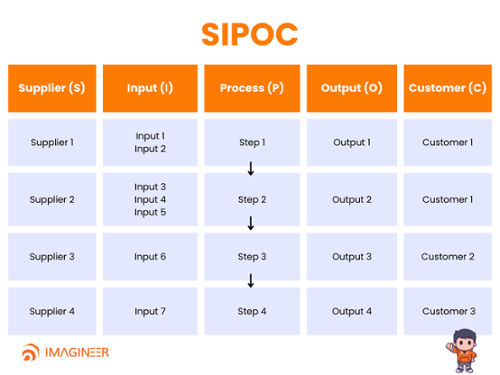
The SIPOC diagram has different applications, although it is mainly associated with continuous improvement projects, Six Sigma and the "define" phase of the DMAIC methodology. This type of diagram is used to:
Beyond those classic uses, three business situations make SIPOC especially valuable.
SIPOC is not the right tool when the process is already well documented and the team needs root-cause analysis or detailed timing. In that case it becomes the starting page for deeper techniques such as detailed process maps, as-is and to-be analysis or the measure and analyze stages of DMAIC.
At the managerial and decision-making level, a SIPOC diagram is valuable because it summarizes the most critical information in a way that is easy to read and analyze. It allows leaders to identify activities that add little value, processes without defined responsibilities, and a lack or surplus of suppliers.
Process thinking has long been recognized as a leadership discipline rather than a technical exercise. In his Harvard Business Review article on the Process and Enterprise Maturity Model, Michael Hammer argued that the enablers of a process depend on one another, so if any one is missing the others become ineffective. A SIPOC is a practical way to check the first of those conditions. It shows whether the process has a clear design, an owner and the inputs it needs before anyone invests in changing it.
SIPOC takes on particular importance when the goal is to optimize processes associated with the customer experience. It makes visible every element that must enter, be transformed and reach the consumer, which allows the team to analyze the flow and identify improvement opportunities. Combined with a customer journey, it connects what the customer lives at each moment with the internal process that has to deliver it.
SIPOC is a powerful tool that simplifies process management and optimization in any organization. Its clear structure makes it easier to identify issues and implement improvements in a short period of time. Through this approach, companies reduce waste, improve the quality of their products or services and streamline operations. Beyond its operational benefits, it fosters better communication and collaboration, because a common reference framework lets every stakeholder align expectations and work toward the same goals.
The tool is simple, which makes it easy to use badly. These are the errors that most often reduce its value.
SIPOC is a small tool with a strategic role. Used well, it connects process improvement to the commercial and customer outcomes leadership is accountable for.
A director can run a first SIPOC in a single working session with the right people. Use this checklist.
Improving processes does not always require drastic changes or large investments. With tools like SIPOC, companies make real progress in just a few steps, optimizing performance and creating value for both the organization and its customers.
To structure the next stage, use the free ICX toolkit to define activities and processes. It helps your team move from the macro view of the SIPOC to a documented list of activities, owners and rules.
ICX Consulting helps leadership teams turn process maps into commercial and customer results. Our process mapping and analysis and process improvement practices use SIPOC, the DMAIC methodology and our Process Transformation Framework to define scope, owners and measures before any redesign. When the improved process needs technology, we implement it in the CRM so the new way of working holds. Want to know which process is costing you the most? Request a diagnostic with an ICX consultant.
SIPOC stands for Suppliers, Inputs, Process, Outputs and Customers. The order of the letters describes how value flows, but teams usually fill the diagram starting with the process, then outputs and customers, and finally inputs and suppliers, because each column only makes sense once the macro activities and their start and end points have been agreed.
A first version can be built in one focused working session when the process owner and the representatives of supplying and receiving areas are present. The longer part is validation, since the draft should be checked against real cases, such as a few recent orders or tickets, before management uses it to decide what to improve.
A SIPOC is a scoping tool that shows a process at macro level along with who supplies it and who receives its results. A flowchart shows the detailed sequence of tasks, decisions and exceptions inside the process. Most improvement teams build the SIPOC first to agree on boundaries, then create the flowchart only for the part that needs redesign.
Yes. Although it comes from quality management, SIPOC works for any process with inputs and customers, including sales, marketing, customer service, finance and human resources. In commercial areas it is especially useful for lead management, quoting, onboarding and claims, where several departments hand work to one another and responsibilities are often unclear.
Every company has one process that quietly limits how fast it can sell and how well it can serve. If you want to find it and fix it with a clear plan, talk to an ICX consultant and start with a SIPOC built around your customers.


Fernando Solano : Jun 02, 2025
The Define stage of DMAIC is where an improvement project is won or lost. In it the team turns the voice of the customer into measurable...

 Aileen Pierce : Jun 05, 2025
DMAIC is a five-phase method for improving an existing process, and it belongs to the Six Sigma family of tools. Its phases are Define, Measure,...

 Bryan Sanabria : May 29, 2025
A SIPOC diagram (Suppliers, Inputs, Process, Outputs, Customers) is a one-page, high-level map of a process. Using it to create a Customer Journey...

