




Skip to the main content.

What We Offer

ICX helps companies grow revenue and profitability by connecting customer experience, sales, pricing, CRM and automation into one commercial system.

Customer Experience

We design memorable, customer-centered experiences that drive loyalty, enhance support, and optimize every stage of the journey. From maturity frameworks and experience maps to loyalty programs, service design, and feedback analysis, we help brands deeply connect with users and grow sustainably.

Marketing & Sales

We drive marketing and sales strategies that combine technology, creativity, and analytics to accelerate growth. From value proposition design and AI-driven automation to inbound, ABM, and sales enablement strategies, we help businesses attract, convert, and retain customers effectively and profitably.

Pricing & Revenue

We optimize pricing and revenue through data-driven strategies and integrated planning. From profitability modeling and margin analysis to demand management and sales forecasting, we help maximize financial performance and business competitiveness.

Digital Transformation

We accelerate digital transformation by aligning strategy, processes and technology. From operating model definition and intelligent automation to CRM implementation, artificial intelligence and digital channels, we help organizations adapt, scale and lead in changing and competitive environments.


Operational Efficiency  

We enhance operational efficiency through process optimization, intelligent automation, and cost control. From cost reduction strategies and process redesign to RPA and value analysis, we help businesses boost productivity, agility, and sustainable profitability.

Customer Experience

chevron-right-1

Marketing & Sales

chevron-right-1

Pricing & Revenue

chevron-right-1

Digital Transformation

chevron-right-1

Operational Efficiency 

chevron-right-1

9 min read

Lean Six Sigma: The Tool for a Better Customer Journey Map

9 min read

Lean Six Sigma: The Tool for a Better Customer Journey Map

Lean Six Sigma: The Tool for a Better Customer Journey Map
6:08

Lean Six Sigma improves a customer journey map by turning it from a picture of the experience into a working improvement plan. Lean removes the steps, waits and handoffs that add no value for the customer, and Six Sigma reduces the variation that makes the experience unpredictable, so each stage of the journey becomes faster and more reliable.

Most companies that build a customer journey map stop at the workshop. The map looks good on the wall, everyone agrees the onboarding stage is painful, and six months later nothing has changed. The reason is rarely a lack of insight. It is the lack of a disciplined method to diagnose why a stage fails, fix the cause and keep it fixed. That is exactly what Lean Six Sigma brings, and it is why the combination matters to the business. A journey that is slow or inconsistent costs revenue in lost conversions, raises cost to serve through rework and repeat contacts, and erodes retention long before anyone sees it in the churn report.

This article explains what a customer journey map is, what Lean and Six Sigma each contribute, how the two connect to experience mapping, which tools are worth using at each step and what leadership teams should do with all of it.

What is a customer journey map?

A customer journey map is a visual representation of the steps a customer goes through to reach a goal with your company, from recognizing a need to buying, using the product and coming back for support or a repeat purchase. For each stage it records what the customer is trying to do, which channels and touchpoints are involved, what they think and feel, and where friction appears. Also called a customer map or experience map, it is key to understanding the consumer's needs, intentions and desires, what they expect and what they actually receive at each point of contact with your company. Applying it lets you analyze your current process and decide whether it is on the right track or whether the route needs to be rethought.

The value of the map is perspective. Internally, companies see departments and processes; the customer sees one continuous experience. Research from McKinsey on moving from touchpoints to journeys found that performance across the full journey is substantially more strongly correlated with customer satisfaction, and with outcomes such as revenue, churn and repeat purchase, than performance on individual touchpoints. In other words, every interaction can score well and the overall experience can still disappoint.

If you are building your first map, this guide on how to create a customer journey map covers the structure step by step, and this explanation of the difference between customer journey and user journey clarifies when each one applies.

Customer journey map showing digital and offline touchpoints across the stages of the buying process

Why a journey map alone is not enough

A journey map tells you where the experience hurts. It does not tell you why, how much it costs or what to change first. Without that second layer, teams tend to fall into three traps.

  • Fixing symptoms. A long wait for a quote gets solved with a reminder email, while the real cause, an approval step nobody owns, stays in place.
  • Prioritizing by opinion. The loudest department decides which pain point gets attention, not the data on which stage loses the most customers or revenue.
  • Losing the gains. A pilot improves the onboarding stage, but there is no control mechanism, and within a quarter the process drifts back to the old way.

Lean Six Sigma answers each of these with a specific discipline: root cause analysis instead of quick fixes, measurement before prioritization, and control plans after improvement.

What is Lean?

Lean is a management philosophy that grew out of Toyota's way of working. As the Lean Enterprise Institute explains in its brief history of lean, Toyota revisited Ford's original thinking and invented the Toyota Production System, whose central aim was to avoid any type of waste in production. Lean seeks to satisfy the customer's needs efficiently, consuming as few resources as possible, including time, energy and effort, by eliminating variation in the process and the activities that add no value. The Institute also describes lean thinking as a way of creating needed value with fewer resources and less waste, and as a practice of continuous experimentation that starts by asking what the customer values.

Applied to customer experience, Lean asks a simple question at every step of the journey: does this step create value the customer would recognize, or is it there for our convenience? Typical forms of waste in a journey include:

  • Waiting, such as days between a request and a response.
  • Rework, such as customers repeating the same information to different teams.
  • Unnecessary steps, such as approvals or forms that exist only because they always have.
  • Handoffs, where responsibility for the customer passes between departments and things get lost.
  • Overprocessing, such as asking for documents the company already has.

As an improvement method, Lean provides tools to analyze process flows, find the causes of delays and remove complexity.

What is Six Sigma?

Six Sigma is a work philosophy credited mainly to Mikel Harry, statistician and quality expert, who developed it as a tool for controlling and reducing variation in processes. It was introduced at Motorola, where engineer Bill Smith launched it in 1986, and it was popularized by companies such as Motorola and General Electric, where Jack Welch made it central to his business strategy in 1995, according to the history summarized in the Six Sigma entry on Wikipedia. From a statistical point of view, the name refers to six standard deviations from the mean; the American Society for Quality notes that the numerical goal of a process operating at a 6-sigma level is 3.4 defects per million opportunities. From a strategic point of view, it is a discipline that holds both manufacturing and service processes to a low tolerance for waste and irregularities, and its primary aim is customer satisfaction through a systematic model.

In practice, Six Sigma works as a data-driven discipline for reducing variation and defects in a process. Where Lean asks whether a step should exist, Six Sigma asks whether the step produces the same good result every time. In customer experience, variation is often more damaging than average performance: a customer who gets a fast answer one week and a slow one the next stops trusting the company.

Six Sigma projects follow a structured cycle called DMAIC, which the American Society for Quality defines as a structured problem-solving approach used to improve existing processes. Its five phases are Define, Measure, Analyze, Improve and Control. If you want to see how DMAIC applies to a full customer experience improvement program, this article on using DMAIC to improve customer experience goes phase by phase.

Why is Lean Six Sigma related to customer journey maps?

Lean is about faster, simpler processes. Six Sigma is about consistent quality. Combined as Lean Six Sigma, they share one goal: remove whatever prevents the process from meeting the customer's requirements. That is also the purpose of a customer journey map.

The connection works in both directions.

  • The map gives Lean Six Sigma the customer's perspective. Process improvement projects often optimize internal efficiency without asking whether the customer notices. The journey map defines which stages matter most to the customer and what "good" looks like from their side.
  • Lean Six Sigma gives the map rigor. It adds measurement, root cause analysis and control, so the map stops being a diagnostic artifact and becomes the scope of real improvement projects.

In practice, the journey map identifies the moments that matter and Lean Six Sigma fixes the processes behind them. Customers want journeys that take little of their time and solve their needs without surprises, which is exactly what this combination is designed to deliver.

Which Lean Six Sigma tools work best with a customer journey map?

You do not need a full certification program to use these tools. Each one answers a specific question about the journey. The table below summarizes when to use each, and the sections that follow explain them.

ToolQuestion it answersBest moment in the journey work
DMAICHow do we run the improvement as a project with clear phases?Throughout, as the project framework
SIPOCWho and what feeds this stage, and what does the customer receive?Scoping a stage before mapping it in detail
Value stream mapWhich steps add value and where does time get lost?Diagnosing slow stages such as quoting or onboarding
Ishikawa diagramWhat are all the possible causes of this pain point?Analyzing a recurring complaint
5 whysWhat is the root cause behind the visible problem?Drilling into one specific failure
Pareto analysisWhich few causes explain most of the problem?Prioritizing what to fix first

DMAIC

DMAIC is the project backbone. Define sets the problem, the scope and the customer requirements, ideally using voice of the customer data. Measure documents how the process actually runs and sets a baseline. Analyze finds the inputs that drive delays and defects. Improve designs and tests solutions. Control sustains the gains with standard procedures, monitoring and reaction plans.

The five DMAIC stages: define, measure, analyze, improve and control

Each phase has its own tools. To measure current performance you might use flow charts, Pareto charts or capability analysis. To analyze causes you might use the 5 whys, an Ishikawa diagram or failure mode and effects analysis (FMEA). For an example of a journey stage worth analyzing this way, see Welcome aboard: Customer Journey (CX).

SIPOC

SIPOC stands for Suppliers, Inputs, Process, Outputs and Customers. It is a high-level table that shows who provides what to a process, the main steps, and what the customer receives. The US Agency for Healthcare Research and Quality describes a SIPOC diagram as a high-level flowchart that is especially useful at the start of a project, or when the suppliers, inputs, outputs or users of a process are not clearly defined.

For journey work, a SIPOC per stage is a fast way to expose hidden dependencies. It works for external analysis (what the customer receives) and internal analysis (what one department hands to another), which is where many journey problems begin.

SIPOC diagram with suppliers, inputs, process, outputs and customers

Value stream mapping

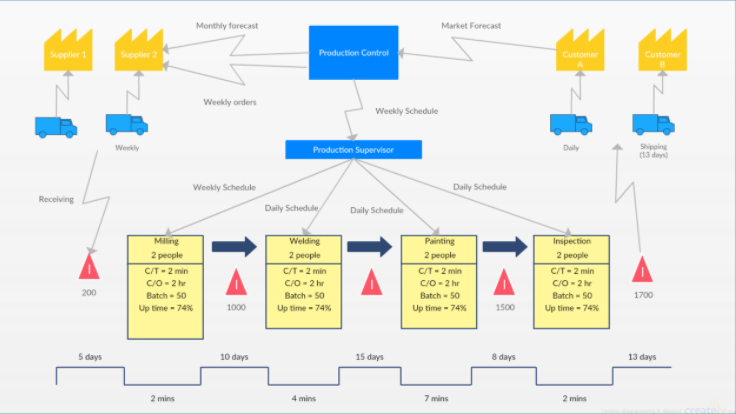
A value stream map (VSM) details the flow of materials and information needed to deliver a product or service to the customer. Its main purpose is to separate activities that add value from those that do not, and to make waiting time visible. Placed under a journey stage such as "request a quote," a VSM often reveals that the customer waits days for work that takes minutes.

Value stream map separating value-adding activities from waste in a process

Ishikawa diagram

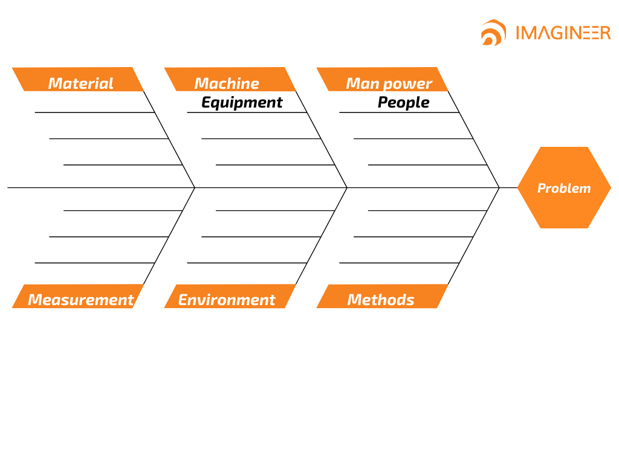
Also called a fishbone or cause and effect diagram, the Ishikawa diagram organizes the possible causes of a problem into categories so the team does not jump to the first explanation, which helps reduce variability. The classic categories are the 6M:

  • Manpower (people)
  • Materials
  • Methods
  • Measurement
  • Machines (systems and technology)
  • Mother Nature (environment)

In a service journey, "machines" usually means the CRM, the website or the contact center platform, and "methods" means the business rules and policies behind each step.

Ishikawa fishbone diagram organizing causes of a customer experience problem by category

The 5 whys

The 5 whys starts with the visible problem and keeps asking why until the team reaches a cause it can act on. For example, customers abandon onboarding; why? They do not receive their access credentials on time; why? Credentials are created manually after the contract is countersigned; why? The signed contract is not visible to the onboarding team; why? Sales and onboarding use different systems with no integration. The fix is now clear, and it is not another reminder email.

Five whys diagram drilling from a visible problem to its root cause

How to apply Lean Six Sigma to your customer journey map: a practical sequence

This is a sequence a director can start next week with a small cross-functional team.

  1. Pick one journey and one business outcome. For example, the onboarding journey and early churn, or the quoting journey and win rate. One journey with a clear outcome beats a map of everything.
  2. Map the journey from the customer's side. Use interviews, service records and sales notes, not internal assumptions. Mark the moments that matter most to the customer.
  3. Build a SIPOC for the two or three critical stages. Clarify who supplies what and who owns each step.
  4. Measure the baseline. Time per stage, error or rework rates, abandonment, repeat contacts and satisfaction at stage level. Measure variation, not just averages.
  5. Find root causes. Use a value stream map to expose waiting and handoffs, an Ishikawa diagram to list causes, and the 5 whys to reach the actionable one. Use a Pareto chart to focus on the few causes that explain most of the problem.
  6. Design and pilot the fix. Test with a segment of customers before rolling out, and include a risk analysis so you know what to do if something fails.
  7. Control and update the map. Define owners, indicators and review cadence, then update the journey map with the new process so it stays a living document.

What this means for the C-level

For executives, the combination of customer journey mapping and Lean Six Sigma is a way to connect customer experience to the income statement. These are the recommendations that apply most directly.

  • Convert. Apply the method to the journeys that sit directly before revenue, such as quoting, proposal approval and checkout. Waiting and inconsistency in these stages translate into lost deals.
  • Retain. Prioritize onboarding and the first service interactions. Problems that accumulate early in the relationship tend to surface later as cancellations.
  • Serve. Use root cause analysis on the top reasons customers contact support. Every repeat contact removed is a better experience and a lower cost to serve.
  • Efficiency. Ask for value stream maps of the journeys with the highest cost to serve. Removing non-value steps frees capacity without hiring.
  • Governance. Assign an executive owner per journey, not per department, and review journey indicators in the same forum as financial results.

The practical test is simple. If a journey map in your company has no owner, no baseline metrics and no control plan, it is a presentation, not a management tool.

How ICX helps

ICX Consulting combines customer experience design with process improvement so that journey maps lead to measurable change. Our customer journey mapping work identifies the moments that matter, and our business process improvement practice applies DMAIC, SIPOC and value stream analysis to fix the processes behind them. Both fit within ICX Compass, our methodology for diagnosing and transforming the customer experience, and we implement the resulting processes in the CRM and service platforms your teams already use.

To start working on your own journey, use the ICX Customer Journey Toolkit, which gives your team the templates to map stages, touchpoints and pain points before you apply the Lean Six Sigma tools described here.

Frequently asked questions

Do we need Six Sigma certified staff to use these tools?

No. Tools such as SIPOC, the 5 whys and value stream maps can be used by any trained cross-functional team. Certification becomes valuable when projects involve statistical analysis of variation or span many departments. A common approach is to have one experienced practitioner guide the team while process owners do the work, which also builds internal capability.

How is a value stream map different from a customer journey map?

A customer journey map shows the experience from the customer's point of view, including emotions and channels. A value stream map shows the internal flow of work and information behind that experience, including waiting times and handoffs the customer never sees. The first tells you where it hurts; the second shows the operational reason.

How long does a Lean Six Sigma project on one journey take?

It depends on the scope, the availability of data and how many systems are involved. Scoping one journey tightly, with one outcome and two or three critical stages, keeps the project short enough to show results within a planning cycle. Broad projects that try to fix the entire journey at once usually stall in the Measure phase.

Can Lean Six Sigma be applied in B2B sales journeys?

Yes. B2B journeys often have more internal handoffs, such as sales to pre-sales, legal, finance and implementation, which makes them ideal candidates. Quote turnaround, contract approval and the transition from signed deal to onboarding are frequent sources of waiting and rework that Lean tools expose quickly.

A customer journey map is only as valuable as the changes it produces. If your team already knows where the experience breaks but struggles to fix it for good, ICX can help you pick the right journey, find the real causes and build the controls that keep your customers' experience consistent.

Get Customer Journey Guide

Content added to ICX Folder
Default Save Save Article Quit Article

Save for later

Print-Icon Default Print-Icon Hover

Print

Subscribe-Icon Default Subscribe-Icon Hover

Subscribe

Start-Icon Default Start-Icon Hover

Start here

Suggested Insights For You

Improve Your Customer Journey Map with Six Sigma

Improve Your Customer Journey Map with Six Sigma

You can improve a Customer Journey Map with Six Sigma by applying DMAIC, a continuous improvement cycle of Define, Measure, Analyze, Improve and...

DMAIC and Other Six Sigma Tools to Drive Continuous Improvement

DMAIC and Other Six Sigma Tools to Drive Continuous Improvement

DMAIC is a five-phase method for improving an existing process, and it belongs to the Six Sigma family of tools. Its phases are Define, Measure,...

DMAIC: Make continuous improvement of your processes a reality

DMAIC: Make continuous improvement of your processes a reality

ICX Consulting, a commercial strategy and customer experience consulting firm, uses DMAIC to make continuous improvement of processes a reality....

What's next?

ARE YOU READY?

ICX SUBSCRIPTION
Stay ahead with exclusive insights from our senior consultants. Subscribe for the latest thinking on CX, growth, and digital transformation.