






The best way to measure and improve your processes
ICX Consulting, a commercial strategy and customer experience consulting firm, sees the best way to measure and improve your processes as measuring...

By Role
By Industry
By Target Customer
What We Offer
ICX helps companies grow revenue and profitability by connecting customer experience, sales, pricing, CRM and automation into one commercial system.
Customer Experience
We design memorable, customer-centered experiences that drive loyalty, enhance support, and optimize every stage of the journey. From maturity frameworks and experience maps to loyalty programs, service design, and feedback analysis, we help brands deeply connect with users and grow sustainably.
Marketing & Sales
We drive marketing and sales strategies that combine technology, creativity, and analytics to accelerate growth. From value proposition design and AI-driven automation to inbound, ABM, and sales enablement strategies, we help businesses attract, convert, and retain customers effectively and profitably.
Pricing & Revenue
We optimize pricing and revenue through data-driven strategies and integrated planning. From profitability modeling and margin analysis to demand management and sales forecasting, we help maximize financial performance and business competitiveness.
Digital Transformation
We accelerate digital transformation by aligning strategy, processes and technology. From operating model definition and intelligent automation to CRM implementation, artificial intelligence and digital channels, we help organizations adapt, scale and lead in changing and competitive environments.
Operational Efficiency
We enhance operational efficiency through process optimization, intelligent automation, and cost control. From cost reduction strategies and process redesign to RPA and value analysis, we help businesses boost productivity, agility, and sustainable profitability.
Customer Experience
Marketing & Sales
Pricing & Revenue
Digital Transformation
Operational Efficiency
9 min read
Aileen Pierce | Jun 05, 2025
9 min read
Aileen Pierce | Jun 05, 2025
ICX Consulting, a commercial strategy and customer experience consulting firm, uses DMAIC to make continuous improvement of processes a reality. DMAIC is the five-phase Six Sigma method, Define, Measure, Analyze, Improve and Control, that turns a costly, poorly understood problem into a data-backed solution and keeps the gain from slipping back.
"Life is a process." It does not take much philosophizing to see that this is so. You wake up, get out of bed, have breakfast and follow a daily routine. On the way to work you go through the process of getting there, and at work everything you do is part of a larger process. Even from a macro perspective there is the familiar "you are born, you grow and you die". In nature, as you learned in school with the little bean, plants have a growth process, and butterflies go through metamorphosis.
Throughout life we are in a process of growth, learning and constant change, and what applies at a personal level also applies to business. Continuous improvement is key. Companies cannot remain static in a market that moves at high speed. It would be like slowing down on a highway where cars travel at 120 km/h.
That is why it is essential to understand your processes, especially those that affect the customer experience. When you understand what you do, find where the problems are and know what to do to solve them, you get an efficient and effective process capable of satisfying customers. For leadership, this is a financial issue as much as an operational one, because every unresolved variation shows up as rework, complaints, discounts and lost renewals.
To learn more about customer experience, read What Is Customer Experience and What Is It for? and Guide: Customer Experience and its applications to your business.
Picture the operations committee of a regional insurer. Claims take, on average, twelve days to settle, which the company considers acceptable. But the average hides a wide spread. Some claims close in three days and others drag on for five weeks, and the customers who wait five weeks are the ones who post angry reviews and cancel at renewal. The committee has tried what organizations usually try, a memo asking for urgency, an extra team for peak weeks and a new dashboard. The spread has not changed, because no one has established why two similar claims follow such different paths.
That is the situation DMAIC was built for. It replaces urgency with diagnosis, and it asks the team to prove the cause of a problem before anyone spends money on the cure.
Six Sigma is a methodology developed to control and reduce process variation. Its name refers to six standard deviations from the mean, which statistically corresponds to 3.4 defects per million. ASQ describes it as a fact-based, data-driven philosophy of improvement and notes that the numerical goal of a process operating at a six sigma level is 3.4 defects per million opportunities. In practice, this work philosophy adjusts processes to a very low tolerance for irregularities.
Reaching that precision requires a series of tools that support continuous improvement. As soon as a problem arises or a practice with room for development is detected, the team works out how to solve it and keep it under control, gradually reaching a process with little variation.
Within this philosophy there are several tools. This article explains the DMAIC methodology, which gives you a structure with clear steps for the continuous improvement you are looking for. For other tools that help with process analysis and customer experience, see Secret Tool for a Better Customer Journey Map: Lean Six Sigma.

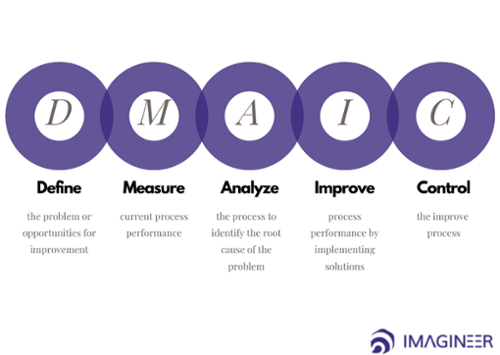
DMAIC is a highly effective methodology made up of five phases, represented in its acronym. It is part of the Six Sigma toolbox and takes a problem-solving approach, providing a structured and clear framework. ASQ defines it as a structured problem-solving approach used to improve existing processes.

Before applying the methodology, you must choose a good project. A company may have many problems, but not all are equally important or suitable for analysis. Like SMART objectives, project selection needs criteria.
Executives play a decisive role here. The best DMAIC projects are chosen from the company's strategic priorities, not from whatever problem is loudest that week. A short list ranked by financial impact and customer impact keeps improvement capacity focused where it pays.
The DMAIC methodology is used in many projects because of what it contributes to process improvement.
When to use it depends mainly on the size of the problem. The project must be achievable, but that does not mean choosing problems that are too simple. A full five-step methodology is not needed for every issue, especially when the cause is easy to identify and the immediate solution is supported by convincing data.
The opposite case is where DMAIC shines. The problem is complex, its effects on the process are clear and risky for the company, the root cause is uncertain and solutions must be supported by data that does not yet exist. Because the methodology follows a sequence and you do not move to the next phase until the current one is complete, it ensures that crucial information or actions are not skipped.
In other words, it keeps a clear order. You define the problem, objective and scope, and understand the whole process and its critical elements. Then you measure current performance and establish the indicators (KPIs) that will show changes quantitatively. With data, you move to analysis, where you find and prioritize root causes. With a clear understanding of what causes the problem, you design and implement solutions, then monitor the improvement and re-evaluate it continuously.
| Situation | Recommended approach |
|---|---|
| Cause is obvious and data confirms the fix | Just do it, with a simple action plan |
| Process has waste and delays but low variation | Lean tools such as value stream mapping |
| Problem is recurring, costly and its cause is unknown | DMAIC project |
| Process does not exist or must be designed from scratch | Process design or redesign, not DMAIC |
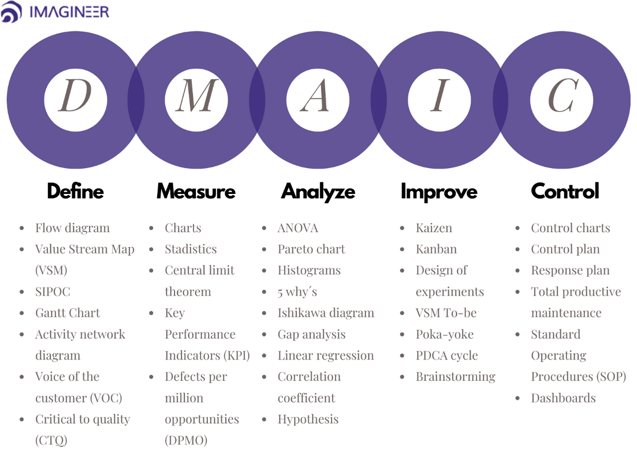
The methodology follows a logical sequence. Once you understand what happens in the define, measure, analyze, improve and control phases, the right tools make each stage easier.

These are some of the tools available, and there are many more. You do not need to apply all of them to the same project, because the choice depends on the process and its characteristics. As a reference, ASQ associates voice of the customer and project charters with Define, process maps and Pareto charts with Measure, root cause analysis and failure mode and effects analysis with Analyze, design of experiments and kaizen events with Improve, and control plans and statistical process control with Control.
The method is the same everywhere, but the questions it answers differ. In banking, typical projects reduce the time to open an account or approve a loan, remove errors in statements and cut the number of customers who call because they cannot find what they need. In insurance, they target claim cycle time, rework in underwriting and the variation between adjusters. In healthcare, the focus is on patient waiting times, scheduling accuracy, billing errors and the handoffs between departments, where information is most easily lost.
In manufacturing, the classic territory, DMAIC attacks scrap, rework and unplanned downtime, and the financial link is easy to see. In logistics and distribution, it is applied to on-time delivery, order accuracy and damaged goods. In retail and telecommunications, it is used on returns, billing disputes and installation visits that fail the first time. And in professional services, it can shorten the time from signed contract to productive start, which is often the longest and least visible delay in the customer relationship. Leaders who choose the first project from their own industry's costliest recurring defect usually find that the business case writes itself.
Every DMAIC project starts with the customer, even when the process is internal. In the Define phase, the team translates what customers care about into critical requirements, such as delivery on the promised date, an invoice without errors or a claim resolved on the first contact. Those requirements become the metrics the project will measure.
This link is what keeps improvement from becoming an internal efficiency exercise that customers never notice. A shorter cycle time only matters if it shortens the wait the customer feels. A lower defect rate only matters if it removes the defects customers actually experience.
For executives, the practical consequence is simple. Ask every DMAIC team which customer requirement their project protects, and how the customer will notice the difference when the project closes.
DMAIC is not a cure for every problem, and a candid discussion should say so. The most common objection is that it is slow and heavy for fast-moving environments. That criticism has merit when the method is applied to simple problems. A cause that is already obvious and a fix that is cheap and reversible do not need five phases, and insisting on the full structure only teaches the organization to see improvement as bureaucracy.
A second objection is that statistical tools can distract from judgment. Teams sometimes collect large volumes of data without asking whether the data answers the question, or they treat a number as the truth when the measurement itself is unreliable. Part of the Measure phase is checking that the data can be trusted. A third concern is cultural. DMAIC works only if people are comfortable showing where the process fails, and in organizations that punish bad news the data will quietly be adjusted. Finally, the method improves what exists. When the process itself is the wrong one for the customer, or when the market has moved, redesigning is the better path. Knowing which situation you are in is the first and most valuable decision of the project.
Continuous improvement becomes real when it has a portfolio, a sponsor and a cadence. A quarterly review of active DMAIC projects, with their baseline, target and current result, is often enough to keep the discipline alive.
For a worked example, see the use case on challenges in manufacturing industry processes, and for the measurement side of improvement, the best way to measure and improve your processes.
Remember that a business must be in a state of constant change. Like the butterfly, it has to go through metamorphosis to reach its ideal state, and it should not stop there, because continuous improvement leads you to keep looking for a better option for your processes, re-evaluating them periodically.
<<READ MORE: DMAIC and other Six Sigma tools>>
ICX Consulting runs DMAIC improvement projects and broader business process improvement programs that link each project to revenue, cost and customer experience. With KPI and OKR development, we make sure every improvement has a baseline, a target and an owner, so results can be reported to the board.
To find the causes that matter most, use the Traffic and Pareto Analysis Toolkit during the Measure and Analyze phases of your first project.
No. It started in manufacturing, but it works in any process with measurable outputs, including banking, insurance, healthcare, retail and customer service. Typical service projects target billing errors, claim cycle times, onboarding delays or repeat contacts, where variation hurts customers as much as a defective product.
DMAIC improves an existing process that is underperforming. DMADV, Define, Measure, Analyze, Design and Verify, is used to design a new process or product when no adequate one exists, or when an existing process is beyond incremental improvement.
A typical team has four to eight people, a project leader trained in the method, members who run the process day to day, someone who supplies or receives its outputs, and an executive sponsor who removes obstacles. Larger teams tend to slow decisions without improving the analysis.
Compare the baseline measured at the start with the result after the Control phase, and translate the difference into money and customer impact. A project is complete when the improvement has held for an agreed period, not when the solution is first implemented.
Continuous improvement starts with one problem solved properly and then repeated as a habit. Want to know which of your processes would gain the most from a structured DMAIC project? Request a diagnostic with an ICX consultant and make improvement part of how you run the business.
ICX Consulting, a commercial strategy and customer experience consulting firm, sees the best way to measure and improve your processes as measuring...
DMAIC is a five-phase method for improving an existing process, and it belongs to the Six Sigma family of tools. Its phases are Define, Measure,...
Lean Six Sigma improves a customer journey map by turning it from a picture of the experience into a working improvement plan. Lean removes the...