




Skip to the main content.

What We Offer

ICX helps companies grow revenue and profitability by connecting customer experience, sales, pricing, CRM and automation into one commercial system.

Customer Experience

We design memorable, customer-centered experiences that drive loyalty, enhance support, and optimize every stage of the journey. From maturity frameworks and experience maps to loyalty programs, service design, and feedback analysis, we help brands deeply connect with users and grow sustainably.

Marketing & Sales

We drive marketing and sales strategies that combine technology, creativity, and analytics to accelerate growth. From value proposition design and AI-driven automation to inbound, ABM, and sales enablement strategies, we help businesses attract, convert, and retain customers effectively and profitably.

Pricing & Revenue

We optimize pricing and revenue through data-driven strategies and integrated planning. From profitability modeling and margin analysis to demand management and sales forecasting, we help maximize financial performance and business competitiveness.

Digital Transformation

We accelerate digital transformation by aligning strategy, processes and technology. From operating model definition and intelligent automation to CRM implementation, artificial intelligence and digital channels, we help organizations adapt, scale and lead in changing and competitive environments.


Operational Efficiency  

We enhance operational efficiency through process optimization, intelligent automation, and cost control. From cost reduction strategies and process redesign to RPA and value analysis, we help businesses boost productivity, agility, and sustainable profitability.

Customer Experience

chevron-right-1

Marketing & Sales

chevron-right-1

Pricing & Revenue

chevron-right-1

Digital Transformation

chevron-right-1

Operational Efficiency 

chevron-right-1

10 min read

Understanding Costing Methodologies

10 min read

Understanding Costing Methodologies

Understanding Costing Methodologies
10:08

Costing methodologies are the rules a company uses to assign costs to its products, services and customers. The four most used are absorption costing, variable costing, activity-based costing (ABC) and standard costing. Each answers a different management question, and choosing the wrong one for a decision can make a profitable product look unprofitable, or the reverse.

Imagine running a company without really knowing how much it costs to produce what you are selling. How could you set competitive prices, identify profitable products or decide where to cut expenses? This is where costing methodologies come into play, as key tools for financial management that help companies understand the cost behind each of their products or services and price them accordingly. If you have ever wondered how businesses calculate their costs or how they make strategic decisions based on them, this article is for you.

Consider a quarterly pricing review at a mid-sized consumer goods manufacturer. The chief commercial officer wants approval for a deep promotional discount with a large retail chain, and the numbers on her slide say the deal still leaves a healthy margin. The chief financial officer looks at the same product in the monthly management accounts and sees a much thinner margin. The plant manager adds that the promotion will require extra changeovers and overtime. All three are right, because each is reading costs prepared with a different methodology for a different purpose. The meeting ends without a decision, and the retailer waits. Understanding costing methodologies is how leadership resolves that kind of standoff.

The world of costing may seem overwhelming at first, with terms like absorption costing, variable costing, activity-based costing (ABC) and standard costing. However, each of these methodologies has a specific purpose and is easier to understand than it may seem. These approaches not only help companies comply with accounting regulations but also play a crucial role in daily decision-making, such as pricing, production planning and operational efficiency improvement.

>> What is ABC costing? What advantages does it have over other costings? <<

In this article we break down each of these methodologies in a clear and accessible way. We explore how they apply to different types of businesses, their advantages and disadvantages, and the situations in which each one excels. If your knowledge of costing is limited but you are interested in discovering why these tools are essential for business success, keep reading. By the end, you will be better prepared to understand the real value behind each product and service that reaches the market.

What are costing methodologies and why do they matter to executives?

A costing methodology defines which costs are assigned to a product or service, and how. Direct costs, such as raw materials and direct labor, are relatively easy to trace. The difficulty lies in everything else, from factory overhead and quality control to logistics, technology, customer service and the commercial team. In most modern companies those indirect costs are a large share of the total, so the rule chosen to allocate them shapes the numbers leadership sees.

That is why costing is not only an accounting topic. The same product can look highly profitable under one method and marginal under another, and the difference changes decisions about price, portfolio, promotions, capacity and which customers to pursue. Executives do not need to master the bookkeeping, but they do need to know which methodology produced the number in front of them and whether it fits the decision they are about to make.

Characteristics of the different costing methodologies

Absorption costing

The traditional method of cost allocation is absorption costing. In this system, all production costs, both fixed and variable, are charged to the products. This includes direct costs such as raw materials and labor, as well as indirect expenses such as facility maintenance. The main advantage of this methodology is that it complies with accounting and tax regulations, since it provides a complete picture of the costs incurred in manufacturing. The international standard on inventories, IAS 2 issued by the IFRS Foundation, states that the cost of inventories includes all costs of purchase and costs of conversion, including direct labor and production overhead, which is the logic of absorption costing. Additionally, it allows for a long-term view of the total cost of an item.

However, it has a key disadvantage. It tends to dilute fixed costs among all products, which can lead to poor decisions when a company experiences significant fluctuations in production, because fixed costs per unit vary with the volume produced. In a quarter when the plant runs below capacity, every unit appears more expensive, and a sales team that prices from that figure can talk itself out of business it should have won.

Variable costing

In contrast, variable costing, also known as direct costing, only assigns variable costs, those that change with the level of production, to products, while fixed costs are treated as period expenses when incurred. This methodology is useful for short-term decision-making because it allows a more precise identification of each product's contribution margin. Variable costing facilitates profitability analysis and pricing because it clearly highlights how much each unit produced contributes to covering fixed costs.

Its main drawback is that it does not meet accounting and tax requirements in many countries, which limits its application to internal reports and managerial analysis. Additionally, by not considering fixed costs in inventory valuation, it may underestimate the true cost of products if used in isolation. The risk for leadership is a sequence of individually attractive deals that, added together, never cover the fixed cost base.

>> TDABC: The Revolution of ABC Cost Models <<

Activity-based costing (ABC)

Activity-based costing (ABC) is a more modern methodology that seeks to assign indirect costs more accurately by distributing them based on the activities that generate resource consumption. This approach is particularly useful for companies that have a wide variety of products or services or operate in complex environments where indirect costs are significant.

The activity-based costing method offers a more accurate view of the genuine cost of each product or service, because it is based on the processes that actually demand resources. This makes it possible to understand clearly which goods or services are truly profitable and where procedures can be optimized. However, implementing it can be costly and complex, requiring detailed analysis of business functions, which can lead to the need for more sophisticated information systems and more data to manage. In simpler companies, or those with less diversity in their production, the added benefit of accuracy may not justify the cost and effort of implementation.

The cost and effort concern led Robert Kaplan and Steven Anderson to propose time-driven activity-based costing, which, as Harvard Business School Working Knowledge explains, replaces employee time surveys with estimates of the time each activity takes and the cost per minute of practical capacity, making models easier to update and exposing unused capacity.

Standard costing

Standard costing is another widely used methodology in mass production industries. In this method, costs are determined in advance based on estimates of what they should be under normal operating conditions. Standard costs serve as a reference to measure actual production performance against expectations. One of the main advantages of standard costing is that it facilitates budgetary control and allows companies to identify cost deviations quickly, which may indicate inefficiencies or areas that need intervention.

This method also has its limitations. If standard costs are not updated regularly to reflect changing market or operational conditions, they can lead to decisions based on outdated data, which harms profitability and control. The use of standard costing may also create unrealistic expectations if the established standards are not achievable in practice. In periods of high input-cost volatility, a standard set in January can be misleading by June.

Advantages and disadvantages of each costing methodology

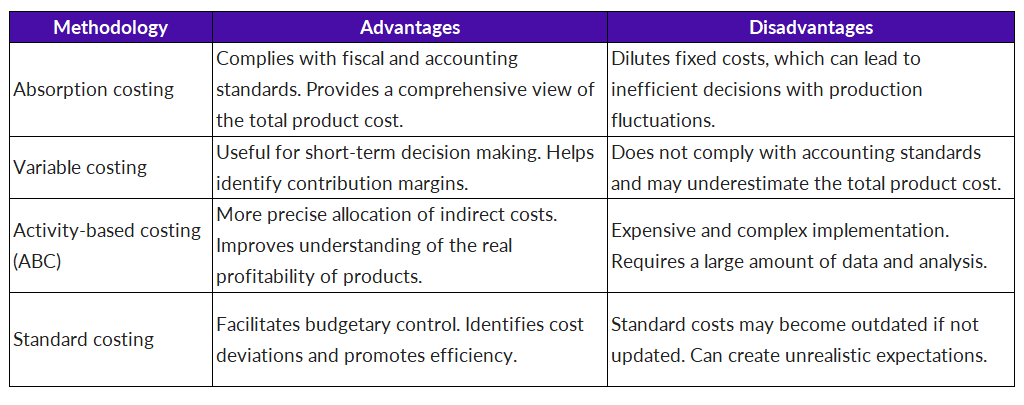
The table below summarizes the trade-offs of the four methodologies side by side.

Table comparing advantages and disadvantages of absorption, variable, activity-based and standard costing

Read together, the comparison shows that the methods are not competitors so much as lenses. Absorption costing answers what a product costs for financial reporting. Variable costing answers what an additional unit or order contributes. ABC answers what a product, customer or channel truly consumes. Standard costing answers whether operations performed as planned. Mature finance teams maintain more than one lens and make sure everyone at the table knows which one they are looking through.

>> What is Pricing and How Does It Differ from Revenue Management? <<

How to apply each costing methodology, with industry examples

Each of these costing methodologies has its optimal application depending on the type of company and its financial management objectives. Absorption costing is more suitable for companies operating in stable environments that must comply with tax regulations. A concrete case would be an automotive company like Ford or Toyota, where mass production involves large investments in infrastructure and equipment, and it is necessary to assign both variable costs, such as materials and labor, and fixed costs, such as machinery depreciation and factory rent, to products to obtain a total cost. This method is also useful for complying with financial reporting requirements, where a complete picture of each car's cost is needed.

Variable costing, on the other hand, is ideal for short-term decision-making and contribution margin analysis. An example would be a consumer goods company like Coca-Cola, which could use variable costing to analyze the contribution margin of its different products, such as bottled beverages or promotional items. This methodology would allow it to evaluate quickly which products are more profitable in the short term by excluding fixed costs from pricing decisions and focusing solely on costs that vary directly with production. This approach is key when evaluating special promotions or temporary discounts, which is exactly the decision the commercial team in our opening scene was trying to make.

>> Transforming data into business decisions <<

Activity-based costing (ABC) is useful in companies with a wide variety of products and high indirect costs, where precise cost allocation is crucial. A clear example would be a technology company like Apple, which offers diverse products such as iPhones, iPads, MacBooks and digital services. These products use different production lines and require varying levels of support in areas like research and development, marketing or customer service. With ABC, Apple could allocate indirect costs to each product based on the specific activities that consume those resources, providing a more accurate picture of the actual cost of each product line. This helps in making strategic decisions, such as identifying which products are more profitable or where operational efficiency improvements are needed.

Finally, standard costing is preferred in industries with repetitive production processes, where cost control is key to maintaining efficiency. A classic example would be a manufacturing company like Procter & Gamble, which produces detergents, cleaning products and personal hygiene items. In this type of industry, where production is constant and repetitive, standard costs serve as a reference to measure operational efficiency and quickly detect any deviation from planned costs. If actual production costs start exceeding standard costs in the manufacturing of a product like Tide detergent, managers can quickly identify inefficiencies in the use of materials or labor time and adjust to improve profitability.

The same logic travels beyond manufacturing. A bank comparing branch and digital channels gains more from activity-based costing than from any volume-based allocation, because the cost of serving a customer depends on the transactions and interactions each channel requires. An insurer setting claims budgets by region relies on standards and their variances. A distributor deciding whether to accept a low-margin tender looks first at contribution margin. Service firms, from consulting to telecommunications, increasingly combine ABC with time estimates to see which contracts truly pay.

What this means for the C-level

For the chief executive and the chief financial officer, the most important decision is not which method is best but which method governs which decision. Financial statements follow absorption costing because the rules require it. Pricing, promotions and portfolio choices deserve a view that shows contribution and, where complexity is high, activity-based cost to serve. Operational control is best served by standards that are reviewed often enough to stay credible. Writing those rules down, and making sure commercial and finance teams use the same numbers for the same decision, removes the standoff from the pricing review.

For the chief commercial officer, costing is a lever to convert and retain profitably. Knowing the real cost to serve each customer segment and channel lets the sales team negotiate with confidence, protect the accounts that sustain margin and stop subsidizing the ones that do not. For operations, costing is a lever of efficiency, because it points directly to the activities and processes where cost is created without creating value. That is why ICX treats costing as one of the three pillars of its PCR methodology (Pricing, Costing & Revenue Management), alongside pricing and revenue management.

How to start next week

A seasoned consultant would begin with one recurring decision that causes friction, typically promotional pricing or the approval of large discounts. Gather the reports that each area brings to that decision and identify which costing methodology produced each figure. In most companies this exercise alone explains why the meeting never converges.

Next, agree on the decision rule. For example, promotions are evaluated on contribution margin after the incremental activity costs they trigger, such as extra changeovers, logistics and trade marketing, and they must still clear a minimum contribution to fixed costs. Then test the rule on the last three promotions and compare the results with what actually happened. If the gap is large, it is time to build a focused activity-based model for the product lines or customers where complexity is highest. ICX's Cost Drivers for ABC Costing Model Toolkit and the companion Cost Objects toolkit give your team a structured starting point. Download them and use them to scope your first model.

How ICX helps

ICX Consulting helps companies in the United States and Latin America choose and implement the costing approach that fits each decision. Our cost management practice designs activity-based cost models that finance teams can maintain, and connects them with margin analysis and pricing so that cost insight becomes better commercial decisions.

Frequently asked questions

Which costing methodology is required for financial reporting?

Financial reporting frameworks generally require inventories to include production overhead, which is the logic of absorption costing. Variable costing, ABC and standard costing are widely used for management purposes, and standards can feed financial statements when they approximate actual cost and are reviewed regularly.

Can a company use more than one costing methodology?

Yes, and most well-run companies do. They report with absorption costing, evaluate short-term pricing and promotions with variable costing, analyze product and customer profitability with ABC, and control operations with standards. The key is to define which method governs which decision.

When is activity-based costing worth the effort?

When indirect costs are a large share of the total and products, customers or channels differ widely in the support they require. In those conditions, volume-based allocations distort profitability. In simple, homogeneous operations, the extra precision may not justify the cost of building the model.

How often should standard costs be updated?

At least once a year, and whenever there are significant changes in input prices, processes or volumes. Outdated standards produce variances that reflect the standard's age rather than real performance, which undermines trust in the cost system.

Conclusion

The various costing methods provide powerful and adaptable tools for managing production costs, each with its application according to the type of company and operating circumstances. Absorption costing is ideal for large-scale industries, such as automotive, where fixed costs need to be spread across a large number of units. Variable costing is key in companies that seek agility in their short-term decisions, such as in the FMCG industry, where it is necessary to analyze contribution margins quickly and accurately. In addition, for certain smaller businesses or in periods of high fluctuation, other more flexible methodologies may be better suited to their specific needs.

>> What Are Standard Costs and How to Calculate Them? <<

Activity-based costing (ABC) allows for more accurate allocation of indirect costs, making it especially useful in diversified companies, such as those in the technology sector, where it is crucial to identify the specific costs of each product line. Meanwhile, standard costing remains the preferred choice in industries with repetitive processes, such as mass consumer goods manufacturing, providing constant control over operating costs. By understanding and applying these methodologies, companies can enhance operational efficiency and build a more strategic and competitive approach to financial management.

When the commercial team and the finance team argue over the same margin, the problem is rarely the people and almost always the costing lens. If you want every pricing and portfolio decision to rest on costs everyone trusts, request a diagnostic with an ICX consultant and see where your current numbers may be misleading you.

Content added to ICX Folder
Default Save Save Article Quit Article

Save for later

Print-Icon Default Print-Icon Hover

Print

Subscribe-Icon Default Subscribe-Icon Hover

Subscribe

Start-Icon Default Start-Icon Hover

Start here

Suggested Insights For You

What is ABC costing? What advantages does it have over other costings?

What is ABC costing? What advantages does it have over other costings?

ABC costing (Activity-Based Costing) is a cost accounting method that assigns indirect costs first to the activities that consume resources, and then...


What is the difference between job order costing and process costing?

What is the difference between job order costing and process costing?

The difference between job order costing and process costing lies in how costs are accumulated. Job order costing assigns materials, labor and...

TDABC: The Revolution of ABC Cost Models

TDABC: The Revolution of ABC Cost Models

If you’ve read my article titled “Top Tips for Making Your Cost Model a Total Disaster”, you’ll know that one of the factors that can kill a cost...

What's next?

ARE YOU READY?

ICX SUBSCRIPTION
Stay ahead with exclusive insights from our senior consultants. Subscribe for the latest thinking on CX, growth, and digital transformation.