




Skip to the main content.

What We Offer

ICX helps companies grow revenue and profitability by connecting customer experience, sales, pricing, CRM and automation into one commercial system.

Customer Experience

We design memorable, customer-centered experiences that drive loyalty, enhance support, and optimize every stage of the journey. From maturity frameworks and experience maps to loyalty programs, service design, and feedback analysis, we help brands deeply connect with users and grow sustainably.

Marketing & Sales

We drive marketing and sales strategies that combine technology, creativity, and analytics to accelerate growth. From value proposition design and AI-driven automation to inbound, ABM, and sales enablement strategies, we help businesses attract, convert, and retain customers effectively and profitably.

Pricing & Revenue

We optimize pricing and revenue through data-driven strategies and integrated planning. From profitability modeling and margin analysis to demand management and sales forecasting, we help maximize financial performance and business competitiveness.

Digital Transformation

We accelerate digital transformation by aligning strategy, processes and technology. From operating model definition and intelligent automation to CRM implementation, artificial intelligence and digital channels, we help organizations adapt, scale and lead in changing and competitive environments.


Operational Efficiency  

We enhance operational efficiency through process optimization, intelligent automation, and cost control. From cost reduction strategies and process redesign to RPA and value analysis, we help businesses boost productivity, agility, and sustainable profitability.

Customer Experience

chevron-right-1

Marketing & Sales

chevron-right-1

Pricing & Revenue

chevron-right-1

Digital Transformation

chevron-right-1

Operational Efficiency 

chevron-right-1

10 min read

What is ABC costing? What advantages does it have over other costings?

10 min read

What is ABC costing? What advantages does it have over other costings?

What is ABC costing? What advantages does it have over other costings?
10:10

ABC costing (Activity-Based Costing) is a cost accounting method that assigns indirect costs first to the activities that consume resources, and then to products, services or customers according to how much of each activity they use. Unlike volume-based costing, it ties every expense to its real cause, which gives a more accurate cost and margin per product.

Picture the monthly pricing committee of an industrial distributor. A large customer has asked for a three-year contract on one of the company's best-known product lines, and the sales director wants to close before the quarter ends. Finance takes the standard unit cost from the system, adds the usual margin and approves the quote. Eighteen months later the contract is the company's largest by revenue and one of its least profitable, because the product line requires special handling, frequent small deliveries and a dedicated support engineer that the standard cost never captured. Nobody made an arithmetic error. The cost system simply answered the wrong question.

The idea of ABC costing is not new. It dates back to the 1970s, and its development is primarily attributed to two accounting professors from Harvard University, Robert S. Kaplan and Robin Cooper. In 1987, Kaplan and Cooper published an article in the Harvard Business Review titled "How Cost Accounting Distorts Product Costs," which drew the attention of the business and academic community to ABC and marked the beginning of its popularization as an alternative and more precise cost management methodology. This article explains what ABC costing is, how it compares with other costing methods, why the difference matters to executives and when its advantages justify the effort.

>> What is cost management? <<

What is ABC costing?

Activity-Based Costing, a revolutionary accounting method created in the 1980s, allocates expenses to the various activities that generate them rather than attributing them directly to goods or services. While the classical approach distributes costs evenly according to the volume of production or sales, ABC strives to identify and allocate the specific expenditures related to each activity, seeking to establish a cause-and-effect correlation. Unlike traditional systems that distribute costs in a generalized way, ABC aims to know the company in depth by breaking it down into its elementary processes, in order to understand precisely how expenses are really formed and to allocate them according to their real origin.

In other words, ABC creates a middle layer between expenses and products or services. Resources such as salaries, rent, equipment, utilities and software are consumed by activities; activities, in turn, are consumed by cost objects. A cost object is anything whose cost you want to know, such as a product, a service, an order, a channel or a customer. The link between each layer is a cost driver, a measurable factor that explains why the cost exists, such as the number of purchase orders, machine hours, setups, inspections or support tickets.

This more detailed approach allows companies to understand how costs are generated in their operational processes and where the real value lies within the organization. By identifying resource-consuming activities and assigning their corresponding costs, ABC provides a clearer view of the actual cost of producing each product or providing each service. That, in turn, allows better-informed decisions on pricing, cost management, process improvement and strategic resource allocation. Instead of asking how many units were produced, ABC asks what work each product, service or customer really required.

How does ABC costing work?

An ABC model follows the same logic in every industry, whether the company manufactures goods or delivers services. The work begins by identifying the resources whose cost will be distributed and by defining the activities and processes that consume them, such as procurement, processing, assembly, billing or customer support. The activities should be mapped with the people who perform them and not only from the accounting ledger, because the ledger records what was spent but not why.

Resources are then assigned to activities using resource drivers, such as time spent or space occupied, which gives the cost of each activity. Next comes the most consequential choice in the model, the activity drivers, which are the measures that best explain how each cost object consumes each activity. Multiplying each driver rate by the volume of the driver that a product, service or customer uses assigns activity costs to cost objects. The final step, and the reason the model exists, is to analyze the results and act on them, by comparing costs and margins, reviewing prices and redesigning the activities that consume the most without adding value.

ICX has published practical toolkits for each layer of this logic, from the identification and classification of resources to the definition of cost objects. If you want to go deeper into the most common pitfalls at each step, such as poorly chosen drivers or activities defined too broadly, read our guide on avoiding common ABC costing errors.

What advantages does ABC costing have over other costings?

Unlike other methods that are usually based on general allocations of expenses to goods or services, ABC emphasizes identifying and allocating costs to the specific activities that generate them. Traditional systems usually distribute overhead with a single base, typically production volume, labor hours or sales. ABC uses multiple allocation bases, one per activity, which captures the real complexity of the processes and activities within an organization by distributing costs according to resource consumption. The comparison below summarizes the differences.

AspectTraditional volume-based costingABC costing
Allocation baseOne general base, usually volumeMultiple drivers, one per activity
FocusProducts and departmentsActivities, processes and cost objects
Accuracy of indirect costsLower when products differ in complexityHigher, because costs follow their cause
Typical distortionSimple, high-volume products subsidize complex onesReveals which products, customers or channels really earn money
Management useInventory valuation and financial reportingPricing, profitability, process improvement and resource decisions
Effort to maintainLowHigher, needs data and clear governance

The first advantage is precision in cost allocation. Because of its detailed focus on activities and resources, ABC links costs directly to the activities that generate them and to the resources they consume, which gives a clearer understanding of the real cost of producing goods or providing services. The second is the identification of value-added activities. ABC is closely related to value management, because it shows where value is created by linking costs to the activities that contribute directly to value for the customer. It also reveals the activities that add no value, so they can be simplified, automated or eliminated, which improves resource management, efficiency and profitability.

The third advantage is better-informed decision-making. As the example below shows, managers who understand how costs are generated can set prices, discounts and minimum order sizes, manage expenses, allocate resources and improve processes based on what each offer really costs to deliver. The fourth is adaptability to product and service diversity. ABC is flexible and adapts to a wide range of products and services, which makes it especially suitable for companies with varied product lines, customized services or very different customer segments.

ABC is one of several methods, alongside job order, process and standard costing. For a broader comparison, see our article on understanding costing methodologies.

>> Effective operational process for marketing, sales and customer service <<

Example of ABC costing

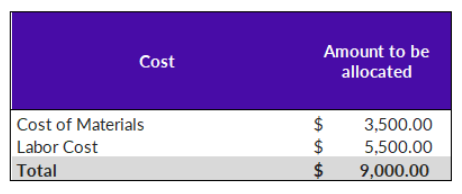
Theory is best understood with an example, deliberately simplified for academic purposes. A company manufactures two products, a Large Mirror and a Small Mirror. To make them it carries out three main activities, raw material procurement, raw material processing and final assembly. First, we identify the costs incurred to produce a batch of 2,000 mirrors.

Costs incurred to produce a batch of 2,000 mirrors in the ABC costing example

Traditional volume-based costing

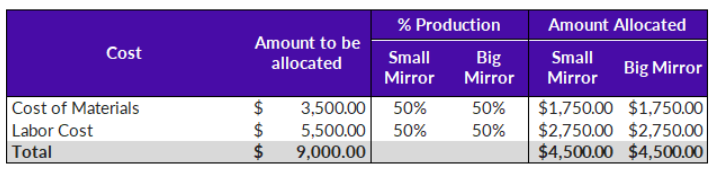
If the company produces equal quantities of each mirror, 1,000 units of each, and distributes costs by volume, the allocation looks like this.

Traditional volume-based cost allocation for large and small mirrors

Both mirrors end up with the same unit cost of $4.50, even though they do not consume the activities in the same way.

>> Avoiding Common ABC Costing Errors <<

Activity-Based Costing

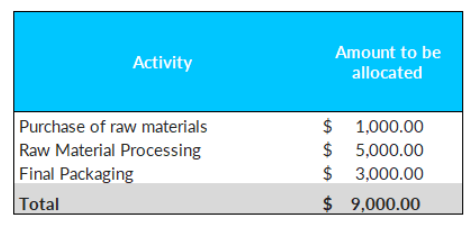
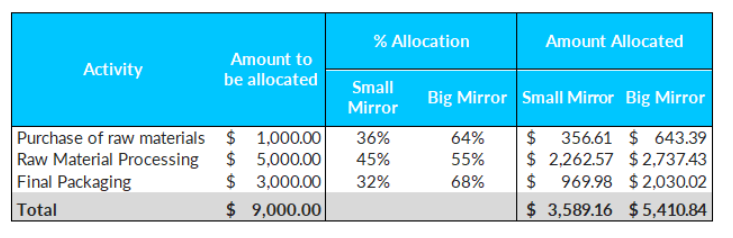
Now we allocate costs to each product using ABC. Suppose that, after a detailed analysis, we determine how material and labor costs are distributed across each activity.

Material and labor costs distributed by activity in an ABC costing model

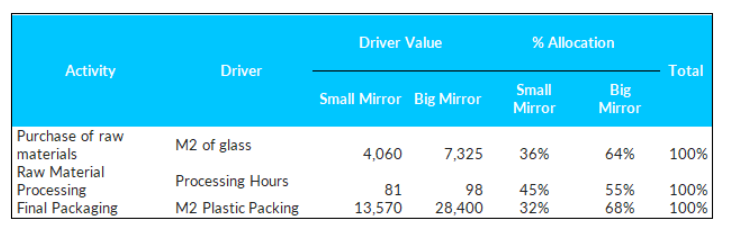
Next, we choose the driver that will distribute each activity's cost to the products.

Cost drivers used to distribute activity costs to each mirror

Finally, we calculate the total cost assigned to each product.

Total costs assigned to the large and small mirror under ABC costing

With ABC, the allocation becomes more precise and the unit cost changes to $3.60 for the small mirror and $5.40 for the large mirror, because the large mirror consumes more of the activities.

The dilemma, and why the difference matters

Suppose a customer requests a contract for 4,000 large mirrors. With the traditional costing method, knowing that the unit cost is $4.50, the company adds a $1.00 profit margin for a final unit price of $5.50. Under this scenario, the theoretical total profit would be 4,000 units times $1.00, or $4,000.

If we use ABC, the results are very different. The unit cost is $5.40, so if the company keeps the $5.50 price defined with traditional costing, the unit margin would be only $0.10 and the total profit only $400, ten times less than with the traditional method. And if management decided, based on the traditional results, to eliminate the production of small mirrors and produce only large ones, the company's profits would be reduced tenfold, putting it at risk of bankruptcy. The example demonstrates that ABC provides more accurate information for decision-making, and it is exactly the trap the distributor in our opening scene fell into.

>> Is Excel Cost Modeling a Path to Failure? <<

Where does ABC costing change decisions across industries?

The mirror example comes from manufacturing, but the same pattern appears wherever products, services or customers differ in the work they demand. In distribution and wholesale, customers who order the same annual volume can have radically different costs to serve depending on order frequency, drop size, returns and credit terms; ABC is often the first tool that makes those differences visible. In banking and insurance, products that look similar on a rate sheet consume very different amounts of underwriting, servicing and claims activity, and an activity view explains why some segments destroy margin despite healthy volumes.

In telecom and utilities, the cost of installation, technical visits and contact center interactions varies sharply by customer type and channel, which matters when a company decides where to push self-service. In professional services and healthcare, ABC helps calculate the real cost of a contract or a procedure, which is indispensable when prices are negotiated or regulated. In each case, the value is not the cost figure itself but the decision it changes, whether that is a price, a minimum order, a service level or the decision to keep or exit a customer segment.

What are the disadvantages of ABC costing?

ABC delivers better information, but it is not free. The first challenge is the cost and complexity of implementation. Implementing ABC can be costly and time-consuming, and identifying and tracking activities can require significant resources. It is essential to have specialized software tools to manage this complexity and be efficient with the resources allocated to the model; we explain why spreadsheets fall short in Is Excel cost modeling a path to failure?

The second is subjectivity in activity identification. The identification and classification of activities can be open to interpretation, which leads to discrepancies in results and makes it difficult to compare units or departments. A centralized team that leads the process, owns the definitions and consults with experts keeps the model consistent. The third is a possible excess of detail. ABC can lead to so many activities that the model hinders effective cost management and invites excessive analysis; a clear understanding of the model's objective and appropriate guidance are essential to build something sustainable over time. The fourth is resistance to change. Employees accustomed to more traditional and simpler accounting methods may distrust new cost figures, so effective training and transparent communication about how the numbers are built are key to adoption.

Many of these issues are what Time-Driven ABC was designed to reduce. Robert Kaplan and Steven Anderson, in an excerpt from their Harvard Business Review work published by Harvard Business School as Rethinking Activity-Based Costing, explain that conventional ABC relied on surveys of how employees spend their time, and that surveyed employees tend to respond as if their capacity were fully used. Their time-driven approach needs only two parameters, the cost per time unit of capacity and the time each transaction consumes. In a later interview, Adding Time to Activity-Based Costing, Kaplan notes that time-driven ABC projects typically pay back in less than a year. Learn more in our article TDABC, the revolution of ABC cost models.

What this means for the C-level

For the chief executive and the chief financial officer, ABC is ultimately a tool for margin, not for accounting. The question it answers is where the company makes and loses money, by product, customer, channel and process, and that answer frequently contradicts the intuition built on average costs. Companies that know their real cost to serve can grow profitably, because they can say no to unprofitable volume, renegotiate terms with demanding customers and redirect sales effort toward the accounts that truly create value.

For commercial leaders, the implication is that prices, discounts and contract terms should be built on activity costs rather than on averages, especially for large or customized deals like the one in our opening scene. For operations leaders, ABC turns process improvement into an economic conversation, because every activity that adds no value has a visible cost and every improvement has a measurable return. And for service and customer experience leaders, an activity view of cost to serve makes it possible to design service levels by segment, offering premium attention where it pays and efficient self-service where it does not, without damaging loyalty.

How to implement ABC costing in your company

A seasoned consultant would advise starting with a business question rather than with the model. Decide whether the priority is product profitability, customer profitability or cost to serve, and run a pilot on one business unit, product line or process instead of the whole company. Map the activities with the people who perform them, choose drivers that can be measured today and are clearly linked to cause, and document each choice so the model can be audited and explained.

Before results are used for pricing, validate them with operations and sales, because their trust will determine whether the numbers change any decision. Connect the model to the pricing and revenue processes so that insight turns into action, and assign an owner and an update cycle so the model stays alive rather than becoming a one-off study. The ICX Cost Drivers for ABC Costing Model Toolkit is a practical starting point for the most important design decision in the model.

Conclusion

Activity-Based Costing significantly revolutionized cost accounting, providing a detailed and accurate perspective on how expenses are generated within an organization. Unlike traditional methodologies, ABC identifies and assigns costs to the specific activities that originate them, which allows a more accurate and detailed allocation of costs and facilitates better-informed decisions in areas such as pricing, expense management and resource allocation.

ABC offers numerous advantages, such as the identification of value-added activities and the ability to adapt to the diversity of products and services, and it also presents challenges, such as the cost and complexity of implementation, subjectivity in the identification of activities and possible resistance to change from the corporate culture. With careful application and effective management, however, ABC can be a powerful tool for improving efficiency and profitability in a wide variety of business environments.

How ICX helps

ICX Consulting designs and implements ABC and Time-Driven ABC models as part of our Activity-Based Costing consulting, from business process mapping and driver definition to profitability analysis by product, customer and channel. When costing is part of a broader review, our PCR methodology connects pricing, costing and revenue management in a single diagnostic, so cost accuracy translates into better prices and healthier margins.

Frequently asked questions

What does ABC stand for in costing?

ABC stands for Activity-Based Costing. It is a costing method that assigns indirect costs to activities first and then to products, services or customers based on how much of each activity they consume. The name reflects its core idea, which is that activities, not production volume, are what really cause most overhead costs in a company.

What is the main difference between ABC costing and traditional costing?

Traditional costing spreads overhead using a single base, usually units produced or labor hours. ABC uses several cost drivers, one per activity, so each product absorbs costs according to the work it really requires. This avoids having simple, high-volume products subsidize complex, low-volume ones, and gives a more reliable margin per product or customer.

Which companies benefit most from ABC costing?

ABC is most valuable for companies with high indirect costs and a diverse mix of products, services, customers or channels. Manufacturers with many references, distributors, service firms and businesses with custom orders often find large differences between traditional and activity-based costs. Companies with a single simple product and low overhead may gain less from the extra effort.

What is a cost driver in ABC costing?

A cost driver is the measurable factor that explains why an activity's cost occurs and how cost objects consume it. Examples include the number of purchase orders, setups, inspections, deliveries or support tickets. Choosing drivers that are clearly linked to cause and easy to measure is one of the most important decisions in building a reliable ABC model.

Can ABC costing be used in service companies?

Yes. ABC works in service companies just as well as in manufacturing, because services also consume activities such as onboarding, account management, billing and support. Applying ABC to services helps calculate the real cost to serve each customer or contract, which is useful for pricing, defining service levels and identifying which accounts are truly profitable.

Before your next large quote goes out, it is worth knowing what that customer really costs to serve. Request a diagnostic with an ICX consultant and find out where your margins are made and lost.

Access the ebook

Content added to ICX Folder
Default Save Save Article Quit Article

Save for later

Print-Icon Default Print-Icon Hover

Print

Subscribe-Icon Default Subscribe-Icon Hover

Subscribe

Start-Icon Default Start-Icon Hover

Start here

Suggested Insights For You

What is the difference between job order costing and process costing?

What is the difference between job order costing and process costing?

The difference between job order costing and process costing lies in how costs are accumulated. Job order costing assigns materials, labor and...


Understanding Costing Methodologies

Understanding Costing Methodologies

Costing methodologies are the rules a company uses to assign costs to its products, services and customers. The four most used are absorption...

Avoiding Common ABC Costing Errors

Avoiding Common ABC Costing Errors

Have you ever tried to divide the ingredients of a recipe among different dishes without considering what each one contains? Sounds absurd, right?...

What's next?

ARE YOU READY?

ICX SUBSCRIPTION
Stay ahead with exclusive insights from our senior consultants. Subscribe for the latest thinking on CX, growth, and digital transformation.