





Skip to the main content.

What We Offer

ICX helps companies grow revenue and profitability by connecting customer experience, sales, pricing, CRM and automation into one commercial system.

Customer Experience

We design memorable, customer-centered experiences that drive loyalty, enhance support, and optimize every stage of the journey. From maturity frameworks and experience maps to loyalty programs, service design, and feedback analysis, we help brands deeply connect with users and grow sustainably.

Marketing & Sales

We drive marketing and sales strategies that combine technology, creativity, and analytics to accelerate growth. From value proposition design and AI-driven automation to inbound, ABM, and sales enablement strategies, we help businesses attract, convert, and retain customers effectively and profitably.

Pricing & Revenue

We optimize pricing and revenue through data-driven strategies and integrated planning. From profitability modeling and margin analysis to demand management and sales forecasting, we help maximize financial performance and business competitiveness.

Digital Transformation

We accelerate digital transformation by aligning strategy, processes and technology. From operating model definition and intelligent automation to CRM implementation, artificial intelligence and digital channels, we help organizations adapt, scale and lead in changing and competitive environments.


Operational Efficiency  

We enhance operational efficiency through process optimization, intelligent automation, and cost control. From cost reduction strategies and process redesign to RPA and value analysis, we help businesses boost productivity, agility, and sustainable profitability.

Customer Experience

chevron-right-1

Marketing & Sales

chevron-right-1

Pricing & Revenue

chevron-right-1

Digital Transformation

chevron-right-1

Operational Efficiency 

chevron-right-1

10 min read

What is pricing and how does it differ from Revenue Management?

10 min read

What is pricing and how does it differ from Revenue Management?

What is pricing and how does it differ from Revenue Management?
12:24

Pricing is the discipline of setting the right price for a product or service based on its costs, its competition and the value customers perceive. Revenue Management is broader. It manages prices dynamically together with demand, customer segments, timing and installed capacity, with the goal of maximizing total revenue rather than the margin of each unit sold.

Picture the Monday commercial meeting of a resort group. The finance director wants to know why the rate card approved in January is already being discounted in March. The sales director explains that two conventions moved dates, a competitor opened forty rooms down the coast and online bookings for the long weekend are running ahead of last year. Everyone around the table agrees that prices should change. Nobody agrees on who decides, on what basis and how often. That is the moment when a company discovers that it has a pricing policy but not a revenue management capability.

When it comes to developing pricing strategies, the terms Pricing and Revenue Management often come to mind. People tend to confuse them and use them interchangeably, thinking they are the same, but they are not. In this article we will explore the key differences between these two concepts and how each plays a distinct and complementary role in maximizing revenue and profitability across various industries. Understanding these differences will help you implement effective strategies, fully leveraging market opportunities to optimize your company's financial performance.

Imagine you are the manager of a hotel that experiences fluctuating occupancy throughout the year. Traditional Pricing will help you set competitive rates that cover your operational costs and generate a profit, but what happens during high demand in peak season or low demand in the off-season? This is where Revenue Management comes into play, adjusting prices to maximize occupancy and revenue based on real-time customer behavior. Understanding this difference is essential to adopting the right strategy and making the most of every business opportunity.

Why the distinction matters to the bottom line

Pricing is generally associated with a more static approach to setting prices, based on cost analysis, perceived value and competition. Revenue Management takes it a step further by monitoring variables such as demand, product or service availability and consumer behavior, with the goal of continuously adjusting prices to optimize revenue. This strategy has become crucial in industries where capacity is limited and demand fluctuates constantly, such as aviation, hospitality or entertainment.

The financial stakes explain why executives should care about the difference. McKinsey's classic analysis The power of pricing, based on the average income statement of an S&P 1500 company, found that a price rise of 1 percent, if volumes remained stable, would generate an 8 percent increase in operating profits. Few other levers have that leverage. Yet a better price is only half the story in businesses with perishable capacity. An empty hotel room, an unsold airline seat or an idle production line cannot be stored and sold tomorrow, so the question is not only what price to charge but which customer to sell to, when and through which channel.

Throughout this article we will look in depth at what Pricing is and how it differs from Revenue Management, how both strategies can be applied in different contexts, the tools most commonly used in each case and how competitive benchmarking can be the deciding factor in efficient revenue management.

What is Pricing?

Pricing is a strategy specifically focused on determining the appropriate price for a product or service. It involves a detailed analysis of costs, competition and customer perceived value, with the aim of setting a price that maximizes sales and the direct profitability of each unit sold.

A typical case illustrates the logic. Suppose a clothing store is launching a new line of jackets for the winter season. To set the price, the sales and marketing team first calculates the total production cost of each jacket, including materials, labor and indirect costs such as transportation and storage. Then they research the prices of similar jackets on the market to understand the competitive price range. They also consider the customer's perceived value, that is, how much customers are willing to pay for a high-quality jacket compared with other brands. Based on this information, they decide to price the jackets at $120, 10% below direct competitors, to attract more customers and gain market share. This is an example of pricing, which focuses on determining the right price to maximize sales and the profitability of each jacket sold.

What does a Revenue Management case look like?

Now think of a luxury hotel located in a highly touristic city that wants to maximize its revenue during the high holiday season. To do this, the hotel analyzes historical occupancy data, rates and local events that affect demand. It identifies different customer segments, such as leisure tourists, business travelers and event attendees, and tailors its offers for each segment. It offers vacation packages with discounts for families booking three months in advance, for instance, and higher rates for last-minute bookings during important events such as local festivals.

The hotel goes a step further by using predictive models and machine learning algorithms to anticipate peaks and troughs in demand, proactively adjusting room rates. During high-demand periods it increases rates to maximize revenue, and during low-demand periods it offers promotions and discounts to maintain occupancy. It also continuously monitors competitors' rates and adjusts its prices to stay competitive. This more holistic and dynamic approach allows the hotel to maximize overall revenue by effectively managing supply, demand and installed capacity.

The intellectual roots of this practice are well documented. Research published by Cornell University on yield management as a tool for capacity-constrained service firms describes how airlines learned to allocate their fixed capacity of seats in the most profitable manner possible, offering low fares to customers who reserve early and full fares to those who call at the last minute, and argues that the approach applies to any firm constrained by capacity.

How is Pricing different from Revenue Management?

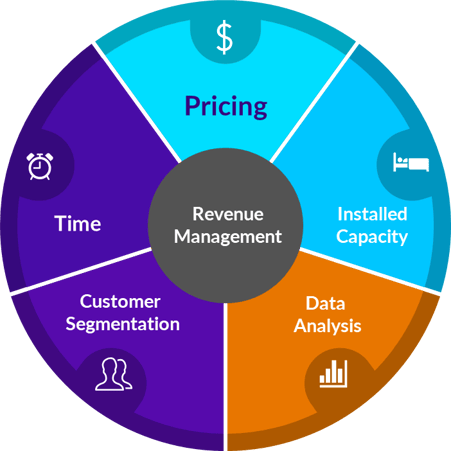
When we talk about Revenue Management, we refer to a broader and more complex discipline that seeks to maximize a company's total revenue through the dynamic management of prices, the value of time and installed capacity. This discipline includes pricing, but it also includes customer segmentation, the analysis of historical and predictive data and the adaptation of marketing and sales strategies to optimize installed capacity and profitability as demand changes. If you want to learn more, you can read my other article, What is Revenue Management?

While Pricing is an integral part of Revenue Management, the latter takes a more holistic approach that considers multiple variables and uses advanced analytical techniques to make strategic decisions. A useful way to put it for an executive committee is that Pricing answers the question of what something is worth, and Revenue Management answers the question of how to sell the capacity we have, at what moment and to whom, so that the total result is the best possible.

>> TDABC: The Revolution of ABC Cost Models <<

Revenue Management as a broader discipline that includes pricing, segmentation, demand and capacity

>> What is the Difference Between Job Order Costing and Process Costing? <<

Which tools are used in Pricing?

The tools used in Pricing are diverse and designed to help companies determine the most appropriate price for their products or services, taking into account the many factors that influence purchasing decisions and market competitiveness. The first is cost analysis. Calculating all the costs associated with the production and marketing of a product or service is important for strategic decision-making. It is necessary to determine both fixed and variable costs to understand how much it costs to manufacture and sell each unit. Only by understanding the cost structure in depth can a company establish a price that covers expenses and provides a sufficient profit margin to ensure the long-term viability of the business.

>> What are Cost Centers? <<

The second is market studies. Market research makes it possible to decipher the complex dynamics between supply and demand within a sector. Using techniques such as surveys, focus groups and careful analysis of sales data, it is possible to identify emerging trends, gauge the potential of demand and determine the price threshold that consumers are willing to pay for a particular item or service. This in-depth knowledge of the market is essential to set competitive prices that maximize the chances of commercial success.

The third family of tools is the set of pricing strategies a company can choose from, depending on its objectives and market context. Dynamic pricing adjusts prices in real time in response to demand, competition and other market factors, and is common in industries such as hospitality and aviation, where demand can vary significantly. Psychological pricing is based on consumer perception. A common example is setting the price at $29.99 instead of $30.00 to make the product appear cheaper; it relies on the unconscious tendency of consumers to ignore the numbers after the decimal point, while the first digit gives the illusion that the price falls in the $20 range instead of the $30 range.

Penetration pricing sets a low price for a new product to attract many customers quickly and gain market share, after which the company can gradually increase prices once the customer base is established. Skimming does the opposite, setting a high initial price to capture revenue from consumers willing to pay more and then gradually lowering it to reach a broader segment of the market. Value-based pricing rests on the value consumers perceive in the product or service rather than on its production cost. Prices are set according to the benefits customers believe they will receive, which is common in luxury products, where brand and perceived quality weigh heavily in the purchase decision.

Pricing strategies such as dynamic, penetration, skimming and value-based pricing

>> Understanding Costing Methodologies <<

Competition-based pricing, also known as competitive pricing, sets prices with reference to competitors. The prices of similar products in the market are analyzed and the company's own prices are set accordingly, whether by matching, undercutting or slightly exceeding them to stand out. Captive pricing sets a low price for a base product and higher prices for the complementary products or accessories needed to use it, as with printers and ink cartridges or coffee makers and coffee capsules. Bundle pricing sells several products or services together at a single price lower than if they were purchased separately, which increases the value the customer perceives, encourages the sale of additional products and raises the average ticket.

Freemium pricing, common in software and digital services, offers a basic version of the product for free while advanced or premium features carry an additional cost, which attracts a broad user base and converts part of it into paying customers. Subscription pricing sets a recurring price, typically monthly but sometimes annual, for continuous access to a product or service. It is common in digital and streaming services, software and recurring consumption businesses such as gyms and clubs, and it generates regular and predictable income.

The fourth tool is competitive comparison. These tools analyze the prices of similar products in the market, monitor competitors' prices, compare product features and evaluate each competitor's value proposition, so that prices remain competitive and attractive without sacrificing profitability. The fifth is price management software. Several solutions are designed to manage and optimize pricing strategies by automating price adjustments, providing real-time analysis and offering data-driven recommendations to maximize revenue. They are especially useful, or even indispensable, for companies with a large product portfolio, different segments and frequently adjusted pricing strategies.

>> Transforming data into business decisions <<

Where do Pricing and Revenue Management apply across industries?

Revenue Management was born in aviation and matured in hospitality, but its logic now reaches any business with fixed or perishable capacity and variable demand. Car rental companies, cruise lines, event venues, parking operators, private clinics with operating rooms and logistics companies with trucks and warehouse space all face the same problem as the hotel in our example. In each of them, the most important decisions are about allocating limited capacity among segments and over time.

Other industries rely mainly on Pricing, but increasingly borrow tools from Revenue Management. A consumer goods manufacturer sets list prices by channel and pack size and then manages promotions and trade terms with the retail chains, where timing and segmentation matter as much as the price itself. A distributor or industrial manufacturer negotiates prices by customer and volume, and benefits from knowing which accounts consume more capacity and service than their price pays for. Online retailers use dynamic pricing to respond to competitors and inventory levels, as explained in our article on dynamic pricing in ecommerce. Banks and insurers price risk by segment and channel, and telecom operators combine subscription, bundle and captive logic in the same portfolio.

What this means for the C-level

For the chief executive and the chief financial officer, the first implication is governance. Pricing decisions are among the most profitable a company makes, yet in many organizations they are distributed among sales, marketing and finance without a clear owner or a shared method. Defining who sets list prices, who approves discounts and who manages dynamic adjustments, and on what data, is often worth more than any single price change.

For commercial and marketing leaders, the lesson is that price is part of the customer experience and of the value proposition. Segmenting customers by willingness to pay, booking window or channel allows the company to attract new customers with entry offers, convert them with well-designed bundles and retain them with subscriptions or loyalty terms, without eroding the price for everyone. For operations leaders in capacity-constrained businesses, Revenue Management connects demand with capacity, which turns idle hours, empty rooms or unused trucks into revenue and improves efficiency without adding cost.

How to start strengthening Pricing and Revenue Management

An experienced consultant would suggest starting with a diagnosis rather than with software. Gather the actual prices obtained by product, customer and channel over the last year, compare them with list prices and with costs, and look for where discounts concentrate and where margin leaks. That exercise usually reveals that a small share of products and customers generates most of the profit, which is the first input for any pricing decision. The ICX Traffic and Pareto Analysis Toolkit helps structure that analysis.

If your business has limited capacity and fluctuating demand, the next step is to measure demand by segment and booking window, define the segments that deserve different prices and conditions, and establish a regular forecasting and price review routine with clear decision rights. Only then does it make sense to select a revenue management system, because the tool will automate a method the organization already understands.

Conclusion

Although Pricing and Revenue Management are terms often confused, each has a distinct and complementary role in managing a company's revenue and profitability. Pricing focuses on determining the right price for a product or service, considering factors such as costs, competition and customer perception. Its primary goal is to maximize sales and profitability per unit sold, using tools such as cost analysis, market studies and various pricing strategies.

Revenue Management adopts a more comprehensive and strategic perspective that includes pricing but also dynamic price management, customer segmentation, historical and predictive data analysis and the adjustment of marketing and sales strategies to optimize capacity and profitability as demand fluctuates. It uses advanced techniques, such as predictive models, to anticipate changes in demand and proactively adjust rates, thereby maximizing overall revenue. Understanding the differences between these concepts allows companies to implement strategies that take full advantage of market opportunities and improve financial results. By combining the precise tactics of Pricing with the broad vision of Revenue Management, you can manage your revenue comprehensively and effectively and optimize your company's profitability.

How ICX helps

ICX Consulting helps leadership teams turn pricing into a managed capability. Our pricing and revenue consulting covers price strategy development, revenue management and margin analysis, and our PCR methodology connects pricing, costing and revenue management in a single diagnostic so that every price decision rests on real costs and real demand.

Frequently asked questions

Is Revenue Management the same as dynamic pricing?

No. Dynamic pricing is one technique that Revenue Management uses, adjusting prices as conditions change. Revenue Management also includes segmentation, demand forecasting, capacity allocation, channel management and the rules that decide which customer gets which offer and when.

Which companies need Revenue Management and not only Pricing?

Companies with fixed or perishable capacity and demand that varies over time, such as airlines, hotels, car rental, events, healthcare facilities and logistics operators, benefit most. Businesses without capacity constraints usually gain more from strengthening pricing strategy, discount governance and margin analysis.

Can a B2B company apply Revenue Management principles?

Yes. A manufacturer with limited plant capacity or a service firm with scarce specialists can prioritize the customers and orders that make the best use of that capacity, set different terms by urgency or volume and manage price exceptions with clear rules.

What should be in place before investing in pricing software?

Clean transaction data, an agreed cost base, defined customer segments and clear decision rights over prices and discounts. Without them, software automates inconsistent decisions; with them, it accelerates a method the organization already trusts.

Every price your company quotes is a decision about margin, customers and capacity. Request a diagnostic with an ICX consultant and find out how much revenue your current pricing leaves on the table.

GET CONSULTING

Content added to ICX Folder
Default Save Save Article Quit Article

Save for later

Print-Icon Default Print-Icon Hover

Print

Subscribe-Icon Default Subscribe-Icon Hover

Subscribe

Start-Icon Default Start-Icon Hover

Start here

Suggested Insights For You

Automate Accommodation Reservations with Revenue Management

Automate Accommodation Reservations with Revenue Management

At ICX Consulting, where we advise hotels and hospitality groups on pricing, revenue and customer experience, we see that automating accommodation...

What is Revenue Management?

What is Revenue Management?

You're just a couple of weeks away from enjoying your long-awaited and well-deserved vacation when you realize that the hotel reservation hasn't been...

Competitive Pricing Without Falling Into a Race to the Bottom

Competitive Pricing Without Falling Into a Race to the Bottom

A competitive pricing strategy uses competitor prices as one input, then applies rules for margin, market and product role before any price changes....

What's next?

ARE YOU READY?

ICX SUBSCRIPTION
Stay ahead with exclusive insights from our senior consultants. Subscribe for the latest thinking on CX, growth, and digital transformation.