











Understanding Costing Methodologies
 Iván Arroyo : May 29, 2025
Costing methodologies are the rules a company uses to assign costs to its products, services and customers. The four most used are absorption...
8 min read
8 min read
The difference between job order costing and process costing lies in how costs are accumulated. Job order costing assigns materials, labor and overhead to each individual job, order or project, which suits customized work. Process costing accumulates costs by production stage and divides them by the units produced, which suits continuous, standardized mass production.
In a market where more and more companies compete on efficiency and profitability, knowing the exact cost of producing goods or services can be the difference between financial success and failure. For many organizations, cost accounting is not just an administrative tool but a key strategy for optimizing resources and maximizing profit margins. Without adequate control over these costs, companies risk losing competitiveness, making uninformed decisions or even devaluing their products. This is precisely where job order costing and process costing come into play, offering structured methodologies to understand and manage production costs efficiently.
Picture the monthly operations review at a mid-sized manufacturer that makes both standard products for distributors and custom orders for industrial clients. The sales director is pleased, because a large custom order was won against two competitors. The plant manager is not, because the order consumed engineering hours, special tooling and overtime that nobody included in the quote. The CFO looks at the numbers and realizes the problem is structural. The company prices its custom work with the same average unit cost it uses for its standard line, so every complex order looks profitable on paper and loses money on the floor. The issue is not effort or discipline. It is the costing system.
Especially in the manufacturing sector, cost management is crucial to the efficiency, profitability and competitiveness of operations. Companies rely on specific cost accounting systems to identify, assign and control the resources invested in their products or services. Among these systems, job order costing and process costing stand out as the most widely used, each addressing the needs of a different type of production. Applied correctly, they give a precise understanding of the expenses involved and improve strategic decisions about pricing, product mix and resource allocation.
Each costing system serves a different operating environment and has its own method for accumulating and distributing costs. Job order costing is designed for companies that manufacture customized products or perform specific services, which makes it suitable for settings where each project has unique characteristics. Process costing is ideal for industries that produce goods in continuous mass production, allowing a homogeneous distribution of costs across all units produced.
The standard managerial accounting literature frames the distinction the same way. As the OpenStax textbook Principles of Managerial Accounting explains, job order costing traces direct materials and direct labor to each job on a job cost sheet, while process costing accumulates costs by department or process because tracing them to individual identical units is impractical. The same source notes that job order costing is generally more expensive to maintain, and that many companies use hybrid systems, mass-producing components under process costing while costing customized final products by job. For a broader map of the alternatives, see our overview of what costing methodologies exist.
The job order costing system is essential in sectors where products or services are not mass-produced but respond to the particular specifications and needs of each client. In this approach, each job order becomes an independent unit of cost analysis, to which all the necessary resources, such as materials, direct and indirect labor and general manufacturing costs, are assigned in detail. This enables precise and transparent control of the costs of each project and gives a clear view of the profit margin and profitability of each order.
A typical example is the manufacture of personalized furniture. When a customer orders a piece with a special design, materials and measurements, each stage of production, from wood selection to assembly and final finishing, is recorded on a single work order. The costs of lumber, tools, paint and labor are assigned exclusively to that order, which makes it easy to calculate the total cost and allows the company to set a selling price that delivers a profit.
Construction applies the same logic. Each project, such as a custom home built to the owner's requirements, is treated as a work order with defined characteristics. The costs of basic inputs such as cement, steel and wood, the payroll of the technical staff involved, from architects to masons and electricians, and the inevitable indirect costs such as permits and insurance are specified in detail. By centralizing this information in a single account, the company can calculate the total cost of the construction faithfully and assess the financial feasibility of the project. To organize those indirect costs, it helps to understand what cost centers are and how they feed each job.
Job order costing is also used in professional services, for example in an advertising agency that designs exclusive campaigns for its clients. Each advertising campaign, with its creative elements, strategy and media, is managed as an independent job order. Associated costs, such as graphic design, influencer contracts, ad production and advertising space, are assigned directly to that campaign, so the agency can calculate the total cost and set its fee to ensure adequate profitability. The same applies to consulting firms like ICX, where each project has unique characteristics and a job order is created for each one to accumulate its costs.

Process costing is the optimal method for industries that mass-produce goods without interruption, where each unit is practically identical to the previous one. It accumulates expenses at each stage of the production flow, whether inputs, labor or overhead, and then divides them by the total number of units manufactured. The result is an average cost per unit, which simplifies cost analysis where volumes are high and operations are homogeneous. Beyond calculating unit costs, the technique supports the scheduling and control of resources, because it lets managers anticipate disbursements and adjust processes to reduce expenses.
A typical example is the food and beverage industry, such as a bottling plant. The production process is continuous, and every bottle is identical in size, content and presentation. Ingredient costs, machine operation labor and indirect expenses such as electricity and maintenance accumulate at each stage, from mixing to bottling and packaging. At the end of the period, total costs are divided by the number of bottles produced, giving a unit cost that reflects the average expense of each bottle. That unit cost then becomes the floor for pricing decisions, a topic we develop in what pricing is and how it differs from revenue management.
The textile industry offers another example in the production of basic t-shirts. In a factory that produces large quantities of the same style, each stage, such as weaving, cutting, assembly and printing, generates costs that accumulate in that process, including cotton, worker salaries and machine maintenance. At the end of the production period, the average cost of each t-shirt is calculated by dividing total costs by the number produced, which gives the company its base cost for setting prices and analyzing profitability.
A third example comes from the chemical industry, in the manufacture of liquid detergents. The process is continuous, and each batch is homogeneous in composition and characteristics. The costs of chemical components, water, packaging, labor and other indirect costs accumulate in each phase, such as mixing, bottling and labeling. At the end of production, the total cost is distributed across the bottles produced, giving an average unit cost that helps calculate margins and adjust production to market demand.

The choice between job order costing and process costing depends on the nature of production and on each company's financial control objectives. Both systems offer clear benefits but also present challenges that affect cost management and operational efficiency. The table below summarizes the main advantages and disadvantages of each, to help assess which best suits a company's production and financial control needs.
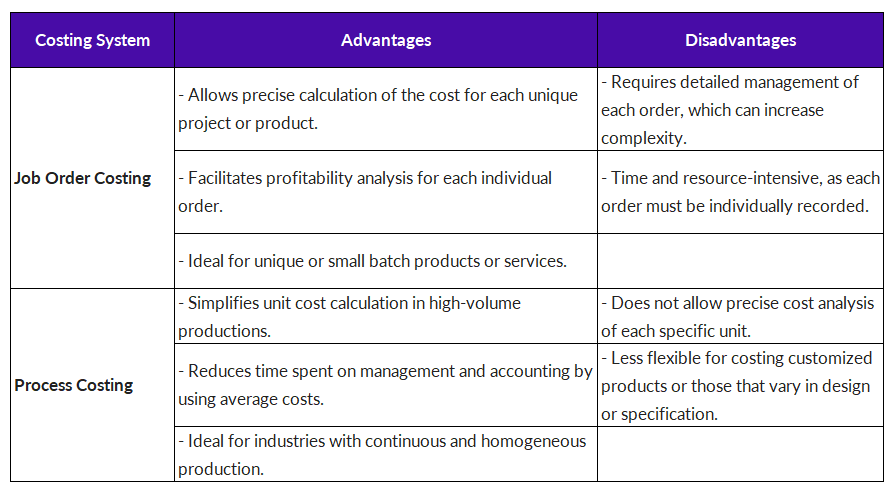
In executive terms, the trade-off is precision against effort. Job order costing tells a company exactly what each order cost, which is invaluable for quoting, for negotiating change orders and for identifying which clients are profitable, but it requires disciplined time and material tracking, and that discipline has a cost. Process costing is simpler and cheaper to run, and it is the natural choice when units are truly identical, but its averages can hide meaningful differences. If two product variants run on the same line and one requires twice the setup time, an average unit cost will subsidize the complex variant with the margin of the simple one. That is exactly the trap our manufacturer fell into, applying a process logic to work that behaved like a job.
Neither system, on its own, answers every question a leadership team asks. Both are good at assigning direct costs, but both rely on allocation rules for overhead, and those rules can distort profitability by product, channel or customer. That is why many companies complement them with activity-based approaches. Robert Kaplan and Steven Anderson's time-driven activity-based costing, described by Harvard Business School Working Knowledge, simplifies the model to two inputs, the cost per minute of available capacity and the time each activity takes, which makes overhead assignment far more realistic. Our article on avoiding common ABC costing errors covers the pitfalls.
The following tables group industries by the costing system they typically apply, job order costing or process costing. The distinction matters because each system responds to the production characteristics of a sector, and seeing them side by side helps match the system to the specific needs of each type of operation.
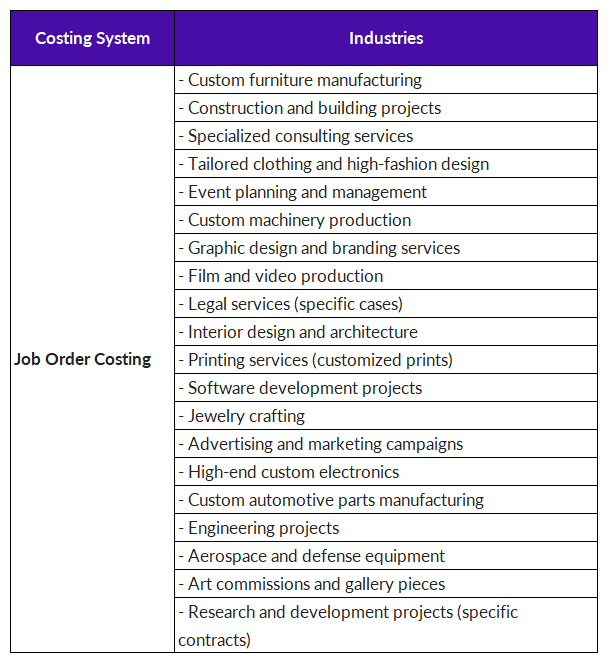
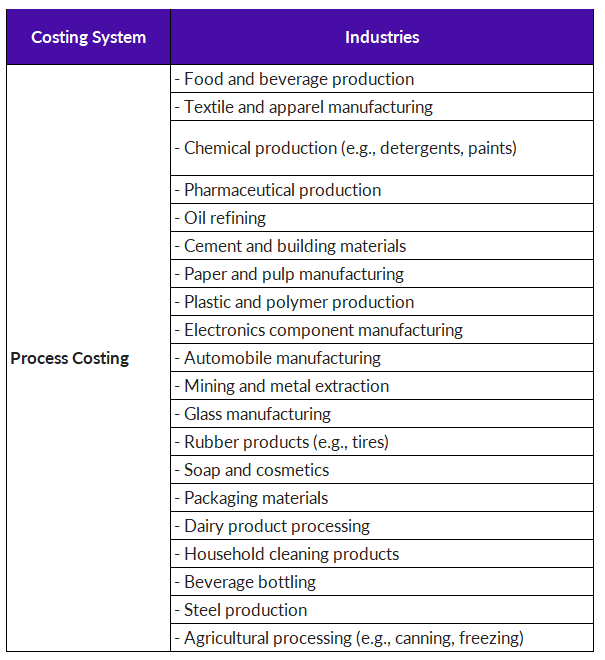
Real companies rarely fit neatly into one column. A food manufacturer may run its core brands under process costing and its private-label contracts as jobs. A printing company may treat standard catalogs as a process and custom packaging as orders. A bank's back office processes payments as a homogeneous flow while its corporate lending desk structures each deal individually. The practical question is not which system the industry uses, but which parts of the business behave like a job and which behave like a process. Answering it usually requires a short walk through the plant or the service floor with finance and operations together, because the people who schedule the work know better than any ledger where standard flows end and exceptions begin. That conversation is often the first time both teams agree on what a product really costs.
For the CEO and the CFO, the costing system is not an accounting preference. It determines which customers look profitable, which products get pushed by the sales team and which quotes win business that the company should have declined. A system that does not reflect how the operation really consumes resources will steer growth toward the wrong orders, and the damage appears in the margin months after the decisions were made.
For commercial leaders, the lesson is to connect costing with pricing and quoting. Custom work deserves a job-level cost estimate before the quote goes out and a job-level review after delivery, so that estimators learn and pricing improves. Standard lines deserve a process cost that is updated as volumes, inputs and mix change. When both disciplines are in place, sales can pursue growth with confidence, operations can plan capacity with real numbers and finance can explain the margin instead of discovering it.
An experienced cost consultant would suggest starting with a simple diagnostic. Take the last twelve months of orders and classify them into those that were genuinely standard and those that required specific engineering, materials or handling. For a sample of the custom orders, rebuild the actual cost by job and compare it with the cost that was used to quote them. The gap, positive or negative, shows whether the current system is fit for the business.
From there, decide which parts of the operation should be costed by job, which by process and where an activity-based layer is needed for overhead. Assign an owner, define the data that must be captured on the floor and review the results with sales every month. Within two or three quarters, the quotes that win the order will also be the quotes that protect the margin.
ICX Consulting helps companies build costing models that support pricing and commercial decisions. Our cost management consulting practice designs job, process and activity-based cost management models, and our proprietary methodologies, PCR (Pricing, Costing & Revenue Management) and Costing IQ, connect cost with price and revenue so that every commercial decision considers its effect on margin.
To begin structuring overhead the right way, use the ICX Cost Drivers for ABC Costing Model toolkit and identify the drivers that explain how your jobs and processes really consume resources.
Yes. Many companies run hybrid systems, costing standardized components or product lines by process and customized orders by job. The key is to define clearly which products, lines or contracts fall under each system and to keep overhead allocation consistent across both.
Service firms that deliver unique projects, such as consulting, agencies or engineering, usually need job order costing to know the profitability of each engagement. Service operations that handle large volumes of identical transactions, such as payment processing or reservations, can use process costing for those flows.
The costing system defines the cost floor that pricing builds on. If custom work is costed with standard averages, complex orders are underpriced and simple ones overpriced, which pushes the company toward the least profitable business. Accurate job and process costs make value-based pricing and margin targets credible.
In conclusion, job order costing and process costing offer specific and tailored approaches to cost management, depending on the production characteristics and strategic needs of each company. Job order costing is essential where customization, uniqueness and detailed tracking of each project or client are priorities, while process costing is ideal for mass production in standardized, homogeneous environments, where it optimizes unit costs and simplifies accounting on continuous production lines.
Choosing the right system ensures accurate and reliable accounting and directly affects profitability by providing clear information for strategic decisions. It also strengthens competitiveness, because effective cost control helps identify improvement opportunities, reduce waste and adjust prices competitively without compromising quality. Understanding the advantages, limitations and practical applications of each system allows a company to align cost management with its financial, operational and market objectives, and a well-selected costing system becomes a strategic tool for optimizing resources, improving efficiency and ensuring long-term sustainability. If you want to know whether your current costing system is quietly rewarding the wrong orders, request a diagnostic with an ICX consultant and see your margin by job, product and customer.


Iván Arroyo : May 29, 2025
Costing methodologies are the rules a company uses to assign costs to its products, services and customers. The four most used are absorption...

Iván Arroyo : May 29, 2025
ABC costing (Activity-Based Costing) is a cost accounting method that assigns indirect costs first to the activities that consume resources, and then...

Iván Arroyo : May 29, 2025
Standard costs are the costs a company should incur to produce one unit of a product or service under defined conditions of materials, labor,...

