PCR (Pricing, Costing & Revenue Management)
ICX Consulting's integral diagnostic for understanding how your company calculates costs, sets prices and manages revenue, and for rehabilitating its profitability.
PCR (Pricing, Costing & Revenue Management) is ICX Consulting's integral diagnostic that reviews, together, how a company calculates its costs, how it sets prices and discounts and how it runs its commercial process. Its purpose is to find where margin is lost and define the decisions that win it back.
In meeting after meeting with CEOs, business owners and boards, the same sentence comes up regardless of country or industry. We are selling more than ever, yet the profit does not show up. Finance arrives with worrying numbers, sales argues that deals do not close without discounts, operations produces more on the same budget and the CEO ends up refereeing between functions that should be chasing the same goal.
The name is deliberate. PCR conveys the idea of rehabilitating a business, because most companies skip this analysis or do it only superficially. It is the starting point of ICX profitability work, and its decisions are sustained over time with Costing IQ and Pricing IQ, the monthly costing and price management services of the ICX pricing and revenue practice.
WHAT IS PCR
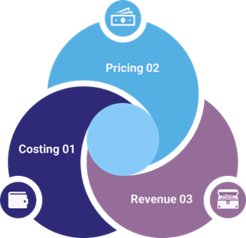
PCR is a working system that connects three dimensions almost always managed separately. How costs are calculated, how prices and discounts are set, and how the commercial process runs day to day. Seen separately, all three seem to work. Once they are connected, the contradictions appear, such as products that sell well but destroy value, large customers with terms nobody dares to review and commissions that pay for volume even as margin evaporates.
It starts from a conviction the ICX Pricing, Costing & Revenue Management practice repeats in every engagement. You cannot talk seriously about price without clarity on cost. You cannot talk about revenue if the commercial process is not aligned with profitability. And you cannot talk about sustainable profitability while these three elements are governed as separate islands.
When ICX walks into an organization, it rarely finds total chaos. It finds partial order. Finance has its statements up to date, sales has reports on revenue, quotas and forecasts, and operations knows how many shifts it needs. The sense of control cracks under specific questions. What is profitability by SKU, not just by product line. What share of the portfolio destroys value even though it sells well. How much margin is really lost to discounts and promotions. And whether commissions reward volume or profitability.
PCR answers those questions with data and turns them into decisions leadership can defend before the executive committee and the board.
PCR is not a project that is delivered and archived. It is a change in the way leadership thinks and talks about the business.
Iván Arroyo, practice director
BENEFITS OF PCR
Many businesses live with a dangerous paradox. They show sales growth, yet cannot explain why profit does not grow the same way. PCR exists to close that gap. Price is the most powerful profit lever, and a classic McKinsey analysis estimated that a 1% price increase, with stable volumes, would lift operating profit by about 8%. The same arithmetic works against the company with every discount that is not justified. PCR lets leadership use that lever with a reliable cost floor and a commercial process that respects it.
For the board and owners, PCR provides an integral view of where value is created and destroyed by product, customer and channel, and an objective basis for decisions on the portfolio, commercial investment and annual targets.
For the CEO, PCR ends the role of referee. Finance, sales and operations stop arguing with different numbers and start deciding on the same cost model, the same pricing policy and the same metrics.
For the CFO, unit cost stops being calculated once a year or by product family. PCR assigns overhead with consumption drivers and shows the true margin left after discounts, promotions and cost to serve.
For the chief sales officer, discounts stop being case-by-case concessions and become tools of an explicit policy, with metrics and incentives that reward mix and margin, not only volume.
Across the value chain ICX works on with its clients, PCR acts on three decisions. Converting better, because every quote starts from a defensible price. Retaining and building loyalty with the right customers, because commercial terms reflect what each one contributes. And operating more efficiently, because cost to serve becomes visible and manageable.
Do you know which products and customers are subsidizing others? Request a diagnostic with an ICX consultant.
HOW PCR WORKS
PCR works on three pillars at the same time, because each one loses strength when it is addressed without the other two.
True costing
The first pillar is knowing the true unit cost by SKU, with direct costs and overhead assigned through consumption drivers such as machine hours, line changeovers, order lines, miles traveled or deliveries made. Volume star products often turn out to be silent value destroyers, because they demand more changeovers, more logistics handling and frequent small orders. This is the pillar that Costing IQ keeps alive afterwards.
Pricing with governance
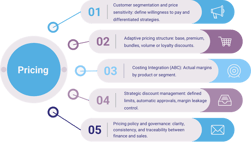
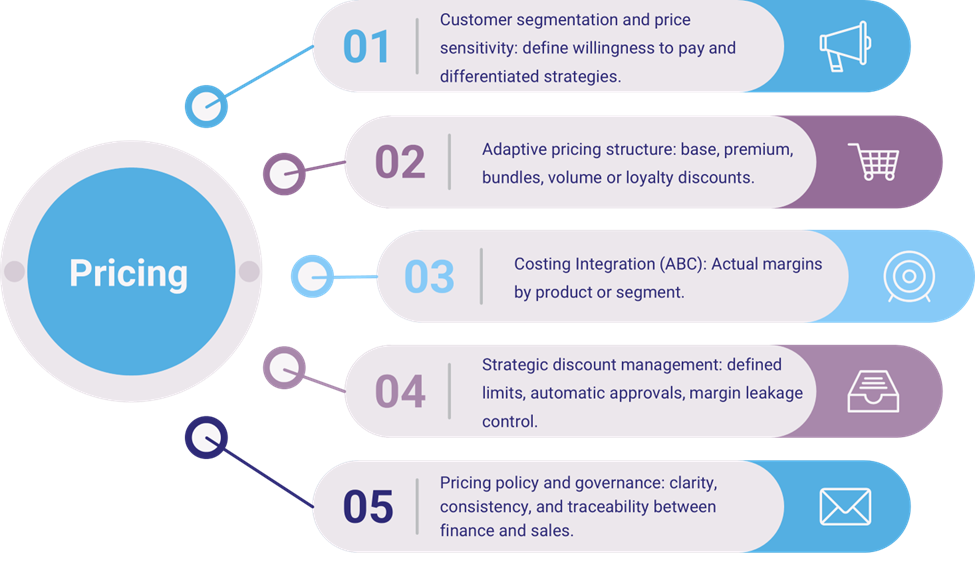
With true cost as the floor, PCR designs a price and discount architecture by segment, channel, region, customer type, perceived value and the role of each product in the portfolio. Larger discounts are reserved for volume commitments, better payment terms, exclusivity or long-term contracts, and they become rules instead of each salesperson's personal judgment. Pricing IQ sustains that discipline month after month.
Revenue and the commercial process
The third pillar reviews the sales funnel and the CRM that supports it, what gets recorded, what gets left out and where opportunities are lost, so the CRM helps manage profitability instead of working as an expensive spreadsheet. From there, metrics and incentives are redesigned so commissions stop being indifferent to what is sold.
Three moments of work
Experience has led ICX to run PCR in three moments. The diagnostic is concentrated in about a month and closes with a clear map of gaps and opportunities, along with impact hypotheses on where value is being destroyed, which products or customers are being subsidized and which decisions could deliver visible short-term improvements. Execution usually runs six to nine months. During that stage the costing model is built, the price architecture and discount policies are defined, the CRM is reconfigured and metrics and incentives are redesigned, always together with people from finance, sales and operations. Follow-up support can extend up to twenty-four months, because costs, product mix, competition and markets change, and without structured follow-up organizations drift back to old habits.
Technology is chosen according to company size. For mid-sized and large companies, Pricing IQ includes Symson and Costing IQ can rely on My ABCM. For small companies, both run on the Microsoft stack, with Power BI, Fabric and similar tools. In every case, the rules reach HubSpot, Salesforce or the CPQ the company already uses.
Pricing analyzes. Sales Architecture designs. The CRM operationalizes. The CPQ executes.
Talk to an ICX consultant
USE CASES
When PCR makes sense
Companies usually come to PCR through recognizable symptoms. Sales grow but profit does not. Nobody can say with certainty which products or customers make money. Price lists are updated only for inflation and discount policies are full of exceptions. Finance, sales and operations bring different numbers to the same question. Or the board asks why margin falls while volume rises.
Portfolio decisions
One of the tensest moments of PCR comes when portfolio profitability is put on the table. There are always products the market loves and sales defends, yet they consume more than they contribute. ICX does not arrive with an axe in hand. Before eliminating anything, it explores alternatives such as reviewing specifications and raw materials, renegotiating with suppliers, adjusting packaging and production batches, changing channel strategy, repositioning the product toward segments willing to pay more or bundling it into packages. Only when the numbers stay in the red does elimination become a serious option, and leadership decides with clear scenarios for each alternative.
An illustrative example
Imagine a portfolio of cleaning products with three sizes of the same detergent. Without a driver-based model, all three look equally profitable. With PCR a different truth usually emerges, because the small size is far more expensive to handle than averages suggest. The answer may be a minimum price below which the sale is not authorized, offering it only in bundles with profitable SKUs or charging a higher price per liter in segments that value convenience.
Commissions that point sales energy in the right direction
Consider a sales team paid a flat commission on gross sales. The most logical way to maximize personal income is to push whatever the customer accepts fastest, not necessarily what is most profitable. With PCR, products with a high contribution to profit can carry more attractive commissions, and sales energy flows toward where the company actually earns.
Further reading from the practice
The criteria behind PCR are developed in Iván Arroyo's article PCR Methodology and in the practice's analysis of how pricing differs from revenue management and ABC costing. You can also explore the Pricing IQ and Costing IQ methodologies and the margin analysis and activity-based cost management services.
If you want to know where your margin is going, request a diagnostic with an ICX consultant.
7 min read
When Sales Has to Correct AI
Sep 23, 2026 by Eduardo García Camilli
31 min read
The mistake of turning a customer into a photograph
Sep 22, 2026 by Yashin Fonseca
17 min read
Key reasons why your customers leave your website
Sep 8, 2026 by Yashin Fonseca
10 min read
The customer journey no longer begins on your website
Jul 17, 2026 by Yashin Fonseca
13 min read
Why your customers no longer complete satisfaction surveys
Jul 16, 2026 by Yashin Fonseca
ICX PLATFORMS
Everything your company needs to succeed
ICX PLATFORMS
Everything your company needs to succeed
Costing IQ
The ICX monthly service that keeps the costing model built in PCR alive and turns it into the floor of every pricing decision.
Pricing IQ
The ICX monthly service that manages prices and discounts continuously on top of the architecture defined in PCR.
CRM and CPQ
ICX takes price, discount and profitability rules into HubSpot, Salesforce or the company's CPQ so they apply to every quote.
Pricing and costing platforms
For mid-sized and large companies, Pricing IQ includes Symson and Costing IQ can rely on My ABCM. For small companies, both run on the Microsoft stack, with Power BI, Fabric and similar tools.
FREQUENTLY ASKED QUESTIONS
-
What is PCR?
PCR stands for Pricing, Costing & Revenue Management. It is ICX Consulting's integral diagnostic that reviews a company's costs, prices and discounts and commercial process together to find where margin is lost and define the decisions that win it back.
-
How long does PCR take?
The diagnostic is concentrated in about a month. Execution usually runs six to nine months, and follow-up support can extend up to twenty-four months, because costs, product mix and markets change and decisions need structured follow-up.
-
What does the PCR diagnostic deliver?
A clear map of gaps and opportunities, with impact hypotheses on where value is being destroyed, which products or customers are being subsidized and which decisions could deliver visible short-term improvements.
-
How does PCR relate to Pricing IQ and Costing IQ?
PCR diagnoses and designs. Costing IQ keeps the cost model alive and Pricing IQ manages prices and discounts every month. Both are monthly services that sustain the decisions made in PCR over time.
-
Why is it called PCR?
Beyond bringing together pricing, costing and revenue management, the name conveys the idea of rehabilitating a business. Most companies skip this analysis or do it only superficially, and PCR puts it at the center of the leadership agenda.