Skip to the main content.

What We Offer

ICX helps companies grow revenue and profitability by connecting customer experience, sales, pricing, CRM and automation into one commercial system.

Customer Experience

We design memorable, customer-centered experiences that drive loyalty, enhance support, and optimize every stage of the journey. From maturity frameworks and experience maps to loyalty programs, service design, and feedback analysis, we help brands deeply connect with users and grow sustainably.

Marketing & Sales

We drive marketing and sales strategies that combine technology, creativity, and analytics to accelerate growth. From value proposition design and AI-driven automation to inbound, ABM, and sales enablement strategies, we help businesses attract, convert, and retain customers effectively and profitably.

Pricing & Revenue

We optimize pricing and revenue through data-driven strategies and integrated planning. From profitability modeling and margin analysis to demand management and sales forecasting, we help maximize financial performance and business competitiveness.

Digital Transformation

We accelerate digital transformation by aligning strategy, processes and technology. From operating model definition and intelligent automation to CRM implementation, artificial intelligence and digital channels, we help organizations adapt, scale and lead in changing and competitive environments.


Operational Efficiency  

We enhance operational efficiency through process optimization, intelligent automation, and cost control. From cost reduction strategies and process redesign to RPA and value analysis, we help businesses boost productivity, agility, and sustainable profitability.

Customer Experience

chevron-right-1

Marketing & Sales

chevron-right-1

Pricing & Revenue

chevron-right-1

Digital Transformation

chevron-right-1

Operational Efficiency 

chevron-right-1

Costing IQ

The ICX Consulting methodology and monthly service for knowing the true cost of every product, customer and channel, and turning it into pricing and efficiency decisions.


Costing IQ is ICX Consulting's proprietary methodology for building activity-based costing (ABC) and time-driven ABC (TDABC) models that reveal true profitability by product, customer and channel. ICX maps activities, defines cost drivers, builds the model with time equations where useful and connects the results to pricing decisions through PCR. Like Pricing IQ, Costing IQ is delivered as a monthly service.

Ask a company for the unit cost of a specific product and the answers tend to sound alike. We have it by product family, not by SKU. We calculate it once a year to adjust prices. We have direct costs and manufacturing overhead, but not administrative and selling expenses. Making pricing and portfolio decisions on that basis is like flying a plane with an altimeter that works more or less.

Costing IQ rebuilds that instrumentation. It is the true-costing pillar of the ICX system for profitability, alongside the PCR (Pricing, Costing & Revenue Management) diagnostic and the ongoing price management of Pricing IQ, and it draws on the ICX cost management practice.
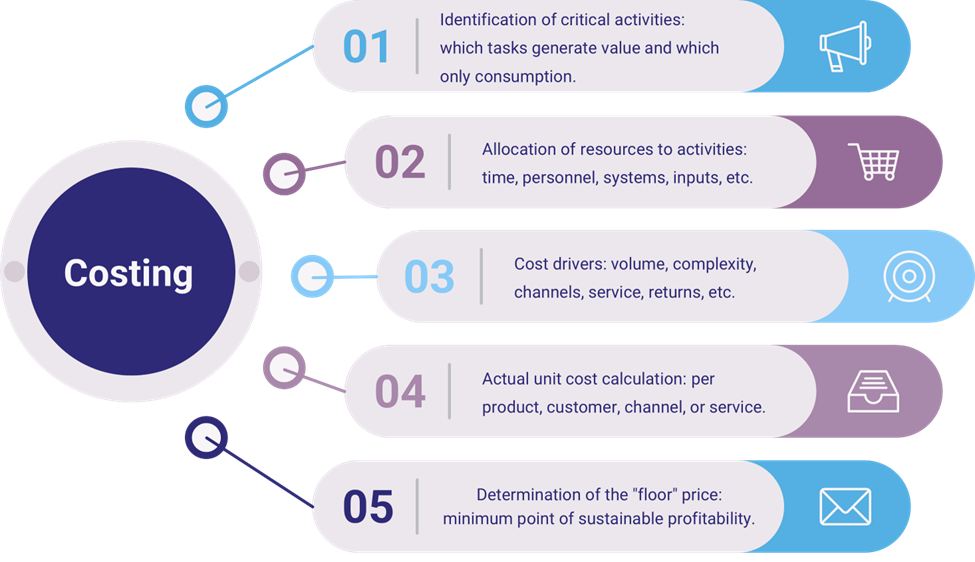
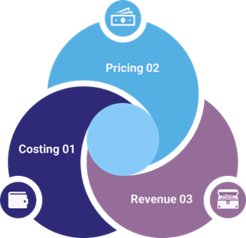
Costing component of the ICX Consulting PCR methodology

WHAT IS COSTING IQ


Costing IQ assigns costs first to the activities that consume resources and then to products, services, customers and channels according to how much of each activity they use. Instead of spreading overhead as a percentage of sales or volume, it relies on consumption drivers that reflect operational reality, such as machine hours, number of setups, order lines, miles traveled or deliveries made.

Where it fits, the model follows the logic of time-driven activity-based costing proposed by Robert Kaplan and Steven Anderson. Instead of surveying employees about how they split their time, it estimates the cost per minute of available capacity and the time each transaction consumes, which also makes unused capacity visible, one of the quietest costs in any operation, as they explain in Harvard Business School Working Knowledge.

The result is a causal chain any manager can audit and a firm floor for everything that comes after. Prices, discounts, portfolio decisions, negotiations with key accounts and commission design all rest on the same number.

Costing IQ does not replace financial accounting or inventory valuation, which follow their own standards. It is a management system for making decisions, and the total it assigns must reconcile with the accounting records so leadership can trust it.

As a monthly service, Costing IQ keeps the model current. Every month operating data is loaded, drivers and capacity use are reviewed, and the updated cost feeds the next month's pricing, portfolio and efficiency decisions. Cost stops being a once-a-year snapshot and becomes a management instrument.

Costing sets the floor of the price. Without a reliable floor, every discount is a bet.

RESOURCES

Profitability diagram from the ICX PCR methodology

Cost Drivers for ABC Costing Toolkit

Costing component of the ICX PCR methodology

Cost Objects for ABC Costing Toolkit


BENEFITS OF COSTING IQ


Most companies do not lack cost data. They suffer from dangerous averages. When overhead is allocated by volume, high-turnover products end up subsidizing low-turnover ones, and customers who demand split deliveries, long payment terms and weekly visits look just as profitable as disciplined customers. Costing IQ makes that difference visible.

For the board and the CEO, Costing IQ turns portfolio reviews into evidence-based decisions. There are always products the market loves and sales defends that consume more than they contribute. The ICX practice does not arrive with an axe. It asks whether each of those products should be redesigned, repositioned or, only when the alternatives run out, retired, with clear scenarios for each option.

For the CFO, cost is no longer a figure calculated once a year. The model shows cost by SKU, customer and channel, separates used from idle capacity and backs margin conversations in front of the executive committee with numbers.

For the head of sales, discounts are no longer negotiated against an average margin but against the true margin of the customer and the order. The sales team knows what it costs to serve each account and can propose differentiated commercial terms.

For operations and procurement, Costing IQ identifies activities that consume resources without adding value for the customer and connects supplier costs with the commercial team, so prices are set on real costs.

For the customer experience leader, the model translates the service conversation into financial language, because it shows what it costs to serve each segment and which customer journey investments reduce cost to serve without eroding loyalty.

Do you know what it really costs to serve your largest customer? Request a diagnostic with an ICX consultant.

ICX APPROACH


Costing IQ is applied within the ICX system for profitability. The PCR diagnostic, which ICX concentrates in about a month, reviews how costs are calculated today and how many layers of detail exist. In the execution stage, which usually runs six to nine months, the costing model is built with consumption drivers alongside the price architecture and commercial rules. After that, Costing IQ runs as a monthly service that keeps the model alive as costs, mix and markets change, within follow-up support that can extend up to twenty-four months.

In ICX practice, a Costing IQ model starts with a specific decision that is made today with insufficient information, such as renegotiating a large contract, reviewing the prices of a product line or assessing the profitability of a channel. That decision defines the scope. Resources are then inventoried, activities are mapped with enough detail to separate different cost behaviors, drivers are chosen from data the company already records in its ERP or CRM and cost objects are defined, whether products, customers, channels or regions. Before the figures reach the executive committee, they are validated with each process owner and the total assigned is reconciled with the accounting records.

Findings do not stay in a report. Through PCR, true cost becomes the floor of the price architecture, and Pricing IQ uses it every month to decide where cost-plus pricing makes sense and where value-based pricing fits better. In processes, the same analysis feeds process cost analysis and redesign and automation priorities, and in operational cost efficiency it measures savings together with the ICX Process Transformation Framework.

Technology follows the decision. A cost model that lives in isolated spreadsheets ends up with a different version in every department, a risk the practice examines in Is Excel cost modeling a path to failure?. The platform depends on company size. For mid-sized and large companies, ICX can implement My ABCM, a specialized activity-based costing tool. For small companies, the model is built on the Microsoft stack, with Fabric, Power BI and similar tools. In both cases it is integrated with the ERP, the CRM and analytics tools.

The ICX Pricing, Costing & Revenue Management practice, led by Iván Arroyo, develops these criteria in its articles on ABC costing, TDABC and cost models people actually use.

Costing IQ turns cost into a firm, defensible floor for every pricing decision.
Talk to an ICX consultant

USE CASES


When Costing IQ makes sense

Costing IQ adds the most value when overhead weighs as much as direct costs and the company offers a wide variety of products, customers or channels. The signals are familiar. Reported margins do not explain the bottom line. The fastest-growing line does not move profit. Finance, sales and operations present three different numbers for the same question. Or the standard cost set at the start of the year no longer describes the operation. In simple, homogeneous businesses the extra precision may not justify the effort, and a focused pilot helps decide with data.

Use cases by industry

Manufacturing. ICX analyzes pricing and cost with PCR, Pricing IQ and Costing IQ. Low-volume SKUs require more line changeovers, smaller purchases and more quality control per unit, and the activity-based model shows which products subsidize others without anyone having decided it.

Distribution and consumer goods. The issue shifts to cost to serve. A customer who buys a lot but demands split deliveries, long credit terms and weekly visits can be less profitable than a disciplined mid-sized customer.

Banking and insurance. The model shows what an account, a policy or a loan application really costs depending on the channel it comes through, which is decisive when leadership debates migrating customers to digital channels.

Omnichannel retail. An online order with home delivery and an in-store order can carry the same price and consume very different activities. Allocating logistics in proportion to sales ends up quietly subsidizing the channel with the highest cost to serve.

Use cases by need

Cost-plus pricing. ICX calculates full cost with Costing IQ, sets markups by segment and channel and compares the result with value-based prices.

Process cost. The model assigns people, time and system costs to each activity to show what a process costs per transaction, and turns the findings into redesign and automation priorities.

Operational efficiency. Costing IQ identifies where costs are lost and measures the savings from redesigned processes.

Procurement. Supplier costs are connected to Costing IQ so the commercial team prices with real costs.

Reading from the practice

The criteria behind Costing IQ are developed in the practice's articles on costing methodologies, standard costs, job order and process costing and the PCR methodology. You can also explore activity-based cost management, cost modeling and forecasting and margin analysis.

If you suspect some products or customers are subsidizing others, request a diagnostic with an ICX consultant.
21 min read
The Customer Journey as a Sales Framework
Right Person, Right Time, Right Product, Right Price. A company can have an excellent product, competitive pricing, and...
7 min read
When Sales Has to Correct AI
B2B buyers increasingly research vendors with generative AI and arrive convinced before they arrive informed. Sales now...
31 min read
The mistake of turning a customer into a photograph
What happens when a company thinks it knows its customers, but in reality only knows an outdated version of them? That...
17 min read
Key reasons why your customers leave your website
There is a moment, in almost any website, portal, or application, when a customer arrives with a clear intention—to pay...
10 min read
The customer journey no longer begins on your website
Your customers have changed. Has your experience changed with them? Most organizations would say yes. They have added...
13 min read
Why your customers no longer complete satisfaction surveys
There is one metric that almost no executive committee examines as seriously as it should: the response rate to its own...
Content added to ICX Folder

ICX PLATFORMS

Everything your company needs to succeed


ICX PLATFORMS

Everything your company needs to succeed


Platforms ICX integrates into Costing IQ

My ABCM


For mid-sized and large companies, ICX implements My ABCM, a tool for activity-based costing, cost modeling and profitability analysis by product, business unit and customer segment.

Microsoft stack and ERP


For small companies, Costing IQ runs on the Microsoft stack, with Fabric, Power BI and similar tools. The model takes its drivers from data the company already records in its ERP, such as orders, shipments or machine hours, so updating it does not depend on manual uploads.

HubSpot


ICX builds profitability logic into the CRM so the commercial team sees the true margin of the customer and the order when it quotes.

Salesforce


For companies that run on Salesforce, ICX brings cost-to-serve information into the CRM so commercial negotiations start from the true margin.

Articles from the ICX Pricing, Costing and Revenue Management practice
What is ABC costing? What advantages does it have over other costings?


How activity-based costing reveals true cost and, with it, the true margin of every product and customer.

Read

Understanding Costing Methodologies


Absorption, variable, ABC and standard costing, and which leadership decision each one informs best.

Read


FREQUENTLY ASKED QUESTIONS

START HERE

Knowing what each product, customer and channel really costs is the foundation of every profitable pricing decision. Request a diagnostic with an ICX consultant

Online Evaluation