











Welcome Aboard: Customer Journey
 Aileen Pierce : Nov 03, 2026
The customer journey is the complete path a customer follows with a company, from the moment they discover a need to the moment they buy, use the...
9 min read
9 min read
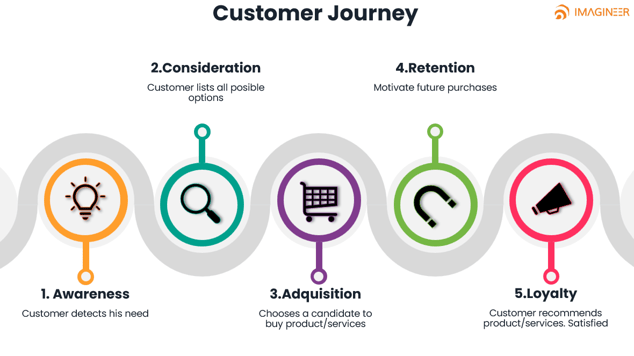
The five relevant aspects that make up a customer journey are its five stages, namely discovery, consideration, purchase, retention and loyalty. Each stage reflects a different customer situation, with its own needs, channels and emotions, and each one asks the company for different actions. Managing all five, not only the sale, is what turns a map into revenue.
Organizations constantly look for the best channels to communicate with customers and prospects, build solid relationships and understand why customers behave the way they do when they interact with a product or service. The customer journey answers these questions. For a leadership team, it also answers a harder question about the exact stage where the company is losing money. A company can win attention and still lose the purchase, or close the sale and lose the customer in the first months. Seeing the five stages side by side shows where growth, margin and retention are leaking.
Consider the board meeting of a company that sells business software to mid-sized firms. The chief executive presents a record quarter for new contracts, and the chief financial officer then shows that a third of the customers who signed twelve months earlier have not renewed. Marketing argues that it delivered qualified leads, sales argues that it met its quota, and customer success argues that the customers were never properly prepared to use what they bought. All three are describing the same customers at different moments, and none of them is describing the whole journey. The renewal figure is the first place where the cost of that fragmentation becomes visible in the income statement.
A customer journey map is the management tool that puts those three conversations on one page. It does not replace the work of each department. It shows how the stages connect, who is responsible for each one and what the customer experiences in the spaces between them.
In this article
The customer journey is the visual representation of the entire experience a customer has when interacting with an organization. It is the path the customer follows from the moment a need arises until the product or service is acquired and used, captured in a map that shows the stages where the customer interacts with the company, so efforts can be segmented according to the consumer's stage.
This information is precious for organizations because it allows them to create strategic marketing plans and, as a result, obtain higher sales. In other words, the customer journey is a method that helps us understand the business from our customer's perspective, so it must not be developed from the organization's point of view. Just like a map that shows how to reach a specific destination, this tool shows the direction to anticipate what comes next and what to consider.
New to the concept? Start with the Introduction to the customer journey.
By building the Customer Journey Map, we create more effective business processes, empathize with our customers and optimize the organization's resources. The map guides us and alerts us to the gaps we need to fill in our strategies, showing the team promptly where we must improve and reinforce our work.
To build the journey we must know our buyer persona, so we can trace that path, and consider the following questions:
With the help of these questions, we can develop the customer journey through its five stages, propose actions for each of them and be more assertive in our value propositions when approaching customers.
Many companies measure each interaction separately, such as the call center, the website or the delivery, and conclude that the experience is fine because each score looks good. The customer does not live the experience in pieces. McKinsey's survey of some 27,000 American consumers found that satisfaction with the whole journey is 30 percent more predictive of overall customer satisfaction than satisfaction with individual touchpoints, and that maximizing satisfaction across journeys can lift revenue by up to 15 percent while lowering the cost to serve by as much as 20 percent.
The same research illustrates the trap with a pay-TV onboarding example: even if each of six interactions had a 95 percent satisfaction rate, up to one in four customers could still have a poor onboarding experience. Small failures add up across a journey, and no single department sees the total.
That is why the five stages matter. They force the organization to look at the handoffs between marketing, sales, operations and service, which is precisely where most experiences break.
Among the benefits of creating and maintaining a customer journey, the following stand out:
Each aspect of the customer journey corresponds to a different situation the customer goes through, including their interest, their direct contact with the company and their state of mind. The time spent in each stage varies because it depends on the industry sector and the type of product or service being acquired. The main stages are these.
A need arises that leads the customer to look for a product or service, motivated by the work environment, social needs and other factors. This first phase is meant to inform the person beyond the purchase itself, letting them know that something can help solve their needs. Being present here matters more than it seems. McKinsey's research on the consumer decision journey found that brands in the initial consideration set can be up to three times more likely to be purchased than brands that are not.
Leadership question. Do the customers we want most know we exist when the need appears?
In their search the customer finds several options, and this is where they should learn the characteristics of the products or services our company offers in more detail. As the name indicates, the customer must consider the brand and keep it in mind. Our messages should be precise and to the point so that we are taken into account. Comparisons, references, demonstrations and clear pricing information carry the most weight at this stage.
Leadership question. When we lose a deal, do we know which competitor won and why?
The customer chooses to buy. The company must offer a unique buying experience, with good customer service, clear communication and any additional information the customer needs. Remove every obstacle from the purchase process so nothing spoils the excellent experience the customer expects. Long forms, slow quotes, unclear contracts and payment friction are some of the most expensive barriers, because they appear when the customer has already decided.
Leadership question. How many customers who wanted to buy gave up during the process?
Provide after-sales service in which the customer is heard and satisfaction is maintained. When our product or service meets or exceeds expectations, there is a high probability that the customer will buy from us again, building a bond of loyalty. Onboarding, first use, support and billing are the moments that decide whether the customer stays.
Leadership question. What happens to a new customer in their first 90 days, and who owns that experience?
In this last stage, the customer is delighted and loyal to the product or service, so much so that they are more likely to recommend it, give it good ratings and share its value with others. McKinsey distinguishes between active loyalists, who stay and recommend, and passive loyalists, who stay without commitment and can be lured away by competitors. The goal is to grow the first group.
Leadership question. How many of our customers would actively recommend us, and what are we doing to earn that?
Just as a map shows the most critical information in a general and simplified way to travel from point A to point B, the customer journey shows customer data so we can know customers better, understand them, care for the relationship and build a close bond.
For practical ideas on what to publish at each step, read Content ideas for each stage of the Buyer Journey.
The five stages are stable, but their weight shifts with the business. In retail banking, discovery and consideration are heavily influenced by comparison sites and recommendations, while the decisive moment is often the first ninety days after opening an account, when the customer decides whether the bank becomes their primary institution. In insurance, the purchase is an act of trust that is tested later, at the moment of a claim, which means that the retention stage is where the brand promise is either honored or broken. In healthcare and hospitality, discovery and purchase may take minutes, whereas loyalty is built through the memory of how the customer was treated.
A business-to-business manufacturer sees a different pattern. Consideration is long and involves several roles, the purchase requires formal approval, and retention depends on delivery performance and technical support. In each of these cases, the same map reveals a different priority, which is the reason leaders should resist copying another company's journey. These are illustrative scenarios, but they show that the value of the exercise lies in building the map with real customers of the specific business.
When companies map their journeys with care, the breaks tend to appear in three places. The first is the handoff between marketing and sales, where interest generated by content meets a response that is slow, generic or uninformed about what the prospect has already read. The second is the passage from purchase to onboarding, where the promises made in the sale are not communicated to the teams who must fulfill them. The third is the long silence after onboarding, in which the company says nothing to the customer until it is time to renew.
None of these breaks is dramatic, and none appears in the dashboard of a single department. They are the product of reasonable local decisions that add up to a poor experience. A leadership team that asks to see the journey as a customer lives it, rather than as a series of departmental reports, will find these breaks quickly, and the fixes are usually cheaper than the acquisition spending required to replace the customers who leave.
A journey without owners becomes a poster on the wall. Assigning a responsible area and a few indicators to each stage is what makes it manageable:
| Stage | Usual owner | Indicators to watch |
|---|---|---|
| Discovery | Marketing | Reach in target segments, brand awareness, qualified traffic |
| Consideration | Marketing and sales | Lead-to-opportunity conversion, content engagement, win rate against competitors |
| Purchase | Sales and operations | Quote turnaround, abandonment, time to close |
| Retention | Service and customer success | Onboarding completion, first-contact resolution, churn |
| Loyalty | Customer experience and commercial leadership | Repurchase rate, Net Promoter Score, referrals |
The most important indicators are often the ones between stages, such as the share of buyers who move from consideration to purchase, because they reveal where the handoff between areas fails.
Each stage of the journey corresponds to a decision that only executives can make. At the front, invest to enter the initial consideration set of your priority segments rather than to generate clicks, since being remembered when the need appears is worth more than being seen by everyone. At the point of purchase, remove friction first. It is the cheapest revenue you will find because the demand already exists, and the barriers are usually internal forms, approvals and quotes.
After the sale, treat onboarding as part of the sale, with an owner, a timeline and success criteria, because that is where retention is decided. Then design reasons for customers to recommend you and measure how many do so, which gives loyalty a number that the board can follow. Throughout, use the journey to eliminate steps and processes that add cost without adding value to the customer, so that better experience and better efficiency become the same project.
To structure the exercise, use the Customer Journey toolkit, which helps your team map stages, touchpoints, emotions and opportunities in a single view.
ICX Consulting designs and manages customer journeys as a business system, not as a one-time workshop. Our Customer Journey mapping practice uses research with real customers, and ICX Compass connects each stage to processes, owners and metrics. When a stage requires deeper work, we extend it into service design or a customer loyalty strategy, and we automate what works in your CRM.
Want to know which stage of your journey is costing you the most? Request a diagnostic with an ICX consultant.
No. The sales funnel describes how the company moves prospects toward a sale, while the customer journey describes the full experience from the customer's point of view, including what happens after the purchase. The funnel ends at closing; the journey continues into use, service, renewal and recommendation, where much of a company's profit is made.
The stages are the same, but their weight changes. In B2B, consideration and purchase involve several stakeholders, longer evaluations and formal approvals, so the map should show each role in the buying group. In B2C, discovery and purchase are usually faster, and channels, convenience and price perception play a larger part.
Retention means the customer keeps buying or renewing; loyalty means they choose you willingly and advocate for you. A customer can be retained by contracts, switching costs or lack of alternatives without being loyal. Those customers leave as soon as a competitor makes switching easy, so leaders should track both renewals and recommendations, not only churn.
A first version for one segment can be built in a few weeks if the team combines internal workshops with customer interviews and existing data. The real work begins afterward, when the company assigns owners, measures each stage and acts on what it finds. Most organizations revisit the map at least once a year.
The five stages give your teams a common language to see the customer as one person moving through one experience. When every area knows the role it plays at each step, the journey stops being a diagram and becomes a growth plan. If you want to see where your customers are slipping away, talk to an ICX consultant and start with the stage that matters most to your business.


Aileen Pierce : Nov 03, 2026
The customer journey is the complete path a customer follows with a company, from the moment they discover a need to the moment they buy, use the...

To optimize your content strategy with the customer journey, map the stages your buyer goes through, define a SMART goal for each one and assign...

Aileen Pierce : May 29, 2025
To build the best customer experience with the customer journey, a company maps how its buyer personas move from need to purchase and beyond, then...

