











Welcome Aboard: Customer Journey
 Aileen Pierce : Nov 03, 2026
The customer journey is the complete path a customer follows with a company, from the moment they discover a need to the moment they buy, use the...
9 min read
9 min read
To build the best customer experience with the customer journey, a company maps how its buyer personas move from need to purchase and beyond, then designs each stage and touchpoint so customers get the right information, at the right time, through an easy process. The journey becomes the blueprint for removing friction and earning loyalty.
In today's highly competitive market, people can turn to a wide variety of brands when they need a product or service. To stand out and build a relationship with its clients, a company must offer a complete experience throughout the process between client and organization. That is why it matters to know what the client wants, how they hope to solve their needs and when. For leadership teams, the payoff is measurable. Forrester's analysts note that even a minor improvement in customer experience quality can reduce churn and increase share of wallet, yet in its 2025 CX Index only 6% of the 469 brands evaluated improved, while 21% declined.
Consider the quarterly commercial review of a private hospital group. Admissions are up, advertising spend is up, and the patient satisfaction score is flat. The marketing director explains that the campaign generates calls, the call center director replies that half of them are about appointment availability the website already shows, and the chief medical officer adds that patients who reach the clinic frequently arrive without the authorizations their insurer requires. Three departments are performing their tasks correctly. The patient, meanwhile, experiences a single journey that includes a search, a call, an authorization and a visit, and it breaks at each handoff. Nobody in the room owns that journey, which is why nobody can fix it.
In this article
The customer journey is the process a person goes through to acquire a product or service. It covers every phase, from the moment the customer identifies a need until they make the purchase that solves their problem, including all the research and considerations involved. The customer journey can be visualized through a customer journey map. To learn more, read Customer Journey Map: What is it and how to create one?
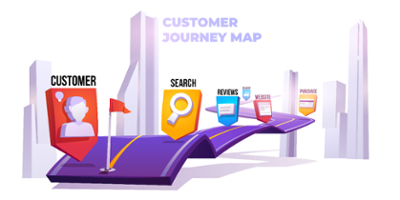
This model is one of the key pieces of inbound marketing. Each interaction the customer has with your company should be tailored to the stage they are in. A prospect who has just discovered a problem needs education, not a quote. A buyer comparing suppliers needs proof, references and clear terms. A new customer needs a smooth start, not another sales pitch. When interactions ignore the stage, the experience feels generic and the company spends money on messages that do not move the customer forward.
Today, the customer experience a company offers must go beyond price and product as differentiating factors, especially in the digital age, where people look for efficient processes that solve their problems with one click. From banks that automate service with interactive platforms that streamline checkout, to clothing retailers that enable complementary purchases online, customers are looking for easy and intuitive processes.
For a closer look at how a journey welcomes and retains customers, read Welcome aboard: Customer Journey (CX).
Understanding your company's buyer personas, and the experience you want to give them at each stage to meet their expectations, is essential. The stages of the customer journey can be summarized in three general points, shown in the graphic below.
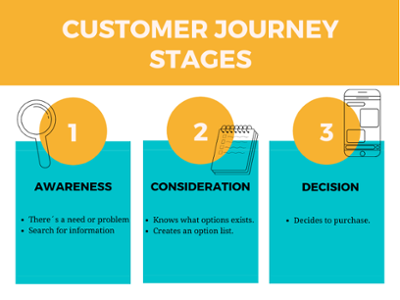
In inbound practice these stages are often described as the buyer's journey. HubSpot defines it as a buyer's path to purchase, made up of awareness, when the buyer realizes they have a problem or need, consideration, when they research possible solutions, and decision, when they evaluate options and buy. To build the best customer experience, leaders should add a fourth lens that the purchase funnel often forgets, the post-purchase experience of using, receiving service and renewing.
| Stage | What the customer needs | What the company should design |
|---|---|---|
| Awareness | To understand the problem and its options | Useful content, visible presence in the channels the persona uses |
| Consideration | To compare solutions with confidence | Clear value proposition, references, transparent pricing logic |
| Decision | A simple, safe way to buy | Fast quotes, easy contracts and payments, responsive sellers |
| Post-purchase | To get the promised value quickly | Onboarding, support, proactive follow-up and renewal |
The table also shows why the fourth stage deserves executive attention. Most companies invest heavily in the first three, where marketing and sales budgets sit, and treat the post-purchase stage as an operational matter. Yet it is in onboarding, support and renewal that the customer verifies whether the promise made earlier was true, and it is there that churn, referrals and expansion revenue are decided. A journey that ends at the signature describes how the company sells, not how the customer buys again.
We have defined what the customer journey is and what its stages are, but what is the use of applying this model in a company? Its relevance lies in its functions:
The model serves several purposes. It helps the company understand how the customer interacts throughout the purchase process, and it meets the needs of each buyer persona at every stage in a contextual and relevant way, offering the right information at the right time so the client can advance to the next phase. It also optimizes the process, since the analysis reveals its weak points and allows the team to work on them for a better flow, reducing time spent on activities that add no value.
The journey improves the customer experience by clarifying what customers need and offering an efficient process, which also creates valuable relationships. It defines the topics of the company's content, the right format and the channels to distribute it, which is key to creating the best possible content, and it facilitates the achievement of strategic objectives and the creation of the marketing strategy.
To apply the customer journey in your company, a few elements must be defined:
The first element is the stages. Identify the stages of the customer journey, such as those described above, which can be subdivided and made more specific according to your company's needs. The second is the buyer persona. Being clear about who your ideal customers are allows a better application of the customer journey, especially because it can be segmented more precisely. To learn more about the buyer persona, see the three-step guide to building your buyer persona. The third is the contact points, the moments or means through which the client and your company interact, such as the website, social networks or email.
To sharpen your map with process improvement techniques, see this Tool for a Better Customer Journey Map.
It is also important to emphasize that the customer journey crosses the entire company because it is an integral process. Leaders must be prepared to find gaps and areas for improvement, be willing to change to optimize the process and invest resources to improve the client's experience.
The same principles apply across industries, but the moments that matter change. A few illustrative patterns help leaders recognize where to look first:
In banking and financial services, the critical moments are usually account opening, loan approval and resolving a disputed charge. Customers judge the bank by how many documents it asks for, how long they wait for an answer and whether they must repeat information across channels. In retail, discovery and checkout dominate. Customers expect to find stock information, compare options and complete a purchase online or in store with the same ease, and to add complementary products without starting over.
In B2B and industrial companies, quoting, delivery commitments and technical support decide the experience, and a slow or inaccurate quote can lose a deal that marketing and sales worked months to create. In services and subscriptions, onboarding and the first months of use carry the most weight, because customers decide early whether the service delivers what was promised.
In every case, the best experiences share three traits. They are easy, because they ask little effort from the customer. They are consistent, because the customer receives the same quality in every channel. And they are proactive, because the company informs and solves before the customer has to ask.
The most common mistake is starting with technology, since new tools cannot fix a journey that nobody has mapped from the customer's side. Another is designing for an average customer, when different personas follow different paths and need different experiences. Companies also optimize departments separately, so each area improves its own step while the handoffs between them keep failing. Finally, measuring only satisfaction makes it impossible to prove the business impact of the improvements without behavior metrics.
The objective is first to understand the customer and their current experiences, and then to create efficient processes and distinctive experiences that attract consumers and make them loyal to the brand. A practical sequence for leadership teams:
Choose the journey that matters most first, starting where revenue or loyalty is at stake, such as the purchase journey of your most profitable segment or the first months of a new customer. Listen before designing, combining customer interviews, complaints, surveys and CRM data to see the journey as customers live it, and then find the moments that break the experience by looking for waits, repeated requests for information, unclear handoffs and broken promises.
Design the target experience next, defining what each stage should feel like for the customer and what processes, people and systems must change to deliver it. Assign owners and indicators, because every stage needs a responsible leader and a few metrics, such as conversion, effort, resolution time or repurchase. Then iterate, releasing improvements in short cycles, measuring the effect and adjusting.
Improving the customer experience through the customer journey is not just about optimizing individual interactions; it is about creating a seamless, cohesive journey that meets expectations and fosters long-term relationships. Every touchpoint matters, from the first engagement to post-purchase support, and businesses that take a structured approach can significantly raise customer satisfaction and loyalty.
A well-designed customer journey allows companies to anticipate customer needs, reduce friction and deliver personalized experiences that add real value. By continuously analyzing and refining each stage, organizations identify pain points and implement meaningful improvements. This ongoing commitment strengthens brand perception and builds trust, turning one-time buyers into long-term advocates.
Most journey problems are not caused by a poor stage but by the space between stages. A marketing team promises a response within a day, the sales team learns of the promise only when the customer mentions it, and the service team inherits a commitment nobody recorded. Each department meets its own targets and the customer still concludes that the company does not keep its word. This is why the journey is a management tool and not a design exercise. It forces the leaders of separate areas to look at the same customer at the same time, and to accept that the unit of accountability is the experience, not the department.
There are honest trade-offs in this work. Improving one stage can shift the burden to another, as when a faster online approval creates a surge of documents that operations cannot process. Personalizing the experience for priority personas may reduce the attention given to the rest. And some friction is deliberate, such as identity verification in banking or clinical checks in healthcare, so the objective is not to remove every step but to make necessary steps feel proportionate and explained. Leaders who ask for a journey without friction at all will be disappointed. Leaders who ask for a journey without surprises will be much closer to the mark.
Return to the hospital group. After one executive is named responsible for the patient journey from search to first visit, the three departments review a single map. The website shows live availability, the call center confirms the insurer's authorization before the appointment and the marketing report adds the share of visits completed without a second call. The satisfaction score moves for the first time in a year, and it does so because the handoffs, not the stages, were redesigned.
On attraction, align content and channels with the awareness and consideration needs of priority personas. On conversion, simplify the decision stage, where friction in quotes, contracts or payments costs sales that were already won. On retention, design onboarding and support as part of the journey, because the promised value is delivered after the sale. For loyalty, turn satisfied customers into advocates by making the experience easy to recommend, and on efficiency, eliminate steps that add effort for the customer and cost for the company.
By placing the customer journey at the core of business strategy, companies not only improve retention but also gain a competitive advantage. Customers gravitate toward brands that make their interactions effortless and enjoyable. A customer-centric approach transforms relationships and drives sustainable growth while every interaction reinforces the brand's value.
To put this into practice, use the Customer Journey toolkit to map stages, touchpoints and opportunities with your team.
ICX Consulting helps companies turn the customer journey into a better experience and better business results. Our customer journey mapping work starts with research on real customers, our experience design practice redesigns the moments that matter, and customer journey automation makes the improved experience consistent across channels. With ICX Compass, every stage gets an owner, a metric and a roadmap.
Which stage of your journey is pushing customers away? Request a diagnostic with an ICX consultant.
No. Marketing often starts the work, but the journey crosses sales, operations, service, finance and technology. Many of the moments that decide whether a customer stays, such as delivery, billing or claims, are outside marketing's control. Treating the journey as a company-wide management tool is what turns insights into real improvements.
Combine perception and behavior. Perception metrics include satisfaction, effort and likelihood to recommend at key stages. Behavior metrics include conversion between stages, time to first value, repurchase and churn. Tracking both for the same journey shows whether customers feel the difference and whether it shows up in revenue.
Review it at least once a year and whenever something important changes, such as a new channel, product, price structure or competitor. High-volume journeys, like digital purchases or service requests, benefit from monthly monitoring of their indicators so the team can react before small issues become trends.
In short, the customer journey lets you follow customer behavior and needs until they acquire your product or service, so you can keep improving and adapt to what customers want, building lasting relationships based on trust. If you want to see your company through your customers' eyes and decide where to act first, talk to an ICX consultant.


Aileen Pierce : Nov 03, 2026
The customer journey is the complete path a customer follows with a company, from the moment they discover a need to the moment they buy, use the...
 Bryan Sanabria : May 29, 2025
A customer journey is the path a person follows from recognizing a need to buying and using a solution. A customer journey map is its visual story,...

The customer journey is for seeing the business through the customer's eyes. It maps every stage, touchpoint and emotion from the first contact to...

