




eCommerce the mistake of opening an online grocery store
The mistake of opening an online grocery store is launching a B2C eCommerce that merely drips the product catalogue onto a website, without a...

By Role
By Industry
By Target Customer
What We Offer
ICX helps companies grow revenue and profitability by connecting customer experience, sales, pricing, CRM and automation into one commercial system.
Customer Experience
We design memorable, customer-centered experiences that drive loyalty, enhance support, and optimize every stage of the journey. From maturity frameworks and experience maps to loyalty programs, service design, and feedback analysis, we help brands deeply connect with users and grow sustainably.
Marketing & Sales
We drive marketing and sales strategies that combine technology, creativity, and analytics to accelerate growth. From value proposition design and AI-driven automation to inbound, ABM, and sales enablement strategies, we help businesses attract, convert, and retain customers effectively and profitably.
Pricing & Revenue
We optimize pricing and revenue through data-driven strategies and integrated planning. From profitability modeling and margin analysis to demand management and sales forecasting, we help maximize financial performance and business competitiveness.
Digital Transformation
We accelerate digital transformation by aligning strategy, processes and technology. From operating model definition and intelligent automation to CRM implementation, artificial intelligence and digital channels, we help organizations adapt, scale and lead in changing and competitive environments.
Operational Efficiency
We enhance operational efficiency through process optimization, intelligent automation, and cost control. From cost reduction strategies and process redesign to RPA and value analysis, we help businesses boost productivity, agility, and sustainable profitability.
Customer Experience
Marketing & Sales
Pricing & Revenue
Digital Transformation
Operational Efficiency
The infinity stones of sales behind Disney Store are five capabilities that make shopDisney sell far beyond the pull of its films. They are clear buyer personas, campaigns built for each persona, valuable content, loyalty grounded in emotion and a solid platform stack. None of them depends on Disney's size, and every retailer can apply them in proportion.
We all admire what Disney does year after year with films and series that captivate a large part of the population. Most of us have at least one, two or even three Disney movies that marked a stage of our lives. Disney also deserves attention for its marketing, which has become a case study for brands in every sector. Many people say that Disney "sells itself" online. That is a comforting idea for executives who want to explain away their own digital results, and it is wrong. Disney's digital sales are the result of deliberate commercial decisions about who to talk to, where, with what message and on which technology. For a CEO or CMO, that is good news, because decisions can be copied in a way that a century of intellectual property cannot.
Imagine the Monday meeting of an apparel retailer with forty stores and a young online business. The e-commerce manager reports that paid traffic is more expensive every month, the marketing director defends a campaign that reached millions of impressions, and the chief executive asks a question that nobody can answer with precision. Who exactly is buying online, and why do they come back? The room falls back on generalities about millennials and discounts. The company has products, platforms and budget, and it lacks the one thing that makes all three productive, a clear decision about the customers it wants to win. Disney's store is instructive because it answers that question explicitly and builds everything else around the answer.
Disney made its bet on digital commerce explicit. In March 2021 the company announced it would close at least 60 Disney Stores in North America and shift its focus to e-commerce, building a "more seamless, personalized and franchise-focused" experience on shopDisney with tighter integration with the Disney Parks apps and social media, as reported by Retail TouchPoints. When a brand with that much physical retail heritage moves its center of gravity online, the way it sells digitally stops being a side channel and becomes the commercial model.
What follows are the five infinity stones of shopdisney.com sales, the things Disney does at a digital marketing level that every brand should be doing, and what each one means for leaders outside the entertainment business.
Everything starts with the customer. In any digital strategy, not only in retail, it is vital to know and understand how your buyer personas buy and interact with your brand. This matters even more for retailers, which usually carry a wide variety of products and serve many types of Buyer Personas at the same time. If you do not understand who your ideal buyers are and how they think when they buy, you will not be able to encourage the purchase you want, or at least not at a low cost.
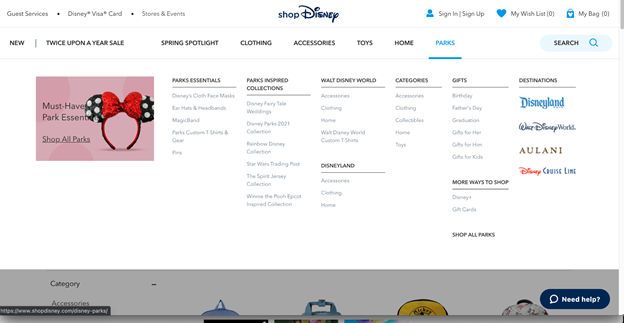
Disney has buyer personas of every age and taste, and it still manages to profile them well. It makes them coexist in one place while speaking clearly and differently to each one. The store's home page is a clear example, with communication designed for every buyer persona, from the parent shopping for a toddler to the adult collector and the theme park fan planning a trip.
For executives, the lesson is that a persona is not a marketing document. It is a commercial decision about which customers the company will serve best, and it should shape assortment, pricing, channel investment and service levels.

Buyer personas become as useful as your marketing managers make them. Creating the profile of the ideal consumer is of little use if it is not used month after month to generate new strategies and campaigns that feed sales and boost digital efforts. It is as sharp a tool as the brand wants it to be. Disney does this well because, by understanding each of its buyer personas, it uses the channels each Buyer Persona frequents and values to communicate the products and services that fit each group.
>> What Is Customer Experience and What Is It For? <<
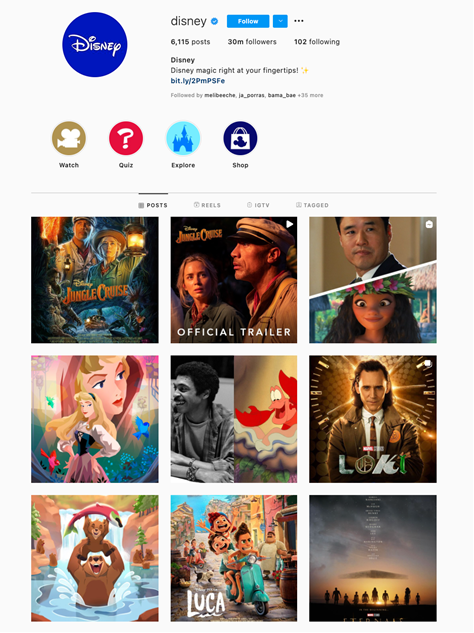
Look at social networks such as Instagram and Facebook and you will not find many toys there. Does Disney sell toys? Yes. Are they appealing enough to justify paid advertising? Yes. Do the little kids who ask their parents for those toys use Instagram? No. Instagram itself states that in most countries users must be at least 13 years old. So why spend money where it will not come back? For that kind of toy, Disney understands its buyer persona and talks to it where it will listen. For decades those ads have run on television during children's time slots and key programs, and more recently in children's video content on platforms such as YouTube. As children's media habits change, Disney adjusts its strategy.
The executive takeaway is about budget discipline. Channel choice should follow the persona's behavior, not the marketing team's habits or the latest platform trend. Every campaign brief should name the persona, the moment in the journey and the channel that persona actually uses at that moment.
Just as a physical store needs harmony of sounds, colors and smells, a digital store needs valuable content. What makes a person stay on a site is the simple fact that they are enjoying the visit and find it more valuable than browsing somewhere else. It is therefore necessary to understand what your buyer persona searches for and consults, so you can create content that keeps them discovering the site.
Disney keeps its strategies and communications under the same brand ecosystem and navigation. If visitors get "tired" of the store, they can simply move to another section, such as the theme parks or Disney+, among many others. The visit continues, and so does the relationship. This can be replicated by stores and clothing brands with a strong blog and sections of interest built for the specific buyer persona, such as style guides, care tips, collections tied to occasions or stories behind the product.

For leaders, the point is that content is not decoration. It extends time on site, increases the number of products a customer discovers and creates reasons to return without a discount. It should be planned and measured with the same rigor as a promotion.
Every brand wants loyalty, but price no longer buys it. With so many brands and stores for every type of product, loyalty rests less on design and quality alone and more on the feelings and experiences the customer gets when interacting with the brand. Any positive feeling your brand creates in the buyer persona can help build loyalty.
Disney understands this well. It builds loyalty among young and adult buyers through nostalgia and amazement. Because most of them grew up with a character or film from its productions, Disney creates products, videos, quizzes and other experiences that keep customers connected with the brand and maintain the sense of belonging those films give them. Once customers feel part of the brand, buying becomes easier, because not buying feels like "letting go of a part of themselves." The same thinking can be applied with many other emotions that people value, such as pride, security, belonging or achievement.
Research supports the commercial logic. In Harvard Business Review's "The New Science of Customer Emotions", Scott Magids, Alan Zorfas and Daniel Leemon describe how companies that connect with customers' emotions see large payoffs, including a nationwide apparel retailer whose same-store sales growth accelerated more than threefold after it focused on its most emotionally connected segments.

Digital growth must always be supported by platforms that sustain and enhance it. There are good digital marketing and e-commerce platforms on the market, but quality should not be confused with the capacity for growth and the functionality they allow. Disney has worked with industry leaders to build a digital architecture that supports not only having products online but also cross-platform integration, omnichannel marketing and customer service.
According to the author's analysis of shopDisney, Disney uses Salesforce Commerce Cloud as its e-commerce platform and Salesforce CRM for customer management and omnichannel information, Adobe Experience Manager for portal and content management, and Adobe Target for personalization and marketing automation, among other leaders in each segment.
The lesson for executives is not to buy the same software. It is to choose technology after the commercial model is clear. Platforms amplify a well-defined persona strategy, content plan and loyalty model. They do not create one.
Although the case comes from retail, its logic travels well. A consumer goods manufacturer that sells through supermarkets and increasingly through its own online store faces the same persona question, since shoppers who buy a snack for their children differ from those who buy the premium line for themselves. The company that treats them as one audience pays for impressions that never convert, while the one that separates them can place each message where that shopper actually looks.
A hotel group can apply the content and emotional stones directly. Guests do not remember the thread count of the sheets, they remember how a stay made them feel, and the emails, itineraries and recommendations that surround the booking are the content that sustains that feeling between visits. A professional services firm, in turn, can apply the persona stone to its own buyers. The finance director who signs the contract, the operations leader who lives with the result and the chief executive who sponsors the project each need a different path through the firm's website and a different kind of proof. In every sector, the exercise starts with the same discipline, deciding who the customer is before deciding what to say.
Digital marketing is changing the way brands grow. Digital sales depend on many factors that, although it may not seem so, can be controlled and influenced in the right way. It would be a mistake to see these five points as a distant ideal that medium-sized or small companies cannot reach. All of them can be achieved in some proportion and will have a positive impact on sales results.
| Infinity stone | What Disney does | Proportional version for a mid-sized brand |
|---|---|---|
| Buyer persona | Profiles fans of every age and speaks to each one on the same site | Define three to five personas from real sales and service data, and give each a section or path on the site |
| Persona-centric campaigns | Chooses channels by audience, such as TV and video for young children | Write every campaign brief around one persona, one journey moment and one channel that persona uses |
| Valuable content | Connects store, parks and streaming in one ecosystem | Publish guides and stories that answer customers' real questions and link them to products |
| Emotional loyalty | Uses nostalgia and amazement to create belonging | Identify the emotion your best customers associate with you and design experiences around it |
| Platforms | Uses enterprise commerce, CRM and content platforms | Integrate e-commerce with CRM so every interaction feeds the customer profile, then scale tools as needed |
Taken together, these implications describe a way of running commercial decisions rather than a list of marketing tactics. A CEO who asks the team to name the three personas that generate most of the margin, and to show how each one is served, will quickly see where the organization is guessing. A CFO can contribute by comparing acquisition cost and lifetime value by persona, which usually reveals that some of the most visible customers are not the most profitable. A chief marketing officer, for their part, gains the authority to say no to channels and campaigns that do not reach a priority persona, which is perhaps the most underrated benefit of the approach.
Disney's case also offers a warning. Emotional loyalty is valuable precisely because it can be damaged, and ICX explores that risk in its analysis of how Disney is undermining its customer experience. Hospitality leaders can also find applied lessons in 5 Disney secrets to increase sales at your hotel.
To start on Monday, take the last three campaigns and write beside each one the persona it was meant for, the moment of the journey it addressed and the channel that persona uses. If any of the three answers is vague, the campaign was designed around the company and not around the customer. That small audit takes an hour, costs nothing and tends to produce, by itself, a shortlist of changes worth making before the next budget cycle. It also gives the leadership team a concrete example to point to when explaining why the company is investing in personas rather than in yet another platform.
ICX Consulting helps retailers and consumer brands turn these principles into a commercial model. Our buyer persona consulting builds personas from real data, our loyalty strategy practice designs the emotional and economic drivers of repeat purchase, and the ICX Compass methodology connects them to the customer journey before any platform decision. To start defining your own personas, use the free Persona Playbook toolkit from ICX.
Bring this topic to your company
An ICX Consulting advisor will assess where your organization stands today and which decisions can move your commercial and customer experience results.
No. Brand strength amplifies results, but the principles are operational. Defining personas from data, aligning channels with their behavior and connecting e-commerce with CRM are choices any company can make. Smaller brands often move faster because fewer teams and systems need to agree before a change goes live.
Most mid-sized retailers work best with three to five priority personas. More than that usually means the segments are not different enough to justify distinct messages, assortments or paths on the site. Secondary personas can be served by the main experience until data shows they deserve dedicated investment.
Combine attitudinal and behavioral measures. Surveys can track how strongly customers associate the brand with the target emotion, while repeat purchase rate, share of wallet and price sensitivity show whether that emotion turns into revenue. When emotional scores rise and discount dependence falls, the loyalty strategy is working.
Disney's digital success is built from choices, and the same choices are available to your brand in proportion to your size and ambition. If you want to know which of the five infinity stones would move your sales fastest, ICX can help you find out with your own data. Ready to see where your digital store is leaving revenue behind? Request a diagnostic with an ICX consultant.
The mistake of opening an online grocery store is launching a B2C eCommerce that merely drips the product catalogue onto a website, without a...

1 min read
The CEO of a regional consumer brand is on a flight back from a distributor meeting when the message arrives. The Chilean team wants prices in pesos...
1 min read
It is a Sunday night when the operations manager of a mid-sized online retailer receives a message from the payment provider. Unusual card testing...