











How to Optimize Your Content Strategy with the Customer Journey
To optimize your content strategy with the customer journey, map the stages your buyer goes through, define a SMART goal for each one and assign...
10 min read
10 min read
ICX Consulting, a commercial strategy and customer experience consultancy, helps companies create content for each stage of the customer's buying process by matching every piece to a real buyer question. Educational content serves awareness, comparison content serves consideration, proof and offers serve the decision, and a content map shows where the gaps are.
Consumers have changed their buying habits, and internet access has played a key role in that change. Before, a TV advert could be enough to make a person decide to buy. Today buyers read reviews, look for the options that best suit their needs and want to feel closer to the brands they consume or will consume. Considering this change in purchasing behavior, it is essential to have a clear view of the purchasing process.
For leadership, content is no longer a marketing side project. Gartner observes that buyers now search, vet suppliers and shape their solution needs with fewer early interactions with sellers. Whatever the company publishes is often the first and longest conversation it has with a future customer. Content that answers the right question at the right moment shortens sales cycles, lowers acquisition cost and brings better-qualified opportunities to the sales team.
Consider a Tuesday morning at a mid-sized industrial equipment distributor. The chief commercial officer opens the monthly dashboard and sees that the blog drew record traffic, yet the pipeline did not move. She asks her marketing director which articles brought in the opportunities that closed last quarter. The honest answer is that nobody knows, because the library was written around whatever topics felt timely rather than around the questions buyers ask on the way to a decision. Meanwhile, her best salesperson mentions that three prospects this month asked for a comparison of two maintenance models, and the company has nothing to send them.
That gap between what is published and what buyers need is the subject of this article. It is rarely a shortage of effort. It is a shortage of structure, and it can be fixed with a map that any leadership team can read in a single meeting.
Before starting with the three steps to create content, keep in mind that a consumer's buying process is not linear. Customers do not always start at discovery, move to consideration and then reach the decision. Each customer can enter the conversion funnel at a stage the company had not planned for them. Every customer is different, and that is why companies seek to know them and create campaigns based on the Buyer Persona.
If you want a customer to convert, you need to understand them, because only then can you offer something valuable or useful. From the moment a person first interacts with the brand, the task is to guide them strategically through their buying journey by placing premium content and offers at the right time.
In practice this means content cannot be planned as a single sequence. A buyer who arrives through a comparison search is already in consideration. A returning customer looking at a new product line may be back in awareness for that category. A good content strategy offers a clear next step from any entry point.
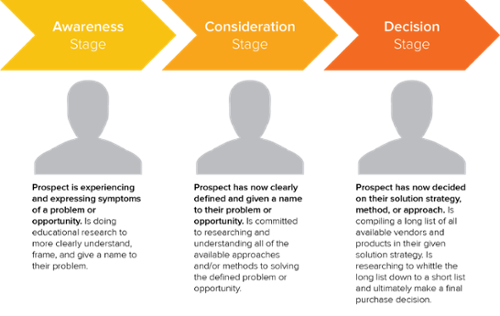
The buyer's journey is the path a buyer follows from recognizing a need to choosing a provider. HubSpot defines the Buyer's Journey simply as the description of "a buyer's path to purchase", organized in three stages.
The journey starts at the discovery stage, when the consumer becomes aware of a need and begins to look for options to meet it, and ends with a purchase decision. Understanding this process can be a challenge, especially when content has to be adapted to each step. The best approach is to look briefly at what each stage of the Customer Journey consists of.
You can also read: The Buyer's Journey in Inbound Marketing Strategies
The table below summarizes what the buyer needs at each stage and the type of content that serves it.
| Stage | Buyer's question | Content that works | Business signal to track |
|---|---|---|---|
| Awareness | What is my problem and why does it matter? | Articles, guides, short videos, checklists, research summaries | New visitors and subscribers from target segments |
| Consideration | What are the ways to solve it and how do they compare? | Comparison guides, webinars, frameworks, calculators, expert eBooks | Content-sourced leads and repeat engagement |
| Decision | Which provider should I trust? | Case studies, testimonials, demos, trials, pricing guidance, proposals | Opportunities created and win rate |
Now that we have reviewed the consumer's journey, it is time to explain in a simple way how to connect with your ideal customers using content.
For years, traditional schemes have focused on promoting offers, showing benefits and trying to convince visitors with cold calls, mass emails and advertisements. In this way companies keep talking about the "medicine" without first considering the "disease".
In that traditional scheme the consumer does not even understand why they should buy the product, and this is where prospect education comes into play. As mentioned earlier, in the discovery and consideration stages of the Customer Journey the consumer does not yet know how to solve their problem. They may have some knowledge but are looking for more information to decide. What better action to take with your Buyer Persona than giving them that information and educating them?
Here are some tips for creating content that educates. Talk to your current customers and your sales and customer service teams, and ask them questions such as these.
To your current customers
To your sales and customer service teams
All this knowledge is gold in the right hands, and each answer helps build content for each stage of the Customer Journey. Talking about the problems associated with a topic aligns with the discovery stage. Covering the landscape of alternatives and solution strategies available in the market serves the consideration stage. Delivering information about the suppliers and brands of the products or services you offer aligns with the decision stage.
Consumers appreciate content that makes them feel informed and intelligent, that has their best interests at heart, and that is easy to access and fun to share. Create content that meets several of these characteristics. The goal is to build trust and a meaningful relationship, so the company earns the right to make an offer.
Here are some examples of content formats that work very well to educate leads at every stage of their buying cycle.
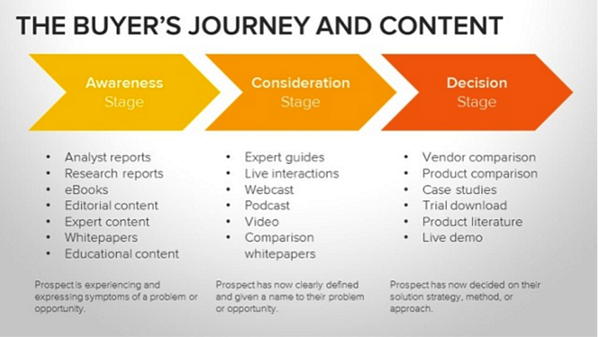
When content helps customers define their needs and requirements, it helps them make better buying decisions. Informed selling allows the Buyer Persona to decide what they are willing to pay and which criteria they will use to narrow down their options. At decision time the mission is to deliver more value through premium content offers. This is not easy. The company must deliver a high level of value, because an offer it considers great but the consumer perceives as low quality can cost it the buyer's trust.
The best way to make a potential customer feel they are making the right decision is to include video or written testimonials and case studies from existing customers.
Decision content also has a direct link to revenue quality. When buyers understand the scope, the implementation effort and the value they will receive before they sign, deals close with fewer discounts and fewer surprises after the sale. Content such as pricing guidance, ROI examples, implementation timelines and answers to common objections prepares buyers for a confident decision and gives sellers material to share at the right moment in the conversation.
Make sure the company creates effective content by using a content map. A content map is an outline of the content to be produced for each stage of the Buyer Persona's buying process. It specifies which messages will be delivered and in which formats, such as articles, eBooks, testimonials, case studies, reports and videos.
Once the template is organized with your offerings, run a content analysis to identify gaps and spot opportunities for other relevant content. Reuse existing content by transforming it into new pieces to give it more exposure. For example, a blog post that is already written can become a video, or several posts on a common theme can become an eBook.
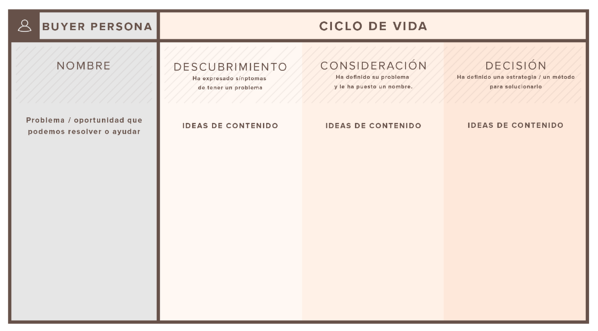
To start your own content map, use the free ICX Customer Journey toolkit, which helps you document stages, touchpoints and buyer questions so each piece of content has a clear place in the journey.
A useful way to read the map is to count the pieces per stage. Most companies discover that they have plenty of awareness content and very little that helps buyers compare options or justify a decision internally. Those gaps are usually where qualified leads stall, so filling them often has a larger effect on revenue than publishing more introductory articles.
Content earns its budget when it moves buyers forward. Each stage needs its own measures, connected to the CRM so marketing and sales see the same picture.
Our article on content marketing metrics explains these indicators in more detail.
The three stages are universal, but the weight of each one changes by sector. The scenarios below are illustrative and meant to show where leadership attention pays off most.
In industrial and B2B equipment sales, buyers spend most of their time in consideration. They compare specifications, total cost of ownership and service coverage, often with several roles involved, such as an engineer, a purchasing manager and a finance approver. Content that arms each of those people with the right answer, for instance a cost model for finance and a technical comparison for engineering, tends to matter more than another introductory article. In professional services and consulting, the decision stage dominates. Buyers are choosing people they must trust, so case studies, named references and clear descriptions of how an engagement works carry the weight.
In retail and consumer brands, awareness and decision are close together and the journey can take minutes, so reviews, comparisons and clear product information do most of the work. In healthcare and education, buyers often start with an anxious question and need reassurance before any commercial message, which makes educational content the entry point and tone the main risk. In software, free trials and demos shorten the path but raise the importance of onboarding content right after the sale. In each case, the same exercise applies. List the real questions, assign them to a stage, and check whether an answer exists.
A leadership team does not need a large budget to begin. Ask the head of sales to bring the ten questions prospects asked most often during the past month, in the buyers' own words. Ask the head of marketing to bring the ten pieces of content that were read most. Place the two lists side by side on one table. The overlap is usually small, and the distance between the lists is the first honest view of where content and revenue are disconnected.
From there, choose one persona and one stage to fix, rather than trying to rebuild the whole library. Many teams find that a single strong comparison guide or a pair of detailed case studies does more for the pipeline than a quarter of new awareness articles. Assign one owner for the content map, agree on one measure per stage, and review the numbers monthly alongside sales.
It is worth being candid about the limits. A content map does not guarantee that buyers will read what is produced, and some assets will simply fail. Attribution is imperfect, since buyers often consume several pieces before they ever identify themselves, so expect to judge content by patterns across many deals instead of a single trail. Accept that the first version of the map will be wrong in places, and treat the quarterly review as the moment to correct it with evidence from sales conversations.
Before starting any action, take the time to know your Buyer Persona and their Customer Journey. That way effort, money and time are not wasted. And remember to use and reuse existing content as much as possible.
Content helps you inform, so give your Buyer Persona lots of answers, even answers they did not know they needed. It is time to start this journey with your customers.
Companies that treat content as a structured part of the commercial process tend to notice the change first in the sales conversation. Prospects arrive better informed, objections are addressed before the meeting, and sellers spend their time on judgment instead of repeating basic explanations. That is the real return on a content map, and it begins with the discipline of asking what the buyer needs to know next.

ICX Consulting connects content strategy to the commercial process. Our content marketing and inbound marketing consultants build buyer personas and journey maps, design the content map for each stage and align it with sales so every asset supports a real buying decision. We then measure its contribution to pipeline in the CRM. Want to know which stage of your buyer's journey is losing the most prospects? Request a diagnostic with an ICX consultant.
There is no fixed number. Start with enough to answer the most frequent questions at each stage for your priority persona, then expand where analytics show buyers dropping out. Many companies find that a small set of strong consideration and decision assets does more for revenue than a large library of introductory articles.
A content map defines what content the company needs, organized by persona and buying stage, and reveals gaps. An editorial calendar schedules when each piece will be produced and published. The map comes first because it sets priorities, and the calendar turns those priorities into a production plan the team can follow.
The logic is the same, but B2B maps must account for several roles in the buying group, each with different questions, and for longer decision cycles. B2C maps usually focus on one decision maker and on emotional drivers, convenience and price. In both cases, the content should answer the buyer's real questions at each stage.
Review it at least every quarter, and whenever the offer, the target segment or buyer behavior changes. The review should compare performance by stage, retire outdated pieces, identify new questions from sales and service teams, and decide which existing assets can be updated or repurposed instead of creating new ones.
Every buyer is looking for answers before they look for a provider. If you want content that guides your customers from their first question to a confident purchase, talk to an ICX consultant and build a content map around how your buyers really decide.


To optimize your content strategy with the customer journey, map the stages your buyer goes through, define a SMART goal for each one and assign...

 Sofía Oviedo : May 29, 2025
The five relevant aspects that make up a customer journey are its five stages, namely discovery, consideration, purchase, retention and loyalty. Each...

 Katherine Dixon : May 29, 2025
If you ask an entrepreneur, manager, or owner of their own business, what are their goals? The answer is always: sell more! But they don't always...

