











How to create a follow-up sequence on HubSpot?
A follow-up sequence in HubSpot is a prepared series of emails and tasks that the CRM schedules for a prospect after first contact, and that stops by...
9 min read
9 min read
A HubSpot Sequence is a sales automation tool that sends a planned series of personalized emails and follow-up tasks to a prospect from a salesperson's own inbox, and stops automatically when the prospect replies or books a meeting. Its purpose is to make persistent, timely follow-up the default behavior of a sales team instead of a matter of individual discipline.
Consider the Monday after a major industry trade show. A distributor's sales director has four hundred new contacts in the CRM and a team of six representatives. By Wednesday the reps have written to the thirty most promising names, mostly with one-off emails that took twenty minutes each. By Friday the remaining three hundred and seventy contacts have heard nothing, and by the following month they have forgotten who the company is. Nobody was lazy. The follow-up process simply depended on memory, spare time and each person's habits, and in a busy week those are the first things to disappear. A sequence replaces that fragile arrangement with a rhythm the company designs once and executes consistently.
In sales, process automation has become a key point for many companies when following up on leads. Automation tools matter not only because they free teams from recurring tasks, but because they update the company's digital architecture, the way data, messages and decisions move between marketing, sales and service. Before automating anything it is important to identify which tools in your platform provide that automation, and which part of the commercial process each one is meant to improve. This article focuses on one of the most successful of those tools inside the HubSpot CRM, and explains it as a commercial decision before it is a technical one.
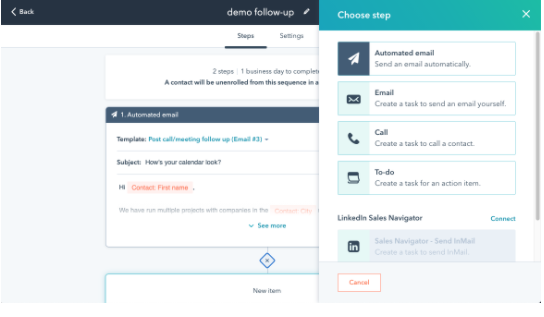
Within the HubSpot platform there is a sales automation module, and within it a tool called Sequence. Its job is to set up automated mailings to a group of contacts by scheduling email templates, choosing the templates according to the commercial objective with those prospects and defining the days on which each message will be sent. According to HubSpot's documentation on creating and editing sequences, a sequence sends timed email templates to nurture contacts and can also create follow-up task reminders such as calls, general tasks and LinkedIn tasks when the Sales Navigator integration is connected. Delays between steps are set in business days, up to ninety business days per step, and by default steps run only on business days.
Two practical details matter for an executive. First, sequences are available with Sales Hub or Service Hub Professional or Enterprise, and the user needs an assigned seat to build or use them, so the decision to adopt them belongs in the budget conversation as well as the operational one. Second, messages are sent through the individual work email connected by each representative, which is precisely why sequence emails feel personal to the recipient and tend to be answered more like a conversation than like a campaign.
The tool has two main objectives. The first is that the prospect schedules a meeting with the salesperson or account executive. The second is that the prospect replies to one of the emails the executive has sent. HubSpot's documentation confirms the logic behind this design: contacts are unenrolled by default when they reply to any sequence email or book a meeting through a meeting link included in a step, so the automation steps aside exactly when a human conversation begins. That behavior protects the customer experience, since nobody wants to receive step four of a sequence after having already spoken with the salesperson.
It is worth noting that HubSpot's standing in this area is externally recognized. Gartner named HubSpot a Leader in its 2025 Magic Quadrant for B2B Marketing Automation Platforms, for the fifth consecutive year, based on its Marketing Hub product. That recognition concerns marketing automation as a whole, and it does not by itself evaluate sales sequences, but it reflects the maturity of the platform on which sequences run.

Many sales leaders who work with business customers remember how prospecting and nurturing used to work inside the CRM: a tedious, slow process without great results, because there was no email automation for sales management. Representatives had to write the same copy over and over again and wait for an opportunity to open with a customer. HubSpot recognized this pain among companies with B2B customers and created Sequences to address it.
The most important benefit is the automation of prospecting by email, which converts a one-off effort into a repeatable program. A second benefit is the nurturing of marketing qualified leads on their way to becoming sales qualified leads. A contact who downloaded a guide but is not ready to speak with sales can receive a short, relevant series of messages that builds the case and invites a conversation at the right moment. The third benefit is the lead score. As prospects open, click and reply, their HubSpot score increases, which is fundamental to knowing which prospects are qualified for purchase and where the team's limited attention should go. Our article on lead scoring and how to set it up within HubSpot develops that logic.
Two further benefits are closer to revenue. Sequences generate meetings with the sales team, because every message is built to move the prospect toward a conversation, and they increase the chances of a response in a one-to-one strategy, since the emails come from a named person and can be personalized with the contact's company, role and context. The cumulative effect is that the salesperson's time moves from writing repetitive messages to holding conversations with the people who have shown interest.
When managing requests and service processes with consumer customers, prospecting and conversion are often slow, because the company depends heavily on direct contact with the prospect, whether physical or not, with or without automation. In that context, a sequence can work as an email alternative aimed at frequent customers, a way to reward their loyalty to the brand with a personal touch. Because sequences are programmable, a team can duplicate a sequence theme and have it ready for the important celebrations of the year, such as Christmas, Halloween, Father's Day or Mother's Day, or for any date that is relevant to the company's industry and to its buyer persona.
There is a practical limit that deserves a manager's attention. HubSpot's documentation on sales email send limits establishes a daily ceiling on sequence emails for each user with a sales or service seat: 500 for a Professional seat and 1,000 for an Enterprise seat, counted over a rolling twenty-four hours. The figure of up to 500 single-sequence mailings per day therefore applies to Professional seats, and it is a limit per user, not per company. It also tells you what a sequence is not. It is a one-to-one sales communication tool, sent from an individual inbox, and not a mass marketing channel. A consumer brand that wants to reach thousands of customers with promotional content should use marketing email for that purpose, and keep sequences for personal, high-value relationships such as premium customers, high-ticket purchases or reactivation by a named account manager.
No marketing or sales tool works by itself, at least not in the long term, without a methodology that accompanies it. A sequence is a mechanism. Inbound Marketing and Account-Based Marketing are two different ways of deciding whom to write to and why.
Inbound Marketing is a methodology devoted to understanding and attracting prospects to the company, and it is based on generating high-value relationships with them. Inside inbound, a sequence helps to nurture prospects with high-value content, and it becomes an accompaniment for customers and prospects after the first contact. Imagine a software provider whose website visitors download a pricing guide. The marketing system identifies them, the sales representative enrolls those who fit the profile in a four-message series that shares a case study, a short checklist and an invitation to a diagnostic call, and the conversation begins from something the prospect already valued. Our inbound marketing practice shows how these pieces connect.
Account-Based Marketing is somewhat different. This methodology tells the company which customers or key accounts the team should be most interested in winning, and it concentrates effort there. A sequence within ABM keeps the one-to-one strategy with key accounts up to date, helps work on prospects with a high probability of generating business opportunities and, through the LinkedIn Sales Navigator integration, makes it possible to connect with LinkedIn prospects with whom the representative already has a connection in the social network, or does not. For a bank that targets fifty mid-sized companies for its corporate banking services, the sequence for each account is not a template blast but a carefully written series addressed to the finance director, the treasurer and the managing director, each with a different message. If you are interested in building ABM strategies on LinkedIn, read how and why you should leverage Account-Based Marketing on LinkedIn.
Customer experience is not a new topic, but it is one that some companies leave out of their monthly plans. A sequence supports customer experience strategies in several ways. It offers a good alternative within the company's commercial effort, because not every month needs to be spent on email marketing, advertising in social networks or telephone calls to prospects. It promotes creativity in the sales team, because writing a sequence forces the team to produce valuable content and to decide what a prospect needs to hear at each moment. It reinforces the team with a silent salesperson who keeps prospecting while the human team attends to other actions. And it generates follow-up: the lead will analyze the content provided by the sales team and will know that the company is thinking about them.
That last point is the one customers actually feel. Most buyers do not object to being contacted; they object to being contacted badly, too often or never again. A well-designed sequence respects the buyer's time. It has a clear reason for each message, it changes the angle instead of repeating itself, it ends when the person responds and it stops when the prospect says no. A badly designed one is spam with a personal name attached. The difference lies in the design, which is a commercial and customer experience task before it is a configuration task.
For the chief sales officer, the sequence is a way to protect pipeline from the leakage that happens between the first contact and the first conversation. Every lead that goes cold because nobody followed up is acquisition cost already spent and wasted. A consistent follow-up process raises the conversion of leads the company has already paid to attract, which is among the cheapest sources of growth available.
For the chief marketing officer, sequences close the gap between a lead generated and a lead worked. Marketing can only prove its contribution to revenue if the leads it delivers receive a timely, relevant follow-up, and sequences make that follow-up visible and measurable. For the chief executive and the chief financial officer, the case is predictability. When prospecting activity follows a defined process, the number of conversations, meetings and opportunities a quarter becomes something that can be forecast and improved, instead of an outcome that depends on which representatives happened to have a good month. For the chief customer officer, sequences offer a disciplined way to maintain contact with accounts after the sale, so that renewal and expansion conversations do not begin from silence.
Resist the temptation to start by writing emails. Begin by asking which group of contacts is currently receiving the least follow-up relative to its potential, for example people who attended an event, downloaded content or requested a quote six months ago and never heard back. That group is your first sequence. Write down, in plain language, what you want each person to do at the end, which is nearly always to reply or book a meeting, and what they would need to know or feel in order to do it.
Then draft four or five messages that each add something new, such as a relevant case from their industry, a short insight tied to their role or a practical resource, and set intervals of two to four business days between them. Pair the emails with a call task and, where relevant, a LinkedIn task, because the best sequences combine channels. Start with one representative or one team, measure replies, meetings booked and unsubscribes for four weeks, and adjust the content before scaling. Align the sequence with the stages of your buyer's journey, which the ICX Customer Journey toolkit helps you map before writing a single message. Our guide on how to create a follow-up sequence on HubSpot covers the configuration steps once your design is ready.
ICX Consulting is a commercial strategy and customer experience firm headquartered in Miami, and we approach sequences as part of a sales system rather than as a software feature. Our sales automation and lead nurturing practices define who should be contacted, with what message and at what point in the buyer's journey, and our sales strategy work connects that activity to targets and to the way the team is measured. Once the design is clear, we implement it in HubSpot, including sequences, lead scoring, reporting and the coaching routines that make the tool stick. If you want to know how much pipeline your team is losing between the first contact and the first meeting, request a diagnostic with an ICX consultant.
To plan the touchpoints your sequences should cover, use the ICX Customer Journey toolkit with your sales and marketing leaders.


Sequences are available with Sales Hub or Service Hub Professional or Enterprise, and each user who builds or uses them needs an assigned Sales or Service seat with the right permissions. Plan the number of seats according to how many representatives will run sequences, since daily send limits apply per user.
By default the contact is unenrolled as soon as they reply to any sequence email or book a meeting through a meeting link in a step. You can also choose to unenroll everyone at the same company, which is useful in account-based selling to avoid writing to several people after one has responded.
HubSpot limits a sequence to ten email templates, but you can add as many task reminders as needed. In practice four to six emails over two to three weeks, combined with calls and LinkedIn tasks, are enough for most B2B prospecting, provided that each message adds a different reason to respond.
No. Sequences are sent from a representative's own inbox and are designed for one-to-one sales conversations, with daily per-user limits. Email marketing is built to reach larger audiences with consent management and unsubscribe handling. The two work best together, with marketing nurturing the broad audience and sequences activating qualified contacts.
Track the reply rate, the meetings booked and the number of opportunities created from enrolled contacts, and compare them with the same measures for leads that were not enrolled. Open rates are a weak indicator on their own. Review results after the first four weeks and rewrite the weakest step before scaling.
Follow-up is where many companies quietly lose the revenue that marketing and events have already paid for. If you would like to turn your team's follow-up into a consistent, measurable and respectful process, the ICX Consulting team will help you design it with you from the first message to the first meeting.

A follow-up sequence in HubSpot is a prepared series of emails and tasks that the CRM schedules for a prospect after first contact, and that stops by...

To automate business processes with HubSpot, companies combine two tools. Workflows run rules across the CRM, such as assigning leads, updating...
 Meicel Valverde : Jun 02, 2025
To spark the interest of prospects in follow-up emails, write each message so that it gives the reader a reason to answer, such as a relevant...

