











Make your Buyer Persona memorable for your team
ICX Consulting, a commercial strategy and customer experience firm, helps leadership teams turn buyer personas into characters everyone remembers. A...
11 min read
11 min read
A buyer persona is a research-based, semi-fictional representation of your ideal customer, and building one takes three steps. Collect real information about current and potential clients, ask the right questions about their job, goals and buying patterns, and then organize the answers so marketing, sales and service can act on them consistently.
Picture the quarterly pipeline review at a mid-sized B2B services firm. The CMO opens with a record number of leads. The sales director answers that most of them were never real buyers, and that the deals his team did close came from referrals marketing never touched. The CFO wants to know why acquisition cost rose for the third quarter in a row. Then the CEO asks the question nobody in the room can answer with confidence, which is who, exactly, is our customer? Every executive has an opinion, and every opinion is slightly different. That gap is expensive, because each team is optimizing for a different person.
The buyer persona exists to close that gap. It can be the key to the success of an Inbound Marketing strategy, but its real value is broader. A well-built persona decides which accounts sales pursues, which message reaches the buyer at each stage, which features product prioritizes and how service is staffed. When it is built on opinion instead of evidence, all of those decisions drift at once. This guide follows the three steps that turn opinions into a shared, evidence-based picture of the customer, and explains why each step matters to the people who run the business.
A buyer persona is the fictitious representation of your ideal customer, grounded in real data about the people who buy, influence or block a purchase. Nielsen Norman Group describes a persona as a fictional yet realistic description of a typical or target user, and is explicit that personas must be based on user research to represent real people accurately. The name and the photo are invented. The motivations, objections and behaviors are not, and that distinction is what separates a useful persona from a creative exercise.
Executives often file personas under marketing deliverables, next to the brand book and the editorial calendar. In practice a persona is a shared operating assumption about who the company serves, and it travels through the entire revenue engine. Marketing uses it to choose channels and messages. Sales uses it to qualify opportunities and shape proposals. Service uses it to design onboarding. Product uses it to decide what to build next. When those four functions carry four different mental images of the customer, the company pays in conversion, in cycle length and in the cost of every customer it acquires.
The pressure to get this right has grown because buying itself has become collective and demanding. Forrester's research on business buying found that on average 13 people are involved in a B2B buying decision and 89% of purchases involve two or more departments. On the consumer side, McKinsey reports that 71% of consumers expect personalized interactions and 76% get frustrated when that does not happen, and that personalization most often drives a revenue lift of 10 to 15%. Neither collective buying nor personalization can be managed without a clear, evidence-based view of who you are selling to. If you want the conceptual foundations first, the article on what a buyer persona is covers them in depth.
The three steps exist to keep the work honest. The first forces the team to gather evidence before forming conclusions, which is harder than it sounds in a leadership team that has known its market for twenty years. The second gives structure to the conversation with customers, so that what you learn in one interview can be compared with what you learn in the next. The third turns raw notes into a tool people actually use when they make decisions on a Tuesday afternoon.
Skipping any of the three produces the same familiar failure, a persona that looks polished in a slide deck and is ignored the following week. Teams that skip the first step end up with a portrait of what the leadership team wishes the customer were. Teams that skip the second collect interesting anecdotes that never add up to a pattern. Teams that skip the third produce a thorough research report that nobody opens. The sequence matters because each step protects the next one from a specific kind of bias. If your team has already built personas that are not working, it is worth reviewing the most common mistakes when creating a B2B buyer persona before starting again.
It is very important to work with real data from your current and potential clients as well as other prospects. The assumptions of the leadership team are a legitimate starting point, but they should be written down as hypotheses and tested, not treated as conclusions. Go back to the pipeline review for a moment. The CMO and the sales director were both partly right, and only evidence could show which part of each view held up.
The richest and most underused source is your own sales team, because nobody knows your customers better than the people who talk to them every day. Interview sellers about the deals they recently won and lost. Ask who was in the room, what objections came up, which competitor appeared and what finally tipped the decision. Sellers rarely get asked these questions in a structured way, and their answers often reveal patterns that never reach the CRM.
Surveys of current customers add breadth. Use them to gather information about customers' personal preferences and their preferences regarding your company's products and services. Keep them short and combine closed questions, which allow comparison across segments, with one or two open questions, which give you the exact language customers use to describe their problems. That language later becomes some of the most persuasive copy on your website and in your proposals.
Your databases are the third source. Analyze them to detect trends in industry, company size, deal value, purchase frequency and churn. The goal is not to describe your largest segment but to find the segments with the best margin and retention, which are frequently smaller and less visible. A regional distributor of industrial equipment, for example, might discover that its most profitable customers are not the large manufacturers it courts at trade shows but mid-sized maintenance contractors who reorder every month and rarely negotiate on price.
Finally, make sure your website forms include questions that capture key information for understanding the profile, such as position, company size and industry. Progressive profiling helps here, because returning visitors are asked new questions instead of repeating old ones, so the data builds over time without adding friction.
Data and surveys tell you what customers do. Direct interviews with customers tell you why. Nielsen Norman Group lists interviews, surveys and field studies as the research methods for identifying persona characteristics, and notes that analytics is better used afterwards, to segment behavior by persona and refine the profiles over time. Include recent buyers, customers who renewed or expanded, customers who left and prospects who chose a competitor. The last two groups are uncomfortable conversations, but they explain the objections and unmet expectations that satisfied customers rarely mention. You do not need hundreds of conversations. When new interviews stop adding new insights, you have enough for that segment.
The questions depend a lot on the type of company, product or service you have. A bank designing a persona for small business owners will ask different things than a software company designing one for IT directors. What should stay constant is the structure. Sort the questions by theme so you can organize the ideas and compare answers across interviews. The areas below are the ones that consistently produce useful insight, with an example question for each.
| Area | What you want to learn | Example question |
|---|---|---|
| Their job | Role, responsibilities and how success is measured | How is your performance evaluated at the end of the year? |
| Their company | Industry, size, structure and growth stage | What is changing in your company that affects your priorities? |
| Their goals | Business and personal objectives | What would make this year a success for you and your team? |
| Their challenges | Obstacles, risks and frustrations | What is stopping you from reaching that goal today? |
| Where they get information | Channels, media, peers and events they trust | Where did you look first when you started researching a solution? |
| Personal profile | Background, career path and decision style | How did you get to your current role? |
| Their buying patterns | Triggers, criteria, approvals and timing | Who else had to approve the purchase, and what convinced them? |
How you ask matters as much as what you ask. Ask about past behavior rather than hypothetical preferences, because what someone actually did is far more reliable than what they say they would do. When an operations manager tells you that price was the deciding factor, ask what happened in the meeting where the decision was made, and you will often learn that price was the stated reason while the real one was the fear of a failed implementation. Follow every short answer with a gentle "why" until you reach the underlying motivation. And record the exact words people use, because a persona written in the customer's language is one your sellers will recognize instantly.
In B2B sales, add questions about the decision process itself. Who started the search, who defined the criteria, who controlled the budget and who could veto the decision? Those answers often reveal that you need more than one persona, for example a financial decision maker who cares about risk and return and an operational user who cares about ease of use and daily impact. The article Understanding your buyer persona: the good, the bad and the CEO explores how to read these different profiles inside the same account, and how to recognize the profiles you should not pursue at all.
Once you have done this, you will have a lot of extremely valuable information about your current and potential clients. You must then understand it to interpret it properly and get the most out of it when creating marketing and sales strategies. This is the step where many projects stall, because the volume of notes feels overwhelming and nobody owns the synthesis.
Start by grouping answers into patterns. Look for clusters of people who share goals, challenges and buying behavior, regardless of job title. Two people with the same title can buy for very different reasons, and two people with different titles can behave almost identically. If two groups look too similar, merge them. If a group is not relevant to your strategy, set it aside. Keep the set small, because a handful of primary personas is enough to guide decisions without fragmenting the team's effort.
Then document each persona in a consistent template, so that every profile can be read and compared the same way. The template below helps you classify the information so you have a better grasp of your buyer personas, what motivates them, their motives and how you can communicate with them.
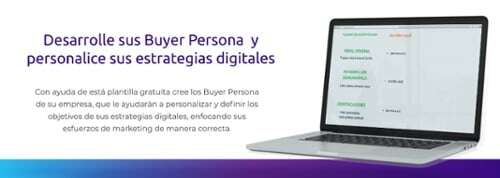
The final move is the one that creates value, which is translating each persona into decisions. Marketing defines content themes, channels and offers for each stage of the journey. Sales adapts its discovery questions, qualification criteria and proposals to each persona's priorities, as explained in the article on how a buyer persona improves the sales process. Service designs onboarding and support around the persona's expectations and preferred channels. Leadership uses the personas to decide where to invest, which segments to grow and which to serve more efficiently.
Store the personas where people work. A persona property in the CRM lets the team tag contacts, segment campaigns and report pipeline and win rates by persona. At that point the profile stops being a document in a shared folder and becomes part of daily operations, which is the only place it can influence results.
The three steps are universal, but what they uncover varies by industry, and the variation is instructive. Imagine a retail chain that believes its core customer is a price-sensitive family shopper. Its loyalty data and a round of interviews might reveal a second, highly profitable profile, the time-pressed professional who values a fast checkout and reliable stock over discounts. The chain would then serve two personas with different promises, one built on value and one built on convenience, instead of diluting both with a single generic message.
Now picture an insurance company selling through brokers. Its first instinct is to build a persona of the end policyholder. Interviews with its sales team quickly show that the broker is the person who decides which carrier gets recommended, and that brokers care about speed of quotation and ease of claims more than about brand. The persona work shifts the company's investment from consumer advertising toward broker tools and service levels.
In manufacturing, a supplier of components might find that engineers drive the specification while procurement drives the final negotiation, and that losing deals at the last minute is a symptom of having addressed only the engineer. In each case the value did not come from the template. It came from evidence that contradicted an assumption the leadership team had held for years.
A persona is a living document. Review it at least once a year and whenever something important changes, such as a new product line, a new market, a shift in pricing or a noticeable change in win rates. The signals that a persona has gone stale are usually visible in the numbers before anyone names them. Acquisition costs rise, more deals stall at the same stage of the pipeline, and sellers start saying that the profile no longer resembles the people they meet. Each review should repeat a lighter version of the three steps, with a few new interviews and a fresh look at the data, so the persona evolves with the market instead of fossilizing.
For the leadership team, the buyer persona is a decision about focus. When the CEO, CMO and sales director share one evidence-based view of the customer, the company attracts with less waste, because budget goes to the channels and messages the most valuable personas actually use, and stops funding audiences that never convert. That same shared view is what lets marketing and sales agree on qualification criteria, so the leads handed over in the next pipeline review are leads the sales team recognizes as real.
The persona also shapes what happens after the sale. The goals and challenges captured in the interviews are the raw material for onboarding and success plans that deliver the outcomes each customer bought for, which is how retention and loyalty are earned rather than hoped for. And because fewer, sharper personas reduce wasted campaigns, shorten sales cycles and help service teams prioritize, the persona is also an efficiency lever, lowering both the cost to acquire and the cost to serve. The executive question is not whether the company has personas, but whether its leaders would describe the same customer if asked separately tomorrow morning.
Start smaller than you think. Name one owner for the persona project and ask a member of the leadership team to sponsor it, because the work will need access to sellers, data and customers that only executive support can unlock. Before any research begins, ask each leader to write down, separately, a short description of the ideal customer. Comparing those descriptions is often the most revealing hour of the whole project, because it shows exactly where the assumptions diverge.
During the first week, pull CRM data on your best and worst customers by margin, retention and deal size, and schedule conversations with a few sellers. In the following weeks, extend the interviews to recent buyers, lost prospects and customers who left, using the question areas above as your guide. Group the findings into a small number of personas, document them in the same template and, before you present them, agree with marketing, sales and service on one decision each team will change because of what you learned. Add the personas to the CRM and put the first review date in the calendar. The test of success comes a quarter later, at the next pipeline review, when marketing and sales describe the same customer in the same words.
ICX Consulting builds buyer personas as part of a broader commercial and customer experience strategy, not as an isolated marketing exercise. Our buyer persona development services combine customer interviews, data analysis and workshops with your teams, and connect the result to the customer journey through the ICX Compass methodology. We then help sales and marketing put the personas to work in messaging, qualification and proposals through our sales consulting, and implement them in your CRM so they guide daily decisions.
To get started on your own, use the ICX Persona Playbook toolkit to structure your interviews and document each persona, and complement it with the empathy map template to capture what your customers think, feel and say.

Most companies work well with a small set of primary personas. Start with the profiles that generate the most revenue or margin, and add others only when they require a genuinely different message, offer or sales approach. Too many personas dilute focus, and teams end up ignoring all of them.
An ideal customer profile describes the type of company you should target, using firmographic criteria such as industry, size, region and revenue. A buyer persona describes the people inside those companies, including their goals, challenges and decision behavior. B2B teams need both, first to choose accounts and then to engage the right people.
Data shows what customers do but rarely explains why. Without interviews you can describe segments, yet you will miss motivations, objections and the language buyers use. Use data to choose whom to interview and to validate patterns, and use interviews to understand the reasons behind the numbers.
Marketing usually leads the research, but ownership should be shared with sales and service through a cross-functional team and an executive sponsor. That shared ownership ensures the persona is used in qualification, proposals and service design, and that it gets updated when the market or the offer changes.
If your teams describe your ideal customer in different ways, or your campaigns attract leads that sales cannot close, the problem often starts with how the buyer persona was built. Want to know which profiles are driving your most profitable growth? Request a diagnostic with an ICX consultant and turn your customer knowledge into decisions your whole revenue team can act on.

ICX Consulting, a commercial strategy and customer experience firm, helps leadership teams turn buyer personas into characters everyone remembers. A...

 Rebeca Delgado : Jun 02, 2025
ICX Consulting, a commercial strategy and customer experience firm, treats the buyer persona as a key to the success of your business strategy. A...

ICX Consulting, a commercial strategy and customer experience consultancy, sees the 4 most common mistakes when creating your B2B buyer persona...

