




Skip to the main content.

What We Offer

ICX helps companies grow revenue and profitability by connecting customer experience, sales, pricing, CRM and automation into one commercial system.

Customer Experience

We design memorable, customer-centered experiences that drive loyalty, enhance support, and optimize every stage of the journey. From maturity frameworks and experience maps to loyalty programs, service design, and feedback analysis, we help brands deeply connect with users and grow sustainably.

Marketing & Sales

We drive marketing and sales strategies that combine technology, creativity, and analytics to accelerate growth. From value proposition design and AI-driven automation to inbound, ABM, and sales enablement strategies, we help businesses attract, convert, and retain customers effectively and profitably.

Pricing & Revenue

We optimize pricing and revenue through data-driven strategies and integrated planning. From profitability modeling and margin analysis to demand management and sales forecasting, we help maximize financial performance and business competitiveness.

Digital Transformation

We accelerate digital transformation by aligning strategy, processes and technology. From operating model definition and intelligent automation to CRM implementation, artificial intelligence and digital channels, we help organizations adapt, scale and lead in changing and competitive environments.


Operational Efficiency  

We enhance operational efficiency through process optimization, intelligent automation, and cost control. From cost reduction strategies and process redesign to RPA and value analysis, we help businesses boost productivity, agility, and sustainable profitability.

Customer Experience

chevron-right-1

Marketing & Sales

chevron-right-1

Pricing & Revenue

chevron-right-1

Digital Transformation

chevron-right-1

Operational Efficiency 

chevron-right-1

9 min read

Continuous improvement applied to the business model

9 min read

Continuous improvement applied to the business model

Continuous improvement applied to the business model means treating the way a company creates and captures value as something to be measured, analyzed and refined on a schedule, not redesigned only in a crisis. Pairing the Business Model Canvas and the Value Proposition Canvas with the DMAIC cycle gives leadership teams a disciplined way to keep the model aligned with what customers actually need.

The payoff is commercial. A model that evolves with its customers protects revenue, sustains pricing power and reduces the cost of acquiring and retaining the same clients. This article explains how to run that cycle, what questions to ask at each stage, and what it asks of the executive team.

The strategy session that produced a familiar canvas

Picture a leadership offsite at a mid-sized distributor of building materials. The team has done everything the textbooks recommend. It has filled in a Business Model Canvas on a whiteboard, photographed it and sent it around. Six months later, the canvas is in a folder and the company is selling much as it did before, to the same customers, at the same margins, in the same way that its three closest competitors do.

The founder asks a question that deserves a serious answer: if we have a powerful tool and everyone knows how to use it, why do we keep arriving at generic models? The reason is not the canvas. Models end up generic when they are built without deep knowledge of the customer, and when nobody owns the task of testing and updating them afterward. A canvas filled in once is a snapshot. A business model that must keep pace with customers requires a process.

What are the Business Model Canvas and the Value Proposition Canvas?

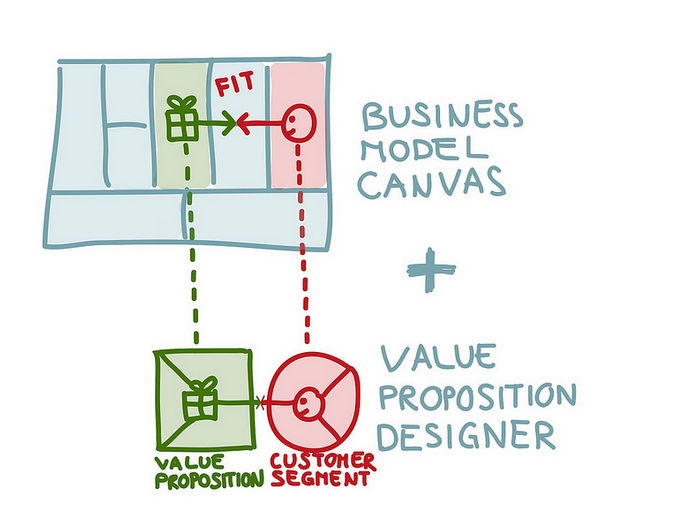
In 2008 Alexander Osterwalder, a business scientist and co-founder of Strategyzer, developed a tool to facilitate the analysis and visualization of business models. The Business Model Canvas has since been widely adopted because it summarizes strategic decisions on a single page, in nine blocks that cover customers, offer, channels, relationships, revenue, resources, activities, partners and costs. Alexander Osterwalder later developed, in 2014, the Value Proposition Canvas, a systematic tool to achieve fit between the needs of the market segments and the value proposition of the company.

The logic of the second canvas is straightforward. Strategyzer describes it as a way to define one customer segment, with the jobs they are trying to get done and the pains they hit along the way, and then to list what the company offers and name the pains it relieves and the gains it creates. It also adds a caution that executives should keep in view: fit is a claim until customers confirm it, as Strategyzer puts it on its Value Proposition Canvas page. That is the reason a continuous improvement method is useful. It converts a drawing into hypotheses and evidence.

Why does this matter at the executive level? Because every decision in the business model, from pricing to channels to partnerships, must revolve around the value proposition. When the proposition is weak, the rest of the model compensates with discounts, marketing spend or sales effort, and margins pay the price.

Why combine the canvases with DMAIC?

The canvases tell you what to examine. They do not tell you how to change it. DMAIC is a structured problem-solving method that does. The American Society for Quality describes it as a structured approach to improving existing processes, running through five phases: Define, Measure, Analyze, Improve and Control, and notes that it is ideal for making incremental improvements to something that already exists. That is exactly the situation of a business model in an established company, which rarely starts from a blank page.

The benefits of using both canvases together are concrete. They promote teamwork by creating a common language to hold conversations about strategy. They represent on a single page everything the company must do to generate and sustain a competitive advantage. They encourage innovation by making it possible to design new business ideas while visualizing existing ones. And they promote strategic discipline because the canvas becomes a living document that must be constantly updated.

Business Model Canvas with its nine blocks, used as the working document in each phase of the DMAIC cycle

Each of the nine blocks of the canvas answers an important question about strategy. The analysis itself should be simple, and ICX recommends using the DMAIC methodology whenever a team sits down to define or redefine the model of a company, a business unit, or a new product or service. Each letter represents one phase.

D: Define the improvement project

In the Define stage the team plans the project, whether the goal is to define or to improve the business model or the value proposition. The first decision is who sits at the table. An effective team is varied in level of responsibility, department, training, gender and, where possible, culture. A model designed only by the executive committee reflects the view from the top floor, while one that includes the people who answer customers' calls, handle returns or negotiate renewals reflects reality. The second decision is the objective and scope, and the recommendation is to write objectives with the SMART approach so that success can be judged afterward.

The team then moves to the definition of the problem, which depends on listening. Use the qualitative and quantitative information the company already holds, involve the people in direct contact with customers, and observe customers doing their work through ethnographic study. The result may be a customer profile, a buyer persona or an empathy map. In parallel, understand how the industry behaves using the five forces framework of Michael Porter, and understand the environment in which the business operates through the PESTA tool. A bank that skips this stage may redesign its savings proposition around product features, when its customers are really trying to feel in control of everyday spending.

M: Measure customer satisfaction

In the Measure stage the team builds a deep understanding of how customers feel and how the company measures it. The goal is to connect results with causes, relating what customers say with the internal factors (processes, policies, culture) and external factors (market, expectations) that produce it. If the company does not yet measure satisfaction, this is the moment to define the metrics and begin, because what is not measured is not improved. This stage matters for another reason: it establishes the baseline against which every later improvement will be judged. Our guidance on Net Promoter Score and related measures is a sound starting point for the measurement system.

A: Analyze the value proposition and the current model

With the information gathered and the satisfaction measures established, the team analyzes the value proposition and the model. The practical technique is to divide the Business Model Canvas into two units of analysis: the right side, which is the market, and the left side, which is the internal operation of the company.

Analysis of the right side

This is where business model innovation happens, so it is where the analysis begins. It starts with the value proposition because of its interdependence with every other decision. The Value Proposition Canvas lets the team see whether the offer fits the needs of customers. Once the segments and the proposition are mapped, the remaining blocks on the right side of the business model canvas follow: channels, customer relationships and revenue streams.

Analysis of the left side

Once the team knows how value is generated, delivered and captured, it aligns the internal side of the company so that the right side can be executed efficiently. The analysis can be enriched with a study of the value chain. Some teams prefer to carry out the Analyze activities within the Define stage so that customer voice does not create noise at the wrong moment. If a team makes that decision, it should use the Analyze phase only to examine problems within the current model.

I: Improve and implement

As in the analysis, the Improve stage works first on the right side of the canvas and then on the left. The aim at the center is to achieve fit between the customer segment and the value proposition, and three questions guide the work.

The first asks about the jobs that customers are trying to do. Jobs are the tasks that customers want to perform and the reason they hire a product or service. The team considers the functional problems clients are solving in their personal and professional lives, the problems they have but may not recognize, the emotional needs they are trying to meet, how they want to be perceived by others, and how they want to feel. A regional insurer might discover that its corporate clients are not trying to buy coverage at all. They are trying to avoid a conversation with their board after an incident.

The second asks about the origin of the customer's pain, understood as anything that diminishes the customer experience. Tools such as Jobs to Be Done, the strategy canvas and the customer experience map help. The team asks what customers consider too expensive, too slow or too much effort, what frustrates them, how they judge current solutions, which features are missing, what performance problems they notice, what social consequences they fear (loss of status, power or trust) and what mistakes they commonly make when using a solution.

The third asks about the sources of happiness, or gains, meaning the results and benefits that customers want. Some are required, some expected, some desired and some are surprises. The team considers which savings of time, money and effort would delight customers, what level of quality they expect, what they look for in design, warranty or features, what they dream of achieving, and what would make them more likely to adopt a proposition, whether lower cost, smaller investment, less risk or better quality.

The answers to these questions must come from the customer voice gathered in the Define stage. With them, the team generates a solution that increases customers' sources of happiness, relieves their pains and helps them complete their functional, social and emotional jobs. It is important to clarify that the solution may focus on only some jobs, pains or gains, not necessarily all, and that choosing which ones is one of the first strategic decisions. When the new Value Proposition Canvas shows a true fit, the team continues with the right side of the business model canvas and finally looks for efficiencies in the value chain on the left, remembering that every block must reinforce the proposition. The Value Proposition toolkit is designed for this step.

C: Control the results over time

Customer tastes and preferences change continuously, and expectations migrate from one industry to another: a customer who gets instant service from a delivery app expects something similar from an equipment supplier. The Control stage monitors whether the proposition remains valid and still delights customers. The team reviews the key indicators defined at the start. Has the Net Promoter Score improved? Has the repurchase rate of customers grown? Have new clients been added to the portfolio? Has word of mouth increased? If the objectives are not being met, the team acts by running the DMAIC cycle again.

This is the discipline that separates improvement from decoration. Without a Control stage, a redesigned model has the same life expectancy as the first canvas on the whiteboard.

What this means for the C-level

For the chief executive, the message is that the business model is a managed asset, with an owner, a review calendar and indicators, not a document produced for a planning cycle. Assign the Control stage to a named executive and review it with the same regularity as the financial results. A model that is reviewed only when profits fall is already late.

For the chief commercial and customer officers, the connection is between the value proposition and the quality of the customer relationship. Attracting customers with a proposition that does not truly fit leads to discounts, churn and weak loyalty. Measuring fit continuously gives the commercial team an early warning on retention, and gives the service organization a reason to bring customer insight into decisions on products and pricing. For the chief financial officer, the improvement cycle offers a way to link customer metrics to economic outcomes, so that decisions about which pains to relieve are also decisions about margin and the cost to serve. For operations, the left side of the canvas is the place to confirm that the organization can actually deliver what the proposition promises, at an acceptable cost.

How to start on Monday morning

A seasoned consultant would recommend modest ambition at first. Choose one business unit or one product line, not the whole company, and assemble a team with representation from sales, service and operations. Spend the first week collecting what the company already knows about the customers in that segment: complaints, satisfaction results, win and loss reasons, renewal data. Resist the temptation to launch a new survey before reading what you already have.

In the second week, fill in a Value Proposition Canvas for the main segment and invite three or four customers to challenge it directly. Ask them what job they were doing when they chose you, what nearly stopped them, and what they would miss most if you disappeared. Document the gaps between what the team believed and what customers said. Those gaps are the first improvement hypotheses, and the baseline measures you set now will tell you in a quarter whether they were right.

How ICX helps

ICX Consulting is a Commercial Strategy and Customer Experience firm based in Miami, and the alignment of business model and value proposition with real customer needs is central to our practice. Our business model and value proposition services help leadership teams run the cycle described here, with the support of our DMAIC expertise and the ICX Compass methodology. We also work with an engineering-based methodology that gives an orderly framework to continuous improvement, because the business model must evolve with the preferences of clients, with the speed at which the central assets of industries are threatened, and with the other forces that affect the business. If you want to build the canvas first, the Business Model Canvas toolkit is available to you, and the companion article on signs that it is time to update your business model will help you decide when to start.

Bring this topic to your company

An ICX Consulting advisor will assess where your organization stands today and which decisions can move your commercial and customer experience results.

Request a diagnostic with an ICX consultant

Frequently asked questions

Is DMAIC suitable for strategic work such as business models?

Yes, with adaptation. DMAIC was designed for process improvement, but its logic of defining a problem, establishing a baseline, analyzing causes, testing improvements and controlling results applies well to a model that already exists. For a completely new business, a design-led approach may be a better starting point.

How long does one cycle take?

For a single business unit, a focused cycle is usually a matter of weeks rather than months, depending on how much customer evidence already exists. The Control stage then continues indefinitely, with a formal review each quarter or semester.

Who should lead the cycle?

An executive with authority over both the commercial and operational sides, supported by a facilitator who is neutral about the answers. When the leader of one function owns the entire exercise, the findings tend to protect that function.

Which indicators best show that the value proposition is working?

Look for a combination of Net Promoter Score, repurchase and renewal rates, new client acquisition and the share of customers who refer others. No single indicator is enough, but a consistent improvement across several of them shows that fit is real and not merely claimed.

A business model is never finished, and the companies that treat it that way tend to outgrow those that treat it as a document. If you would like help turning your canvas into a cycle of measurable improvement, request a diagnostic with an ICX consultant and start with the proposition your customers value most.

Content added to ICX Folder
Default Save Save Article Quit Article

Save for later

Print-Icon Default Print-Icon Hover

Print

Subscribe-Icon Default Subscribe-Icon Hover

Subscribe

Start-Icon Default Start-Icon Hover

Start here

Suggested Insights For You

We Love the Business Model Canvas (and so should you!)

We Love the Business Model Canvas (and so should you!)

The Business Model Canvas is a one-page map of how a company creates, delivers and captures value. Its nine blocks, from customer segments and value...

How to Build a Business Model Canvas Step by Step

How to Build a Business Model Canvas Step by Step

A Business Model Canvas (BMC) is a one-page visual map of how a company creates, delivers and captures value, organized in nine building blocks. To...

When to Use the Value Proposition Canvas: A Decision Guide for Leaders

When to Use the Value Proposition Canvas: A Decision Guide for Leaders

Use the Value Proposition Canvas when a decision depends on understanding one customer segment in depth, such as launching a product, entering a new...

What's next?

ARE YOU READY?

ICX SUBSCRIPTION
Stay ahead with exclusive insights from our senior consultants. Subscribe for the latest thinking on CX, growth, and digital transformation.