






What is Content Marketing? Strategy Guide | ICX Consulting
ICX Consulting, a commercial strategy and customer experience firm, builds content marketing strategies tied to revenue. Content marketing is a...

By Role
By Industry
By Target Customer
What We Offer
ICX helps companies grow revenue and profitability by connecting customer experience, sales, pricing, CRM and automation into one commercial system.
Customer Experience
We design memorable, customer-centered experiences that drive loyalty, enhance support, and optimize every stage of the journey. From maturity frameworks and experience maps to loyalty programs, service design, and feedback analysis, we help brands deeply connect with users and grow sustainably.
Marketing & Sales
We drive marketing and sales strategies that combine technology, creativity, and analytics to accelerate growth. From value proposition design and AI-driven automation to inbound, ABM, and sales enablement strategies, we help businesses attract, convert, and retain customers effectively and profitably.
Pricing & Revenue
We optimize pricing and revenue through data-driven strategies and integrated planning. From profitability modeling and margin analysis to demand management and sales forecasting, we help maximize financial performance and business competitiveness.
Digital Transformation
We accelerate digital transformation by aligning strategy, processes and technology. From operating model definition and intelligent automation to CRM implementation, artificial intelligence and digital channels, we help organizations adapt, scale and lead in changing and competitive environments.
Operational Efficiency
We enhance operational efficiency through process optimization, intelligent automation, and cost control. From cost reduction strategies and process redesign to RPA and value analysis, we help businesses boost productivity, agility, and sustainable profitability.
Customer Experience
Marketing & Sales
Pricing & Revenue
Digital Transformation
Operational Efficiency
Content marketing is crucial for your sales team because relevant, consistent content answers buyers' questions before and during the sale, builds trust with key accounts and gives sellers material that moves each opportunity to the next stage. When the content is designed with sales, it shortens cycles and raises the quality of every conversation. When it is not, it becomes an expensive library that sellers never open.
Imagine the Monday forecast meeting of a company that sells industrial equipment. The sales director reviews twelve opportunities that have been in the same stage for more than a month. Asked why, the sellers give three different answers, and none of them is about price. One says the buyer's finance team never understood the return. Another says the technical evaluator wanted proof from a similar plant. A third says the champion could not explain the project to his own board. In all three cases the missing ingredient was not a better pitch. It was a piece of content, a case, a model, a one-page argument, that the buyer could take into a room where the seller was absent.
That scene is the heart of this article. Content marketing is often discussed as a way to generate traffic and leads, and it is that. But for the commercial leader, its most valuable function appears after the lead exists, in the weeks when a team of buyers has to convince itself, and each other, that the purchase is wise. The way those buyers behave has changed. A Gartner survey of 646 B2B buyers found that 67% prefer a rep-free experience and 45% used AI during a recent purchase. When buyers do much of their research alone, the content they find is effectively the first sales conversation, and if it is missing, generic or inconsistent with what the seller says later, the opportunity begins at a disadvantage.
Content marketing is a methodology that aims to develop, implement and share content suitable for attracting, converting and delighting audiences of significant interest to the company. Its importance lies in sharing with prospects and customers material based on focused strategies that solve their daily problems, needs or challenges. If you want the full definition and its evolution, see our article what is content marketing.
It is worth stressing what the process is not. It is not a mass approach. It is a highly strategic one, aimed at your key accounts, your buyer personas or a specific segment of customers and prospects that needs to receive differentiated content. A message that tries to speak to everyone persuades no one, and the sellers who work the accounts know it better than anyone.
Many of the challenges faced by commercial, marketing, sales and service managers are closely related to communication strategy, or derive from other processes and end up becoming a communication challenge as well. A seller who cannot explain why a project pays back is facing a content problem. A customer who does not understand what a new service adds is facing one too. When leaders see it that way, the question stops being how much marketing should publish and becomes whether the company's content helps the buyer decide at each stage of the journey.
It helps to follow the journey stage by stage. At the beginning, a prospect needs a reason to pay attention, which is the work of point-of-view articles, industry insights and short diagnostics. During discovery, the buyer needs help framing the problem, and guides, benchmarks and checklists give the conversation a structure. At evaluation, proof and comparison dominate, so case studies, return models and solution overviews written for each role carry the weight. At the moment of decision and expansion, the buyer needs confidence to sign and to grow, which implementation plans, onboarding materials and success stories provide. A company that has content for every stage has, in effect, a sales team that works even when the sellers are not in the room.
Content marketing is not about concentrating the marketing team's effort on producing messages. Imagine that your company generates the same content every month, no matter what industry it serves or which buyer persona it addresses. Do you believe it will translate into new customers, more sales or retention? The answer is no, and it would achieve none of the three. Repeating the same communication month after month is not a strategy. It becomes a monthly annoyance that loses impact until the audience simply receives repetitive content. It does not translate into sales because it does not solve the needs or problems of the audience, and it does not help retain customers who are unaware of the value the company gives them.
Long-term strategies matter for reasons that reach beyond marketing. Well-planned content engages the different business verticals in continuous customer acquisition, sales improvement and retention. It establishes good practices for analysis and for the adoption of agile, innovative methods with buyer personas or target accounts. It defines specific business goals for each vertical and sets performance indicators based on results. And it attracts leads while strengthening the company's demand generation.
A long-term plan also protects the sales team from the most common frustration with marketing content, which is pieces that arrive too late for the deals they were meant to support. When sales and marketing agree on a twelve-month content calendar tied to the commercial plan, sellers know what will be available for each campaign, product launch or key account push, and they can plan their own conversations around it. Think of a bank preparing to launch a new line of credit for small businesses. If the case studies, the comparison with alternatives and the explanation for accountants are ready on the day the relationship managers begin to call, the launch has a chance. If they arrive three months later, the first wave of conversations has already been spent.
Every content strategy needs a direction and a starting point. It is not a matter of producing pieces and then publishing or sending them. An essential element in the gears of any content strategy improves its results, and that element is contextualization. Contextual marketing is a tactical approach oriented to the digital world and its channels, such as the company's websites, search engines and social media pages. Its purpose, as described in the HubSpot Academy course on contextual marketing, is to guide marketing efforts by user behavior, across interactions on different devices such as computers and smartphones.
For a sales team, context means that the right content reaches the right person at the right moment of the opportunity. A prospect who has just downloaded a pricing guide should not receive the same introductory email as someone who has never visited the site. A key account that is about to renew needs different material from one that is onboarding. Connecting content to CRM data, lifecycle stages and deal stages is what turns a content library into a sales tool, because the seller can see what the contact has read and choose the next conversation accordingly.
Take a distributor of consumer goods with a regional account team. Without context, every retailer receives the same quarterly newsletter. With it, a retailer whose reorders have slowed receives an analysis of category trends and a suggestion for the shelf, while a new retailer receives an onboarding sequence that explains ordering, delivery windows and support. The content may be the same pieces, reorganized, but the commercial effect is very different.
The pieces that can be used in a content strategy are very diverse. They include articles, publications and blogs, events with a certain exclusivity or restricted access, ebooks, and audiovisual resources such as videos or visual content. A company should not limit itself to a single format. It is free to choose the materials and resources that align with its strategy, audience and business model, and generating diverse content to communicate the business strategy is crucial.
The best source of ideas is usually the sales team itself. The questions prospects ask in discovery calls, the objections that stall deals and the reasons customers give for choosing the company are a ready-made editorial agenda. Research from the Content Marketing Institute among 1,015 B2B marketers shows that content relevance and quality is the factor most often credited by teams that rate themselves effective (65%), while creating content that prompts a desired action is the most common challenge (40%). Sellers know which content prompts action, because they see it happen in their conversations. A monthly conversation in which marketing listens to the three most repeated objections will produce better ideas than any brainstorming session.
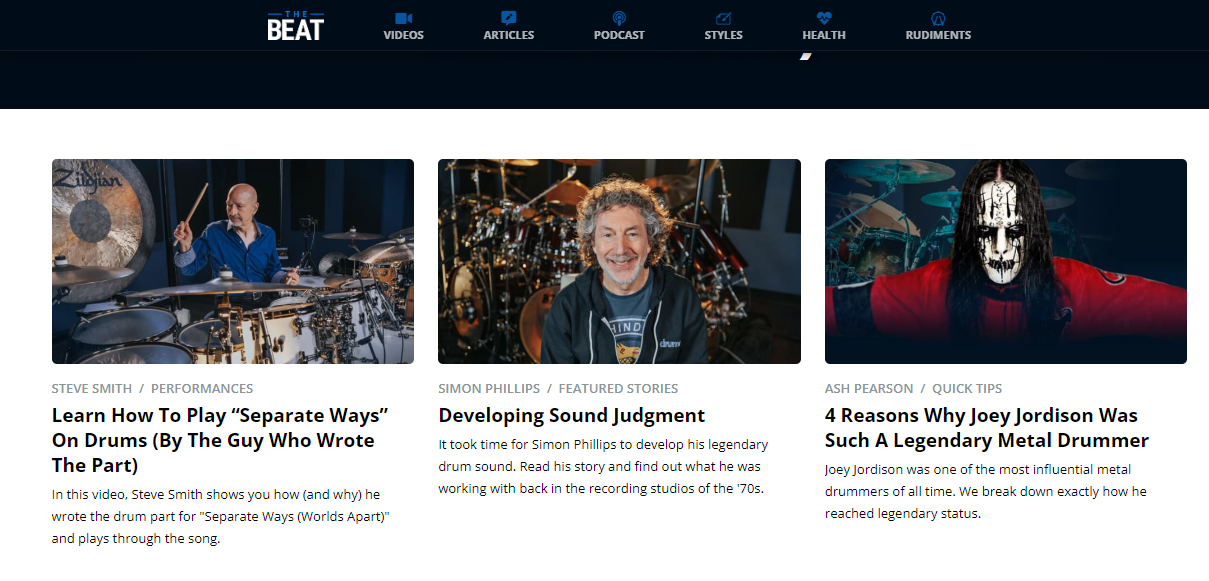
Two cases illustrate the principle from opposite ends of the market. The first is Drumeo, a company dedicated to teaching percussion instruments such as the drums. It does so through a methodology of ten levels of study with personalized classes, which independent reviews such as MusicRadar's review describe as including more than 260 courses and over 2,500 lessons. Drumeo also maintains a section of articles called The Beat, in which it shares a wide range of topics, tips and guides on practice, teaching and musical health, and even podcast sessions with experts in the field. In this way, it reinforces its prestige as a leading platform in its market, working in alliance with and consulting its associated teachers.


The second is Coca-Cola. Content marketing for a global company may seem like an ordinary task, but the brand manages these strategies at a very high level. It has made its products and content connect with a basic feeling of human nature, happiness, and it has established itself as a leader in its industry by reaching audiences with content highly targeted to their feelings and emotions. Its Share a Coke campaign is a clear example. According to the company, the campaign began in Australia in 2011 with the 150 most popular first names, sold more than 250 million named bottles and cans in a country of under 23 million people and has since reached more than 70 countries.

The lesson for a B2B sales team is not to copy a consumer campaign. It is that both cases build content around the identity and goals of the audience, the drummer who wants to improve, the person who sees their own name on a bottle. In B2B, the equivalent is content built around the buyer's role, industry and business problem. A financial director does not need a brochure about features. She needs to see her own question, how to justify the investment to the board, answered in her own language.
Imagine that you already have the essential elements of the strategy, the pieces, the resources to share with your audiences and the direction for your sales teams. You are still missing an important variable. How do you plan to measure and analyze its effectiveness? Companies need reports and data that show the reality of their efforts. A good diagnosis begins with the campaign goals and objectives, the buyer persona types and the objectives specified for each, the strategic campaign metrics from reports, forms, landing pages, email marketing, automated sequences and web traffic, and the flow of contacts through the conversion stages of the customer lifecycle.
For the sales team specifically, three indicators connect content with revenue. The first is the share of opportunities in which sellers used content. The second is the win rate and cycle length of those opportunities compared with the rest. The third is the content most often viewed by contacts in deals that closed. These measures turn a debate about opinions into a conversation about evidence, and they tell marketing which pieces deserve more investment and which should be retired. Our article on 6 content marketing metrics for continued success goes deeper into the marketing side of measurement.
For the chief executive and the chief commercial officer, the first question is whether content is treated as a commercial asset or as a marketing expense. When it is built for specific personas and key accounts, it attracts prospects who already understand the problem the company solves, which improves the quality of the pipeline before a seller makes a call. When sellers are equipped with stage-specific content, they spend less time explaining basics and more time on the decision, which supports shorter cycles and more predictable forecasts. These are not marketing outcomes. They are revenue outcomes.
Content also matters after the sale. Onboarding and success material reminds customers of the value they receive, which is a condition for renewal and for the loyalty that makes expansion possible. And it is a question of efficiency. A shared calendar and a single library avoid the duplication in which each seller builds his or her own slides while marketing produces pieces nobody uses. A leader who asks for one view of what exists, who uses it and what it contributes to wins will quickly find where the effort is being wasted.
An experienced commercial leader would start by listening. Ask the sales team for the ten most frequent questions and objections of the last quarter, and place each one on the buying journey to see whether the company already has content that answers it. The gaps will be obvious, and they should be filled first in the stages where deals stall most often. Make the content easy to find by storing it where sellers work, inside the CRM or the sales enablement tool, organized by persona and stage, because a piece that takes five minutes to locate will not be used during a live conversation. Then review the results every month, comparing content usage with win rates and cycle times, and retire what does not help.
To map content to each stage of the journey, use the ICX Customer Journey toolkit, a practical template for identifying which content your buyers need at every touchpoint.
ICX Consulting advises companies on how to apply and develop effective content strategies with working methodologies such as Inbound Marketing and Account-Based Marketing, among others. Our content marketing consulting connects editorial planning with the commercial plan, our account-based marketing practice tailors content to key accounts, and our sales enablement service puts that content in sellers' hands at the right moment. Want to know which content is helping your deals and which is not? Request a diagnostic with an ICX consultant.
Bring this topic to your company
An ICX Consulting advisor will assess where your organization stands today and which decisions can move your commercial and customer experience results.
Marketing should own production, quality and brand consistency, while sales owns the input, meaning the questions, objections and deal situations the content must address. A joint monthly review, with a clear owner on each side, prevents the classic gap in which marketing produces pieces that sellers never use.
It is especially useful there. Long cycles involve several stakeholders who join at different moments and need to be brought up to speed. Role-specific content lets the champion share the business case with finance, operations or IT without the seller having to repeat the same presentation in every meeting.
Sales enablement content, such as case studies or objection guides, can help within weeks because sellers use it immediately in active deals. Content meant to attract new demand through search or social channels usually takes several months to build momentum, which is why both types should be planned together.
AI can speed up drafting, research and repurposing, but it does not replace knowing what your buyers care about. The value of sales-focused content comes from real customer questions, proprietary experience and a clear point of view, which still require people who understand your market and your sales process.
Your buyers are already reading before they talk to your sellers, so the content they find shapes every conversation that follows. If you want your content to open doors and close deals, talk to an ICX consultant and build a plan your sales team will actually use.
ICX Consulting, a commercial strategy and customer experience firm, builds content marketing strategies tied to revenue. Content marketing is a...
ICX Consulting, a commercial strategy and customer experience firm, helps companies turn content into a revenue asset. Quality content for an inbound...
ICX Consulting, a commercial strategy and customer experience consultancy, helps companies create content for each stage of the customer's buying...