











1 min read
How to configure the wishlist in Magento
A shopper is waiting at an airport gate when she finds the jacket she has wanted for months. The price is a little high, her flight boards in ten...
9 min read
9 min read
Shopping tools are the features enabled inside an eCommerce store that make buying easier and more engaging, such as wish lists, saved carts, product ratings and reviews, and comparison functions. They improve the customer experience, and they also give the company valuable data about what each customer wants.
Consider the Monday review of a digital commerce director at a home goods retailer. The catalog has grown to thousands of products, the integrations with the ERP and the payment gateway work flawlessly, and traffic is up. Yet the numbers that matter tell a different story: visitors browse, add items to the cart and leave, and the repeat purchase rate is flat. The technology team insists that the platform is stable. The marketing team insists that the traffic is qualified. Both are right, and neither answers the question that the chief executive asks at the end of the meeting, which is why customers who clearly want something do not come back to buy it. The answer, more often than companies expect, lies in the small tools that sit between browsing and buying.
In a world that increasingly revolves around pleasing the user, the experience within a store becomes more important with every year. A company can have an eCommerce site with more SKUs and a wider variety of products than any competitor, but if the customer experience is not enjoyable and complete, the results will not be satisfactory. This article uses the infographic below as its starting point to explain what shopping tools are, why they matter to revenue and to the knowledge a company has of its customers, and how an executive team can decide which ones deserve investment first.
Shopping tools are the functionalities enabled within an eCommerce store through which the user experience is encouraged and improved. They are not the core infrastructure of the store, which covers catalog, checkout, payment and inventory. They are the layer that helps a customer decide, remember, compare and return.
The infographic that accompanies this article shows the most striking and important functionalities that can be included in a store. Their main objective is to increase the robustness of the site, in the sense of making it more useful and more persuasive for the person who is browsing. Companies should not focus only on the back end, with its integrations, payments and data, but also on the front end, which is, after all, the part with which the customer interacts. A solid back end can still deliver poor sales results if nobody asks about, or cares for, the customer.
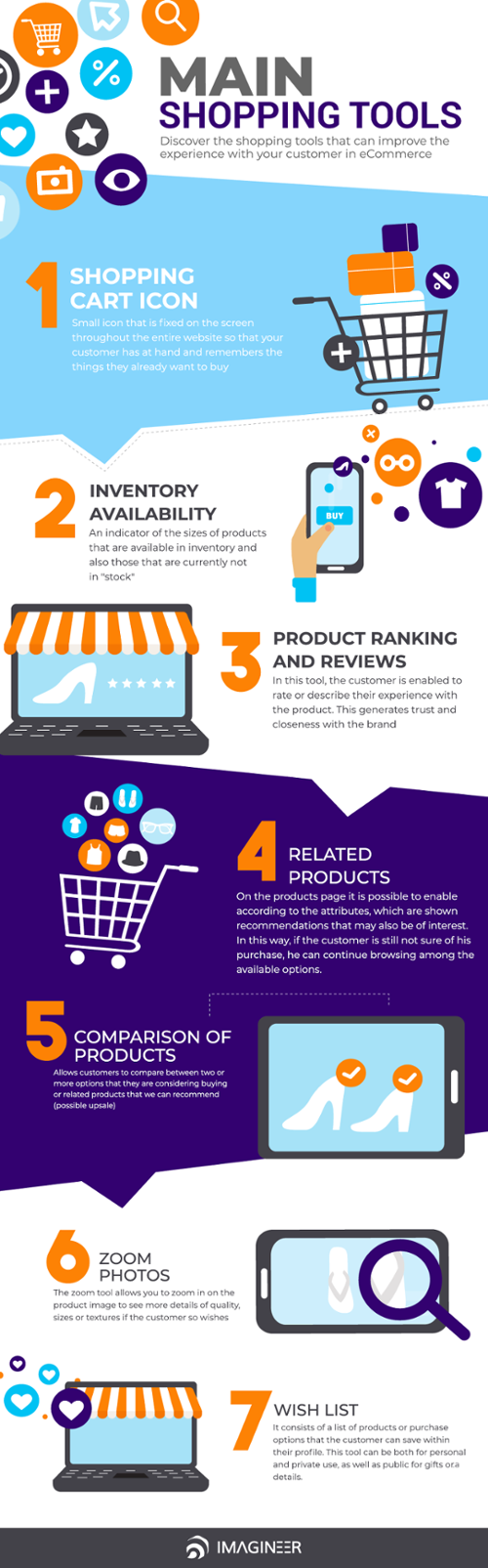
As the infographic shows, shopping tools can be small changes or improvements within the virtual store that end up meaning a significant increase in the experience the user perceives and enjoys. They also deliver benefits at the brand level, since a store that remembers preferences and makes decisions easy builds a reputation for being pleasant to buy from.
Shopping tools matter because most visits to an online store do not end in a purchase, and the reasons are often about friction and confidence rather than price alone. Baymard Institute, which has compiled dozens of studies, reports an average documented cart abandonment rate of 70.22 percent, and it identifies reasons such as extra costs, forced account creation, a checkout that is too long or complicated, and doubts about trusting the site, in its overview of cart abandonment rate statistics. Many of those reasons, Baymard argues, can be addressed through design changes.
Shopping tools address a different part of the same problem. A customer who is not ready to buy today can save the product to a wish list and return. A customer who hesitates between two options can compare them. A customer who doubts the quality of an item can read the ratings and reviews of people who bought it. Each of these tools replaces an exit with a next step, and each makes the store a place where the customer can think rather than a corridor that leads either to payment or to the door. The ICX article 4 benefits of eCommerce wish lists examines one of these tools in detail.
Product reviews illustrate the mechanics well. In Adobe Commerce, according to the platform's documentation on product reviews, customers can rate products on default criteria such as quality, price and value, store administrators moderate the reviews before they are published, and a configuration setting controls whether reviewers must have an account. That combination of customer voice and company control is exactly the balance an executive should seek, because unmoderated reviews expose the brand while no reviews at all leave the customer without reassurance.
Shopping tools deliver a double benefit. First, they encourage and motivate the customer to keep browsing the site, which also helps with search engine optimization since engaged visitors spend more time and visit more pages. Second, they allow the company to understand the customer and their consumption patterns.
That understanding comes from the information that can be observed from the customer: wish lists, products in the cart, reviews and ratings, among the other elements mentioned in the infographic. When the tools are configured thoughtfully, the store generates experience for the customer and, at the same time, produces data that can be used to design campaigns and incentives specifically for the preferences of each person. A wish list is a declaration of intent. A product left in the cart is a signal of interest. A review is an unprompted explanation of what the customer valued or disliked.
Imagine a specialty retailer of sporting goods that notices that a particular pair of running shoes is saved on many wish lists but rarely purchased. The data suggests the product interests customers and that something prevents the purchase, perhaps price, perhaps sizing information. A targeted email when the item goes on promotion, or a clearer size guide on the product page, addresses the specific obstacle. Without the wish list tool, that signal would never have existed. This is the kind of loop that connects the store to marketing automation and to the CRM, which is why integrations matter, as discussed in the ICX article on 6 key integrations in your eCommerce.
Every industry that sells online benefits, but the tools that matter most vary with the purchase. The following examples are illustrative scenarios.
In fashion and apparel, where fit and style drive decisions, wish lists, saved outfits and reviews that mention sizing reduce hesitation and returns. In consumer electronics, where customers compare specifications, comparison functions and detailed ratings carry more weight. In grocery and consumables, saved carts and reorder lists turn a weekly chore into a few clicks, and the repeat purchase becomes the business model. In B2B distribution, where buyers purchase the same items repeatedly under negotiated conditions, saved lists and quick reorder tools are often more valuable than any promotional feature, a point developed in the ICX article on the characteristics of a B2B eCommerce that reduce costs.
The lesson is to choose tools by the behavior of the customer, not by the availability of the feature. A store that adds every possible tool without understanding how its customers buy risks clutter, slower pages and a confusing experience. A store that adds the right three produces measurable change.
The order in which tools are introduced also matters. Many successful stores begin with the tools that reduce uncertainty, such as clear product information, ratings and reviews, because they work on every visit. They then add the tools that encourage return, such as wish lists and saved carts, and finally the tools that personalize the experience, such as recommendations based on browsing history. Each stage builds on the data produced by the previous one, so the sequence is not only a matter of priorities but of learning. A retailer that jumps directly to personalization without the underlying signals ends up recommending products on the basis of very little knowledge of the customer.
A shopping tool is working when it changes behavior that the business cares about, and that requires deciding in advance what to measure. The temptation is to count usage, for example how many people created a wish list, and to celebrate the number. Usage is a useful first signal, but it is not the result. The result is what customers who use the tool do afterward compared with similar customers who do not.
A practical approach is to track four indicators. The first is the conversion rate of visitors who interact with the tool against those who do not, bearing in mind that engaged visitors may already be more likely to buy, which is why a controlled test on a subset of products or audiences is more reliable than a simple comparison. The second is the rate of return visits within thirty days, which shows whether the tool brings customers back. The third is average order value, since comparison and recommendation functions often lead customers to choose a better or larger item. The fourth is the volume of customer service contacts about product questions, which should fall when ratings, reviews and clear product information answer them in advance.
Imagine a home improvement retailer that introduces ratings and reviews on its most visited product category. After a quarter, the team compares conversion on that category with a similar one that has not yet received the tool, notes how many product questions reach the call center, and reviews which items attract the most reviews. If conversion rises and service contacts fall, the business case for extending the tool is clear. If conversion is flat but reviews are mostly negative, the tool has revealed a product problem, which is also valuable, though not in the way anyone expected. Either way the company learns something it did not know, which is the real return on shopping tools.
Every tool added to a store has a cost, and an honest executive discussion includes it. The first cost is complexity. Each feature adds code that must be maintained, tested across browsers and devices and kept compatible with platform updates. A store that accumulates tools without discipline can become slow, and a slow store loses the very customers the tools were meant to retain.
The second cost is governance. Reviews need moderation to prevent abuse and to protect the brand, wish lists and saved carts hold personal information that must be handled according to privacy rules and the consent customers have given, and any use of that information for marketing must respect those limits. The third is organizational: tools generate data, and data without an owner is wasted. Someone in marketing or digital commerce must be responsible for turning wish list and cart signals into campaigns, and someone in merchandising must act on what reviews reveal about products.
These costs are manageable, and they are a reason to be selective rather than a reason to avoid the tools. The companies that benefit most are those that treat each tool as a small business initiative, with an owner, an expected result and a date to review whether it is delivering. That discipline is also what separates a store that evolves continuously from one that periodically undergoes costly redesigns.
For the chief executive and the chief commercial officer, shopping tools are a way to increase conversion and repeat purchase without increasing acquisition spend. Each visitor who returns because a product was saved is a visitor the company did not have to pay to acquire a second time. For the chief marketing officer, they are a source of first-party data that becomes more valuable as third-party tracking becomes less available, since wish lists, carts and reviews are information customers share directly with the brand.
For the chief experience officer and those responsible for loyalty, the tools are expressions of the customer journey. They reduce effort at the moments when customers hesitate, and they signal that the brand pays attention. For the chief technology officer, the point is balance: each tool adds code, maintenance and potential performance costs, so the choice should be driven by evidence of customer need. There are trade-offs, and an executive should expect them. Tools that collect personal information require clear consent and privacy practices, reviews require moderation resources, and every feature must be tested on mobile devices, where most browsing now takes place.
A seasoned consultant would begin by observing rather than building. Ask the analytics team to show where in the journey visitors leave, and ask customer service which questions customers ask most often before buying. Those two sources point to the moments of hesitation. Then choose one or two shopping tools that address them directly, for example a wish list if many visitors leave after viewing a product page, or ratings and reviews if customer service is flooded with questions about quality.
Implement the chosen tools on a limited set of products or a segment of the audience, measure their effect on conversion, return visits and revenue per visitor, and expand if the results justify it. Ensure the data collected flows into the CRM and into campaigns, since a tool that gathers information that nobody uses is only half implemented. This approach is modest and testable, and it gives the leadership team evidence rather than opinion when deciding where to invest next. The ICX article on product pages that can boost sale conversions is a useful companion for the next step.
ICX Consulting helps retailers and manufacturers design digital stores around the behavior of their customers. We review the journey from visit to purchase, define which shopping tools will have the greatest effect, implement them on platforms such as Adobe Commerce, and connect the resulting data with marketing and CRM so it informs campaigns and service. Our work in digital eCommerce for B2C and in UX optimization brings the technology and experience perspectives together. To map where your customers hesitate before choosing tools, the Customer Journey Toolkit is a practical place to begin.
Common examples include wish lists, saved carts, product ratings and reviews, product comparison, recently viewed items and quick reorder lists. Each helps customers decide, remember or return, and each can give the company data about preferences that supports targeted campaigns.
They can, because they address hesitation, which is a main reason visitors leave without buying. The effect depends on matching the tool to the customer's behavior, so test one or two tools on a limited scale and measure conversion and repeat visits before expanding.
Indirectly. Tools that keep visitors engaged lead to more pages viewed and more time on site, and user reviews add fresh, relevant content to product pages. They complement, but do not replace, solid technical and content optimization.
Start with evidence. Identify where visitors leave and which questions they ask customer service, then select the tools that answer those specific obstacles. Avoid adding features simply because they are available, since clutter can hurt the experience.
If your store attracts visitors who browse but do not buy, a review of the customer journey can show which small changes would make the largest difference. Request a diagnostic with an ICX consultant and we will help you decide which shopping tools deserve investment first.



1 min read
A shopper is waiting at an airport gate when she finds the jacket she has wanted for months. The price is a little high, her flight boards in ten...

1 min read
On the Tuesday after a long weekend, the commercial director of a home furnishings retailer opens the monthly report and finds two numbers that...

Advanced reporting in Magento and Adobe Commerce turns store data into dashboards on orders, customers and products, so executives can see what...

