











Suzuki Success Story: Implementation of Inbound Methodology
Suzuki South Africa grew sales by 21.3 percent in a year when the car market fell 2.3 percent, after it replaced broad advertising with an inbound...
9 min read
9 min read
Inbound sales is a consultative sales methodology that starts from the buyer's goals, challenges and timing instead of the seller's quota. It relies on inbound marketing to attract informed prospects and on salespeople who identify, connect, explore and advise, so that conversations feel like help rather than pressure and convert more reliably into loyal customers.
Imagine the weekly revenue meeting at a mid-sized B2B services company. The marketing director reports that leads grew 30% this quarter. The sales director answers that most of them are not ready, that her team wastes mornings calling people who barely remember downloading a guide, and that the best deals still come from referrals. The CEO listens to two reasonable executives describing the same funnel from opposite ends and asks why growth in leads is not growth in revenue. The honest answer is that the company has two functions but no shared method. Marketing generates attention and sales generates pressure, and the buyer experiences neither as help.
That gap is exactly what inbound sales was designed to close. The methodology belongs to the same family as inbound marketing, which emerged in the mid-2000s when marketing and sales began to be rethought to be less intrusive and more valuable to the customer: marketing educates and sales becomes a service. This article argues that the two disciplines are one revenue system, explains how each stage of an inbound sale works, and shows what executives should change in structure, measurement and behavior to make it pay.
For decades, purchase decisions were made under the heavy influence of brands. Companies spoke through television, radio and newspapers, and salespeople were the main source of new prospects, using intrusive techniques such as cold calls and door-to-door visits. The rapid advance of the internet and social networks changed the starting point. It is now difficult to reach buyers en masse with generalized messages, because they investigate and look for the option that fits their needs. That process includes evaluating different suppliers and brands, reading reviews and the opinions of other users, and comparing prices, characteristics and functionalities, usually before any conversation with a vendor.
Data from the field confirm the shift. HubSpot reports, citing its State of Sales research, that most prospects (96%) research companies and products extensively before talking to a rep, in its description of the inbound sales methodology. Gartner's 2026 survey of 646 B2B buyers goes further and finds that 67% prefer a rep-free experience, which means that sellers who arrive late and talk about themselves are, in effect, an obstacle in a process the buyer already controls.
There is a fair objection to this reading. Self-directed buying does not eliminate the seller, particularly in complex, high-ticket or regulated purchases where risk is high and requirements are ambiguous. The point is different: the seller's contribution moves from supplying information, which the buyer already has, to interpreting it, framing trade-offs and reducing the risk of the decision. That is a consultant's role, and it requires a different way of selling.
Inbound sales is a methodology that prioritizes the needs, goals and interests of buyers. Instead of focusing on closing the sale as quickly as possible, the seller acts as a consultant who guides the person naturally, offers accompaniment, pays attention to their needs and helps solve their weak points. HubSpot describes the approach as one that introduces buyers to the brand before they are even looking to make a purchase, so that when the need arises the company is already known and trusted.
The seller's work begins with understanding how the consumer behaves along the buyer's journey. Once that behavior has been analyzed, the inbound salesperson can design an approach that is useful for each prospect, and the extra time and care devoted to that potential customer increase the probability of converting them and keeping them loyal. Readers who want to go deeper into the journey itself will find it in our article on the buyer's journey in inbound marketing strategies.
Inbound marketing is an essential requirement of inbound sales. It delivers to the buyer persona the right content at the right time and feeds them with information that helps alleviate their need. The salesperson, for their part, is prepared so that when contacting the customer, if the person is still not completely decided, it is possible to offer more relevant content to help in the decision process. Marketing therefore does not hand over a name and a phone number. It hands over a history of what the person has read, asked and downloaded, which is the raw material of a useful first conversation.
Consider an industrial equipment manufacturer. A plant manager downloads a guide on reducing unplanned downtime, then reads two articles on predictive maintenance and visits the pricing page for service contracts. A seller who sees that sequence does not open with a catalog. She opens with a question about the plant's downtime, offers a relevant case, and treats the pricing visit as a sign that a budget conversation is near. A seller who sees only a name calls the same plant manager, who politely declines.
The relation between the two disciplines is also a question of data. When both teams work on the same database of prospects and share indicators, the company can see where leads stall and why. If you want to examine the structure of that funnel, our guide to understanding the inbound marketing funnel explains how its stages connect to sales activity.
The first requirement is to combine the efforts of both teams, a process known as smarketing. Both functions must manage common goals and work together on strategies that handle potential customers in the most effective way, from before they arrive as visitors to the website until they finally become buyers. Merging them in this sense creates a symbiosis in which each department supports the other, shares indicators, pursues common goals, exchanges strategic information and works on the same prospect database.
The evidence on how rare this alignment is should give executives pause. HubSpot's research, cited in the same methodology article, indicates that only about 30% of sales professionals say their sales and marketing teams are closely aligned. A company that achieves real alignment therefore has an advantage that is organizational rather than technological, and difficult for competitors to copy.
In practice, alignment means agreeing on three things before any campaign is launched. The first is a shared definition of a qualified lead, written in the language of the buyer's behavior and not of volume. The second is a service-level agreement that specifies how quickly sellers respond and how marketing treats leads that sellers return. The third is a common revenue target, so that both teams answer for the same number. Without them, inbound methodology becomes a vocabulary rather than a practice.
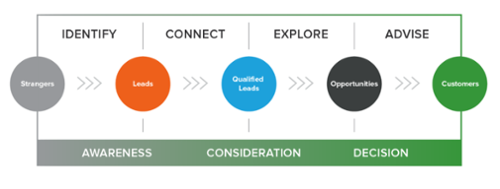
Creating an inbound sales strategy can be divided into four parts: identify, connect, explore and advise. HubSpot frames them within the awareness, consideration and decision phases of the buyer's journey. What follows is how each works in practice and what separates a disciplined team from one that merely uses the names.
In this first stage, the seller identifies active buyers, meaning those who have begun to look for a solution to their problem. It is very likely that the person found the company through a blog article, completed a form to download quality content or interacted with a chatbot. The seller should identify them and gather clues before starting the conversation, either by researching the buyer on social networks or, in B2B, on the company's website, or by preparing a series of questions that help judge whether it is prudent to continue or to direct the person toward another solution. In a private bank, for instance, an advisor who learns that a prospect has just sold a business, and has been reading about wealth succession, will open a very different conversation than one who only sees a contact record.
Once the prospect has been researched, the moment comes to connect in a personalized way. The first impression is important and can be decisive, and a seller who takes the time to understand the prospect can differentiate from the first contact. A good connection starts with listening. The seller should not talk too much and should ask what the prospect wants to achieve before saying anything about the company. Honesty matters just as much: do not try to sell something the person does not need, and be clear about whether the company can help. Then, tell a real success story in which the company has solved a similar problem, which gives the prospect evidence without turning the call into a presentation. Finally, judge whether it is time to move to exploration, and if not, agree on a concrete next step so the relationship does not depend on goodwill. HubSpot adds that reps should not push for a demo immediately, a rule that many teams find hard to follow when quotas are tight.
Is it time to solve problems? Not yet. The task now is to understand the problem and to determine whether the product or service can truly solve it. Because inbound sales is customer-focused, the seller should not arrive with a keynote on how good the company is. The seller keeps learning about the prospect and guides them through key questions that provide the information needed to build a plan, a solution or the right offer for their particular needs. HubSpot suggests asking about goals and about what stands in the way of achieving them, and then discussing budget and timeline. A health-care equipment supplier that asks a hospital director how procurement decisions are really made, who signs, and which budget cycle applies, will qualify the opportunity better in thirty minutes than a month of follow-up emails.
Finally, it is time to support potential clients and advise them on their decision. If the buyer's problem and its solution have been correctly identified, it is easy to make a tailored, simple and concrete proposal, to the point and at the right price. When the client has concerns about the offer, the seller must address them thoroughly instead of clinging to the defense of the proposal. Understanding the concern in depth usually makes it easy to explain how the risk can be reduced. The advise stage is where the earlier discipline pays off, because a proposal built on real discovery rarely needs heavy discounting to close.
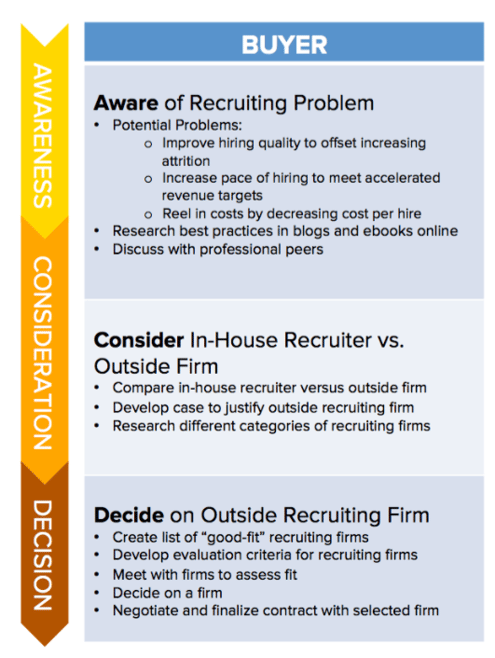
For the CEO, inbound sales is a governance question before it is a sales question. The company either has one revenue system, with shared targets and shared data, or it has departments that optimize their own metrics. The most productive step is to hold marketing and sales jointly accountable for pipeline and revenue, and to review the funnel in one meeting rather than two.
For the CFO, the method changes the economics of acquisition. Informed prospects who are advised instead of pressured tend to convert with less discounting and shorter cycles, which improves margin and the predictability of the forecast. For the chief commercial and marketing officers, the decision is about attracting the right buyers and converting them well: content that answers real questions, a clear definition of readiness, and sellers trained to explore before they propose. The CX leader benefits because the experience becomes consistent from the first article to the first invoice, which supports retention and loyalty. Happy customers become brand ambassadors, and the coordination of marketing, sales and service teams produces faster conversion, faster closing, higher lead flow and overall revenue growth.
A seasoned consultant would not start with a tool. She would ask five recent closed-won customers how they first found the company, what they read before speaking to a seller and what the seller did that helped or irritated them. That conversation, repeated a few times, exposes the real buyer's journey and the points where the company either helped or interrupted.
Next, bring the heads of marketing and sales together to write down, on a single page, what a qualified lead looks like and how fast each side responds. Then choose one segment and train the sellers who serve it in the four stages, using real leads as case material, and listen to a handful of recorded calls to see whether they listen before they pitch. Measure the result with a small set of indicators: conversion from qualified lead to opportunity, sales cycle length and discount level. If those improve in one segment, extend the method to the next. For a view of the end-to-end process that supports all of this, read The Sales Process: The Backbone of a Successful Sales Effort, and use our persona playbook toolkit to sharpen who you are talking to.
ICX Consulting helps companies design the commercial system that connects attraction, conversion and retention. Our inbound sales practice builds the stages, scripts and metrics described above, while our inbound marketing work ensures that the right buyers arrive with the right information. When lead quality is the bottleneck, lead management defines how leads are scored, routed and followed up. We implement the technology, including HubSpot, after the method is clear, so that the CRM reflects how your company actually sells.
If your leads grow faster than your revenue, request a diagnostic with an ICX consultant and see where the funnel loses its best prospects.
Bring this topic to your company
An ICX Consulting advisor will assess where your organization stands today and which decisions can move your commercial and customer experience results.
Traditional selling pushes a product toward a broad list, usually through cold outreach and early demos. Inbound sales starts with people who have already shown interest, researches them first and structures each conversation around their goals and obstacles. The measurable differences are fewer wasted calls, longer but more productive discovery and less dependence on discounts to close.
Yes, and it is often more valuable there. Long cycles involve several decision makers and ambiguity about requirements, so a seller who helps each stakeholder understand the problem shortens uncertainty. The method applies to each stakeholder separately and requires careful note-keeping in the CRM so that every contact builds on the previous one.
Ownership should be shared through an explicit agreement. Marketing remains responsible for lead quality and for nurturing leads that are not ready, while sales commits to a response time and to feeding back why a lead was rejected. Reviewing those rejections monthly is the fastest way to improve targeting.
Look at conversion from qualified lead to opportunity, the length of the sales cycle, the average discount and the percentage of revenue that comes from referrals and existing customers. If these improve while call volume falls, the team is selling more effectively rather than simply working harder.
The companies that grow in a market where buyers do their own research are those that treat selling as a service to the customer, supported by marketing that educates and by sellers who advise. If your teams are ready to work as a single revenue system, we would be glad to talk about how to build it with you.

Suzuki South Africa grew sales by 21.3 percent in a year when the car market fell 2.3 percent, after it replaced broad advertising with an inbound...

 Susana Matamoros : May 29, 2025
The buyer's journey in inbound marketing is the research and decision process a potential customer follows, from discovering a problem to choosing a...

 Ariane Abdelnour : May 29, 2025
The inbound marketing funnel is the path a prospect follows from first discovering your company to becoming a customer. It is organized in three...

