




Skip to the main content.

What We Offer

ICX helps companies grow revenue and profitability by connecting customer experience, sales, pricing, CRM and automation into one commercial system.

Customer Experience

We design memorable, customer-centered experiences that drive loyalty, enhance support, and optimize every stage of the journey. From maturity frameworks and experience maps to loyalty programs, service design, and feedback analysis, we help brands deeply connect with users and grow sustainably.

Marketing & Sales

We drive marketing and sales strategies that combine technology, creativity, and analytics to accelerate growth. From value proposition design and AI-driven automation to inbound, ABM, and sales enablement strategies, we help businesses attract, convert, and retain customers effectively and profitably.

Pricing & Revenue

We optimize pricing and revenue through data-driven strategies and integrated planning. From profitability modeling and margin analysis to demand management and sales forecasting, we help maximize financial performance and business competitiveness.

Digital Transformation

We accelerate digital transformation by aligning strategy, processes and technology. From operating model definition and intelligent automation to CRM implementation, artificial intelligence and digital channels, we help organizations adapt, scale and lead in changing and competitive environments.


Operational Efficiency  

We enhance operational efficiency through process optimization, intelligent automation, and cost control. From cost reduction strategies and process redesign to RPA and value analysis, we help businesses boost productivity, agility, and sustainable profitability.

Customer Experience

chevron-right-1

Marketing & Sales

chevron-right-1

Pricing & Revenue

chevron-right-1

Digital Transformation

chevron-right-1

Operational Efficiency 

chevron-right-1

8 min read

What Is the Inbound Marketing Funnel? Stages and Examples

8 min read

What Is the Inbound Marketing Funnel? Stages and Examples

The inbound marketing funnel is the path a prospect follows from first discovering your company to becoming a customer. It is organized in three stages, top, middle and bottom of the funnel, that mirror the buyer's journey of awareness, consideration and decision, and each stage pairs a buyer need with the right content, conversion point and hand-off to sales.

For a leadership team, the funnel is not a marketing diagram. It is the operating agreement between marketing and sales that decides how much pipeline you generate, what each customer costs to acquire and how predictable next quarter's revenue will be. When the stages are defined, measured and owned, growth becomes a system you can manage. When they are not, marketing reports leads, sales reports a lack of leads, and nobody can explain why revenue is flat.

What is the inbound marketing funnel, and what is it not?

Inbound marketing attracts prospects with content and experiences they actually look for, instead of interrupting them with advertising they did not ask for. Traditional efforts such as print and broadcast still play a role, especially for larger companies, but inbound aims to attract specific segments of likely buyers rather than the general public. The inbound funnel is the structure that turns that attention into revenue. It is not a single campaign, a content calendar or a piece of software. It is a set of agreed definitions, conversion points and service levels that every team uses in the same way.

Four definitions make the funnel work in practice, and it pays to write them down:

  • Lead. A contact who has given you permission to continue the conversation, usually by exchanging information for something of value.
  • Marketing qualified lead (MQL). A lead whose profile and behavior show enough fit and interest for marketing to keep investing in them with more specific content.
  • Sales qualified lead (SQL). A lead that sales has reviewed and accepted as worth a direct conversation, based on criteria both teams agreed in advance.
  • Opportunity. An SQL with a confirmed need, a buying process and a potential deal value, tracked in the sales pipeline.

If your marketing and sales leaders would define these four terms differently, the funnel is already leaking, however good the content is. For a deeper look at the first step, see our article on what leads are and why they matter in inbound marketing.

What are the stages of inbound marketing?

The stages of inbound marketing are usually described as top of the funnel (TOFU), middle of the funnel (MOFU) and bottom of the funnel (BOFU). Each one answers a different buyer question and needs a different owner and metric.

StageBuyer questionTypical contentConversion pointPrimary ownerMetric that matters
Top of the funnel (TOFU)What is my problem and is it worth solving?Articles, guides, short videos, social posts, search-optimized pagesVisit to lead (subscription, download)MarketingQualified traffic and visit-to-lead rate by segment
Middle of the funnel (MOFU)What are my options and how do I compare them?Toolkits, webinars, comparison guides, case studies, assessmentsLead to MQLMarketing, with input from salesMQL rate and engagement with decision-stage content
Bottom of the funnel (BOFU)Who should I trust to solve it?Consultations, demos, proposals, references, trialsMQL to SQL to opportunitySalesSQL acceptance, opportunity rate and win rate

Two practical points matter more than the labels. First, each stage needs one clear next step for the buyer; content without a conversion point creates traffic, not pipeline. Second, the hand-off between MOFU and BOFU is where most revenue is lost, so it deserves the most executive attention.

How does the inbound funnel map to the buyer's journey?

The funnel describes what your company does; the buyer's journey describes what the customer is going through. HubSpot frames the buyer's journey in three stages: awareness, when the buyer realizes they have a problem; consideration, when they research possible solutions; and decision, when they evaluate options and buy. Aligning both views is what keeps content relevant and sales conversations well timed.

Diagram mapping the awareness, consideration and decision stages of the buyer's journey to the top, middle and bottom of the inbound marketing funnel

In practice, alignment means three things:

  • Awareness content speaks the buyer's language, not yours. At this point the prospect is searching for symptoms, such as rising churn or slow quote turnaround, not for your service name.
  • Consideration content helps the buyer build a business case. Frameworks, comparison criteria and diagnostic tools earn the right to a conversation because they make the buyer look competent internally.
  • Decision content reduces risk. Proof, references, clear scope and a low-friction first step matter more here than persuasion.

The quality of this mapping depends on how well you understand your buyers. A customer journey map is a good place to start documenting the questions, channels and moments of doubt at each stage.

Where does the inbound marketing sales funnel leak?

Most funnels do not fail for lack of traffic. They fail at the seams between teams. These are the leaks we see most often when reviewing an inbound marketing sales funnel:

  • No shared definition of sales-ready. Marketing passes leads on volume targets, sales ignores them, and both sides lose trust in the data.
  • No service level for follow-up. An MQL that waits days for a response cools off, and the investment that produced it is wasted.
  • Scoring that rewards activity, not fit. A student who downloads five guides scores higher than a procurement director who visited the pricing page once. A sound lead scoring model weighs both profile and intent.
  • Bottom-of-funnel content gaps. Many companies produce plenty of awareness content and almost nothing that helps a buyer justify the decision to a CFO or a board.
  • No feedback loop. Sales learns why deals are won or lost, but that insight never reaches the people writing content and setting targeting.

Each of these is a management decision rather than a tool problem. That is why funnel performance improves fastest when leadership sets the rules and the CRM simply enforces them.

From funnel to flywheel: is the inbound funnel still relevant?

The funnel has been criticized for good reasons. It is linear, and it ends at the sale. As early as 2009, McKinsey argued in The consumer decision journey that the funnel fails to capture all the touchpoints that influence a purchase, and proposed a circular model where the post-purchase experience feeds a loyalty loop. In B2B, Gartner describes a buying journey that resembles a maze more than a linear path, with six buying jobs, from problem identification to consensus creation, and most buyers revisiting nearly every one of them at least once before they purchase. The same research argues that the traditional hand-off from marketing to sales should give way to coordinated support across the whole journey.

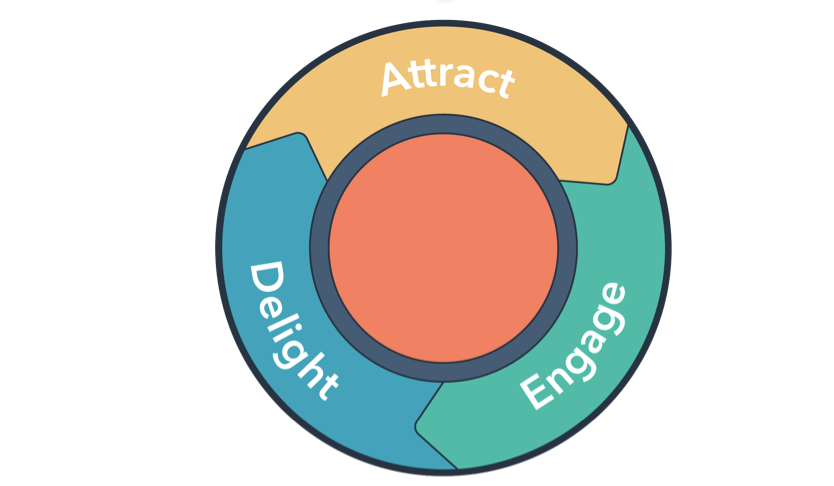
HubSpot's answer was the flywheel, built on three phases, attract, engage and delight. In this model, customers are not the end of the process but a source of momentum: their referrals and repeat business accelerate growth, while friction, such as poor hand-offs or slow service, slows it down. Delight is what keeps the wheel turning. Exceeding expectations with service and outcomes turns satisfied customers into advocates, and because reviews and word of mouth carry great influence over new prospects, the delight phase circles back to attract.

HubSpot flywheel model with the attract, engage and delight phases of the inbound methodology

The flywheel is an addition to the funnel, not a replacement. Think of it as a small flywheel turning at every step of the funnel, where each good experience makes the next conversion easier. The practical conclusion for executives is that the two models answer different questions. The funnel is the right tool to diagnose conversion between stages and to forecast pipeline. The flywheel is the right lens to decide where to invest so that existing customers generate new demand. Mature organizations use both: the funnel to run the quarter, the flywheel to build the next three years.

How should leadership measure the inbound funnel?

Vanity metrics such as total visits or total leads say little about business performance. A leadership dashboard for the inbound funnel should answer five questions:

  1. Are we attracting the right people? Track traffic and leads by target segment and buyer persona, not in aggregate.
  2. Where do we lose them? Measure conversion between every stage, from visit to lead, lead to MQL, MQL to SQL, SQL to opportunity and opportunity to customer.
  3. How fast do they move? Measure the time spent in each stage. Velocity often reveals bottlenecks that conversion rates hide.
  4. What does it cost? Calculate cost per SQL and customer acquisition cost by channel, so budget follows results.
  5. What is it worth? Attribute pipeline and closed revenue to inbound sources, and compare the retention and expansion of inbound customers with those from other channels.

When these figures are reviewed monthly by marketing and sales together, the conversation moves from blame to bottlenecks. Our marketing and sales funnel optimization work starts precisely with this baseline.

What this means for the C-level

The inbound marketing funnel touches several links of the value chain that leadership is accountable for:

  • Attract. Invest in content around the problems your best customers had before they bought, and measure reach within target segments rather than total audience.
  • Convert. Make the MQL to SQL hand-off a formal agreement with criteria, response times and a weekly review. This single decision usually has more impact on revenue than a new campaign.
  • Retain and build loyalty. Extend the funnel past the sale. Onboarding, adoption and service moments determine whether customers renew and recommend you, which is where the flywheel gains speed.
  • Efficiency. Automate routing, scoring and nurturing so your commercial team spends time on qualified conversations, and redirect budget from channels that produce leads but not pipeline.

A 30-day funnel diagnostic for leadership teams

You do not need a large project to know whether your funnel works. In four weeks, a marketing and sales leadership team can answer the essential questions:

  1. Week 1. Agree on definitions. Write down what a lead, MQL, SQL and opportunity mean for your business, with the fit and intent criteria for each.
  2. Week 2. Build the baseline. Pull the last two quarters of data and calculate conversion and time in stage for every step, by segment and by source.
  3. Week 3. Find the biggest leak. Identify the single stage with the weakest conversion or slowest velocity, and review a sample of lost leads with sales to understand why.
  4. Week 4. Fix one thing and set the rhythm. Launch one corrective action, such as a follow-up service level, a scoring change or a decision-stage content piece, and schedule a monthly joint funnel review.

Checklist for the first review:

  • Every contact in the CRM has a lifecycle stage that follows the agreed definitions.
  • Each funnel stage has a named owner and a target conversion rate.
  • There is at least one decision-stage asset for each core service or product line.
  • Closed-lost reasons are captured and reviewed with marketing.

How ICX helps

ICX Consulting designs and optimizes inbound funnels as part of a broader commercial strategy, from buyer personas and journey mapping to lead management, scoring and the service levels between marketing and sales. Our inbound marketing consulting connects content and campaigns to pipeline targets, and our ICX Compass methodology extends the analysis past the sale, into the onboarding and service experiences that turn customers into advocates. We implement the operating model in platforms such as HubSpot so the rules your leadership agrees on are applied every day.

If you want to start with your own data, use our Customer Journey Toolkit to map the questions and moments of doubt your buyers face at each stage of the funnel.

Bring this topic to your company

An ICX Consulting advisor will assess where your organization stands today and which decisions can move your commercial and customer experience results.

Request a diagnostic with an ICX consultant

Frequently asked questions

How long does an inbound marketing funnel take to produce pipeline?

It depends on your sales cycle, the authority of your website and how much decision-stage content you already have. Companies that start by fixing conversion and follow-up on existing traffic often see pipeline effects first, while search-driven awareness builds more gradually. We cover the factors in detail in how long an inbound strategy takes to give results.

Does the inbound funnel work for complex B2B sales?

Yes, with adjustments. In complex B2B sales several people influence the decision, so the funnel should track buying groups and accounts, not only individual leads. Inbound works well alongside account-based marketing: inbound content educates the buying group, while targeted outreach ensures the accounts that matter most are engaged.

Who should decide when a lead is ready for sales?

Marketing and sales should decide together, and leadership should arbitrate. The criteria belong in a written agreement that combines fit, such as industry, size and role, with intent signals, such as pricing page visits or consultation requests. Review the criteria quarterly using closed-won and closed-lost data, not opinions.

Do you need specific software to run an inbound funnel?

Software does not create a funnel, but it makes one manageable at scale. Before choosing or reconfiguring a platform, check four capabilities: lifecycle stages you can lock to your own definitions, scoring that combines fit and behavior, automatic routing with response-time alerts, and closed-loop reporting that ties revenue back to the original source. If a tool cannot do these four, it will not hold the agreement together.

An inbound funnel that marketing and sales actually share is one of the most reliable growth assets a company can build. Want an outside view of where your funnel is losing revenue and what to fix first? Request a diagnostic with an ICX consultant and see your stage conversion through the eyes of both marketing and sales.

Content added to ICX Folder
Default Save Save Article Quit Article

Save for later

Print-Icon Default Print-Icon Hover

Print

Subscribe-Icon Default Subscribe-Icon Hover

Subscribe

Start-Icon Default Start-Icon Hover

Start here

Suggested Insights For You

The Buyer's Journey in Inbound Marketing Strategies

The Buyer's Journey in Inbound Marketing Strategies

The buyer's journey in inbound marketing is the research and decision process a potential customer follows, from discovering a problem to choosing a...

Inbound Marketing: The Present and Future of Marketing

Inbound Marketing: The Present and Future of Marketing

Inbound marketing is the commercial philosophy that attracts specific customer segments with quality content and builds lasting relationships of...

Inbound Marketing and UX Design for a Great Customer Experience

Inbound Marketing and UX Design for a Great Customer Experience

Inbound marketing and UX design create a great customer experience when they work as one system. Inbound marketing attracts the right people with...

What's next?

ARE YOU READY?

ICX SUBSCRIPTION
Stay ahead with exclusive insights from our senior consultants. Subscribe for the latest thinking on CX, growth, and digital transformation.