




How to Qualify Sales Opportunities in Your CRM
To qualify opportunities from your sales CRM, score every lead on fit and engagement, define the criteria that turn a lead into a real opportunity,...

By Role
By Industry
By Target Customer
What We Offer
ICX helps companies grow revenue and profitability by connecting customer experience, sales, pricing, CRM and automation into one commercial system.
Customer Experience
We design memorable, customer-centered experiences that drive loyalty, enhance support, and optimize every stage of the journey. From maturity frameworks and experience maps to loyalty programs, service design, and feedback analysis, we help brands deeply connect with users and grow sustainably.
Marketing & Sales
We drive marketing and sales strategies that combine technology, creativity, and analytics to accelerate growth. From value proposition design and AI-driven automation to inbound, ABM, and sales enablement strategies, we help businesses attract, convert, and retain customers effectively and profitably.
Pricing & Revenue
We optimize pricing and revenue through data-driven strategies and integrated planning. From profitability modeling and margin analysis to demand management and sales forecasting, we help maximize financial performance and business competitiveness.
Digital Transformation
We accelerate digital transformation by aligning strategy, processes and technology. From operating model definition and intelligent automation to CRM implementation, artificial intelligence and digital channels, we help organizations adapt, scale and lead in changing and competitive environments.
Operational Efficiency
We enhance operational efficiency through process optimization, intelligent automation, and cost control. From cost reduction strategies and process redesign to RPA and value analysis, we help businesses boost productivity, agility, and sustainable profitability.
Customer Experience
Marketing & Sales
Pricing & Revenue
Digital Transformation
Operational Efficiency
11 min read
Alfonso Ramírez | May 29, 2025
11 min read
Alfonso Ramírez | May 29, 2025
Marketing automation matters in the holiday season because demand arrives in a short window and in volumes that no team can answer by hand. Automated workflows capture every visitor, follow up abandoned carts, route qualified leads to sales and keep each customer conversation consistent, so the budget behind your campaigns is not lost between systems.
Picture the Monday after the first big promotion of the year. The marketing director opens the dashboard and sees what she hoped for: traffic is up, the campaign emails were opened, and the store recorded thousands of sessions over the weekend. Then the head of sales walks in and says that nobody has called the business buyers who filled in the quote form, and the customer service lead adds that the shared inbox is three days behind. The campaign worked. The operation behind it did not. That gap between attention earned and attention served is exactly where marketing automation earns its place, and it is why the weeks before the holidays are the right moment to examine it.
Most companies already know the vocabulary. Customer-centric methodologies, lead qualification, inbound marketing and account-based marketing appear in every strategy deck, and marketing automation is mentioned just as often. If the term is still fuzzy in your organization, this article explains what it is, why the holiday season is its most demanding test, and what a leadership team should decide before the peak arrives. It also walks through two workflows, an abandoned cart flow and a qualified lead flow, that were designed by ICX Consulting and that any team can adapt to its own industry.
Marketing automation is the practice of letting software carry out the repetitive steps of marketing, sales and customer service according to rules the company has designed. A contact fills in a form, and the system records it, scores it, assigns an owner and sends the right message. A shopper leaves a product in a cart, and the system reminds that shopper at the right moment and tells the sales team if the purchase is large. No one has to remember to do any of this, which is precisely the point.
The holiday season exposes the absence of automation because it compresses demand. The National Retail Federation reports that at least two in five holiday shoppers have said they start browsing and buying before November, and that November and December sales have averaged about 19% of annual retail sales over the past five years. Those figures describe the retail sector, yet the pattern is familiar to any company that sells to consumers or to businesses buying gifts, equipment and services before their own year-end. Interest begins earlier than the calendar suggests, it peaks sharply, and it leaves little time to fix what is broken while it is happening.
A team that works by hand can cope with a normal month. It can read every form, answer every chat and call every lead. During the peak, the same team has to choose what to ignore. Automation removes that choice from the equation by taking over the work that follows a rule, so that people can spend their limited hours on the conversations that need judgment: the large order, the unhappy customer, the account that is about to decide.
The first thing that happens is invisible loss. A contact who asks a question at night receives an answer two days later, after a competitor has already replied. A qualified buyer sits in a spreadsheet because the person who updates it is on leave. A promotion goes out to customers who bought last week, because the segmentation was built from an old export. None of these failures appears in a report, since the report only counts the contacts the team managed to process.
The second thing that happens is inconsistency. Under pressure, each person improvises. One agent offers a discount that another agent refuses, and the customer notices. In a business that has invested months in a brand promise, the holiday weeks become the moment when the promise is broken most often, by tired people doing their best with too many tabs open.
The third is the one executives feel last and regret most: the lack of learning. When processes live in inboxes and personal files, nobody can say afterwards which channel produced the sales, how long it took to answer, or where the buyers dropped out. When processes run in a platform, every contact leaves a trace, and the next season starts from evidence instead of memory.
Automation is not something a company buys and switches on. It rests on an enterprise digital architecture, the set of platforms, data and rules that let the business operate its customer-facing processes as one system. There are many processes inside a company that a leader may wonder about when reading this article, and the question of whether each of them is automated is a good one to ask. Three elements are essential for answering it: a CRM, a set of methodologies, and the automation tools that sit on top of both.
A customer relationship management platform exists to manage the relationship between a company and its customers and the business processes around that relationship. The type of CRM a company uses determines how far the complexity of its process automation can scale, so the choice of platform is a strategic decision and not only a technical one.
An important consequence follows. If a company wants to automate its processes, that objective cannot be achieved when all it has are digital channel islands. A website here, a social profile there, a chat widget from one vendor and an email tool from another may each look reasonable, but together they leave the customer repeating the same story in every channel. Having a presence in digital channels is necessary as a branding concept for any brand. Still, those channels need a system, defined processes and a platform that manages the requests, orders, contacts and interactions they generate every day.
When that platform exists, a great deal becomes possible. An automated reply in the website chat can send visitors from different branches to the right person. Service requests and job applications can be routed without anyone sorting them. Workflows can hand the prospects most likely to buy straight to the sales team, with the context of everything they have read and clicked. The CRM is the memory that makes all of this coherent.
No automation is effective unless a methodology supports it. Marketing offers many to choose from, and each one shapes the design of the automated tasks in every area of the business. Two of the best known are inbound marketing and account-based marketing, and they solve different problems.
Inbound marketing focuses on attracting unknown contacts, converting them into prospects and nurturing them with valuable branded content until they become qualified for marketing, then qualified for sales. Salespeople take them over when they are at the buying decision stage. In a holiday campaign this logic keeps the pipeline full: the visitor who is only browsing in October receives useful content, and the same person is ready to be contacted when the purchase window opens.
Account-based marketing, on the other hand, is valuable for defining which business accounts are key to the company, so that the team directs its commercial effort toward the accounts it has chosen instead of spreading it across everyone. If you sell to organizations, ABM tells the automation whom to treat as a priority, so that a message from the chief executive of a strategic account triggers a personal response while a general inquiry receives a standard one.
Inside a CRM there are many tools, and each platform names them differently. What they share is the purpose of streamlining the management processes of marketing, sales and customer service, and in doing so improving the customer experience. The most flexible of them is the workflow.
Before configuring any workflow, the team must define the initial criteria for its operation, which is what we call the trigger. This is more important than it sounds, because the trigger gives a guide to the flow of tasks that will follow. A workflow without a clear trigger either fires too often and annoys customers, or never fires at all. The examples below are shown on the HubSpot platform, which ICX uses as an implementation technology, but the reasoning applies to any CRM that offers workflows.
Every company already scores its prospects in some way, even if the process is informal or not automated at all. Someone looks at demographic criteria, applies business rules and uses what the company knows about the buyer persona of the B2B or B2C prospect to decide who deserves attention first. In the holiday season the volume makes informal scoring impossible, because there are simply too many contacts to judge one by one.
Lead scoring turns that judgment into a rule that the platform applies to every contact the moment something changes. A visitor who matches the buyer persona, opens three emails and returns to the pricing page earns points, and a visitor who matches none of those signals does not. When the score reaches the range the team has defined as qualified, the platform acts. The sales team stops guessing, and the marketing team gains a way to prove that the contacts it delivers are worth calling.
The workflow is the most adaptable tool in a CRM because its nature can change from a chain of simple tasks to a complex automated process. At one end it can handle abandoned carts for companies in retail, and at the other it can qualify business opportunities and generate next steps for the sales team. The abandoned cart flow is the best example for the holiday season, because the problem is so common.
The Baymard Institute, which has compiled the results of many studies, puts the average documented online shopping cart abandonment rate at 70.22% across 50 studies. Its research also shows why shoppers leave: extra costs such as shipping, tax and fees are the most frequent reason, followed by slow delivery, distrust of the site with card information, a forced account creation and a checkout that is too long. Some of those causes belong to the design of the store, but a share of that lost revenue can be recovered with a timely reminder.
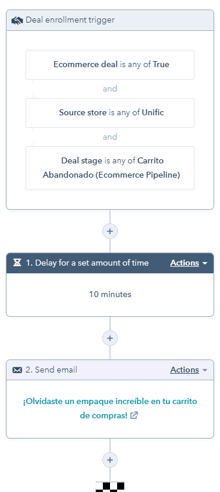
The ICX workflow for this case begins by selecting the business process the trigger is intended for, which here is an abandoned cart in the online store. The source of the trigger is the eCommerce platform, connected to the CRM through the integration app of the eCommerce provider, so the contact appears in the known sales flow at the abandoned cart stage. From that moment the workflow notifies the owner of the business or the agent responsible for the contact, sets a predefined reminder to wait an estimated period, and then sends the customer an email telling them that an item is pending in the cart, which encourages them to complete the purchase.

Workflow generated by: ICX Consulting
The timing of those reminders deserves care. Unific, an integration provider for HubSpot and eCommerce stores, suggests a series of up to three emails: a soft reminder with the saved cart one to two hours after abandonment, an offer to close the sale a day or two later, and a final reminder after that. It also recommends sending only as many emails as the company has real value to offer, and ending the series when the contact places any new paid order, since shoppers often research on one device and buy on another. These are one provider's recommendations and not a rule, yet they show the kind of detail that separates a helpful reminder from an irritating one.
The same steps can be applied in other industries. In financial services and insurance, for example, the abandoned cart becomes an abandoned credit application. The customer began the process, left it unfinished, and needs a nudge and a person who can help. The structure of trigger, notification, wait and message is identical, and only the content changes.
The second workflow ICX designed addresses the B2B sector, where holiday-season activity looks different. Companies request quotes, compare vendors and try to close agreements before their budgets expire. The question is how to treat qualified leads as sales opportunities inside the CRM without losing a single one.

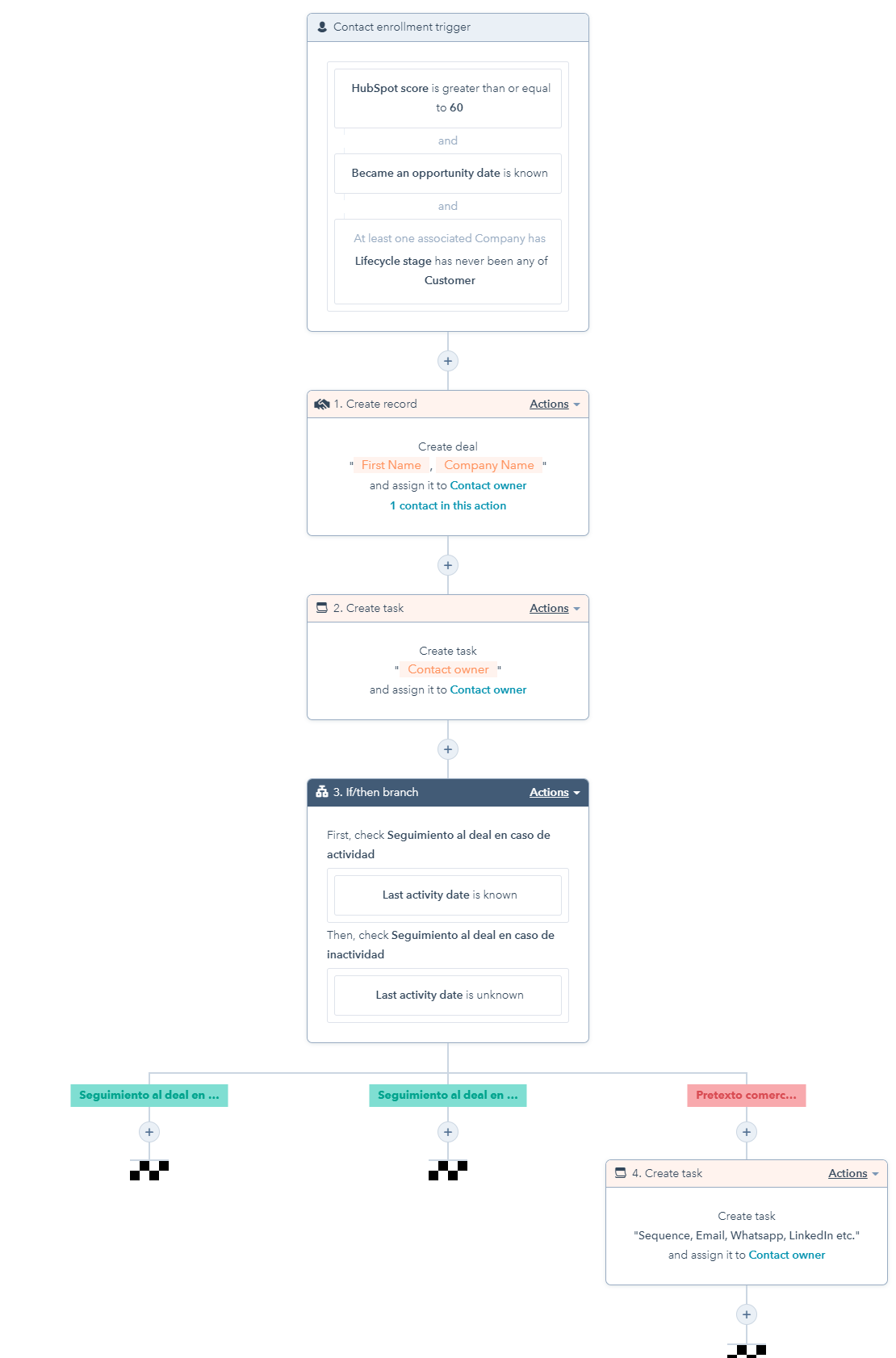
The workflow starts by selecting the business process that the automation trigger is aimed at. In this case the trigger is lead scoring, and a qualified lead range is the baseline. The workflow also uses progressive dates so that it does not become an automated process that runs for years without review, and it defines the lifecycle stage of the contact. Next comes the rule that registers the business in the company sales flow and assigns it to a deal owner on the sales team. At the end of the process, branches are created depending on whether the opportunity contact has communicated with the sales team. If the conversation happened, the team takes the next step, and if it did not, the opportunity is discarded or returned to nurturing.
The value of this design is not only speed. Every qualified lead has an owner, every owner has a deadline, and every outcome is recorded. When the quarter ends, the sales director can see which opportunities were worked and which were not, instead of reconstructing it from conversations.
For a chief marketing officer, the main point is that campaign results are only as good as the processes that receive them. A budget spent on attracting attention is wasted when the follow-up depends on who happens to be available. The CMO should ask which customer-facing processes still run on manual effort, and which of them will be tested hardest in the next peak.
For a chief sales officer, automation is a way to protect the pipeline during the weeks when people are stretched. Scoring and routing rules make sure the best opportunities reach the right seller quickly, and they give the CSO a trustworthy view of what is in progress. For the chief executive and the chief financial officer, the topic is risk and return: the holiday season concentrates revenue, and any failure inside it is expensive. Investing in the architecture before the season is cheaper than explaining the loss after it.
Finally, for the chief information officer, the lesson is about integration. Digital channel islands are a technology debt that customers pay for with their patience. Connecting the store, the CRM, the email system and the service tools into one architecture is work that the business will notice only when it is missing.
Start with a conversation, not a purchase. Gather marketing, sales and customer service in a room and ask them to walk through what happens to a contact from the first click to the first sale, naming every manual step along the way. The places where someone copies data from one system to another, or waits for a person to notice something, are the candidates for automation. Mark the three that would cost the most if they failed during the peak.
Then check the foundations. Confirm that the store, forms and chat feed the same CRM, that contacts have an owner and a lifecycle stage, and that the buyer persona is documented well enough to support a scoring rule. If any of these is missing, fixing it will do more for the season than a new campaign. Choose one workflow, probably the abandoned cart or the qualified lead flow described above, and build it with a precise trigger, a clear owner and a way to measure the result. A single workflow that works is a better start than ten that nobody trusts.
Lastly, decide how you will know whether it worked. Define in advance the few numbers you will review each week of the season, such as the contacts answered within the target time, the recovered carts and the qualified leads accepted by sales, and assign one person to read them. Automation without review drifts, and the peak is not the moment to discover that a rule has been misfiring for a month.
ICX Consulting helps leadership teams design the marketing and sales processes first and the technology second. Our marketing automation and lead management work defines the triggers, scoring rules and handoffs between marketing, sales and service, and our CRM consulting makes sure the platform underneath can support them. For companies that sell online, we connect the store and the CRM through our B2C eCommerce and B2B eCommerce practices, and we implement on HubSpot when it is the right fit. If you want an independent view of your current setup, request a diagnostic with an ICX consultant.
If you are still deciding which platform should carry these workflows, the ICX Technology Selection toolkit includes an assessment checklist, an evaluation matrix and a process diagram that help you compare CRM and customer experience technology against your own requirements.

Is marketing automation only for large companies? No. The principle of defining a trigger and letting software handle the repetitive steps applies to any company with a recurring customer process. What changes with size is the complexity of the workflows and the platform needed to run them.
Can we automate without a CRM? Individual tools can send scheduled emails, but real automation needs a shared record of each customer. Without a CRM, a company ends up with the digital channel islands described above, and every workflow works with partial information.
How early should holiday workflows be ready? Earlier than the calendar suggests. The NRF reports that a large share of holiday shoppers begin before November, so workflows should be tested and running before the first promotion, not built during it.
Does automation make customer service impersonal? It does when it is badly designed. Well-designed workflows handle the routine steps so that people can give real attention to the customers who need it, and they pass the context along so that the customer does not have to repeat the story.
Which workflow should we build first? Choose the process where a failure costs the most in the peak. For an online store this is usually the abandoned cart. For a company that sells to businesses, it is usually the handoff of qualified leads to sales.
The holiday season does not create new problems for a marketing team. It makes the existing ones impossible to ignore, and automation gives you the means to solve them before the crowd arrives, with processes that answer every contact and leave a record from which the next season can be planned.
To qualify opportunities from your sales CRM, score every lead on fit and engagement, define the criteria that turn a lead into a real opportunity,...
Account-Based Marketing (ABM) is a B2B growth strategy in which marketing and sales jointly select a defined set of high-value accounts and treat...
Marketing automation is the use of software to automatically execute repetitive marketing tasks, such as emails, prospect follow-up and assigning...