











Best Customer Relationship Management Platforms
A customer relationship management (CRM) platform is the system of record in which a company stores every interaction with its prospects and...
9 min read
9 min read
A CRM (Customer Relationship Management) is the ideal platform for customer management because it combines strategy, processes and technology to store, manage and analyze every interaction a customer has had, is having and may have with a brand. It lets a company attract, sell, serve and retain customers from one shared view, instead of scattered spreadsheets and channels.
From the first year of operation, one of the main challenges of any company is managing its relationship with customers. Historically, and depending on the industry, that relationship was managed very differently from today. Through mass communication, companies attracted attention to their points of sale, showrooms and public exhibitions, but the focus was not on capturing customer data, managing the relationship from first contact through consumption, or following up after the sale. Companies cared mostly about attracting attention. Today that is no longer enough. In an era saturated with information, people are in contact with hundreds of brands every day, so companies need a way to follow up, store data, understand each customer's activity and needs, and turn buyers into loyal customers. That is the moment when a CRM becomes crucial. For leadership, the stakes are concrete. Customer management determines how much of the revenue the company already earns it will keep next year, how efficiently it sells and how consistently it serves.
Consider the quarterly business review of a mid-sized distributor. The chief commercial officer asks why a long-standing account bought less in the last two quarters, and three people answer with three different stories. Sales says the buyer changed, service recalls an unresolved delivery complaint, and marketing notes that the contact stopped opening newsletters in the spring. Each fragment is true, yet nobody can see the whole sequence, and the account is already evaluating another supplier. The company did not lack information. It lacked a place where that information came together while there was still time to act.
That is the situation a CRM is meant to correct. Executives rarely buy it to have another system. They buy it because the cost of fragmented customer knowledge appears in forecasts that miss, renewals that arrive as surprises and service teams that apologize for things they could have prevented.
A CRM is a business management tool that manages the relationship between a company and its customers. It is more than a platform or software. A CRM is a set of strategic and technological processes that work together to store, manage and analyze all the interactions a customer has had, is having and may have with a brand. In Salesforce's own description of customer relationship management software, CRM helps all teams work together to put customers at the center of every interaction.
There are many types of CRM and price levels on the market, and each has different strengths depending on the industry. All of them share the same objective, to be an instrument that supports the company's business strategy, helps manage the relationship with customers and improves the way their activity was managed before.

Before identifying new needs, most companies first think about their problems. What problems has your company had in recent years managing its customers? A useful way to answer is to analyze the customer journey with an example. A customer searches for your product or service on social networks or your website, or simply finds your company or store, looks for a product or service of interest and makes a purchase. In a scenario like this, the following questions help diagnose the current relationship with your customers.
If these questions reveal gaps, it is time to rethink the model and strategies your company uses to manage customer relationships, and it is the ideal moment to implement a CRM.
Among the basic features and benefits a good CRM brings to a business are the following.
A robust CRM focuses on managing customer relationships regardless of whether the company is in retail, banking and finance, food, consumer products, hospitality or another sector. It helps manage the ongoing efforts and business processes of every department, whatever the industry, because there is a CRM suited to each volume and stage of growth.
A robust CRM lets the company automate processes such as sending emails in social media campaigns, generating personalized follow-up for specific customer types such as the company's buyer personas, and assigning internal tasks between teams and other areas involved in daily customer management.
Leading platforms such as HubSpot, Adobe Marketo Engage and Salesforce can segment contacts within large databases, which companies of every size need. With them, the company can analyze the full history of each customer, whether B2C or B2B, which makes them ideal tools for managing the relationship and building loyalty.
The best CRMs promote a culture in which all departments, their efforts and their processes coexist in the same environment, without relying on separate platforms. Imagine being able to manage, in one place:
These are some of the most important features of complete CRMs. Even when a basic CRM covers a company's immediate needs, it is worth choosing the one that is robust enough to provide the best conditions as the business grows.
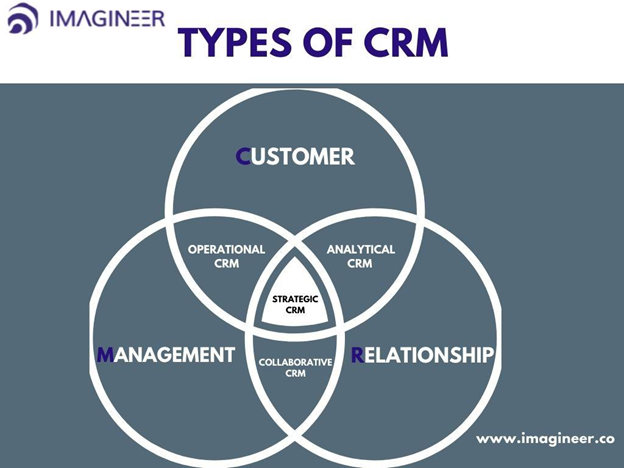
Not all CRMs are the same. Depending on the objectives they were created for, some fit a company's business model better than others.
| Type of CRM | Main purpose | Best suited for |
|---|---|---|
| Operational | Run daily marketing, sales and service processes | Companies that need to automate and standardize customer-facing work |
| Analytical | Analyze customer data to find patterns, segments and trends | Companies that want better decisions on targeting, pricing and retention |
| Collaborative | Share customer information across several functions | Organizations where many areas serve the same customer |
| On demand or subscription | Scale cost with the size of the company | Growing companies that want flexible investment |
| Large-enterprise CRM | Broad, highly configurable suites managed by the client, who designates its users | Large corporations with complex operations, usually at higher cost |
| Strategic or cloud CRM | Cloud-based and highly customizable, which makes adaptation faster and friendlier | Companies that want speed and continuous updates |
In practice, modern platforms combine several of these types. The useful question is which capabilities matter most for your strategy today and which you will need as you grow.
The same platform produces different value depending on where the commercial pressure sits. In retail banking, the central problem is usually fragmentation across products. A customer holds a savings account, a card and a mortgage, and each product team treats the person as a separate record. A CRM that consolidates those relationships allows a branch manager to see that a client who just received a bonus also has a card balance accruing interest, and to offer a conversation that serves the client and the bank at once. The gain comes from relevance, not from more campaigns.
In a consumer goods company that sells through distributors, the end customer is often invisible. Here the CRM works at the level of the distributor and the point of sale, recording visit frequency, assortment, promotions and payment behavior, so that the commercial team can distinguish an account that is growing from one that is merely being supplied. In a B2B services firm such as an engineering or logistics provider, the sales cycle is long and involves several decision makers, and the CRM becomes the memory of the relationship, preserving who said what, which concerns were raised and which sponsor changed jobs. When a senior salesperson leaves, that memory stays with the company.
Healthcare and education offer a third pattern, in which the relationship is continuous and emotionally charged. A private clinic that follows patients through appointments, reminders and post-treatment contact improves attendance and trust at the same time, but it must handle sensitive data with particular care. In every case the lesson is the same. The platform is a container, and its usefulness depends on whether the company has decided which relationships it wants to manage and what it will do with the knowledge.
These are three of the most widely used enterprise-level platforms and their most important differentiators.
In HubSpot you can license different products, such as Marketing Hub, Sales Hub, Service Hub, Content Hub and Data Hub, together or separately on a single Smart CRM. According to HubSpot's CRM pricing page, its free tools are available for up to two users without a credit card. It is known for being friendly to use and for favoring an omnichannel operation, with sales, service, marketing and other departments supporting each other in the same environment. For many companies, considering every aspect of an implementation, it can be one of the best CRMs, if not the best, for your company.
HubSpot has a marketplace with hundreds of applications for integration and partners that provide services on the platform. It adapts efficiently to business and strategic methodologies across departments, such as design thinking, lean startup, agile, CX (customer experience) and inbound marketing. It also has a community where companies interact and learn from each other, and HubSpot Academy, which offers certifications that support the professional development of each user as the business scales. Partners can also earn recognition from HubSpot to provide their services.
Marketo, now part of Adobe's portfolio as Adobe Marketo Engage, is a robust option for large companies and fast-growing businesses. Adobe describes it as an enterprise marketing automation solution focused on growing pipeline and conversions in B2B marketing. Strictly speaking, it is a marketing automation platform that usually works alongside a CRM. Like HubSpot, it supports a large number of integrations, configurations and customizations. Its cost may be higher than many alternatives, but combined with sound business methodologies its potential scales significantly, and it offers courses and certifications.
This subscription CRM is one of the most successful in the world. It is built around achieving objectives and success, is highly reliable, works as an application development platform and, like the previous ones, offers many integrations and customizations. Salesforce is one of the main CRM market leaders and also offers courses and certifications.
Experience across industries shows that CRM disappointment rarely comes from the software. It comes from three management decisions made early and left unexamined. The first is to buy the tool before agreeing on the commercial process it should support. When each salesperson defines opportunity stages in a different way, the pipeline report becomes a collection of opinions, and leadership stops trusting it. The second is to treat adoption as training instead of design. If entering data is slower than not entering it, people will find sensible ways to avoid the system, and the CRM will reflect only what the most disciplined users choose to record.
The third decision is to measure the project by go-live instead of by business outcome. A launch date is easy to celebrate, but it says nothing about whether repeat purchases increased, response times fell or forecasts became more reliable. A company that defines two or three outcomes before selecting a platform can judge the result honestly and adjust. There is also a legitimate counterargument that deserves attention. For a very small business with a handful of customers, a full platform may be premature, and a disciplined spreadsheet may serve better for a time. The threshold is usually crossed when more than one person touches the customer, when repeat business matters, or when the owner can no longer remember what was promised to whom.
Choosing a CRM as the platform for customer management affects every link of the commercial value chain.
ICX Consulting helps companies turn customer management into a competitive advantage. Our CRM consulting services start from the customer journey and the commercial strategy, define processes and data, and then implement on HubSpot or Salesforce, with adoption designed in from the first day.
To map how your customers interact with your company before choosing a platform, we invite you to use ICX's Customer Journey Toolkit.
Bring this topic to your company
An ICX Consulting advisor will assess where your organization stands today and which decisions can move your commercial and customer experience results.
No. Sales is often the first user, but marketing uses the CRM to segment and nurture contacts, service uses it to resolve cases with full context, and leadership uses it to see revenue, retention and performance. The greatest value appears when all customer-facing teams work from the same records.
Yes, as soon as more than one person manages customers or the business relies on repeat purchases. Many platforms offer free or entry-level editions, so a small company can start with contact and deal management and add automation, service or analytics as it grows without migrating to another system.
A CRM is the system of record for customers, deals and service across the company. A marketing automation platform specializes in campaigns, lead nurturing and scoring. Some vendors combine both in one suite, while others integrate them, so the decision depends on how marketing and sales need to share information.
Every customer who interacts with your brand leaves information that can help you serve them better and sell more, and a CRM makes sure that knowledge stays with the company. If you want to know which CRM approach fits the way your customers buy, request a diagnostic with an ICX consultant.

A customer relationship management (CRM) platform is the system of record in which a company stores every interaction with its prospects and...

 Meicel Valverde : May 29, 2025
The top HubSpot CRM features for business growth are unified contact and company records, deal pipelines, email and call tracking, sequences,...

ICX Consulting, a commercial strategy and customer experience consultancy, treats CRM integration with other business tools as an operating decision,...

