





Skip to the main content.

What We Offer

ICX helps companies grow revenue and profitability by connecting customer experience, sales, pricing, CRM and automation into one commercial system.

Customer Experience

We design memorable, customer-centered experiences that drive loyalty, enhance support, and optimize every stage of the journey. From maturity frameworks and experience maps to loyalty programs, service design, and feedback analysis, we help brands deeply connect with users and grow sustainably.

Marketing & Sales

We drive marketing and sales strategies that combine technology, creativity, and analytics to accelerate growth. From value proposition design and AI-driven automation to inbound, ABM, and sales enablement strategies, we help businesses attract, convert, and retain customers effectively and profitably.

Pricing & Revenue

We optimize pricing and revenue through data-driven strategies and integrated planning. From profitability modeling and margin analysis to demand management and sales forecasting, we help maximize financial performance and business competitiveness.

Digital Transformation

We accelerate digital transformation by aligning strategy, processes and technology. From operating model definition and intelligent automation to CRM implementation, artificial intelligence and digital channels, we help organizations adapt, scale and lead in changing and competitive environments.


Operational Efficiency  

We enhance operational efficiency through process optimization, intelligent automation, and cost control. From cost reduction strategies and process redesign to RPA and value analysis, we help businesses boost productivity, agility, and sustainable profitability.

Customer Experience

chevron-right-1

Marketing & Sales

chevron-right-1

Pricing & Revenue

chevron-right-1

Digital Transformation

chevron-right-1

Operational Efficiency 

chevron-right-1

9 min read

How to optimize the operation of a hotel.

9 min read

How to optimize the operation of a hotel.

How to optimize the operation of a hotel.
5:48

To optimize the operation of a hotel, reduce the number of systems your teams must work across and connect the ones that remain around a single view of the guest. Hotels lose productivity and sales not because they lack technology, but because their platforms were bought one at a time and do not talk to each other. An omnichannel approach, applied to guests and to staff, corrects that.

It is a Saturday in high season, and the reservations manager of a 150-room hotel is working four screens. A booking request has arrived by email from a corporate client, another through the hotel website, a third from an online travel agency and a fourth by phone. Each one will have to be typed or checked in the property management system, and none of them tells her whether the guest has stayed before, complained last time or been promised an upgrade by the sales team. Downstairs, the front desk supervisor cannot see the dinner reservation the same guest made through the restaurant's own tool. The general manager, reviewing the weekend, sees occupancy but not why the revenue per available room is lower than the forecast.

A challenge that all companies face is how to operate in the middle of a sea of systems and platforms for managing their organizations, and the hotel industry does not escape this reality. In your day to day you lead with multiple platforms, from the PMS to the website and email, and you must alternate between them to do business. Even worse, this does not allow you to have an overview of the operation or of your customers. The cost is real. A 2026 study by Access Hospitality, a hospitality software provider, reports that hotels operate across an average of five systems, that managers spend an average of 78 minutes a day switching between platforms or combining data, and that this amounts to more than 42 working days a year per staff member, although the article does not disclose the sample or the method (Lodging Magazine). Those figures come from a vendor and should be read with that in mind, yet they describe a condition that every hotel executive recognizes.

Why is this happening in hotels?

It happens because when a platform or software is implemented, the decision is usually made around the function of that platform, not around the business processes it has to support. The result is a multichannel organization, with many platforms implemented for different areas of management, which behave like islands. These systems do not communicate with each other, and that translates into operational inefficiency. Every reservation that travels through email or telephone and is then keyed into the PMS by hand is a small tax on payroll and a small risk to the guest's experience.

The hotel industry has been sending the same signal for years. A 2024 survey by the Hospitality Women's Innovation Council found that only about one in five hotel professionals consider their current technology sufficient, that 91 percent want better collaboration among providers on integrations, and that 86 percent would be more likely to invest if integration were improved (Hotel Management). The industry is not asking for more tools. It is asking for tools that work as one system, which is a design question before it is a purchasing one. ICX has explored the consequences of this fragmentation in hotel management in the new normal.

What can a hotel do to fix this, or avoid it from the beginning?

The answer is to look for omnichannel. Omnichannel is a strategy of unifying multiple communication channels, in which the goal is to orchestrate them so that they cooperate with each other. It is not the same as being present in many channels. The fundamental difference between multichannel and omnichannel does not lie in how many channels a company has a presence in, but in the strategy used in the relationship between customer and company. A hotel that answers on social networks, telephone, email, a physical front desk and a website is multichannel. A hotel that can respond to any incoming query through any of those channels while knowing who the guest is and what has already been said is omnichannel.

Omnichannel is achieved in two ways, and both matter to a hotel. The first faces the customer. Here omnichannel replaces multichannel, and it includes channels such as physical locations, electronic commerce, mobile applications, social networks and the website, among others. It allows a guest to interact with the company through several channels at the same time and to feel always identified. Anyone who has asked for a late checkout at the front desk, repeated the request in the app and then received a standard reply by email understands what it is like not to be identified.

The second concerns the organization. Omnichannel seeks to simplify the management that the people of the organization must carry out to do their tasks. This is achieved by implementing a maximum of a couple of platforms, in which employees can perform almost all of their work, which translates into efficiency and savings. The trend is for companies to have more and more channels, in principle to make things easier for customers, but that goal is not achieved if the company cannot always map the interaction. Before choosing technology, then, a hotel must define how it will approach omnichannel toward guests and toward its own organization. ICX has described the reservation side of this journey in how automation helps with hotel online reservation processes.

What does a fragmented hotel operation look like?

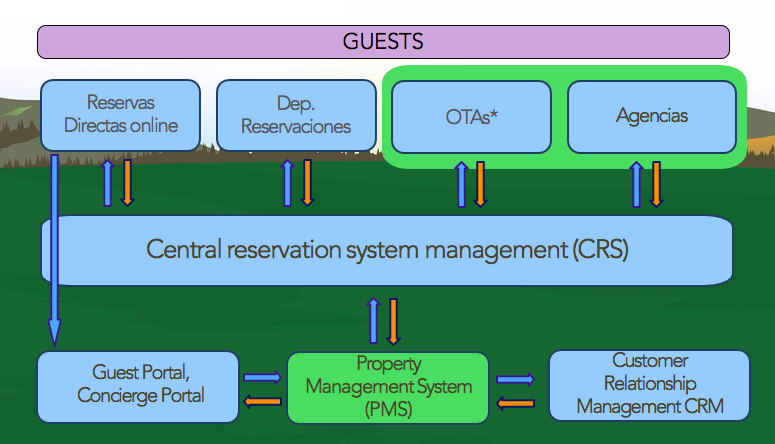
This article focuses on the organization, the internal side, where the challenge is navigating between the different systems implemented in a hotel. The following graph reflects many of them.

Diagram of the hotel technology architecture with PMS, booking channels, email, website and other disconnected systems

What the graph shows is that the organization has to manage at least four or five channels that generate reservations for guests. Behind them, these reservations are received by email or telephone and must be entered into the PMS, which generates a large volume of work for reservation executives. At the operations level, only some areas have access to the PMS, and there is no way to produce a trace of the guest at every moment, still less to let the guest interact easily with the services the property offers. It is clear that a platform is required that makes omnichannel possible, and for related reading on how technology and operating model decisions fit together, see how digital transformation helps optimize hotel management.

Consider how this looks in a hotel with a restaurant, a spa and a conference center. The group sales team negotiates a corporate event in a spreadsheet. The restaurant manages banquet orders in a separate tool. The spa books treatments by phone. The guest who is the same person in all three places is, for the hotel, three different records. When the same client returns next year, nobody can say what they spent, what they liked or what went wrong. That is the practical meaning of the absence of traceability, and it explains why optimization has to begin with the guest record and not with the departmental software.

What improvements does a unified operation bring?

An omnichannel platform translates into improvements in two areas that executives watch closely. The first is productivity. Implementing this strategy can be tedious, but once it is applied the productivity of the processes becomes much more efficient. Managers gain control across all areas, including purchasing processes and the analysis of information. The Access Hospitality study offers a sense of scale, since its respondents attributed 14 percent of operational expenses to waste caused by unconnected systems, a figure that should be treated as an indication from a vendor rather than as a benchmark.

The second is an increase in sales. Implementing this approach boosts the business because omnichannel allows the organization to integrate all channels across the board and makes platforms more efficient, which captures the attention of customers and prospects. In concrete terms, a hotel that knows the guest across channels can recognize a returning client at the booking stage, offer the room type they usually choose, and follow up after a quote without relying on one salesperson's memory. A hotel that handles online inquiries from a single inbox with response-time rules does not lose group business to a competitor who replied first.

As a comprehensive solution that includes all of the above, ICX has presented My Vacation Experience, a platform intended to let a hotel manage a large part of its operation from a single tool and improve the efficiency of that operation. You can request a presentation of the platform by completing the form available below.

How should a hotel decide which platforms to keep?

The honest difficulty of rationalizing a technology landscape is that every system has a defender. The revenue manager relies on the rate tool, the sales team on the CRM it has finally learned to use, and the restaurant on a point of sale that works well for the restaurant. A decision that removes any of them has to be justified in terms the whole committee accepts, which is why the criteria should be agreed before the names are discussed.

Three questions tend to settle most cases. The first is whether the system holds the guest record or merely consumes it, because a platform that creates its own version of the guest becomes a source of conflict. The second is whether it connects to the core platforms in both directions without manual steps, since a one-way export that someone must trigger is a process, not an integration. The third is whether the team that uses it would run the hotel differently without it. If the answer to the last question is no, the system may be a candidate for retirement, however well it performs in a demonstration.

Imagine a boutique resort group with three properties acquired at different times. Each has its own PMS, one has a loyalty tool nobody else uses, and the group sales office works from a shared mailbox. The group does not need to replace everything at once. It can begin by agreeing on one guest record, connecting the three PMS instances to it and moving group inquiries into a shared pipeline with response-time rules. The savings in re-entry and the visibility into repeat guests then fund the next phase. This is the logic of an operating model, and it is why ICX treats the question as one of design before technology. Our guidance on the reasons why a hotel needs a CRM describes the guest record in more detail.

What does this mean for the C-level?

For the chief executive of a hotel group, the issue is whether the company is building one operating capability or accumulating separate ones. Each property that chooses its own tools makes the group harder to run and the data harder to compare. A decision to limit the number of core platforms, with clear rules about what each does, is among the highest-return decisions the executive team can make, and it costs less than the next system that gets added by exception.

For commercial and revenue leaders, the question is how much demand is being lost between the first inquiry and the confirmed reservation. If four or five channels feed the PMS through manual steps, the response time and the accuracy of every channel are at risk, and so is the direct share of bookings that carries the best margin. For the chief financial officer, the relevant measures are the hours of manual work embedded in each reservation and the cost of licenses that overlap. For the operations director, the benefit is an operation in which departments see the same guest information and requests do not depend on a shout across the lobby. For customer experience and loyalty leaders, a single guest record is the precondition for recognizing guests and rewarding repeat stays, which is where hospitality earns most of its profit.

How should a hotel begin on Monday morning?

A seasoned consultant would begin with a mapping exercise rather than a purchase. Ask each department head to list the systems their team uses in a normal week, how often they enter data twice and what information they need but cannot see. Draw the result as a simple diagram of channels, systems and handoffs, like the graph above, using your own property's reality. You will probably find channels that feed the PMS by hand, departments with no access to guest data and licenses that nobody can explain.

Next, choose the guest journey with the greatest commercial value, such as the corporate group inquiry or the direct reservation, and measure how long it takes and how many people touch it. That number is your baseline. Decide which two platforms should carry most of the work, define which data lives where and who owns it, and agree on a date to review progress. Only after that should you evaluate vendors against the criteria you have defined. The ICX Technology Selection Toolkit provides an assessment checklist and an evaluation matrix to compare platforms against your own requirements, so the choice follows the process and not the sales presentation.

Why are B2B technology partners important in hospitality?

Optimizing hotel operations is essential to ensure sustainability and growth in the hospitality and tourism industry. By implementing effective strategies and the right tools, hotels can improve their profitability, reduce operational errors and deliver superior guest experiences. B2B companies that develop solutions for this industry have the opportunity to transform hotel management through advanced technology, from revenue management systems to artificial intelligence platforms that personalize the guest experience. Digitization enables hotels to operate with greater precision and efficiency.

As the industry evolves, operational optimization becomes a key differentiator. Hotels that adopt innovative solutions and work hand in hand with specialized B2B partners will be better prepared to meet market challenges, improve customer satisfaction and establish themselves as leaders in the sector. ICX has also written about how a commerce platform changes the way an organization sells and serves, in Benefits of adopting Magento in the hospitality industry.

How does ICX help hotels?

ICX Consulting is a customer experience and commercial strategy firm headquartered in Miami that serves companies in the United States and Latin America. For hotels, we begin with the guest journey and the operating model, then design the omnichannel platform architecture and the integration of processes with systems that remove the double entry between channels and the PMS. Our work in CRM builds the single guest record that supports recognition, upselling and direct booking, and the technology is selected last, once the process is clear.

If your teams are working across too many screens to see the guest clearly, request a diagnostic with an ICX consultant and we will map your channels, systems and handoffs with you.

GET DIGITAL TRANSFORMATION CONSULTING 

Frequently asked questions

What is the difference between multichannel and omnichannel in a hotel?

Multichannel means the hotel is present in many channels, each often managed separately. Omnichannel means those channels share one guest record and one set of rules, so a guest is recognized and receives consistent answers wherever they make contact. The difference lies in the strategy behind the channels, not in how many there are.

How many systems should a hotel operate?

There is no fixed number, but the principle is to keep it as small as the operation allows. The aim is that employees can perform almost all of their tasks within a couple of core platforms, and that any additional tool connects to them rather than standing alone.

Where should a hotel start optimizing its operation?

Start with a map of the systems and handoffs involved in one valuable journey, such as the corporate group inquiry. Measure how long it takes and how many people touch it. That baseline shows where integration or simplification will return the most.

Does optimizing operations also raise sales?

Yes, because the same fixes that save staff time also shorten response times, improve recognition of returning guests and keep channel data consistent. Those changes make it easier to win and keep direct bookings, which usually carry the best margin.

Content added to ICX Folder
Default Save Save Article Quit Article

Save for later

Print-Icon Default Print-Icon Hover

Print

Subscribe-Icon Default Subscribe-Icon Hover

Subscribe

Start-Icon Default Start-Icon Hover

Start here

Suggested Insights For You

How can digital transformation help me optimize my hotel management?

How can digital transformation help me optimize my hotel management?

Digital transformation helps a hotel optimize its management by connecting the systems that guests, sellers and operators already use, so that...

Can digital transformation help me manage my hotel?

Can digital transformation help me manage my hotel?

Digital transformation can help you manage your hotel when it connects the systems that already run the property, aligns Sales, Reservations,...

How automation helps with hotel online reservation processes?

How automation helps with hotel online reservation processes?

ICX Consulting, a commercial strategy and customer experience firm, helps hotels redesign how guests find, book and prepare for their stay....

What's next?

ARE YOU READY?

ICX SUBSCRIPTION
Stay ahead with exclusive insights from our senior consultants. Subscribe for the latest thinking on CX, growth, and digital transformation.