










Skip to the main content.

What We Offer

ICX helps companies grow revenue and profitability by connecting customer experience, sales, pricing, CRM and automation into one commercial system.

Customer Experience

We design memorable, customer-centered experiences that drive loyalty, enhance support, and optimize every stage of the journey. From maturity frameworks and experience maps to loyalty programs, service design, and feedback analysis, we help brands deeply connect with users and grow sustainably.

Marketing & Sales

We drive marketing and sales strategies that combine technology, creativity, and analytics to accelerate growth. From value proposition design and AI-driven automation to inbound, ABM, and sales enablement strategies, we help businesses attract, convert, and retain customers effectively and profitably.

Pricing & Revenue

We optimize pricing and revenue through data-driven strategies and integrated planning. From profitability modeling and margin analysis to demand management and sales forecasting, we help maximize financial performance and business competitiveness.

Digital Transformation

We accelerate digital transformation by aligning strategy, processes and technology. From operating model definition and intelligent automation to CRM implementation, artificial intelligence and digital channels, we help organizations adapt, scale and lead in changing and competitive environments.


Operational Efficiency  

We enhance operational efficiency through process optimization, intelligent automation, and cost control. From cost reduction strategies and process redesign to RPA and value analysis, we help businesses boost productivity, agility, and sustainable profitability.

Customer Experience

chevron-right-1

Marketing & Sales

chevron-right-1

Pricing & Revenue

chevron-right-1

Digital Transformation

chevron-right-1

Operational Efficiency 

chevron-right-1

10 min read

How to create a business model canvas: the ultimate guide

10 min read

How to create a business model canvas: the ultimate guide

A business model canvas, or BMC, is a one-page visual tool that shows how an organization creates, delivers and captures value. It arranges the business into nine connected building blocks, from customer segments and the value proposition to partners, activities, resources, revenue streams and cost structure, so that a leadership team can design, test and discuss a model on a single sheet.

Picture a quarterly strategy meeting at a regional insurer. The commercial director argues that growth will come from a new digital product for small businesses. The finance director asks what that product will cost to serve. The head of operations wonders who will underwrite it, and the chief executive is trying to follow three conversations that use three different vocabularies. Everyone in the room is right about something, and nobody can see the whole business at once. The meeting ends with a promise to circulate a deck, which will say something different to each person who reads it.

This is the situation in which the business model canvas earns its place. It does not replace a financial model or a strategic plan. It gives the people who will have to execute the plan one shared picture, simple enough to be drawn on a whiteboard and rigorous enough to expose a contradiction. A value proposition that promises personal attention to a segment whose channels are entirely automated stands out immediately on the canvas. A revenue stream that depends on a partner the company has not yet approached becomes a visible risk instead of a footnote. For executives accountable for growth, margin and customer retention, that visibility is the reason the tool has endured.

What is a business model canvas, and what is it for?

BMC is the acronym of Business Model Canvas, known in Spanish as lienzo de modelo de negocio. The tool shows how the organization captures, delivers, organizes and creates value, and it is an essential instrument for creating business models. With its help, the main aspects of the business idea that the project needs in order to work properly are described. Its authors, Alexander Osterwalder and Yves Pigneur, developed it from Osterwalder's doctoral research at the University of Lausanne, and he has said that dropping academic jargon was deliberate, because "as soon as you have to explain something, you create a barrier to adoption" (AACSB, Seeing Business Differently). The canvas is now taught in business schools around the world, and Strategyzer describes its nine blocks as the nine most important elements a team must decide on when designing a business model (Strategyzer).

It helps to see where the canvas sits among other ways of thinking about a business. The Harvard Business Review article "Reinventing Your Business Model" by Mark Johnson, Clayton Christensen and Henning Kagermann describes a model as four parts, a value offer that serves customers better than competitors do, a method of earning money from it, the key assets needed to deliver it and the key operating methods that make delivery work (Harvard Business Review). The canvas covers the same ground but breaks it down into blocks a team can discuss one by one. If you want to compare the canvas with alternative frameworks, ICX has reviewed the Osterwalder-Pigneur canvas and its alternatives, and for a broader view of the categories of models, see types of business model in less than 800 characters.

What are the main components of the canvas?

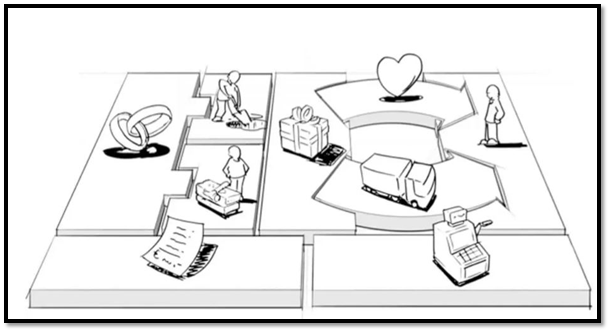
The business model canvas can be drawn in many aesthetic variants, but there are certain main components that the tool must have for the model to be built in a satisfactory way. It must also be defined clearly enough to show what the business idea is and what the value proposition for the customer is. In the ICX way of teaching it, the canvas is read through three main components, a cost center, a value proposition and a profit center. The value proposition sits in the middle, represented as a gift the company offers its customer. Everything to the right of the gift corresponds to the profit center, and everything to the left corresponds to the cost centers.

Business model canvas main components: cost center, value proposition and profit center

This reading is useful for executives because it separates two kinds of questions. On the cost side are the key partners (who should the company partner with to deliver and create a solution), the key activities (what actions must be taken to create and deliver it), the key resources (what is needed to produce and deliver it) and the cost structure (which components are involved in the business model and what each one costs). On the profit side are the customer relationships (how new customers are acquired and what relationship the model desires), the customer segments (which groups of people the company wants to serve), the channels (how the solution reaches customers and where they can find it) and the revenue streams (how the company generates revenue). At the center, the value proposition answers the question that gives all the others a purpose, which is what customer problem is being solved and how.

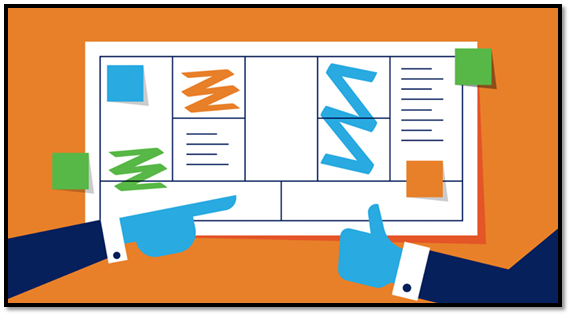
Detailed diagram of the business model canvas blocks and the questions each one answers

Reading the canvas as a conversation between cost and profit also explains why it so often surfaces disagreements. The commercial team tends to focus on the right-hand side, on segments, channels and revenue. Operations and finance live on the left, with activities, resources, partners and costs. A model can look attractive from one side and unaffordable from the other, and the canvas puts both views in front of the same people at the same moment.

What is the best way to use the tool?

The canvas does not have a rigid structure that prevents, for example, a preliminary brainstorming session to improve the design of the model. A team can begin with the blocks where the organization is clearer about its business and, once confidence in contributing ideas grows, move to the questions that require deeper analysis. Even so, when creating a first BMC, the order described below tends to produce the most coherent result, because each decision constrains the next. The steps are not a form to be filled in. They are a sequence of choices, and the quality of the whole depends on how honestly the team answers each one.

1. Choosing customer segments

A useful strategy for segmenting customers is to group them according to their needs, the channels through which they can be reached and the different types of offerings or relationships they want. This also creates ideas for the other sections and gives the team an orderly way of understanding the customer. A bank that treats small merchants, salaried families and young professionals as one segment will find that it cannot write a single value proposition that is true for all three, and the canvas makes that failure visible early.

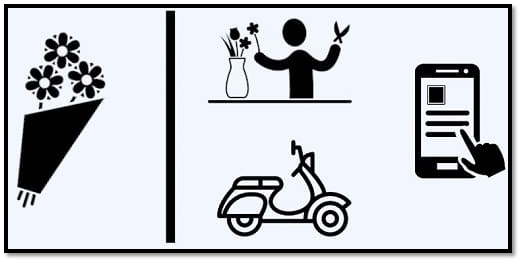
Business model canvas step 1: choosing customer segments

2. Defining the value proposition

The second step asks what features and benefits are created for the customer of the segment or segments chosen in the previous step. The criteria that help justify a value proposition include novelty, meaning how new the products and services offered are, performance, meaning the quality and speed that increase the value of the model, customization, meaning how adaptable the products and services are, design, meaning how the design differentiates the company from its competition, and price, meaning how high or low the price will be, which depends on the business model chosen. A value proposition rarely wins on all five. The discipline lies in choosing the two or three that the target segment actually values and building the rest of the model around them. The ICX value proposition canvas goes deeper into this block.

Business model canvas step 2: customer value proposition criteria

3. Choosing channels

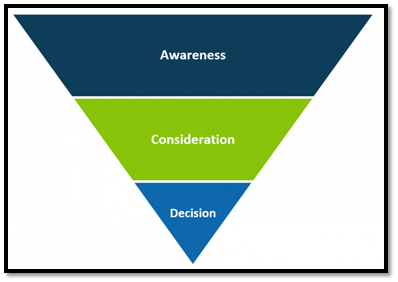
Channels can be very varied. They can belong to partners or to the company, and they can be direct or indirect at the same time. Channels exist at the different stages of the customer journey, and in the buyer journey those stages are awareness, consideration and decision. Mapping a channel to each stage prevents a common mistake, which is to invest heavily in the channel that closes the sale while neglecting the ones that create the interest in the first place.

Business model canvas step 3: choosing channels across awareness, consideration and decision

4. Establishing the customer relationship

Customer relationships are of the utmost importance in delivering, reaching and communicating the value proposition to the customer. In this block the team determines how new customers are acquired and which kinds of relationship are consistent with the solution the company has to deliver. A premium advisory service and a self-service subscription both have customers, but the relationship each one requires, and the cost of sustaining it, could hardly be more different.

Business model canvas step 4: establishing the customer relationship

5. Determining revenue sources

The question here is how the company generates revenue from each client, and whether the revenue is recurring or the client pays only once for the solution. The clearest examples are sales, in which the company sells a product or service for which the customer owes a one-time payment, subscription, which is a recurring payment for a specific service, and pay-per-use, which is similar to a subscription in being recurring but varies with the customer's usage. This choice shapes cash flow, forecasting and the kind of loyalty the company must earn. A subscription business lives or dies on retention, while a one-time sale depends on the continuous winning of new buyers.

Business model canvas step 5: revenue sources, sales, subscription and pay-per-use

6. Determining key resources

Resources are everything that is needed to carry out the business model successfully. They can be divided into physical, intellectual, human and financial resources. Executives often discover at this step that the resource that matters most, whether a customer database, a brand or a team with scarce skills, is the one that appears nowhere on the balance sheet.

Business model canvas step 6: physical, intellectual, human and financial key resources

7. Establishing the core activities

These are all the tasks required to carry out a business model that gives the target user or customer a solution to their problems. The test of a core activity is whether the value proposition would collapse without it. If it would not, the activity may belong to a support function or to a partner.

8. Choosing key partners

This block includes the stakeholders and the network of suppliers and partners needed to carry out the business model. Some of the factors that make a model need a partner are the optimization of economies of scale, the reduction of risk and the acquisition of resources or activities, especially through outsourcing companies. The question for the executive is which capabilities the company must own to protect its differentiation, and which it can rent without weakening it.

Business model canvas step 8: choosing key partners

9. Differentiating the costs incurred in the business model

Finally, to run a successful business model the company must ensure financial viability. For this it is necessary to divide operating costs into fixed costs and variable costs, and to consider economies of scale, cost minimization and premium value propositions that generate the maximum possible value. The cost block is where the earlier choices are tested. A segment that demands a high-touch relationship, served through a costly channel, with a price the market will not pay, shows up here as a margin that does not close.

The way a team completes its canvas should not be rigid, but following a series of steps ensures the process is sequential and logical. That makes the design of the model a high-value activity instead of an afternoon of sticky notes.

How does the canvas work in different industries?

The nine blocks apply to any organization, but the interesting insights come from how differently industries fill them. Imagine a regional bank launching a digital account for freelancers. Its segment is narrow, its value proposition leans on convenience and speed, and its channel is almost entirely digital. The weight of the model falls on key activities such as onboarding and risk scoring, and on key partners such as payment networks and identity providers. The canvas helps its executives see that the cost structure depends on how many applications can be approved automatically, which makes the automation of onboarding a business model decision rather than an IT project.

Now imagine a consumer goods manufacturer considering a direct-to-consumer subscription alongside its traditional retail distribution. On the canvas, the new revenue stream is a subscription, but the existing retail relationships are a partner and channel arrangement that could be disrupted. Placing both models side by side exposes the conflict before it appears in a customer complaint or a distributor's letter. A B2B services firm might find the opposite problem, a sound value proposition and a healthy set of segments, but a revenue stream so dependent on a few large accounts that the canvas highlights a concentration risk the sales forecast had hidden.

What does this mean for the C-level?

For the chief executive, the canvas is a way to conduct a strategy conversation that does not depend on who speaks most persuasively. By asking each member of the leadership team to complete the canvas independently and then comparing the results, the chief executive learns where the organization is aligned and where each function believes it is running a different business. The differences are almost always more informative than the agreements.

For the commercial and customer leaders, the canvas turns attracting, converting and retaining customers into a design problem. Segments, channels and relationships are decisions with costs attached, and the revenue stream shows whether the chosen relationship pays for itself. For the finance leader, the left-hand side is a map of where the money goes, and the canvas encourages asking which costs are essential to the value proposition and which are inherited habits. For anyone responsible for efficiency, it is a prompt to challenge whether each activity and each resource is truly core.

The deeper discipline is to treat the canvas as a living document. Markets move, competitors copy, and the segments that were profitable three years ago may no longer be. ICX has listed some of the symptoms in 10 signs that it is time to update your business model, and the canvas is the natural instrument for the revision.

How should a team begin on Monday morning?

The most practical advice is to start with a real decision. Pick one product, one market or one proposed initiative that the leadership team is already debating, and ask four or five people from different functions to complete a blank canvas separately for it, in thirty minutes, without conferring. Then put the canvases next to each other. Look first at the value proposition, because if people describe it differently, nothing else will line up. Then look at the two blocks that tend to be least developed, usually key partners and cost structure, and ask what evidence supports each entry.

Next, convert the weakest assumptions into tests. If the model assumes that a segment will pay a certain price through a certain channel, design the smallest experiment that would confirm or refute it, set a date and name an owner. This is where the canvas becomes a management tool and not a workshop artifact. A model that is reviewed every quarter against evidence improves, and one that was drawn once and framed on a wall does not.

ICX offers an editable template, a practical guide and a validation checklist in its Business Model Canvas toolkit. Download it, run the exercise with your team, and bring the results to the next strategy meeting.

If you want to go further, our related guides explain how to build a business model canvas step by step (Construye paso a paso un Business Model Canvas) and why many teams say they love the business model canvas.

GET CONSULTING

How does ICX help?

ICX Consulting is a customer experience and commercial strategy firm headquartered in Miami that serves companies in the United States and Latin America. We help leadership teams use the canvas as part of a wider business model design engagement, then refine the value proposition through value proposition development and align the organization through operating and business model alignment. When the model is settled, we connect it to the pricing, sales and customer experience decisions that turn it into results.

If your leadership team is debating a new product, segment or channel, request a diagnostic with an ICX consultant and we will help you test the model before you commit the investment.

Frequently asked questions

What are the nine blocks of the business model canvas?

The nine blocks are customer segments, value proposition, channels, customer relationships, revenue streams, key resources, key activities, key partners and cost structure. In the ICX reading, the value proposition sits at the center, the customer-facing blocks make up the profit side and the infrastructure blocks make up the cost side.

Who should complete the canvas?

A small cross-functional group works best, with people from commercial, operations, finance and customer-facing teams. Having each person draw a version alone before comparing them reveals different assumptions about the same business, which is often the most valuable result of the exercise.

How often should a business model canvas be reviewed?

Review it at least every quarter for a company in a fast-moving market, and whenever a major change occurs, such as a new competitor, a pricing shift or the launch of a channel. Each review should compare the assumptions on the canvas with real customer and financial data.

Is the canvas enough to build a business plan?

No. The canvas clarifies the logic of the business, but it does not replace financial projections, market sizing or an execution plan. It is the best first step because it makes the logic visible, and the quantitative work then tests whether that logic holds.

Content added to ICX Folder
Default Save Save Article Quit Article

Save for later

Print-Icon Default Print-Icon Hover

Print

Subscribe-Icon Default Subscribe-Icon Hover

Subscribe

Start-Icon Default Start-Icon Hover

Start here

Suggested Insights For You

We Love the Business Model Canvas (and so should you!)

We Love the Business Model Canvas (and so should you!)

The Business Model Canvas is a one-page map of how a company creates, delivers and captures value. Its nine blocks, from customer segments and value...

Business Model Canvas: A New Way to Understand Your Customers

Business Model Canvas: A New Way to Understand Your Customers

The Business Model Canvas is a one-page strategic tool that describes how a company creates, delivers and captures value through nine connected...

What Is the Business Model Canvas? How to Use It and Alternatives

What Is the Business Model Canvas? How to Use It and Alternatives

The Business Model Canvas is a one-page tool, created by Alexander Osterwalder and Yves Pigneur, that describes how a company creates, delivers and...

What's next?

ARE YOU READY?

ICX SUBSCRIPTION
Stay ahead with exclusive insights from our senior consultants. Subscribe for the latest thinking on CX, growth, and digital transformation.