











Introduction to Adobe Commerce Coupons for Revenue Leaders
Adobe Commerce coupons are discount codes attached to cart price rules. A rule defines who qualifies, which products or cart conditions apply and...
9 min read
9 min read
Content personalization in Adobe Commerce, the platform formerly known as Magento Commerce, means showing each shopper the banners, products, offers and messages most likely to matter to them, based on who they are and what they have done. A powerful platform does not produce this result on its own. It becomes profitable when the company decides which customers deserve which experience and measures what changes.
Imagine the Monday trading meeting at a regional distributor of home improvement products that sells online to contractors and to households. The e-commerce director opens the storefront on a laptop and shows the room the home page. A contractor who has bought paint and fasteners every week for two years sees the same hero banner as a first-time visitor looking for a garden hose. The chief marketing officer asks why a customer who orders twice a week is shown a welcome discount he will never use. The CFO asks why the promotions budget keeps rising while average order value stays flat. The platform is robust, the catalog is complete, and the experience is generic. That gap is the subject of this article.
Magento has consolidated itself as one of the industry leaders in e-commerce and is growing in popularity among corporate applications under the Adobe Commerce name. Yet a robust solution does not translate automatically into higher profits. It is essential to have a strategy that drives e-commerce operations toward success, and one of the key aspects is an engaging, rewarding and trustworthy user experience, because any business depends on the patronage of its customers, and their satisfaction and loyalty sustain modern commerce. Personalization is one of the most direct ways to build that experience.
Content personalization has become a core strategy for capturing attention and raising conversion rates in e-commerce. The research is consistent about the expectation. McKinsey reported that 71 percent of consumers expect companies to deliver personalized interactions and that 76 percent get frustrated when this does not happen, and it found that companies that grow faster drive 40 percent more of their revenue from personalization than their slower-growing counterparts (McKinsey, the value of getting personalization right or wrong). That study focused on consumers, so a B2B seller should treat it as a direction rather than a benchmark, though business buyers increasingly carry consumer expectations into their work.
The commercial logic is straightforward. With its functionality, Adobe Commerce lets a business deliver experiences based on customer behavior, purchase history, location and other key factors. That strengthens the bond with the customer and produces more relevant interactions. Relevance has a measurable effect on the figures an executive watches: conversion rate, average order value, repeat purchase frequency and the return on promotions. When a shopper sees products and offers that fit, fewer discounts are needed to close the sale, and margin improves.
Through dynamic blocks, customer segmentation and targeted promotions, the platform can display personalized banners, product recommendations and tailored content in different sections of the store. This does more than increase interaction. It improves the effectiveness of campaigns by aligning content with the customer's buying journey. Adobe groups these capabilities as personalization at scale, covering campaigns and communications, product discovery, promotions and offers, and content experiences (see Adobe's guide to creating personalized experiences at scale).
Four building blocks matter most. The first is product recommendations. Adobe Commerce offers a native solution to provide product recommendations using AI, powered by Adobe Sensei and part of the Adobe Experience Cloud architecture. It analyzes shopper behavior and historical data to predict which products a person may want. These systems can also recommend by product characteristics, popularity, trends and item similarity. Other services can be connected as well. Amazon Personalize, a fully managed machine learning service that generates item recommendations and user segments from interaction data, is one example (AWS documentation on Amazon Personalize), although integrating it requires more work and a developer to build the connection.
The second is content personalization itself, which consists of adapting the look and feel of the site to what each customer is likely to prefer. It ranges from the choice of colors, banners and text to sections available only to certain customers. Localization is a large part of it, meaning adaptation to a region or culture through language, local expressions, display currency and cultural references. For a company that sells in several Latin American markets, localization is often the first and most profitable form of personalization, because it removes friction that shoppers would otherwise have to tolerate.
The third is customer segmentation. Adobe Commerce includes rules-based customer segments, and a customer can belong to several at once or to none. Rules can match customers automatically according to attributes such as age, gender or address, or according to actions such as number of orders, total spent or time as a customer. Segments are the foundation for everything else, because they define who sees what.
The fourth is the set of things that segmentation enables. Dynamic content displays banners, widgets and product blocks specific to certain segments. Promotions apply discounts, coupons and other offers to segments. Related product rules create product relationships based on custom rules and apply them to specific segments, supporting cross-sell and up-sell.
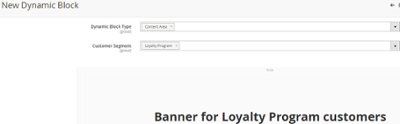
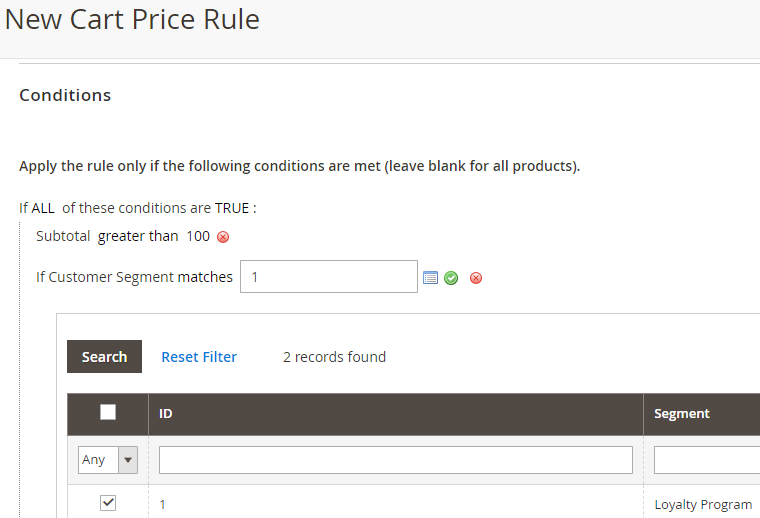
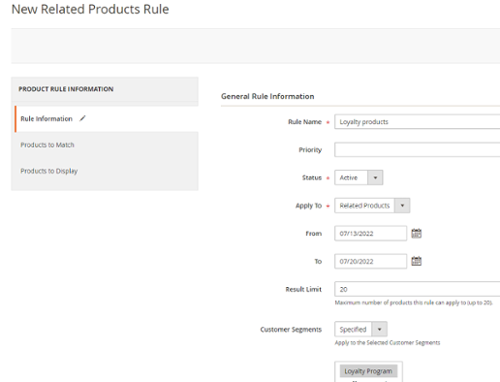
Although the strategic decisions are the main point, a concise outline of the mechanics helps an executive judge the effort. According to Adobe's documentation, dynamic blocks are an Adobe Commerce feature and are not part of Magento Open Source. They are created in the admin under Content, Elements, Dynamic Blocks, their content is completed in Page Builder, and they are placed on pages through the Add Dynamic Block content type. In the customer segment list, the team selects each segment that should see a block, and related cart price rules or catalog price rules can be attached as promotions. A block with no segment selected is visible to everyone, which is worth remembering when a campaign appears to reach the wrong people (see Adobe's documentation on dynamic blocks). Where a company also uses Adobe Real-Time CDP, the same documentation notes that its audiences can drive these blocks through an additional extension.
The practical lesson is that the technical steps are short. The difficult part is the preceding work: deciding which segments exist, what each should see, who maintains the content and how results will be read. Without that, a store can accumulate dozens of blocks that no one remembers creating and that quietly contradict each other. Treat each personalization as a small commercial hypothesis with an owner and a review date.
Distribution and wholesale gain from showing reorder shortcuts, negotiated catalogs and relevant complementary items to repeat buyers, so a contractor finds his usual products on the first screen. Consumer goods manufacturers selling direct can use segments to separate loyal households from bargain hunters, protecting margin by offering incentives only where they change behavior. Fashion and specialty retail benefit from recommendations tied to browsing and purchase history, and from localized collections by climate or region. A financial services firm selling accessories or services online can personalize by life stage. In each case the pattern is identical: fewer generic messages, more relevant ones, and a clearer line between what the customer sees and what the company knows.
Consider a regional pharmacy chain that sells wellness products online. A customer who regularly buys vitamins for older adults should see related items and refill reminders, while a new parent should see a different set altogether. The chain does not need an enormous team to do this. It needs three or four well-defined segments, one recommendation approach, and a person accountable for reading the results every month. The ICX article on large-scale personalization explores how successful companies structure this work.
>> Magento B2B and its Importance in Businesses <<
The sophistication of the tool matters less than the quality of the customer record behind it. A segment such as customers who have ordered more than ten times this year is only as reliable as the order history that feeds it. Many companies discover, when they first try to personalize, that the same customer exists under three accounts, that purchases made through sales representatives never reach the store database, and that region and industry fields are filled in inconsistently. Cleaning that foundation is unglamorous work, and it is the part that decides whether the experience will feel relevant or random.
Adobe's documentation points to a broader path for companies that need it. Adobe Commerce Data Sharing can send storefront, back office and customer profile data to Adobe Experience Platform, where it can be used in Real-Time CDP, Journey Optimizer, Customer Journey Analytics, Adobe Analytics and Adobe Target. Not every company needs that architecture. A mid-sized distributor may do very well with native segments and a CRM that records account-level information. But the principle is the same at any scale: personalization should draw from one agreed view of the customer, and the store should not be left to guess.
This is also why the store and the CRM have to be designed together. When the sales team records that a customer has changed their purchasing manager, or that a contract has new terms, that knowledge should influence what the customer sees online. When the store records that a customer has abandoned a large cart, the account manager should know. Companies that connect the two see personalization move from a marketing exercise to a commercial capability, because the knowledge held by people and the knowledge held by systems start to reinforce each other.
A disciplined measurement plan protects the program from both overselling and premature cancellation. Start by choosing a primary metric for each personalized experience, such as the conversion rate of the segment, the average order value or the repeat purchase rate, and a guardrail metric, such as margin after promotions. Hold back a control group, even a small one, so that you can distinguish the effect of the experience from seasonal movement. Review results at a fixed cadence, monthly for fast-moving retail and quarterly for longer B2B cycles.
Executives should also expect a pattern. The first personalized experiences usually produce clear gains because the starting point was generic. Later ones produce smaller gains and require more care, which is the signal to move effort from adding segments to improving content quality and offer design. Resist the temptation to judge the program by a single campaign. The cumulative effect, visible in retention and in the share of revenue from repeat customers, is where the value accumulates.
Personalization has three predictable failure modes. The first is complexity: rules multiply, segments overlap, and nobody can explain why a given shopper saw a given message. The remedy is a short list of segments, written definitions and a regular cleanup. The second is data quality. A segment built on incomplete or inconsistent customer records will misclassify people, and the resulting experience feels careless, not personal. The third is privacy. Customers appreciate relevance but dislike feeling watched, so the company should be clear about what data it uses and respect consent and local regulations, a point developed in the ICX article on effective personalization and privacy.
There is also a commercial risk that is easy to miss: personalizing discounts can train customers to wait for them. A segment-based promotion should be tested against a control group and judged by incremental margin, not by gross sales. If a loyal customer would have bought anyway, the discount is a cost, not growth.
For the CEO, personalization is a way to turn a platform investment into a customer relationship that is harder for competitors to copy. The decision is to define the few customer groups that matter most and to ask the organization for a concrete experience for each. For the CFO, it is a lever on margin, since relevant experiences reduce reliance on blanket discounts, and a discipline of control groups makes the benefit measurable.
For the chief marketing officer, the shift is from campaigns aimed at everyone to a managed set of experiences aimed at segments, supported by content that is produced once and reused. For the sales and customer experience leaders, segments connect the online store to the account teams: the contractor who orders every week deserves a different relationship than the occasional visitor, and the store should reflect it. Retention and loyalty are the main prizes, because customers return to businesses that appear to understand them.
Begin with the data you already have. Ask the e-commerce team to produce a list of your top customers by frequency and value, and a list of those who have not purchased in six months. Those two groups already define two segments, and each calls for a different home page message and a different offer. Write, in plain words, what you want each group to do next. A contractor should reorder more easily; a lapsed customer should be given a reason to return.
Next, build only those two experiences. Create the segments, one dynamic block for each, and one recommendation placement. Keep a control group that sees the standard store. After a month, compare conversion, order value and margin. If the results justify it, add a third segment. This incremental method avoids the typical overreach of a big-bang personalization project and gives the finance team evidence to support further investment. The ICX customer journey toolkit offers a practical way to map which moments in the buying journey deserve personalized content first.
ICX Consulting is a commercial strategy and customer experience firm headquartered in Miami. In personalization projects, its consultants start with the customer segments, the value each represents and the journey that should be improved, and then configure the platform to support them. The work draws on the practices for customer experience, B2C digital commerce and B2B digital commerce, and on the experience of the Adobe Commerce implementation team. A robust platform is necessary but not sufficient, and a strategy that ensures a successful experience from start to end is what ICX specializes in. To discuss your case, talk to an ICX consultant about personalization.
Adobe Commerce is the current name of the commercial edition formerly sold as Magento Commerce. Features such as dynamic blocks belong to Adobe Commerce and are not included in the open source edition, so check your edition before planning.
They group shoppers by rules based on attributes or behavior, so that content, promotions and recommendations can be tailored to each group. A shopper can belong to several segments or to none.
Native tools such as segments, dynamic blocks and promotions are configured by trained administrators. Connecting external recommendation services usually requires a developer to build the integration.
Compare a personalized group with a control group on conversion rate, average order value, repeat purchase rate and margin after promotions. A positive change in margin is a stronger sign than a rise in sales alone.


Adobe Commerce coupons are discount codes attached to cart price rules. A rule defines who qualifies, which products or cart conditions apply and...

A discount looks like the simplest lever in retail. A percentage comes off a price, a banner goes up, and sales rise. Anyone who has run a promotion...

 Mauricio Lang : Nov 03, 2026
The promotion tools in Adobe Commerce (Magento) make it possible to automate discounts through catalog price rules, cart price rules and coupons,...

