








Skip to the main content.

What We Offer

ICX helps companies grow revenue and profitability by connecting customer experience, sales, pricing, CRM and automation into one commercial system.

Customer Experience

We design memorable, customer-centered experiences that drive loyalty, enhance support, and optimize every stage of the journey. From maturity frameworks and experience maps to loyalty programs, service design, and feedback analysis, we help brands deeply connect with users and grow sustainably.

Marketing & Sales

We drive marketing and sales strategies that combine technology, creativity, and analytics to accelerate growth. From value proposition design and AI-driven automation to inbound, ABM, and sales enablement strategies, we help businesses attract, convert, and retain customers effectively and profitably.

Pricing & Revenue

We optimize pricing and revenue through data-driven strategies and integrated planning. From profitability modeling and margin analysis to demand management and sales forecasting, we help maximize financial performance and business competitiveness.

Digital Transformation

We accelerate digital transformation by aligning strategy, processes and technology. From operating model definition and intelligent automation to CRM implementation, artificial intelligence and digital channels, we help organizations adapt, scale and lead in changing and competitive environments.


Operational Efficiency  

We enhance operational efficiency through process optimization, intelligent automation, and cost control. From cost reduction strategies and process redesign to RPA and value analysis, we help businesses boost productivity, agility, and sustainable profitability.

Customer Experience

chevron-right-1

Marketing & Sales

chevron-right-1

Pricing & Revenue

chevron-right-1

Digital Transformation

chevron-right-1

Operational Efficiency 

chevron-right-1

9 min read

7 Reasons to Use SIPOC to Create Your Customer Journey Map

9 min read

7 Reasons to Use SIPOC to Create Your Customer Journey Map

7 Reasons to Use SIPOC to Create Your Customer Journey Map
9:21

A SIPOC diagram (Suppliers, Inputs, Process, Outputs, Customers) is a one-page, high-level map of a process. Using it to create a Customer Journey Map connects what the customer experiences with the internal suppliers, inputs and activities that produce that experience, so teams can see which process gaps cause friction and fix them at the source.

Understanding the customer journey is essential for improving the experience and optimizing every touchpoint with the company. Without a clear view of how customers interact with internal processes, businesses miss opportunities for improvement and create friction that hurts satisfaction and loyalty. To achieve a structured and effective analysis, SIPOC becomes a key tool.

This method shows how each stage of the Customer Journey Map relates to suppliers, inputs, processes, outputs and customers. With its organized approach, businesses can identify gaps in the customer experience and address them before they become major issues. For executives, this is the difference between a journey map that decorates a wall and one that changes how the company operates. Most customer complaints are symptoms of process problems, such as a late handoff, missing information or an unclear rule, and SIPOC is one of the fastest ways to trace the symptom back to its cause, protecting revenue, retention and cost to serve at the same time.

Integrating SIPOC into the development of a Customer Journey Map helps companies detect optimization opportunities and ensure that internal processes match customer expectations. With a structured view, teams improve operational efficiency and create smoother interactions at every stage of the journey.

Imagine the monthly operations committee of a regional insurer. The customer experience director presents a journey map for new policyholders, and its lowest point is the first thirty days, when customers receive their documents late and call to ask whether they are covered. The operations director replies that the issue is not service but the way underwriting sends data to the document team. The head of sales adds that agents promise delivery in forty-eight hours because nobody told them otherwise. Each of them is right about a part of the process and none of them has seen the whole. The journey map shows how the customer feels. It does not show which supplier, input or handoff is responsible, and that is exactly the gap a SIPOC fills.

How much should we learn from other disciplines? In Range: How Generalists Triumph in a Specialized World, David Epstein argues that the way to excel is by sampling broadly, gaining a variety of experiences, taking detours, experimenting relentlessly and exploring many interests, in other words, by developing range. Combining a Lean Six Sigma tool like SIPOC with a customer experience tool like the journey map is that idea applied to business.

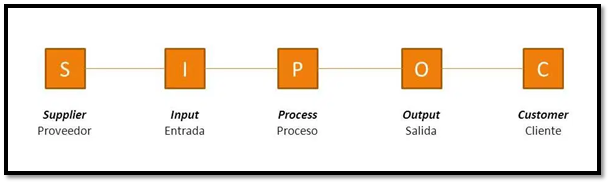
SIPOC diagram with suppliers, inputs, process, outputs and customers

What is a SIPOC diagram?

SIPOC is a graphical representation of a process, named for the acronym Supplier, Input, Process, Output, Customer. The U.S. Agency for Healthcare Research and Quality describes it as a high-level flowchart that includes data on suppliers, inputs, outputs and users involved in a process, recommended early in a project and whenever the parties, inputs or outputs of a process are not yet clear. The diagram resembles a Customer Journey Map because both describe a process with the customer in mind.

A SIPOC is usually a simple representation, so the entries in each column should be as brief and concise as possible. It defines the scope of a team's work and identifies, at a high level, the gaps between what the process expects from its suppliers and, above all, what the customer expects from the process.

ElementQuestion it answersExample in a customer onboarding journey
SuppliersWho provides what the process needs?Sales, legal, finance, the customer
InputsWhat materials, data or services enter the process?Signed contract, customer data, configuration requirements
ProcessWhat are the five to seven high-level steps?Kickoff, setup, training, go-live, first review
OutputsWhat does the process deliver?Working account, trained users, success plan
CustomersWho receives the outputs, internally and externally?Client team, account manager, support
Experience (E)What should the customer feel at each step?Confident, informed, valued

What are the 7 reasons to use SIPOC to create your Customer Journey Map?

Seven reasons to use SIPOC in a customer journey map

1. It is the ideal complement

SIPOC involves thinking about the entire journey of a product or process, from the supplier all the way to the customer. An alternative approach is to map the process from customer to supplier, known as COPIS. Still, the best way to use SIPOC for the Customer Journey Map is to add a new letter.

This new letter stands for the customer experience and can be represented by the letter "E." Every time a SIPOC is created, it then carries an important added question. What do you want the client to experience throughout this process?

Do you want the customer to feel happy, excited, delighted or appreciated throughout the process? By including this letter, a key component of the journey map, the client's emotions, becomes part of the analysis. This version of the diagram can be called SIPOCE, and it serves as the input for a Customer Journey Map.

Team brainstorming a SIPOCE diagram for a customer journey

2. It provides a structured and easy way to brainstorm

Brainstorming is intrinsic to creating both the Customer Journey Map and the SIPOCE. When you use these tools you are, at heart, brainstorming. One of the biggest challenges of generating ideas is keeping control and a clear goal for each space where different people contribute many ideas.

The SIPOCE can be built easily with an online whiteboard, because in essence it is a table where the specific information of a process is placed concisely and simply. The result is a tool that captures the outcome of the brainstorm. The more structured the ideas, the more useful they are for a Customer Journey Map.

3. It lets you think beyond the process

SIPOC makes all the variables that affect a service or product explicit. That global view, observing from different points of view, is key in the Customer Journey Map. To look beyond the process steps, the diagram answers specific questions.

The first question is who the suppliers and customers of the process are, since they can be internal or external to the organization. The second is what the inputs and outputs are, which can be materials, services or information.

SIPOC focuses on capturing inputs and outputs rather than only the individual steps of a process. It is the first step toward cause-and-effect thinking, which is exactly what a journey map needs when a pain point appears and the team must find where it originates.

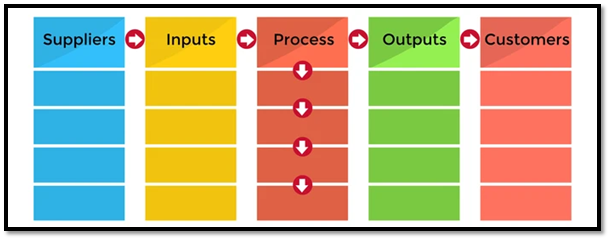
SIPOC focuses on inputs and outputs, not only process steps

4. It is a visual and simple tool

As the image shows, the SIPOC diagram is very easy to apply. An important reason to use it is that a lot of information can be stored in a structured and concise way.

When a process has many variables and verticals, explaining it fully usually requires a document with many pages. That makes the analysis hard to use, and the author of the document will probably receive little constructive feedback on the work.

A SIPOC can be built with online mapping tools, which makes it extremely practical for distributed teams, or with an A3 sheet and sticky notes in a workshop. Either way, the diagram becomes a visual record of a group's critical thinking on a specific topic.

>> How to improve processes in a few steps? <<

Visual SIPOC diagram summarizing a process on one page

5. It helps you understand how the process serves the customer

Every step in the process must add value for the customer. This is a key pillar in both the SIPOC and the Customer Journey Map. The SIPOC model is used to make the process highly effective and efficient, but none of that matters if the customer is not considered at every step.

When analyzing a process with SIPOC, each individual step should add value for the client. This can be complemented with a value-added matrix, which lists all the procedures or activities of the process and asks whether each one adds value for the end customer. Once you identify the activities that do not, find a way to eliminate them or transform them so that they do.

Understanding how the process serves the customer is therefore a fundamental part of the thinking behind a Customer Journey Map. Our article on how value stream mapping drives customer experience shows the next level of this analysis.

Customer journey map built from SIPOC process analysis

6. It enables collaboration across groups

There are methods to unite teams, such as smarketing, which aims for sales and marketing to work toward a common objective. Building a SIPOC diagram likewise requires the knowledge of people from several disciplines.

The purpose of bringing several groups together is to make the process diagram as close to reality as possible. That requires the experts in each activity around the process to contribute their ideas and points of view.

7. It helps create shared understanding

The exercise also refreshes the knowledge of people whose familiarity with a process has faded or become outdated because the process changed. When marketing, sales, operations and service build the same SIPOCE, they leave the session with one shared picture of how the customer is served, which makes the journey improvements that follow much easier to agree on and execute.

Cross-functional collaboration on a SIPOC and customer journey map

How do you build a SIPOCE for a customer journey in one workshop?

Start by choosing one journey and defining its boundaries, for example from signed contract to first value delivered, or from order placed to order received. Begin with the customer, listing who receives the outputs and what they expect, and then work backwards through outputs, process, inputs and suppliers. Keep the process to five to seven high-level steps, because detail comes later, in process maps for the steps that cause problems.

Add the E column next. For each step, write the emotion you want the customer to feel and, using real feedback, the emotion they actually feel today. Mark the gaps where desired and actual experience differ, and trace the cause to a specific input or supplier. Close by assigning owners and next steps, so that each gap gets an owner, a fix and a metric, and the SIPOCE becomes the input for the full Customer Journey Map.

To structure the session, use the ICX Define Activities and Processes Toolkit for the SIPOC part and the Customer Journey Toolkit to turn the result into a journey map.

Where SIPOC adds the most value by industry

The tool is most useful where an experience depends on a chain of internal handoffs. In insurance and banking, onboarding, claims and credit approval involve underwriting, operations, compliance and sales, and a SIPOCE exposes which input arrives late or incomplete. In manufacturing and distribution, the customer experiences order accuracy and delivery, which depend on suppliers, planning and logistics that never appear in a marketing journey map. In healthcare, a patient's experience of waiting is the output of admissions, authorizations and scheduling, and the diagram helps the institution see which supplier of information causes the delay. In hospitality and retail, the experience of a promise kept, such as a room ready at arrival or a product available as shown, can be traced to housekeeping or inventory processes that the customer never sees but always feels.

Limits of the method and how to use it with judgment

SIPOC is deliberately high level, and that is both its strength and its limit. It tells the team where to look, but it does not measure how long each step takes, how often it fails or what it costs. When the diagram identifies a problematic step, the next move is a detailed process map and real data, not a longer diagram. Teams also tend to document the process as it is supposed to work, so the facilitator should ask for the version that employees actually follow, including workarounds, since the workaround is often the real source of the customer's frustration.

There is also an organizational risk. A workshop that exposes cross-department gaps can feel like a search for blame, and a company that has not prepared for this may find that participants defend their areas instead of describing them. The sponsor's role is to frame the exercise as a shared diagnosis of the customer's experience and to commit in advance that each gap will receive an owner and a decision. Return to the insurer's committee. After a single SIPOCE session, the team finds that the document delay originates in a data field that underwriting fills in after issuing the policy. A change in the order of two steps brings delivery within the promised time, and the first thirty days stop being the weakest point of the journey.

What this means for the C-level

On service, use SIPOCE to link each customer pain point to the internal step that causes it, so service improvements fix causes instead of symptoms. To retain and build loyalty, journeys designed with the E column in mind deliver consistent experiences, which is what keeps customers coming back. On efficiency, the value-added analysis exposes steps that cost money and add nothing for the customer, often the quickest savings available. And on conversion, applied to the sales and onboarding journey, SIPOC reveals handoff delays between marketing, sales and operations that slow deals down.

How ICX helps

ICX Consulting combines process excellence and customer experience in the same engagement. Our SIPOC diagram and process scoping consulting and process mapping and analysis services connect directly with our Customer Journey Map work, and our Process Matrix methodology documents how each process serves the customer. The result is a journey you can manage, measure and improve, supported by the systems your teams already use.

Bring this topic to your company

An ICX Consulting advisor will assess where your organization stands today and which decisions can move your commercial and customer experience results.

Request a diagnostic with an ICX consultant

Frequently asked questions

What is the difference between SIPOC and COPIS?

They contain the same elements in opposite order. SIPOC reads from supplier to customer, while COPIS starts with the customer and works backwards. COPIS is useful when you want the team to anchor every discussion in customer requirements first, and many facilitators build the diagram in COPIS order and present it as SIPOC.

Is SIPOC only for Lean Six Sigma projects?

No. SIPOC originated in quality and Lean Six Sigma practice, but it works for any process that needs a clear scope, including sales, onboarding, service and ecommerce fulfillment. Its simplicity makes it a good shared language between operations teams and customer experience teams.

How detailed should a SIPOC be?

Keep it high level, usually five to seven process steps and a few entries per column. Its job is to set scope and reveal gaps, not to document every task. When a step needs more detail, create a separate process map for that step only.

Who should participate in a SIPOC workshop?

Include the people who supply inputs, perform the steps and receive the outputs, plus someone who represents the customer's voice, ideally with real feedback data. A neutral facilitator helps keep the discussion at the right level and prevents any single department from dominating.

SIPOCE can be seen as the structured, visual and elegant result of brainstorming a process. It keeps the analysis focused on the experience and on the value each activity adds for the client, and it works best with multidisciplinary teams that build a shared understanding. These are some of the reasons to use this diagram in a Customer Journey Map, and putting it into practice is the best way to discover its advantages. If you want to connect your customer journey with the processes behind it, request a diagnostic with an ICX consultant and find the internal causes of the friction your customers feel.

>> Read More: Understand the difference between Customer Journey and User Journey <<

Content added to ICX Folder
Default Save Save Article Quit Article

Save for later

Print-Icon Default Print-Icon Hover

Print

Subscribe-Icon Default Subscribe-Icon Hover

Subscribe

Start-Icon Default Start-Icon Hover

Start here

Suggested Insights For You

SIPOC: How to improve processes in a few steps?

SIPOC: How to improve processes in a few steps?

ICX Consulting, a commercial strategy and customer experience consultancy, uses SIPOC as the fastest way to improve processes in a few steps. A SIPOC...

What Is a Customer Journey and a Customer Journey Map?

What Is a Customer Journey and a Customer Journey Map?

A customer journey is the path a person follows from recognizing a need to buying and using a solution. A customer journey map is its visual story,...

DMAIC Methodology: Define Stage

DMAIC Methodology: Define Stage

The Define stage of DMAIC is where an improvement project is won or lost. In it the team turns the voice of the customer into measurable...

What's next?

ARE YOU READY?

ICX SUBSCRIPTION
Stay ahead with exclusive insights from our senior consultants. Subscribe for the latest thinking on CX, growth, and digital transformation.