






How to Improve the Customer Experience and Turn It Into Growth
To improve the customer experience, understand who your customers are and what they are trying to get done, map their end-to-end journey, compare it...

By Role
By Industry
By Target Customer
What We Offer
ICX helps companies grow revenue and profitability by connecting customer experience, sales, pricing, CRM and automation into one commercial system.
Customer Experience
We design memorable, customer-centered experiences that drive loyalty, enhance support, and optimize every stage of the journey. From maturity frameworks and experience maps to loyalty programs, service design, and feedback analysis, we help brands deeply connect with users and grow sustainably.
Marketing & Sales
We drive marketing and sales strategies that combine technology, creativity, and analytics to accelerate growth. From value proposition design and AI-driven automation to inbound, ABM, and sales enablement strategies, we help businesses attract, convert, and retain customers effectively and profitably.
Pricing & Revenue
We optimize pricing and revenue through data-driven strategies and integrated planning. From profitability modeling and margin analysis to demand management and sales forecasting, we help maximize financial performance and business competitiveness.
Digital Transformation
We accelerate digital transformation by aligning strategy, processes and technology. From operating model definition and intelligent automation to CRM implementation, artificial intelligence and digital channels, we help organizations adapt, scale and lead in changing and competitive environments.
Operational Efficiency
We enhance operational efficiency through process optimization, intelligent automation, and cost control. From cost reduction strategies and process redesign to RPA and value analysis, we help businesses boost productivity, agility, and sustainable profitability.
Customer Experience
Marketing & Sales
Pricing & Revenue
Digital Transformation
Operational Efficiency
9 min read
Aileen Pierce | May 29, 2025
9 min read
Aileen Pierce | May 29, 2025
Customer experience design (CX design) is important because it turns the customer's journey into something the company manages on purpose instead of leaving to chance. By aligning processes, people and technology with what customers need at each stage, it raises satisfaction and loyalty, protects revenue and removes the costs that broken experiences create.
In a highly competitive market, people have many brands to turn to when they need a product or service. For a company to stand out and build a lasting relationship with its customers, it must offer more than a transaction. It must offer a complete experience throughout the purchasing process and beyond it.
For the leadership team, the importance of customer experience design is ultimately economic. Experience influences which brand customers choose, how much they are willing to pay, whether they come back and how often they need help. Each of those effects shows up in revenue, margin or cost to serve. This article explains what customer experience and CX design are, builds the business case for investing in them and describes the tools that make the work practical.
Picture the monthly commercial committee of a regional insurer. The sales results are acceptable, but the head of customer operations reports that complaints about claims have doubled in the same period, the retention director notes that renewals are slipping among customers who filed a claim, and the CFO points out that the contact center is spending more every month answering the same questions. Each executive owns a piece of the problem and nobody owns the customer's experience from the first quote to the claim payment. The committee agrees to improve satisfaction, which commits no one to anything. The business case for customer experience design starts at precisely this table, with the decision to treat the journey as a managed asset.
The relationship between a company and its customers is built on many interactions through different points of contact, physical or digital. Depending on the quality of each of these moments, customers form their level of satisfaction with the purchasing process and with the brand.
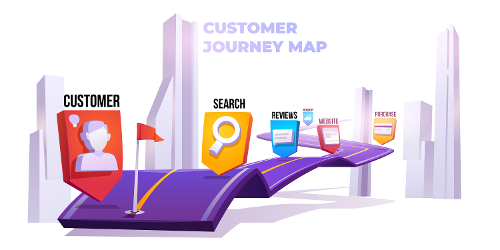
The buying process refers to the different stages of the Customer Journey. It starts when a need or problem arises, continues as the customer researches existing options through search engines and other sources, and narrows as the list is filtered, until the purchase decision is made and the transaction is completed. After that come delivery, use, support and, ideally, repurchase.
Customer experience is therefore the set of moments in which the consumer and the brand come into contact. That experience can be positive or negative depending on the strategies the company has in place, and that is where customer experience design becomes essential.
Customer experience design is a strategic process carried out by CX designers to optimize the customer experience and ensure maximum customer satisfaction. It requires understanding processes as well as people, so the company can align its strategies, actions and technology with customer needs.
In practice, CX design answers three questions for each priority journey. What does the customer need at this stage? What does the company currently deliver? Which changes in process, policy, channel or capability would close the gap? The output is not a slogan. It is a target experience with clear standards, owners and metrics.

Consumers today are well informed. Information is a couple of clicks away, which gives them quick access to many options. When customers have a need, they want to solve it in the shortest time possible and in their own way, and they expect the chosen brand to meet their expectations. If it does not, they look for the next option.
At an accelerating rate, more customers prioritize the experience when choosing a brand, which means a good customer experience puts the company ahead of the competition. That is why it becomes critical to understand customers, including their process, motivations, frustrations, emotions and desires, and to adapt the company's process to the customer's, generating memorable experiences that make people choose the brand over others.
There is also a perception gap that only deliberate design can close. In a well-known survey of 362 firms, Bain & Company found that 80% of companies believed they delivered a superior experience, while customers said only 8% really did. Without a structured design process, companies tend to judge themselves by intentions while customers judge them by results.

Executives fund what they can connect to results. The research gives a clear basis for that connection. In The CEO guide to customer experience, McKinsey reports that customer journeys are significantly more strongly correlated with business outcomes than individual touchpoints, and that customer experience leaders using advanced analytics can achieve revenue gains of 5 to 10 percent and reduce costs by 15 to 25 percent within two or three years.
Those gains come from four mechanisms that CX design addresses directly:
| Mechanism | How CX design acts on it | Business result |
|---|---|---|
| Conversion | Removes friction from evaluation, quoting and purchase | More sales from the same demand |
| Retention | Designs onboarding, support and renewal as managed journeys | Lower churn and higher customer lifetime value |
| Price realization | Strengthens the value customers perceive beyond the product | Less pressure to discount |
| Cost to serve | Eliminates the causes of repeat contacts, errors and rework | Lower operating cost per customer |
The point for the C-level is that CX design is not a cost center. It is a way to manage revenue drivers and cost drivers through the same lens, the customer's journey.
Improving processes, and with them the customer experience, requires a team with the right expertise. Two tools are especially useful to define and analyze the different stages of the journey.
A buyer persona represents a semi-fictional character created according to business objectives. Buyer personas are ideal customer profiles built from demographic and attitudinal characteristics. Using them helps the company understand the objectives, needs, behaviors and expectations of ideal customers, which makes them the basis for any marketing, sales or service strategy.
If you want to read more about buyer personas:
A three-step guide to building your buyer persona shows how to begin, Buyer Persona: the key to the success of your business strategy explains why it matters, and Make your buyer persona memorable for your team covers how to keep it alive inside the organization.
The Customer Journey is a methodology for understanding the buying process, physical or digital, of each buyer persona. Applying it identifies the stages of the process along with customers' objectives, motivations, pains and emotions, and then supports an analysis that defines opportunities to improve internal processes. The Customer Journey Map is the visual representation of that process.
Read more about the customer journey:
You can start with Improve your customer experience through the Customer Journey, and see how the method applies to a specific sector in Customer Journey in the Retail Industry.

Mature CX teams add a few more instruments once personas and journeys are in place. A service blueprint connects what the customer sees with the internal processes and systems behind each step. Voice of customer programs capture feedback continuously. Experience metrics, such as satisfaction, effort and likelihood to recommend, show whether the redesigned journey is working. For a short overview of these tools and how CX differs from UX, see our executive primer on CX design.
The importance of customer experience design becomes visible to the board only when it is measured in the same language as other investments. A practical scorecard combines three layers of indicators for each redesigned journey:
Experience indicators show how customers perceive the journey, for example satisfaction after a key interaction, the effort required to complete a task and the likelihood to recommend the brand. Operational indicators show whether the process behind the journey improved, such as time to onboard a customer, first-contact resolution, error rates in orders or invoices and the number of repeat contacts. Financial indicators translate the change into business value, including conversion rate, churn, repeat purchase, average order value, discount levels and cost to serve per customer.
The discipline is to define the baseline before any change, agree on the target with the journey owner and review the three layers together. When experience scores rise but financial indicators do not move, the redesign may be improving moments that customers notice but that do not drive their decisions. When financial indicators improve while experience scores fall, the company may be capturing short-term value at the expense of loyalty. Reading the layers side by side keeps CX design honest. For a closer look at how the design process itself creates this value, read about the power of Customer Experience Design.
Knowing the importance of customer experience design is not the same as getting results from it. In our consulting work, the same causes appear again and again:
The first cause is the absence of an owner for the journey. Each department optimizes its own step and nobody is accountable for the end-to-end result. The second is research without decisions, when personas and maps are produced, presented and archived, but no process or policy changes. The third is technology first, where a new platform is implemented before the target experience is defined, which automates the existing friction.
A fourth cause is the lack of a link to financial metrics. When CX results are not translated into revenue or cost, the initiative loses priority at the first budget review. The last is a one-time project mindset. Customer expectations keep changing, so a journey designed once and never revisited loses relevance.
The principle is the same in every sector, but the decisive journey changes. For an insurer or a bank, it is usually the moment of truth when the customer needs the product to work, such as a claim or a dispute, because trust is built or lost there far more than at the point of sale. For a retailer or consumer goods company, it is the path from discovery to repeat purchase, where delivery, returns and promotional consistency determine whether a first purchase becomes a habit. For a hotel or a healthcare provider, the experience is judged almost entirely in the moments of contact between people, so design focuses on handoffs, waiting and communication. For a B2B manufacturer or services firm, the journey includes several roles, from the technical evaluator to the buyer who approves payment, and the design challenge is to give each of them what they need without lengthening the cycle.
These are illustrative contrasts rather than prescriptions, yet they show why a generic customer experience program rarely works. The first step in any serious effort is to decide which journey carries the most revenue or cost in that particular business.
Designing for the customer also means making choices that are uncomfortable internally. A faster claims process may require changing approval limits that risk teams have defended for years. A simpler onboarding may remove a step that sales relied on to collect data. A consistent experience across channels may demand that regions give up local practices they consider their competitive edge. Leaders who underestimate these conflicts find that the design is approved in the workshop and then quietly reversed in the operation.
Cost is also a legitimate concern. Not every moment deserves the same investment, and a company that tries to delight customers everywhere will exhaust its budget without being remembered for anything. Good CX design chooses the moments that matter most to the customer and to the business, sets a clear standard for the rest and accepts that parity is sometimes enough. Return to the insurer's committee. Six months after naming an owner for the claims journey, the same executives discuss one scorecard that combines satisfaction after a claim, time to payment, renewals among claimants and the cost of repeat calls. The conversation is no longer about whether to improve the experience. It is about where the next improvement will pay for itself.
On conversion, ask for a journey view of your sales process. Where do qualified prospects stall, and what would remove that friction? On retention, treat onboarding and problem resolution as designed experiences with standards and owners, not as operational afterthoughts. For loyalty, use persona insights to decide which benefits and recognition actually matter to your best customers.
In service, give the service team a voice in journey design, since they see the consequences of upstream decisions every day. And on efficiency, quantify the cost of rework, repeat contacts and exceptions in each journey and set a target to reduce it.
Begin by picking one journey with a visible effect on revenue or cost, such as onboarding, quoting or claims. Define the persona that matters most for that journey and validate it with real customer interviews, then map the current journey with the teams involved and mark the moments of highest friction.
Design the target experience for those moments, including process, policy and channel changes, and assign an owner. Finally, measure before and after with one experience metric and one financial metric, and report results to the executive committee.
ICX Consulting helps companies turn customer experience design into measurable business results. Our customer experience design service builds personas, maps journeys and redesigns the processes behind them, while our buyer persona development work grounds every decision in real customer insight. With the ICX Compass methodology, we prioritize improvements by their impact on revenue and cost and define the roadmap. Platforms such as HubSpot or Salesforce are implemented afterwards to support the designed experience.
To begin defining who you are designing for, use the ICX Persona Playbook toolkit, a practical guide to building personas your marketing, sales and service teams can use.
Bring this topic to your company
An ICX Consulting advisor will assess where your organization stands today and which decisions can move your commercial and customer experience results.
A strong team combines customer research, process analysis, service design and data analysis, plus enough business and financial understanding to build a case for change. It also needs people who can facilitate sessions across departments, because most improvements require agreement between marketing, sales, operations and service.
Customer service improvements usually focus on the moments when customers ask for help. CX design looks at the entire journey, including the steps that create the need for help in the first place. Often the most valuable change is upstream, such as clearer onboarding or simpler billing, which reduces service demand.
Start small. Most companies get the best return by focusing on two or three personas that represent most of their revenue and one or two journeys where friction is highest. Once those are working and measured, the approach can be extended to other segments and journeys.
Very much so. B2B journeys involve several decision makers, longer sales cycles and complex onboarding, so there are more moments where the experience can break. Designing the journey for each role in the buying group, from the technical evaluator to the person who approves payment, often shortens sales cycles and reduces churn at renewal.
The importance of customer experience design comes down to a simple idea. Customers will judge your company by the journey they live, so it is better to design that journey than to discover its flaws through lost sales. If you want to understand where your customer experience is costing you revenue, request a diagnostic with an ICX consultant.
To improve the customer experience, understand who your customers are and what they are trying to get done, map their end-to-end journey, compare it...
Maximizing sales through customer experience means designing every interaction a buyer has with your company, from the first search to renewal, so...
Customer experience in the telecommunications industry is the sum of every interaction a subscriber has with a provider, from the first inquiry and...