











What is a BPM and what is it for?
A BPM, short for Business Process Management, is a management discipline that analyzes, designs, executes, monitors and continuously improves the...
14 min read
14 min read
ICX Consulting helps leadership teams use Business Process Management to connect strategy with daily operations. The benefits of BPM are lower operating costs, faster and more reliable delivery, better customer experience, stronger compliance and the agility to change processes quickly, because BPM manages processes end to end as a discipline that unites people, data and technology.
Companies operate in an environment that is constantly changing and where competition never lets up. They face the ongoing challenge of improving their operations, adapting quickly and, above all, keeping the customer as their top priority. Overcoming these challenges is not easy, and this is where strategies that improve efficiency and drive sustainable growth come into play. Business Process Management (BPM) becomes a key ally in transforming the way organizations manage their processes. For the board, the stakes are concrete. Processes decide the cost of every order, the time it takes to serve a customer and how fast the company can respond to a new regulation or competitor.
With BPM, it is not just about mapping processes or creating attractive diagrams. BPM helps companies identify the critical points where things get stuck, highlights areas for improvement and opens the door to innovation. By applying BPM, a company does not only optimize how things are done. It also cuts costs and saves time on repetitive tasks, which leaves more resources and energy for what really matters, innovating and delivering a better experience to customers.
One of the great advantages of BPM is that it gives the company the ability to move quickly in response to market changes or new regulations. This flexibility is crucial in a volatile world. Integrating technologies such as automation or artificial intelligence also becomes much more natural, making the operation more agile and more sustainable over time. Best of all, this approach puts the customer at the center. BPM aligns every internal process with what customers truly expect and need, which translates into faster service, more positive experiences and more loyal customers.
Although business process management is not a new concept, it has evolved tremendously with technology. Today, BPM combines well-structured methodologies with digital tools that allow companies to continuously map, analyze and improve their internal processes. Adopting BPM is not just about implementing a system or software. It is a cultural shift toward continuous improvement. For board members, CEOs and executive directors, understanding and using BPM can make the difference between reacting to the market and leading it with a strategic vision.
>> What is a business process? <<
The following topics will be discussed.
>> retail industry and its processes <<
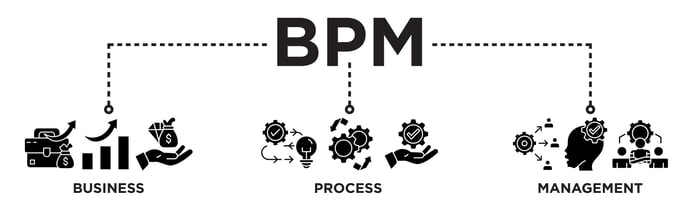
Business Process Management (BPM) is a management discipline that focuses on identifying, modeling, analyzing, optimizing and automating the processes of an organization. BPM is not a specific tool or technology. It is a holistic approach that connects people, processes and technology to achieve the company's strategic objectives, with the purpose of improving the efficiency, quality and adaptability of processes and keeping them aligned with the organization's goals.
Thanks to BPM, companies gain a clear view of how their current processes work, find bottlenecks or inefficiencies and propose solutions based on data and analysis. BPM also makes it easier to implement changes and lets teams work more collaboratively. Organizations that integrate BPM optimize their operations and gain a competitive advantage by responding faster to market demands. Processes are usually documented with a common notation, and the most widely used standard is Business Process Model and Notation (BPMN).
>> 6 key steps to define your business processes <<
BPM works like a roadmap that helps companies organize, improve and automate their operations. Implementing BPM optimizes current processes and prepares the business to adapt quickly to market changes, making sure every task delivers value to business objectives. These are its defining characteristics.
Business Process Management is much more than a tool for organizing tasks. It is a strategy that strengthens the organization's ability to compete, innovate and adapt. Implementing BPM optimizes internal operations and also improves areas such as customer experience, decision-making and team collaboration.
The customer benefit deserves special attention, because it is where process work and revenue meet. McKinsey describes a European energy retailer that redesigned its home-moving journey end to end and achieved a 50 percent increase in customer satisfaction, a 15 percent reduction in customer-service cost and churn cut by more than half for that journey. That is the kind of result BPM targets when it manages a process across departments instead of one step at a time.
| Benefit of BPM | What leadership should measure | Value chain lever |
|---|---|---|
| Efficiency and cost reduction | Cost per transaction, cycle time, rework | Efficiency |
| Agility | Time to change a process or launch a product | Attract and convert |
| Customer experience | Satisfaction, complaints, on-time delivery | Serve, retain and loyalty |
| Compliance and risk | Audit findings, exceptions, penalties | Efficiency |
| Data-driven decisions | Share of processes with live dashboards | All levers |

Unlike methodologies such as Lean or Six Sigma, which focus primarily on reducing waste and improving quality, BPM takes a broader approach. Lean and Six Sigma are specific tools that can be used within the BPM framework, while BPM integrates aspects of both and pays special attention to the digitization and automation of processes. BPM seeks efficiency and, at the same time, continuous adaptation and strategic alignment with business objectives.
Another major difference is that BPM uses technology to map and automate processes, which makes it especially relevant in the digital age. More traditional methodologies, while effective, sometimes lack the flexibility and speed needed to meet market demands.
| Approach | Main focus | Typical scope | Role of technology |
|---|---|---|---|
| Lean | Eliminating waste and improving flow | Specific value streams | Supportive |
| Six Sigma | Reducing variation and defects | Specific processes and problems | Statistical tools |
| BPM | Managing processes end to end, aligned with strategy | Cross-functional, organization-wide | Central, for modeling, automation and monitoring |
Knowing when to implement BPM is crucial to staying competitive. Signs include fragmented or redundant processes, difficulty meeting deadlines, lack of visibility into accountabilities, declining customer satisfaction, resistance to change, disorganized growth, high operating costs and problems measuring results. In all these cases, BPM can centralize and optimize flows, improve communication, eliminate inefficiencies and ensure alignment with strategic objectives.
BPM goes beyond managing processes. It is a strategic discipline that transforms business operations. Its strategies include managing process exceptions, using predictive analytics to anticipate bottlenecks, applying artificial intelligence to optimize workflows and personalizing processes dynamically for each client or project. Integration with agile methods allows continuous adjustment, a focus on employee experience raises productivity, gamification motivates teams, simulation tests changes before they are made, process mining reveals real inefficiencies, and sustainability strategies reduce environmental impact.
Processes rarely run in a completely linear way. Customized client requests or unexpected issues can cause disruptions and delays. An effective strategy is to design workflows with alternative routes for these exceptions, so the overall operation is not compromised. A product return process, for example, can follow different paths depending on product type or customer policy, keeping satisfaction high even in unusual situations.
Predictive analytics uses historical data and behavior patterns to anticipate future situations. In BPM, it helps identify potential bottlenecks, demand spikes or supply chain failures before they affect performance. A logistics company can anticipate peak periods and adjust resources to avoid overloads, which improves planning, resource use and the customer experience.
Integrating artificial intelligence into BPM can transform process automation. AI analyzes large volumes of data in real time, makes decisions based on defined rules and keeps optimizing workflows. In customer service, an AI system can classify incoming inquiries and route them to the most suitable agent, improving response times and service quality, and it can also suggest process improvements based on the patterns it detects.
Every client or project has unique needs, and BPM can address them with dynamic workflows that adjust automatically to customer characteristics or preferences. In a service company, client onboarding can vary by business size or industry, so each customer receives specific, relevant attention and the relationship grows stronger.
Combining BPM with agile methods suits companies that must adapt quickly. Instead of rigid processes that are hard to modify, the integration allows frequent adjustments through short iterations. A software company can design processes that deliver value in small stages with continuous client feedback, ensuring constant improvement and alignment with market needs.
Employee experience is as critical to process success as customer experience. BPM strategies that prioritize it improve productivity and job satisfaction. Automating repetitive administrative tasks and providing intuitive tools for time and resource management reduce workload and increase engagement, so people can focus on higher-value work.
Gamification turns routine tasks into more motivating activities with rewards, rankings and competitions. In a sales process, teams can compete to reach specific goals and receive incentives based on performance, which creates a more dynamic, collaborative environment and better goal achievement.
Before making significant changes, BPM simulation tools model different scenarios and show how they will affect performance. If a company plans to add a step to its production process, it can simulate the effect on delivery times, costs and capacity, and decide with less risk.
Process mining analyzes the event logs generated by business systems to understand how workflows are actually executed. IBM describes it as a method of applying specialized algorithms to event log data from systems such as ERP and CRM to reveal how a process really unfolds. This exposes inefficiencies, variations and improvement opportunities that would otherwise go unnoticed. In a technical support process, process mining might reveal that certain requests take longer than expected, which justifies a redesign to improve speed and service quality.
Sustainability is a key factor for many organizations. Incorporating sustainability metrics into processes reduces environmental impact and improves social responsibility. A manufacturing process can be optimized to use less energy or waste less material, which strengthens the company's image and supports compliance with environmental regulations.
Many leading companies have adopted process management as a fundamental strategy to transform their operations, improve customer experience and reduce costs. These cases show how a process discipline can become a driver of success.
>> Case study: How does Coca Cola do it, in the digital world? <<
Few companies move from informal processes to fully managed, automated ones in a single step. A maturity view helps leadership understand where the organization stands today, what the next level requires and which benefits become available at each stage. It also prevents a common mistake, which is buying advanced automation for processes that have never been documented or owned.
| Level | How processes are managed | Typical symptoms | Next step |
|---|---|---|---|
| 1. Informal | Work depends on people and habits, with little documentation | Errors when key people are absent, inconsistent service | Document the core processes and name owners |
| 2. Documented | Main processes are mapped, but each department manages its own part | Handoff delays, duplicated data entry | Define end-to-end processes and shared metrics |
| 3. Managed | End-to-end processes have owners, targets and regular reviews | Manual monitoring, slow change | Automate rule-based steps and integrate systems |
| 4. Automated and measured | Processes run on integrated platforms with live dashboards | Improvement depends on a few experts | Add process mining, simulation and AI |
| 5. Continuously optimized | Data drives ongoing redesign across the organization | Risk of complacency | Link process goals to strategy and innovation |
In ICX Consulting's experience, most mid-sized companies in the Americas sit between the documented and managed levels. The largest jump in value usually comes from moving to the managed level, because that is when processes stop belonging to departments and start belonging to the customer. Automation and AI pay back much faster once that foundation exists, since they are applied to stable, measured processes rather than to work that changes every week.
The maturity view is also useful in budget discussions. Instead of debating a large technology purchase, leadership can fund the next level of maturity for two or three priority processes, measure the results and decide on the following step with evidence.
For board members, CEOs and senior executives, BPM is an opportunity to lead with clarity and purpose. It is not only about correcting inefficiencies but about establishing a framework that cultivates innovation, improves decisions and lets the organization adapt swiftly.
Automating tasks and optimizing processes free up time and resources, allowing leaders to focus on designing strategies that deliver value and sustain long-term growth. BPM does not just improve what already exists. It opens the door to deep, continuous transformation.
For more on the concept itself, read what Business Process Management is.

At ICX Consulting, we recognize that every organization has its own identity, needs and objectives, so our approach is personalized. Our business process management, process mining and process automation services support every step, from identifying improvement areas to implementing solutions that transform operations, guided by the Process Transformation Framework. Our goal is real, tangible results aligned with your strategic vision.
To begin, use the Process Transformation Framework toolkit to map your first end-to-end process and identify where BPM will create the most value.
It is a management discipline first. BPM defines how processes are owned, measured and improved across the organization. Software, often called a BPM suite or workflow platform, supports modeling, automation and monitoring, but companies that buy the software without process ownership and governance rarely capture the benefits.
Focused programs usually show measurable gains in one or two quarters on the first processes, especially in cycle time, rework and on-time delivery. Organization-wide benefits, such as agility and better decisions, build over several years as more processes are documented, owned and connected to live data.
Start with cross-functional processes that touch customers or money, such as order to cash, procure to pay, claims or service requests. They involve several departments, which is where handoffs fail, and their improvement shows up quickly in satisfaction, cash flow and cost. Pick one with a clear owner and a pain the board already feels.
No. BPM provides the end-to-end governance and technology layer, while Lean and Six Sigma remain useful tools for removing waste and reducing variation inside specific processes. Mature organizations use them together, with BPM deciding which processes to improve and Lean or Six Sigma guiding how.
BPM is more than a technical tool. It is a new way of thinking and acting, and with proper implementation your business can face today's challenges with more confidence and seize tomorrow's opportunities. Request a diagnostic with an ICX consultant and find out which of your processes will deliver the greatest benefits once they are managed end to end.

A BPM, short for Business Process Management, is a management discipline that analyzes, designs, executes, monitors and continuously improves the...

 Steven Martínez : Jun 25, 2025
For ICX Consulting, which designs and automates commercial and service processes, Business Process Management (BPM) is a management discipline for...

Adrian Ureña Moraga : Jun 20, 2025
Business process management (BPM) is the discipline of designing, modeling, executing, monitoring and continuously optimizing the way work flows...

