








Skip to the main content.

What We Offer

ICX helps companies grow revenue and profitability by connecting customer experience, sales, pricing, CRM and automation into one commercial system.

Customer Experience

We design memorable, customer-centered experiences that drive loyalty, enhance support, and optimize every stage of the journey. From maturity frameworks and experience maps to loyalty programs, service design, and feedback analysis, we help brands deeply connect with users and grow sustainably.

Marketing & Sales

We drive marketing and sales strategies that combine technology, creativity, and analytics to accelerate growth. From value proposition design and AI-driven automation to inbound, ABM, and sales enablement strategies, we help businesses attract, convert, and retain customers effectively and profitably.

Pricing & Revenue

We optimize pricing and revenue through data-driven strategies and integrated planning. From profitability modeling and margin analysis to demand management and sales forecasting, we help maximize financial performance and business competitiveness.

Digital Transformation

We accelerate digital transformation by aligning strategy, processes and technology. From operating model definition and intelligent automation to CRM implementation, artificial intelligence and digital channels, we help organizations adapt, scale and lead in changing and competitive environments.


Operational Efficiency  

We enhance operational efficiency through process optimization, intelligent automation, and cost control. From cost reduction strategies and process redesign to RPA and value analysis, we help businesses boost productivity, agility, and sustainable profitability.

Customer Experience

chevron-right-1

Marketing & Sales

chevron-right-1

Pricing & Revenue

chevron-right-1

Digital Transformation

chevron-right-1

Operational Efficiency 

chevron-right-1

9 min read

6 key steps to define your business processes

9 min read

6 key steps to define your business processes

6 key steps to define your business processes
5:54

ICX Consulting, a commercial strategy and customer experience consulting firm, helps companies define their business processes in six steps. Involve every area, appoint owners for the survey, choose a mapping tool, validate the current process in the field, obtain management approval and measure it continuously. The result is a documented, measurable process that teams understand and leaders can improve.

When we are part of an organization, we interact with different areas, each composed of teams, systems and workflows that together contribute to the company's objectives. These areas do not operate in isolation. They function as interconnected units that rely on efficient communication and collaboration, and that synergy is what delivers a product or service to customers. Ensuring that each business process runs without unnecessary delays, bureaucracy or outdated methods requires a deep understanding of operational workflows and a commitment to continuous improvement.

For the leadership team this is not an administrative exercise. Undefined processes are where margin leaks, where quotes stall between departments and where customers receive a different answer depending on who picks up the phone. Defining the process is the first step to controlling cost to serve, speeding up delivery and making the customer experience consistent.

A process is a structured sequence of related tasks in which inputs are transformed into an expected outcome. Every Business Process plays a crucial role in organizational efficiency, and a process survey is the fundamental tool to document, define and refine these workflows. A process survey consists of identifying, mapping and structuring the step-by-step activities carried out within an organization, providing a clear framework that highlights the process's identity, characteristics and objectives. As organizations grow, the demand for structured workflows and cross-functional collaboration makes it imperative to establish processes that optimize day-to-day operations and are also easily understood, measurable and adaptable for continuous improvement.

>> How Value Stream Mapping drives customer experience <<

Index

Team defining and mapping a business process workflow

Consider the chief executive of a mid-sized food distributor who asks a simple question in a Monday meeting. How long does it take, from the moment a supermarket buyer places an order, until the invoice is paid? The sales director says four days. The logistics manager says six. Finance says it depends, and the customer service lead quietly points out that the answer changes depending on which warehouse picks the order. Each answer is honest, and each reflects a different version of the same process that has never been written down in one place. The executive realizes that she has been trying to improve something that nobody has defined.

What is process mapping and why does it matter?

Process mapping allows organizations to understand their activities, routines and procedures. These processes range from operational and support processes to strategic ones. A good process survey is a valuable tool when it is easy to understand, reviewed periodically and used to establish action plans and relevant improvements. You can capture these surveys in flowcharts, process maps, SIPOC diagrams or standard procedures.

The level of detail should follow the decision you need to make. A board discussion needs a view of the end-to-end value chain, while a team redesigning invoice approval needs every activity, rule and handoff. Many companies use a reference taxonomy to avoid reinventing the list of processes. APQC's Process Classification Framework, which the organization describes as a taxonomy of business processes that lets organizations compare their performance internally and externally with organizations from any industry, is a common starting point for naming and grouping processes before mapping them in detail.

LevelWhat it showsWho uses it
Value chainStrategic, operational and support process groupsExecutive team and board
ProcessStart, end, owner, inputs, outputs and customersArea directors and process owners
ProcedureActivities, roles, business rules and systemsTeams that execute the work
InstructionDetailed steps for a single taskIndividual employees and trainers

Agree on the level before the first workshop. Teams that skip this step often spend hours debating whether an activity belongs on the map, when the real question is which level of detail the decision at hand requires. Agreeing on the level also sets expectations about effort, because a procedure-level survey of one process can take as long as a value-chain view of the whole company.

How can I build a process in just six steps?

Once we know what a process is and why a process survey matters, the next questions are where to start and who should be involved. These six steps give the work a clear order.

1. Involvement of all areas and positions

Everyone in the organization must participate and document the processes of their own department. Work sessions, brainstorming, discussion of the most visible pain points and the definition of indicators that track the evolution of each process are part of this start. Executives, managers, analysts and other profiles must take part, be informed and contribute according to their role in the organization.

Cross-functional brainstorming session to identify process pain points

2. Designate those responsible for the survey

Once the work teams and the tasks of the previous step are established, collect the ideas and the know-how of the process, and prepare a questionnaire with the most substantial questions about how the process is currently done. Establish the suppliers of each stage, constraints, systems, inputs and outputs, responsible parties and stakeholders.

A useful rule is to name one process owner per process, a person with authority over the outcome, and a facilitator who runs the sessions and writes the documentation. Mixing those two roles slows decisions, and leaving the owner role empty means no one can approve changes later.

Process owner responsible for the business process survey

3. Choose a tool to capture the survey

Many tools can help. The important choice is what works best for your organization, what is most useful, what resources you have, and how practical and easy to understand the result will be. Flowcharts, for example, show the number of activities in a process and the logic that guides people through each stage. Process maps and SIPOC are other options. ASQ describes SIPOC as a data collection tool used by process improvement teams, best used before constructing a flowchart, which makes it a natural first step when scoping a process. Whichever tool you choose, it should be simple to understand without losing the crucial details of the process.

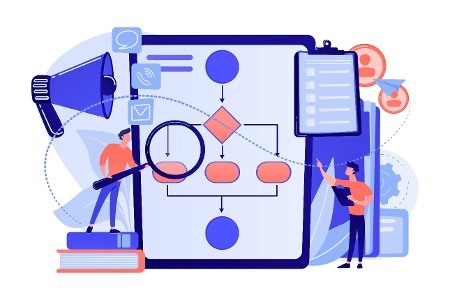
Flowchart tool used to capture the process survey

4. Validation and fieldwork

When the draft version of the process is ready, hold team meetings to validate that it really is the As-Is, the current process as it is executed today. All parties involved must agree with what the process states, and then working sessions are held where the process is explained and simulated.

Fieldwork matters because documented procedures and real practice often differ. Observing a few real cases from start to finish, and checking the system records they leave, reveals workarounds, informal approvals and waiting times that never appear in a workshop.

5. Approval of the process mapping

In their key role, management must ensure that the definition is aligned with the organization's overall objectives and that it reflects value for customers. Established indicators show results against the goals set. With management's approval, the process becomes official and gives rise to training and coaching in the relevant areas.

Management approving the documented business process

6. Measurement and continuous improvement

Process surveys should be part of the DNA of any organization. Include them in the calendar and review them periodically. In this way the measurements stay accurate, and the resulting action plans allow the organization to improve continuously and move to new stages of maturity.

Key performance indicators to measure a defined process

How process definition looks in different industries

The six steps are the same everywhere, but the first process worth defining changes with the business. In banking and insurance, it is often onboarding or claims handling, where regulatory steps, approvals and customer communication collide and a single missing handoff can delay a decision for weeks. In manufacturing, it is typically order to delivery, where engineering, planning, purchasing and logistics each hold a piece of the truth. In healthcare, it is admission and discharge, where clinical and administrative flows must match for the patient to move without waiting.

In retail and distribution, the process that pays back first is usually returns or order fulfillment, because every error is visible to the customer. In professional services, it is the path from proposal to project kickoff, where a vague handoff between sales and delivery turns into scope disputes. In every sector, the best starting point is the process with the most customer contact, the most rework and a clear owner willing to sponsor the work.

What comes after the As-Is process?

Once the As-Is process survey is ready, it is time to go further. Getting closer to the organization's objectives requires more mature processes, the To-Be processes, which describe where the organization wants to go. The gap between the two versions becomes the improvement roadmap, and the method is explained in detail in process improvement using As Is and To Be.

Defined processes are also the foundation for costing. When activities and times are documented, the company can calculate what each process really costs and which customers or products consume the most resources.

>> Temporal Equations in TDABC Cost Models <<

What are the advantages of defining your business processes?

Collecting all the processes produces valuable information that allows you to do several things.

You can listen and attend to your customers' needs, stay at the forefront of the competition and develop systems and applications. You can also innovate in products and services, merge, separate and expand areas in the organization, gain efficiency in time and execution of tasks, and measure performance by establishing key indicators.

There is a further advantage for any company considering new technology. A defined process tells the implementation team exactly which rules, approvals and data the system must support, which shortens projects and avoids automating steps that should have been removed. That is why defining comes before automating, a point developed in 10 reasons to automate your business processes.

Business success from well-defined processes

Common mistakes when defining processes

The most frequent mistake is mapping the ideal instead of reality. Teams describe how the process should work, so it is essential to validate with real cases before designing improvements. A close second is going into too much detail too early. Start with the start, the end, the owner and the main stages, and add procedure-level detail only where a decision requires it.

Another trap is department-only maps. The most expensive problems sit in the handoffs between areas, so map end to end, from customer request to customer outcome. Teams also forget indicators, yet a process without a measure of time, quality or cost cannot be managed or improved. Finally, many organizations produce documents no one opens, when the approved process should be stored where teams work and reviewed on a fixed calendar.

There is a quieter mistake that executives should watch for, which is treating the exercise as a project with an end date. Processes drift as products, people and systems change. A company that defines its processes once and never revisits them will, within two years, have documentation that describes a business that no longer exists.

What this means for the C-level

Return to the executive and her Monday question. To serve customers well, she would insist that a defined process gives them the same answer and the same delivery time regardless of who handles the request. To convert more, she would ask for clear sales and quoting processes that remove the internal delays that cost deals.

To retain, she would want documented service processes that make failures visible early, before they turn into churn. And for efficiency, she would use the knowledge of activities and times as the basis for cutting waste, redistributing workloads and calculating the real cost of each process. The next Monday, the answer to her question would be one number, and everyone in the room would agree on where it came from.

Taking the time to complete this exercise gives the organization a good definition, a global and interrelated view of all areas and their processes, and leaves behind the erroneous habit of working in silos without the cooperation and participation of everyone.

How to start next week

Choose one end-to-end process that directly affects customers, such as order to cash or request to resolution, and name its owner and a facilitator. Draft a SIPOC in one session with the people who run it, then observe three real cases and record times and handoffs.

Validate the As-Is with all areas involved and obtain management approval. Finish by defining two or three indicators and setting the next review date, so the work does not end the day the map is approved.

How ICX helps

Each organization has its own challenges, assignments and day-to-day workload, which is why ICX Consulting runs process definition as a guided engagement. Our process mapping and analysis and business process management services document the As-Is, design the To-Be and set the indicators, using the ICX Process Matrix to connect each process with its owners, rules and systems. You can learn more about our work at icx.co.

To begin on your own, use the Define Activities and Processes toolkit to list the activities, owners, inputs and outputs of your first process.

Bring this topic to your company

An ICX Consulting advisor will assess where your organization stands today and which decisions can move your commercial and customer experience results.

Request a diagnostic with an ICX consultant

Frequently asked questions

How long does it take to define a business process?

A single end-to-end process with a clear owner can usually be surveyed, validated and approved in a few weeks. The time depends on how many areas take part, how available the people who run the process are, and whether system data exists to confirm what the workshops describe.

What is the difference between a process and a procedure?

A process describes what is transformed, from which inputs to which outputs, for which customer and under whose ownership. A procedure describes how a specific part of that process is executed, step by step, by a given role. Companies need both, but processes should be defined first so procedures fit a coherent whole.

Who should own a business process?

The owner should be the person accountable for the outcome the customer receives, with enough authority to change rules across departments. In cross-functional processes this is often a director rather than an area manager. Without an owner, documented processes drift back to old habits within months.

Which software should we use to document processes?

Start with the simplest tool your teams will actually open, even a shared diagramming tool. Use BPMN notation when processes will be automated or handed to developers, because it describes events, gateways and roles precisely. Specialized BPM suites make sense once processes are stable and need governance at scale.

How do we keep processes alive after the first survey?

Give every process an owner who reviews it on a fixed calendar, at least twice a year, and link the review to the indicators that were defined during approval. When a system, a policy or a product changes, the owner decides whether the documented process needs an update before the change goes live. A short change log, kept next to the approved map, shows teams that the document is current and that someone is accountable for it. Without that routine, even a well-made survey becomes outdated within a few quarters.

Where does process definition connect with technology projects?

Before any system is selected or configured. A defined process tells the project team which rules, approvals and data the system must support, and it prevents the expensive pattern of automating steps that should have been removed. Executives can ask for the approved process map as a condition for starting a technology project, which keeps the scope grounded in how the business actually works.

If your teams describe the same process in three different ways, the cost is already showing up in delays, rework and customer complaints. Request a diagnostic with an ICX consultant and define the processes that matter most to your customers and your margin.

Content added to ICX Folder
Default Save Save Article Quit Article

Save for later

Print-Icon Default Print-Icon Hover

Print

Subscribe-Icon Default Subscribe-Icon Hover

Subscribe

Start-Icon Default Start-Icon Hover

Start here

Suggested Insights For You

SIPOC: How to improve processes in a few steps?

SIPOC: How to improve processes in a few steps?

ICX Consulting, a commercial strategy and customer experience consultancy, uses SIPOC as the fastest way to improve processes in a few steps. A SIPOC...

Basic guide to Business Processes

Basic guide to Business Processes

At ICX Consulting, where we redesign commercial and customer processes for companies in the Americas, a business process is defined as the repeatable...

DMAIC Methodology: Define Stage

DMAIC Methodology: Define Stage

The Define stage of DMAIC is where an improvement project is won or lost. In it the team turns the voice of the customer into measurable...

What's next?

ARE YOU READY?

ICX SUBSCRIPTION
Stay ahead with exclusive insights from our senior consultants. Subscribe for the latest thinking on CX, growth, and digital transformation.